LinksLocal Links Social Media My Other Websites Music Politics Others Networking Music DatabaseArtist Search: Website SearchGoogle: |
The Real Road to SerfdomExtraction, Resentment, Trump
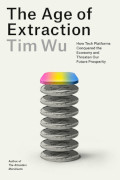
Tim Wu, in The Age of Extraction: How Tech Platforms Conquered the Economy and Threaten Our Future Prosperity, has a short section he calls "The Real Road to Serfdom" (pp. 122-124). The phrase "comes from Austrian economist Friedrich Hayek, who believed that a well-meaning government, as it expanded and began to engage in centralized economic planning, was certain to metastasize into a despotic totalitarian state." With his 1944 bestseller, Hayek became an instant hero to the right, helping them distance from fascism (unfashionable in the UK and US since war with Nazi Germany broke out) and group it with dreaded communism. More importantly, by tracing the original sin of both to the idea that any form of popular government could ameliorate the problems of capitalism — as had just been demonstrated with the Keynesian response to the Great Depression (especially in the US — they could argue against any use of democratic power to limit or compensate for the pure freedom of the market. We needn't go into the many levels on which Hayek's rhetoric veers between the inept and evil. Wu doesn't. He merely points to another path toward the same end, starting with the concentration of economic power in private hands. (Although I suppose state ownership could act as self-interestedly. The real question is less whether a state is involved than who the state belongs to, and for what purpose.) What matters is that both of these paths end in "serfdom" (which we Americans read as "slavery," but with a whiff of feudalism, and not confined to one race). Like all paths, Wu notes several landmarks along the way:
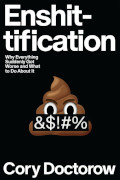
Wu ends the chapter with: "This is the sequence. The question is how to break it." So instead of offering a hypothetical development model, he's talking about us, here and now. With Trump, we already have a fairly complete caricature of a strongman, even if he's not quite as strong as many of the models. He certainly wants to be that strong, and often acts like he is. Moreover, it's pretty clear just how democratic failure led to his election — if it isn't obvious to you, try following the money, then factor in how the mass media decides what to promote and what to expose — so again we're spared having to consider hypotheticals. We don't have to consider whether the push toward greater corporate and financial power in the 1970s inevitably led to Trump. All we have to consider is the fact that it did. Wu, like Cory Doctorow in his more colorful Enshittification: Why Everything Suddenly Got Worse and What to Do About it, is more interested in policies than in the politics necessary to give them a chance. There are few things I'd rather do than talk tech policies. While I like most of what I've read in these two books, I have much more I'd like to see. But there's a lot of blue sky in these proposals already. And at this stage most are certain to be opposed by some of the richest and most influential people anywhere. And perhaps worse — getting people to recognize those "robber barons" as villains isn't so hard — many depend on arguments that few people understand and appreciate. For instance, let's go back through the five stages and consider the most obvious, and in some cases traditional, solutions:
Democratic failure has allowed the government to be captured by ideologues and profiteers, whose prime concern is to lock themselves and their supporters into permanent power, regardless of how much damage their schemes cause, and how unpopular they become. I'm not sure that the strongman move was necessary, but the folksy Bush burned all of his credibility between his terror wars and the financial meltdown, and media darlings McCain and Romney didn't inspire much enthusiasm. Trump gave rank-and-file Republicans a new lease on life, a chance to be bigots and braggarts once again, to turn their resentment into a club for beating their enemies. He promised to fix their problems, and to be their redemption. Meanwhile, Harris and Clinton painted themselves as stalwart devotees of the liberal-globalist status quo. So while on any nerdy policy survey they should have fared much better than Trump, at least Trump acknowledged problems needing fixing, and their intense hatred of the man, even more than anything he himself said, made them think of him as their champion. Sure, that was the dumbest thing possible, but for some reason Democrats couldn't be bothered to point that out. In the end, Trump recapitulated the classic fascist formula: rabble rousing + oligarchy = power-mad dictatorship. Having failed to stop it, with few options to effectively resist, we're largely resigned to riding this out, until Trump and his cult and fellow-travelers flame out. The test then will be whether we'll just try to restore the ancien régime that generated such resentment in the first place, or break with the old thinking that got us in such a predicament, and come up with better ideas and methods. While I still feel pretty isolated, I should note that there is a lot of quality thinking that points to ways out of this disaster. Wu and Doctorow have good ideas on tech, but also realize that extraction and enshittification aren't just tech issues: those are problems that occur all across the political and economic spheres. Tech particularly matters, because tech (especially AI) is providing the tools (especially for surveillance and split-second decision making) that are being applied elsewhere. But to get some traction, I think we have to dig deeper beyond the attention-grubbing surface of tech with its dark underbelly of surveillance and scheming and admit to the real problem, which is that in a world where everything depends on making money, no one can be trusted not to screw you over. That's ultimately what the resentment is about: fear and loathing for the society we live in and cannot live without. Notes on Everyday Life, 2026-05-05 |