
LinksLocal Links Social Media My Other Websites Music Politics Others Networking Music DatabaseArtist Search: Website SearchGoogle: |
Jordan PetersonCapitalism on the verge of a nervous breakdown
Google's summary of Robinson's essay is: "Robinson argues that Peterson is an intellectual fraud who uses obscure, grand language to mask a lack of substantive, valuable ideas." I don't know how often in Peterson's work that is true, but this title is one jam-packed example. Let's start with the word "catastrophism." It's a real word, with a specific meaning, just not the one Peterson intends. In the 19th century, there was a big divide between geologists who thought that the Earth and its features were formed slowly over vast time by processes that are currently observable, and others who sought to explain those features as resulting from sudden catastrophic events. The latter group started from the biblical story of creation, and sought evidence in geology to prove its truth. They were disparaged as "catastrophists," while the former group called themselves "uniformitarians." Contemporary views have evolved: those who sought to use science to validate the biblical creation story have retreated into dogmatic creationism; meanwhile, scientists have accepted that some catastrophes occur naturally, like the meteor strike that ended the Cretaceous with a mass extermination. I have no idea what Peterson thinks of this, or whether he thinks at all, but his use of "catastrophism" is just a verbal sleight of hand. He knows that many critics of climate change warn that failure to address the problem will be catastrophic. All he seeks to do is to characterize those views as an "ism": the dogmatic faith in an overarching idea. He knows that many people have grown skeptical of all "isms," and seeks advantage from that. However, he does seem to make an exception of "capitalism," seeing it not as an arbitrary belief structure but as a proxy for all the valuable creations of human industry. A more common term for what he's describing is "civilization," but that too has baggage we don't need to drag along. I'm going to propose a better definition of capitalism below. But at this point, let's see if we can rewrite Peterson's title in the form of an argument:
I don't doubt that the first two premises can be illustrated by referring to individuals who believe those things, but most people who identify with the Left have more complex and nuanced views that Peterson doesn't recognize. I also want to point out that while capitalism has had much to do with causing climate change, the solution does not necessitate the end of capitalism, or even any fundamental reforms. In other words, the linkage between the two issues (capitalism and climate change) is weak, and the impulse to link them tends to be politically opportunistic: while Peterson complains about the Left trying to link them, he's as guilty of that himself. Let's start by clearing up some terminology. Capitalism is a system where the owners of capital claim all of the profits from its use and employment. Property rights are secured by government, which may attempt to represent democratic interests, but often is captured by capitalists for their own purposes. Markets are also constructed by government, and again may be captured. (Markets and property rights go back before capitalism, but the role of government is now universal, even if some capitalists like to romanticize its natural origins.) Capitalism is productive, exploitative, and alienating, shot full of contradictions that make it unstable and self-destructive. Because of its ownership, it concentrates wealth in the hands of a few, resulting in pervasive inequality, which poisons society. Its defenders, like Peterson, celebrate the wealth it has produced, and write off all of the side-effects as incidental. They argue not only that the side-effects are necessary to obtain the wealth, but that any effort to limit the side-effects would only hamper this fabulous engine of wealth-creation. Whether they claim that would be to everyone's detriment, or just to that of the rich, varies according to how pompous and/or cynical they are. The terms Right and Left date from the French Revolution. The Right were defenders of class stratification, and of the privileges of those higher up to rule those lower down. At the time, the higher ups were the king and aristocracy, but by the end of the 1800s, they had been supplanted by wealthy capitalists. Even when revolutions toppled kings, ended aristocracy, freed slaves, redistributed land, and/or confiscated businesses, the Right always bounced back, ever ready to defend the privileged (including themselves) against the poor. The Left, on the other hand, asserted that all people deserve to be treated as equals, endowed with inalienable rights, not subject to the whims of privilege. While Left and Right may correlate with other issues, their only definition is in the opposition of privilege and equality. It should be noted that the vision of Left and Right has always been circumscribed by history: just as the Right has always rallied to those already in power, the Left has supported whoever opposed the existing privileges. Thus, early capitalists found themselves on the Left, only to switch sides as they grew wealthy and were accepted into the prevailing hierarchy. By then, their own ideology embedded in the established power, in lieu of the previous justifications of popes and kings. While the Left has a reputation for being anti-capitalist, the critique has always been more nuanced. Most on the Left have always loved the productivity that capitalism unleashed, and saw it as the foundation for an equitable society of plenty. The Left's critique focused on details: power-seeking, inequality, impoverishment, toxic waste, and ideology.[2] But the goal was not to "destroy capitalism." It was to save capitalism from its bad side-effects. And arguably to free capitalists from the bad habits their ideology instills in them. There are ways to do this that avoid the full state ownership that older communist (and sometimes socialist) parties favored: that allow firms to continue independently, innovate, and compete in free markets, with profits and productivity gains going to workers and/or the public.[3] There are many good reasons to do this.[4] Fighting climate change isn't necessarily one of them, but a major obstacle is the entrenched political power of the fossil fuel industry. But there are other obstacles, some ideological, some psychological. Nonetheless, it is possible to address climate change without changing the capitalist paradigm. Indeed, there is considerable reason for current capitalists to fight climate change. They have much property tied up in land, farms, and other operations that finely tuned to the current climate. And as severe weather increases its toll, insurance will become increasingly unaffordable. On the other hand, switching over to renewable energy sources opens up lots of business opportunities. Isn't capitalism supposed to thrive on such "creative destruction"? The problem here isn't capitalism as such but the politically entrenched interests of fossil fuel moguls. And ideology: perhaps Peterson is on payola, but more likely he's just fallen, like Trump and most of his MAGA fan club, for the idea that gas guzzling is an intrinsic part of their lost American greatness. How dare those commie-liberals take anything away from our heritage? That's remarkably short-sighted, not to mention dumb, but it isn't unprecedented. Those 19th century catastrophists didn't necessarily see the light. Most opted to double down on faith and come up with creationism, which with no scientific evidence whatsoever still has a fairly substantial number of believers. Still, the worst thing about this right-wing ideology isn't its ignorant denial of climate change. The worst thing is that they're stuck on a power trip where their willingness to resort to violence (and all other forms of manipulation) to impose their will over all those they consider enemies — ultimately for most or nearly all of us. But there's much more wrong here. They've somehow managed to make their ideology impervious to logic, reason, evidence, and any sort of human sympathy or solidarity. Peterson's title is not just a bundle of wildly erroneous, rather ridiculous assertions. It's a defensive shell, designed so that nothing I've said above can penetrate it. As such, it's intended more to rally believers, not to convince others. One last point, which I've skirted around above because I didn't want to go down this particular rabbit hole: while I accept the well-established science behind anthropic climate change, including the range of predictions based on that science, I'm not especially inclined to view them as catastrophic — at least not in the sense of the asteroid that wiped out the dinosaurs, or the global thermonuclear war that we've been threatened with since 1945. What I expect is that the Earth will get progressively hotter for decades after we reach some future point where we're no longer adding more greenhouse gases to the atmosphere than are being removed. The longer this takes, the worse the situation will be, but whatever that point is, we will adapt to it. The costs may be unimaginable, but nothing we can't cope with. The worst case scenario isn't heat, or weather, of any degree. The worst case scenario is war.[5] So the real question going forward is how well we can cope, and how soon we realize that this isn't going to be easy. How well we cope depends mostly on our ability to cooperate constructively, and here we should stress that "our" means pretty much everyone — not just a cabal of makers and shakers. That's a big problem, because right-wing ideology divides people between us and them, and solves their inevitable opposition by the imposition of power. And while capitalism could cope with the technical problems of climate change, it's stuck in the same ideological rut, only worse: there the division is between the few people taking profits and the many who are feeding them and/or being preyed on. Peterson's nightmare scenario is a world where masses of people slip out of his propaganda bubble and start to pay attention to facts, science, and reason, and who start to find common cause with their neighbors, and decide to elect a government that responds to their concerns and needs, not to the ultra-rich and their ideologically groomed cadres. The irony is that the more influence, and the more complete control people like Peterson think they have, the harder they're going to fall. I'm not happy saying that. At my age, I'd be happy with a boring ruling class I'd never have to give a second thought to. But they'd have to care, and they'd have to be competent. They'd have to help people other than themselves. They would have to anticipate problems, which means they would have to understand how the world works, and not just for them. They wouldn't have to be perfect, but when they screwed up, they'd need to apologize, learn, and make amends. They'd have to earn respect and trust. And I'm not getting that from smart guys like Peterson, let alone clods like Trump. Here's another version of Peterson's title: "To protect the fragile egos of oil-based capitalism's billionaires, we're willing to ignore all we know and risk everything by pretending climate change is just an imaginary threat conjured up by people who hate us for no reason." Notes:
Notes on Everyday Life, 2026-08-09 |
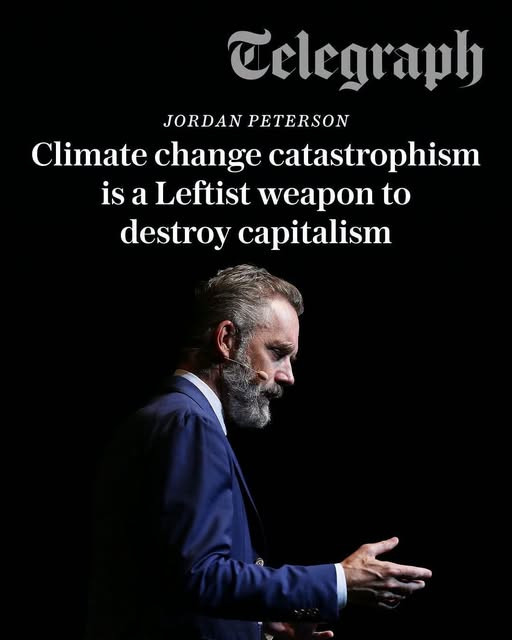 I know nothing about Jordan Peterson. Sure, I've read the chapter
on him in Nathan J. Robinson's Rules for Life, but all that
left me with is total disinterest in actually reading him.[1] I'm
bringing him up here based on a
I know nothing about Jordan Peterson. Sure, I've read the chapter
on him in Nathan J. Robinson's Rules for Life, but all that
left me with is total disinterest in actually reading him.[1] I'm
bringing him up here based on a