|
Tuesday, May 20, 2025
Book Roundup [T1]
This is a temporary blog file container. It can be used for
assembling a file well ahead of publication, allowing me to keep
multiple files open without committing to a specific order. The
file will be given a sequence number when ready for publication.
As of 2025-05-20, I'm opening two Book Roundup files. This first
one will be for featured new books since the previous file back on
May 23, 2025. The second one will be for lower-priority books,
especially ones written up long ago but not yet published. I'd like
to clean up as many of those as possible.
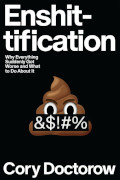 Cory Doctorow: Enshittification: Why Everything Suddenly Got
Worse and What to Do About It (2025, Verso Books): Sci-fi
novelist, has written several books about the internet, increasingly
on how tech businesses make everything they touch worse in their
relentless effort to exploit users, extract and mine data, and lock
in monopoly profits — although the dynamic seems to apply to
all current forms of capitalism. What makes tech especially sinister
right now is the tremendous overvaluation of their stocks, based on
the hunch that their control of information will eventually give
them infinite powers of extraction.
Cory Doctorow: Enshittification: Why Everything Suddenly Got
Worse and What to Do About It (2025, Verso Books): Sci-fi
novelist, has written several books about the internet, increasingly
on how tech businesses make everything they touch worse in their
relentless effort to exploit users, extract and mine data, and lock
in monopoly profits — although the dynamic seems to apply to
all current forms of capitalism. What makes tech especially sinister
right now is the tremendous overvaluation of their stocks, based on
the hunch that their control of information will eventually give
them infinite powers of extraction.
- Tim Wu: The Age of Extraction: How Tech Platforms Conquered
the Economy and Threaten Our Future Prosperity (2025, Knopf):
Pretty much the same book, with less profanity.
Tim Berners-Lee: This is for Everyone: The Unfinished Story
of the World Wide Web (2025, Farrar Straus and Giroux): By the
inventor of HTML, who had a different idea of how it should develop. Ulises A Mejias/Nick Couldry: Data Grab: The New Colonialism
of Big Tech and How to Fight Back (2024, University of Chicago
Press). Marletje Schaake: The Tech Coup: How to Save Democracy
From Silicon Valley (2024; paperback, 2025, Princeton University
press).
Maggie Haberman/Jonathan Swan: Regime Change: Inside the
Imperial Presidency of Donald Trump (2026, Simon &
Schuster): New York Times reporters, Haberman previously wrote
Confidence Man: The Making of Donald Trump and the Breaking
of America (2022), write a first-draft history of Trump's
first year back in office.
 Dahlia Scheindlin: The Crooked Timber of Democracy in Israel:
Promise Unfulfilled (paperback, 2023, De Gruyter): A thorough
history of what passes for democracy in Israel, dating back to and
beyond 1948, including the pivotal initial decisions to exclude and/or
control the Palestinians, and to grant the religious parties extensive
control over Jewish civil life, up through the 2022 election which
gave us Netanyahu's coalition with the extremist settler parties,
the revolt in Gaza, and the subsequent genocide. The fateful early
decisions were made by David Ben-Gurion, who comes off poorly here:
his grasp for power so determined his claims for democracy and/or
socialism come off as flimsy rhetoric. Compared to him, Menachem
Begin appears to be a principled liberal, until he came to power
and reverted to form. While Scheindlin is sensitive to the legal
skirmishes around democracy, especially the formulation of "basic
laws" in lieu of a constitution, and the balancing act performed
by the Supreme Court, she pays little attention to the underlying
ideological straitjacket of zionist supremacism, which these days
seems so wedged into the Israeli psyche that it's impossible for
them to imagine any alternative.
Dahlia Scheindlin: The Crooked Timber of Democracy in Israel:
Promise Unfulfilled (paperback, 2023, De Gruyter): A thorough
history of what passes for democracy in Israel, dating back to and
beyond 1948, including the pivotal initial decisions to exclude and/or
control the Palestinians, and to grant the religious parties extensive
control over Jewish civil life, up through the 2022 election which
gave us Netanyahu's coalition with the extremist settler parties,
the revolt in Gaza, and the subsequent genocide. The fateful early
decisions were made by David Ben-Gurion, who comes off poorly here:
his grasp for power so determined his claims for democracy and/or
socialism come off as flimsy rhetoric. Compared to him, Menachem
Begin appears to be a principled liberal, until he came to power
and reverted to form. While Scheindlin is sensitive to the legal
skirmishes around democracy, especially the formulation of "basic
laws" in lieu of a constitution, and the balancing act performed
by the Supreme Court, she pays little attention to the underlying
ideological straitjacket of zionist supremacism, which these days
seems so wedged into the Israeli psyche that it's impossible for
them to imagine any alternative.
- Robbie Michaelson: The Broken Covenant: Netanyahu and
Israel (paperback, 2025, Truth Dispatch).
- Neta Oren: Israel Under Netanyahu: Populism and Democratic
Decline (2025, Lynne Rienner).
There are many more recent books on Israel ongoing war against
the Palestinians and anyone else sympathetic to them.
Robert A Schneider: The Return of Resentment: The Rise and
Decline and Rise Again of a Political Emotion (2023; paperback,
2025, University of Chicago Press): Tim Wu identified resentment
as a stage on his "real road to serfdom" extending from monopoly
capitalism to dictatorship. For Wu, resentment is the feeling that
those in power are taking advantage of you. But there is a tendency
to dismiss resentment as unfounded, especially (for those in power)
when it drives one to leftist political views, opposing the power
that caused such a reaction. Sure, resentment can also feed rightist
political views, but this is rarely a problem for those in power, as
it spares them in favor of convenient scapegoats. Indeed, the main
purpose of right-wing media seems to be in cultivating and directing
resentment against people other than those actually responsible for
injustice.
Paul Starr: American Contradiction: Revolution and Revenge From
the 1950s to Now (2025, Yale University Press): A broad politial
history of my lifetime: it does seem like you have to go back to the
1950s to find solid ground, and portraying everything since as a dance
between revolution and revenge helps explain a lot. I would add that
ever since the late 1950s there has been a desire for revolution, but
that it has been stymied, not so much by the repressive right as by
the responsible center. The problem, of course, is that the center
hasn't satisfied the desire for revolution, which keeps growing, and
has eventually been exploited by the Trumpy right, not that they're
actually offering anything that will work either.
Robert Wright: The God Test: Artificial Intelligence and Our
Coming Cosmic Reckoning (2026, Simon & Schuster): Author
of Nonzero: The Logic of Human Destiny (1999), where he quite
sensibly tried to show how society progresses and benefits from looking
beyond zero-sum games to cooperative enterprises that benefit all (or
most), an effort only slightly marred by his attempts to wrap the whole
enterprise up in some kind of teleology ("destiny"). That probably goes
back to his roots in theology, which seem to recur here, but even as I
distrust that approach, I do appreciate his big question: "how do we
create a happy ending?" I suspect his answer will be the same as he
offered in Nonzero. And that, I think, is fundamentally correct.
I'm not sure whether the common alarmism about AI is warranted, but I
do believe we need to think of it as something more than just another
way to make or save money. And we need to consider the likelihood that
unless we're careful, it will accelerate and exacerbate already extant
problems, perhaps to a catastrophic degree. So it's good to think
about it in these big picture terms. It turns out I only had three
references to AI in my archive. Here are some more that caught my
eye:
Abi Awomosu: How Not to Use AI: 50 Contrarian Principles
for the Imagination Age (paperback, 2026, Data Art &
Soul). Emily M Bender/Alex Hanna: The AI Con: How to Fight Big
Tech's Hype and Create the Future We Want (2025, Harper). Meredith Broussard: Artificial Unintelligence: How Computers
Misunderstand the World (2018; paperback, 2019, MIT Press). Brian Christian: The Alignment Problem: Machine Learning
and Human Values (2020; paperback, 2021, WW Norton). Kate Crawford: Atlas of AI: Power, Politics, and the
Planetary Costs of Artificial Intelligence (paperback, 2022,
Yale University Press). Virginia Dignum: The AI Paradox: How to Make Sense of a
Complex Future (2026, Princeton University Press). Cory Doctorow: The Reverse Centaur's Guide to Life After
AI: How to Think About Artificial Intelligence — Before It's Too
Late (paperback, 2026, MCD): Moving on to AI, which certainly
has its limits and problems, but is new enough they're still trying to
hook you. The enshittification will come later. Bob Hutchins: What AI Reveals: How Artificial Intelligence
Exposed What Was Already Broken: And What We Can Build Instead
(paperback, 2026, Book Publishing Wizards). Erik J Larson: The Myth of Artificial Intelligence: Why
Computers Can't Think the Way We Do (2021; paperback, 2022,
Belknap Press). Kai-Fu Lee/Chen Qiufan: AI 2041: Ten Visions for Our
Future (paperback, 2024, WH Allen): CEO of Sinovation Ventures
and president of the World Chinese Science Fiction Association: how
can they possibly miss? Gary Marcus/Ernest Davis: Rebooting AI: Building Artificial
Intelligence We Can Trust (2019, Pantheon; paperback, 2020,
Vintage). Gary Marcus: Taming Silicon Valley: How We Can Ensure That
AI Works for Us (paperback, 2024, MIT Press). Melanie Mitchell: Artificial Intelligence: A Guide for
Thinking Humans (2020; paperback, 2025, Picador). A student
and colleague of Douglas Hofstadter (Gödel, Escher, Bach),
author previously wrote Complexity: A Guided Tour (2011). Ethan Mollick: Co-Intelligence: Living and Working With
AI (paperback, 2024, Portfolio). Arvind Narayanan/Sayash Kapoor: AI Snake Oil: What Artificial
Intelligence Can Do, What It Can't, and How to Tell the Difference
(2024; paperback, 2025, Princeton University Press). Matteo Pasquinelli: The Eye of the Master: A Social History
of Artificial Intelligence (paperback, 2023, Verso). Dwarkesh Patel/Gavin Leech: The Scalilng Era: An Oral
History of AI, 2019-2025 (2025, Stripe Press). Joanna Stern: I Am Not a Robot: My Year Using AI to Do
(Almost) Everything (2026, Harper). Josh Tyrangiel: AI for Good: How Real People Are Using
Artificial Intelligence to Fix Things That Matter (2026,
Simon & Schuster). Richard E Suskind: How to Think About AI: A Guide for
the Perplexed (2025, Oxford University Press). Roman V Yampolskiy: AI: Unexplainable, Unpredictable,
Uncontrollable (paperback, 2024, Chapman and Hall). Eliezer Yudkowsky/Nate Soares: If Anyone Builds It,
Everyone Dies: Why Superhuman AI Would Kill Us All (2025,
Little Brown).
Let's add a second section for the business end of AI:
Keach Hagey: The Optimist: Sam Altman, OpenAI, and the
Race to Invent the Future (2025, WW Norton). Karen Hao: Empire of AI: Dreams and Nightmares in Sam
Altman's OpenAI (2025; paperback, 2026, Penguin Press). Sebastian Mallaby: The Infinity Machine: Demis Hassabis,
DeepMind, and the Quest for Superintelligence (2026, Penguin
Press). Claude St John: The Scaling Curve: Dario Amodei, Anthropic,
and the Race to Build and Survive Superintelligence (paperback,
2026, independent). Stephen Witt: The Thinking Machine: Jensen Huang, Nvidia,
and the World's Most Coveted Microchip (2025, Viking).
Not sure whether these belong among the general books or with the
business ones:
Robert Wachter: A Giant Leap: How AI Is Transforming
Healthcare and What That Means for Our Future (2026,
Portfolio).
Dan Wang: Breakneck: China's Quest to Engineer the Future
(2025, WW Norton): Born in China, emigrated to Canada as a child,
later to Pennsylvania, graduated from Yale Law, went back to China
as a business journalist. Key concept is to contrast the relative
dominance of engineers in China vs. lawyers in the US, the result
being that China is heavily biased toward building things, while
the US is swamped in red tape. Most books on China seem to spend
more time carrying political water than actually explaining things,
so I've been looking for one that at least makes sense. This mostly
does.
Current count:
1 links, 1713 words (2119 total)
Ask a question, or send a comment.
|