Blog Entries [530 - 539]Sunday, August 2, 2020
Weekend Roundup
My oldest surviving cousin, Duan Stiner, died on Sunday, due to
Covid-19. He was days away from his 93rd birthday. He had been living
in a VA center near Tulsa, Oklahoma. The center was locked down in
March. He hasn't been able to leave, and our relatives haven't been
able to visit, since then. Nonetheless, Covid-19 got into the facility,
causing at least 58 cases and 10 deaths (figures I got before Duan
died). Duan joined the Army in 1945, spent some time occupying Japan,
then got called back for the Korean War in 1950. He never talked much
about his Army days (unlike his older brother, Harold, who was an MP
and was present for the war crimes trials on Tokyo; Harold died in
2015). Duan was a butcher, first in a grocery store, then he owned
his own meat business. When I was young, my parents used to buy a
side of beef at a time from him. I think he was the first person I
personally knew to die of the disease, although I've written about
dozens of more famous people in these pages.
I also found out that Don Bass (77) died last week, but don't know
the cause (so he may have been the first). I ran into him often,
especially at Peace Center events. He was a talented artist, and
always a welcome sight.
More newsworthy individual deaths below. For numbers of the less
famous, see
At least 151,000 people have died from coronavirus in the US.
Worldometer has the US death count at 158,365. (Those links
may be volatile.)
Minor formatting change here, as I've eliminated the outer layer of
bullets.
Some scattered links this week:
Dean Baker:
An economic survival package, not a stimulus package. I could have
buried this among the other "stimulus" articles (see Li Zhou), but
they're tied to actual negotiations, whereas this is more along the
lines of what should be done. Krugman described the downturn as more
of an induced coma than a typical recession, a distinction that is
lost on people who have one-track minds (like everyone in business).
Until the virus is contained and normalized (cured would be nice, but
I'm imagining a somewhat more delicate and treacherous equilibrium),
talk of restoring growth really misses the point, which is survival --
difficult enough in any case.
More thoughts on the post-pandemic economy: GDP is headed down, but
are we worse off for that?
If we do let obsessions with government deficits and debt curtail spending,
then we can expect to see a long and harsh recession. . . . And, we also
have to recognize that when we have a serious problem of unemployment,
the failure to run large deficits is incredibly damaging to the country.
Millions of workers will needlessly suffer, as will their families. And
the failure is increased when it means not spending in areas that will
have long-term benefits for the country, like child care and slowing
global warming. It is tragic that deficit hawks are able to do so much
harm to our children under the guise of saving our children.
Peter Baker:
More than just a tweet: Trump's campaign to undercut democracy.
Jake Bittle:
The right's increasingly unhinged fight against Black Lives Matter:
"As the movement's popularity surges, the conservative media insists
that it is hell-bent on destroying the American way of life."
Charles M Blow:
Trump's nakedly political pandemic pivot.
Alleen Brown:
Trump's pick to manage public lands has four-decade history of "overt
racism" toward native people: Meet William Perry Pendley.
Alexander Burns:
Trump attacks an election he is at risk of losing: "Mr Trump has
become a heckler in his own government, failing to marshal leaders in
Washington to form a robust response to the health and economic crises.
Instead, he is raising doubts about holding the election on time."
Katelyn Burns:
The NYPD unit that snatched a protester off the street has been accosting
people for years.
Alexia Fernández Campbell:
A small federal agency focused on preventing industrial disasters is on
life support. Trump wants it gone: "The Chemical Safety and Hazard
Investigation Board is without enough voting members, and its investigations
are stuck in limbo."
Matthew Cappucci/Mustafa Salim:
Baghdad soars to 125 blistering degrees, its highest temperature on
record. Also record-high temperatures elsewhere in the Middle
East.
Steve Coll:
Is the Postal Service being manipulated to help Trump get reëlected?
Summer Concepcion:
Cotton's office denies he believes slavery was a 'necessary evil' after
backlash over remark: Maybe if he wasn't such a reactionary racist,
he wouldn't be so often misunderstood? Still, it's hard to be any kind
of conservative in America without having lots of racist skeletons in
your closet. Maybe that's why so many conservatives move them to the
front porch, and celebrate them.
James Downie:
Republicans' pandemic blunders keep piling higher.
Katherine Eban:
How Jared Kushner's secret testing plan "went poof into thin air":
"This spring, a team working under the president's son-in-law produced
a plan for aggressive, coordinated national COVID-19 response that
could have brought the pandemic under control. So why did the White
House spike it in favor of a shambolic 50-state-response?" Or, as
David Atkins commented on this piece:
Trump and Kushner should be prosecuted for crimes against humanity.
Alex Emmons:
Democrats unveil draft foreign policy platform with promises to end
"forever wars" and "regime change": however, blanket support for
Israel makes it harder to achieve those goals.
Richard Fausset/Rick Rojas:
John Lewis, a man of 'unbreakable perseverance,' is laid to rest:
I'm afraid I found all the pomp surrounding the death and funeral of
John Lewis a bit disconcerting. Such events only come about when
someone has a political legacy they want to build up -- usually around
a president, most recently/similarly someone like John McCain. I don't
actually have much of an opinion about Lewis, but he does provide a
reminded that the fight for civil rights isn't over, and the struggle
for equality still has a long ways to go. Still, it was a big deal,
all the more conspicuous because of the times (e.g., see the picture
of Obama delivering a eulogy to a more-than-half-empty church). More
related to the funeral:
John Feffer:
The no-trust world. The first point George Brockway made in his
brilliant The End of Economic Man (1991) was that nothing works
in modern society without trust. Indeed, it's impossible to get anything
done when you constantly have to scan 360 degrees for potential threats.
(E.g., imagine trying to do simple reconstruction projects in war-torn
Iraq.) Of course, it's even harder to defend against an invisible virus,
especially where you can't trust people around you to follow recommended
practices. Karen Greenberg's article below pairs well with this one: a
big part of the reason we an trust no one is that powerful people, like
but not exclusively Trump, are rarely held accountable for their acts,
let alone their accidents.
Conor Friedersdorf:
Forging a right-left coalition may be the only way to end the War on
Drugs. Link to Atlantic article therein, but I'm up against my
article limit. Quote sets up a 1991 debate between black liberal
Charlie Rangel and white reactionary William F Buckley Jr, quoting
Rangel in favor of escalating the war on drugs:
In fact, Rangel clarified, if somebody wants to sell drugs to a child,
they should fear "that they will be arrested and go to jail for the
rest of their natural life. That's what I'm talking about when I say
fear." Then he suggested that America should tap the generals who won
the Gulf War to intensify the War on Drugs. "What we're missing: to
find a take-charge general like Norman Schwarzkopf, like Colin Powell,
to coordinate some type of strategy so that America, who has never run
away from a battle, will not be running away from this battle," he said.
"Let's win this war against drugs the same way we won it in the Middle
East."
That Gulf War "victory" doesn't look so great now, though the War
on Drugs may have fared even worse. Neither failed for lack of tough
guys like Schwarzkopf. Both were severely tarnished by the arrogance
and racism that was baked into their execution, and were utterly
ruined by the contempt and carelessness the enforcers had for the
people they impacted. Here's another quote:
Had the drug war ended back in the early 1990s, younger Millennials
would have been spared a policy that empowered gangs, fueled bloody
wars for drug territory in American cities, ravaged Latin America,
enriched narco cartels, propelled the AIDS epidemic, triggered police
militarization, and contributed more than any other policy to racial
disparities in national and local incarceration.
Also note that while Buckley and other libertarians have criticized
the War on Drugs, they've never spent any political capital doing so.
The one issue conservatives are serious about is privileging the rich,
and that makes them comfortable with repression as a tool to protect
the established order. So while it's possible that the left might pick
up a few right-wing votes to decriminalize drugs, I don't expect them
to be much help.
Masha Gessen:
Why America feels like a post-Soviet state.
Shirin Ghaffary:
The TikTok-Trump drama, explained.
Karen Greenberg:
Can the pandemic bring accountability back to this country?
Glenn Greenwald:
The US-supported coup in Bolivia continues to produce repression and
tyranny, while revealing how US media propaganda works.
Daniel A Hanley:
Another Trump legacy: Spreading price discrimination on the Internet:
"Consumers are already feeling the pain of the president reversing net
neutrality." Two prominent offenders mentioned here are Cox, which we
use, and AT&T, which has made a big push to break into Cox's cable
monopoly here.
Shane Harris:
DHS compiled 'intelligence reports' on journalists who published leaked
documents.
Doug Henwood:
We have no choice but to be radical.
Sean Illing:
"It's ideologue meets grifter": How Bill Barr made Trumpism possible.
Interview with David Rohde, who wrote a long
New Yorker profile of Barr.
Roge Karma:
We train police to be warriors -- and then send them out to be social
workers. A breakdown of training time (840 total hours) here shows
that 20% goes for "firearm skills, self-defense, and use of force." A
breakdown of actual time spent by police shows that only a tiny fraction
of time is spent dealing with violent time, and that's mostly taken up
by things like interviewing witnesses. Given that a large percentage of
police are former military, this training bias is probably even more
warped -- and given how many former military suffer from PTSD, the
bias could be even more dangerous.
Annie Karni/Katie Rogers:
Like father, like son: President Trump lets others mourn: "Whether
he is dealing with the loss of a family member or the deaths of nearly
150,000 Americans in a surging pandemic, President Trump almost never
displays empathy in public. He learned it from his father."
Ankush Khardori:
There's never been a better time to be a white-collar criminal:
"Thanks to the Trump administration's signature mix of incompetence
and corruption, America is knee-deep in fraud and corporate malfeasance."
Bonnie Kristian:
Trump's reasoning is bad, but withdrawing troops from Germany is a good
idea.
Paul Krugman:
The nightmare on Pennsylvania avenue: "Trump is the kind of boss who
can't do the job -- and won't go away.
The cult of selfishness is killing America: "The right has made
irresponsible behavior a key principle."
Why can't Trump's America be like Italy? "On the coronavirus, the
'sick man of Europe' puts us to shame." The "sick man of Europe" quip
was commonly applied to the Ottoman Empire in its last century, as
European powers were chipping away at its borders and demanding
"capitulations" to give them extraterritorial rights within the
Empire. I've never heard it used to refer to anyone else. Italy is
often derided for its unstable governments and unequal economy, but
Greece and Portugal are more often viewed as the bottom of the
barrel. If there is a "sick man of Europe" these days, it must be
Donald Trump, who's personally much more rooted in Europe than in
America.
What you don't know can't hurt Trump: "Slow the testing down," he
said, and it's happening."
Republicans keep flunking microbe economics: "Getting other people
sick isn't an 'individual choice.'" Henry Farrell has a comment at
Crooked Timber, more focused on economists than Republicans.
My own theory is that most economists do everything possible to
view everything through their own prism, which is single-mindedly
focused on increasing growth. The problem with the pandemic is
that it's causing a lot of people to consider other factors, like
health and safety, and that messes with the economists' heads.
It also messes with Republicans, who basically agree with the
economists but tweak their measurements to only really consider
the effects of policy on making the rich richer.
Michelle Ye Hee Lee/Jacob Bogage:
Postal Service backlog sparks worries that ballot deliveries could be
delayed in November.
Jill Lepore:
How the Simulmatics Corporation invented the future: Mostly on
the data-driven 1960 presidential election.
Nancy LeTourneau:
How white supremacists are using protests to fuel racial tensions.
It's widely felt, especially among Trump's campaign advisers, that
playing up the protests, and especially provoking violence in/around
them, will produce a backlash that will benefit Trump and his ilk.
Trump's eight potentially impeachable offenses in six months:
If we've learned anything about impeachment under Trump, it's that it
isn't a very useful process. The two-thirds supermajority rule makes
it impossible to convict in the Senate, and the simple majority rule
in the House makes it too each to impeach. Maybe that could work if
the complaint wasn't political, but everything's political these days,
so nothing works. As this list here indicates, it's easy to come up with
a list of essentially political charges, and it's also fruitless. What
might have worked better was if Congress had reserved to itself the
right to overrule executive actions by simple majority, but somehow
we've gotten into the ridiculous where Trump can simply veto
Congressional resolutions (like ones limiting arms sales to Saudi
Arabia, or military interventions in Syria). That puts us back at
needing a two-thirds supermajority, which is well nigh impossible.
On the other hand, the thing I find most disturbing about this list
isn't its pointlessness. It's that a lot of these things aren't
very good charges. Indeed, number four ("abuse of power in foreign
affairs") insists on policies that Trump is right not to have
followed ("willingness to ignore China's treatment of the Uighurs
in exchange for help with farmers during trade negotiations" and
"totally ignored Russia placing bounties on the lives of American
soldiers in Afghanistan").
Martin Longman:
The key to a real Democratic landslide: Better rural performance:
I'm sympathetic to this position, partly because with all the factors
stacked against them Democrats have to win landslides to be effective --
Obama's margins clearly weren't sufficient, and the popular pluralities
of Al Gore and Hillary Clinton didn't even score as wins -- but also
because I believe that Republicans are doing a terrible job of serving
rural and small-town voters, and Democrats could do a lot better, so
why not try harder. Kansas has long thought of itself as a rural state,
but the percentage has been declining steadily, at least since my father
moved to Wichita in the 1940s. According to the first measure I found,
the rural percentage in 2018 was 31.5%, but I doubt the farm percentage
is even 10%. (There are 58,500 farms in Kansas. If 4 people lived on
each, that would come to 8%. The nationwide farm population is 2%.)
Carlos Lozada:
Trump tried to shut him down, but Robert Mueller was his own worst
enemy. Review of Jeffrey Toobin's new book, True Crimes and
Misdemeanors: The Investigation of Donald Trump.
Eric Lutz:
Nick Martin:
It was insane to restart sports in America.
William Marx:
Far-right groups now pose the greatest terrorist threat in the US and
Europe. Links to:
Jihadist plots used to be US and Europe's biggest terrorist threat.
Now it's the far right. And that's just freelance terror, not
the kind practiced by "law enforcement" organizations.
Ian Milhiser:
Bennett Minton:
The lies our textbooks told my generation of Virginians about slavery.
Max Moran:
The 277 policies for which Biden need not ask permission: "As president,
Joe Biden could take action on hundreds of policies without having to go
through Congress. The Biden-Sanders unity task force provides a map."
Sara Morrison/Rebecca Heilweil:
How Trump and his son helped make a Covid-19 conspiracy theorist go
viral in a matter of hours.
Nicole Narea:
Ella Nilsen:
The slow-motion 2020 election disaster states are scrambling to prevent,
explained.
Joe Biden will announce his running mate soon. Here's who's on the
list. Not something I spend much time thinking about, although
I still think Elizabeth Warren is a cut above the rest on two major
counts: she's a fearless campaigner, and while that isn't especially
reassuring in a presidential candidate, it's a quality that stacks
up especially well against Trump and Pence; and she simply knows a
lot more about policy than anyone else. She's also likely to be a
shrewd judge of personnel, if she gets the chance. The last two
Republican gave their VPs (Cheney and Pence) decisive impact on
staffing, but Clinton and Obama worked through their own personal
staffs (who often gave them limited bad choices). Beyond Warren,
Gretchen Whitmer would be a sensible pick, helping in a key state
where she's currently very popular. I don't see any advantage in
picking a black woman: Biden has very solid black support, but he
also has substantial support from whites who might take exception
to a black VP, so why run that risk. Only one I have any specific
objection to is Susan Rice, who was a consistent hawk under Obama
and a leading player in all of his foreign policy mistakes. The
idea that her selection would allow Biden to focus on domestic
policy while she runs foreign is one of the worst advanced here.
Still, there isn't much reason to think that anyone else on the
list would be much better than Rice on foreign policy issues --
they've just had less opportunity to discredit themselves.
Osita Nwanevu:
The 2020 election doesn't really matter to Republicans.
Helaine Olen:
The CFPB once defended consumers. Thanks to Trump, it now helps companies
prey on them instead.
Vijay Prashad/Alejandro Bejarano:
'We will coup whoever we want': Elon Musk and the overthrow of democracy
in Bolivia.
Laurence Ralph:
Countries with levels of police brutality comparable to that in the US
are called 'police states': That's the title in the link from
Attention to the Unseen; better than "To protect and serve: Global
lessons in police reform." There's a chart here of "Number of people
killed by the police" per ten million residents, and the US is only in
second place, barely above Iraq and just below Democratic Republic of
the Congo, but no other country is close (only Luxembourg is more than
5% of the US rate, and Luxembourg is so small that its 16.9 rate works
out to be 1 unfortunate person).
Catherine Rampell:
Trump knows he's going to lose. He's already salting the earth behind
him. Part of her evidence is Fed nominee Judy Shelton. Rampell
wrote more about her here:
Yes, Trump's latest Fed pick is that bad. Here's why.
Diane Ravitch:
How Trump politicized schools reopening, regardless of safety.
Katie Rogers/Maggie Haberman:
Kayleigh McEnany heckles the press. Is that all?
Theodore Schleifer:
Tech billionaire Peter Thiel is searching for new political allies. He's
found one in Kansas: Thiel's spent almost $1 million on Kris Kobach's
Senate primary race. The only other candidate Thiel has supported so far
this year is Sen. Tom Cotton (R-AR). More on Kansas and/or elections:
Dylan Scott:
Herman Cain, 2012 presidential contender, dies after contracting
Covid-19: He was 74, a former CEO of Godfather's Pizza, one
of the most prominent black Republicans, a major Trump surrogate.
He attended Trump's Tulsa rally, signed his liability waiver, and
was diagnosed a week later. More on Cain:
Robert J Shapiro:
Trump is wrong again: US manufacturing is not recovering.
Jeffrey St Clair:
Roaming charges: Demon seed.
Matt Taibbi:
Kansas should go f--- itself: Review of Thomas Frank's new book,
The People, No: A Brief History of Anti-Populism. I have the
book, and expect to read it soon -- maybe then I'll be able to figure
out the confusion from Taibbi's review. I've read most of Frank's
books, from What's the Matter With Kansas? (which has left
a bad taste, mostly because it seems mostly to have been read and
taken to heart by culture war conservatives, who have taken it as
a dare to hold Republicans responsible for their promises) through
Listen, Liberal (which perhaps could be blamed for exposing
the Clintons as liars and frauds, although there's little evidence
that the people who took that insight and voted for Trump got it
from reading a book). Taibbi also cites a recent review by Jeff
Madrick:
Why the working class votes against its economic interests,
which could be of Frank's work, but actually refers to Robert B
Reich: The System: Who Rigged It, How We Fix It, and Zephyr
Teachout: Break 'Em Up: Recovering Our Freedom From Big Ag, Big
Tech, and Big Money.
Adam Taylor:
Trump ordered federal forces to quell Portland protests. But the chaos
ended as soon as they left.
Alexander S Vindman:
Coming forward ended my career. I still believe doing what's right
matters.
Alex Ward:
5 real steps the US could take to help Uighurs in China: The first
one that's missing is: why? It's certainly not because the US has any
sympathy with or concern for Muslims in the far west of China, even as
part of a more general commitment to human rights. To demonstrate the
latter, one would have to make a show of supporting the Palestinians
against Israeli occupation. One suspects the US of bad faith, because
the US has rarely shown anything but bad faith on human rights. Otherwise,
the US would support international institutions that tackle human rights
issues, like the ICC. The US can't even be bothered to support the WHO.
And the "real steps" listed here are straight from the Cold War toolkit
being retargeted at China, for reasons only known to Trump and Pompeo.
For more on them, see the comment under Robin Wright, below.
Robin Wright:
Why Trump will never win his new cold war with China. Couple
things here. First, the notion that the US "won" the Cold War with
Russia is flat-out wrong, and misguided too. I've compared it to
a wrestling match where one fighter has a heart attack, then the
other pounces on top to claim the win. The people under the Soviet
Union's thumb simply gave up their system of government, and really
didn't get much from the West for their trouble. (Russia was so
ravaged under Yeltsin that average life expectancy dropped 10 years
in less time than that. Putin's popularity is to no small extent
based on arresting that decline.) One striking aspect is that
countries the US had totally ignored, like Albania and Mongolia,
fell without so much as a funny glance from the US. The ones that
didn't fall were the ones the US fought wars with (Korea, Vietnam),
blockaded (Cuba), and China (both, but somewhat different), so
there's no evidence that the Cold War's most aggressive tools
achieved anything, other than to make the US look like a public
menace. China might also have fallen, but the ruling party held
on and imposed top-down reforms that radically grew the Chinese
economy -- much faster and more equitably than any capitalist
regime had achieved. Second thing is that while the Soviet Union
saw itself as leading a worldwide workers revolution, China is
just concerned with China. Their investments abroad promote their
businesses, mostly at home. While they like the idea of garnering
good will, they don't pose any threat to the regimes they do
business with. As such, there's no demand for a global capitalist
alliance to limit their power, let alone to tell them how to run
their own damn country. On the other hand, the US is always telling
its "allies" and clients how to run their countries and how to
mistreat their people -- start by looking up
Washington Consensus for examples. Article explains some of
the ways China has outmaneuvered typical Cold War tactics like
sanctions. It doesn't even dignify the neocons' unipolar military
fantasies with a rebuttal, but well before his death in 2010,
Chalmers Johnson wrote about how China could easily disable
America's advanced weapons systems by "launching a dumptruck
full of gravel into space" (destroying every satellite). The
fact is that America's military can't win in Aghanistan, let
alone take on a vastly more sophisticated foe like China. The
only question here is how stupid Trump and Pompeo really are.
More on China:
Matthew Yglesias:
Thursday's historically bad economic growth numbers, explained.
Subhed tries to reassure us -- "It's not as bad as it looks" -- but
that vastly understates how bad the chart looks. Real GDP dropped
about 5% in Q1, most of which occurred before the lockdown. The Q2
GDP drop, which picked up part of the original lockdown, the slow
reopening, but not much of the further backpedaling as cases rose
to a second peak, is a staggering 33%. That's "not just the worst
on record, but the worst on record by a large margin." This suggests
to me that, given that the drop in employment is only half that much,
we're seeing a huge drop in productivity in addition to lost jobs.
Offhand, that makes intuitive sense, given the number of people
working from home, the overhead of masks and sanitation, and the
pretty severe dip in demand. But Yglesias focuses more on how the
numbers are cooked up. That leads him to the hypothesis that in Q3
"we're probably going to see a historically amazing growth number
when expressed as an annualized rate," and that "Trump will doubly
brag that it's the best economy ever, but of course it won't be,
any more than Q2 was the worst economy." Still, one shouldn't
soft-peddle the notion that this is the worst economy ever. The
only reason it hasn't been as painful as the Great Depression is
that Congress (mostly thanks to Democrats) moved quickly to shore
up incomes (and the Fed moved even faster to bail out banks and
stockholders). Take that away (as many Republicans want to do) and
it won't be long before we feel just how bad this economy is.
More on this economy:
The real stakes in the David Shor saga.
Li Zhou:
Senate Republicans have a new stimulus bill. Here's what's in it.
Author also wrote, with Ella Nilsen:
Senate Republicans' dramatically smaller unemployment insurance proposal,
explained, and
Millions of people will see a sharp drop in their unemployment benefits
because Congress failed to act..
Ask a question, or send a comment.
Monday, July 27, 2020
Music Week
July archive
(done).
Music: Current count 33697 [33650] rated (+47), 220 [224] unrated (-4).
I usually figure 30 records per week is a solid effort. This month
I've averaged 40, which is largely attributable to streaming a lot of
old jazz records: specifically, Freddy Cole (died this month), Hampton
Hawes (got a
question on him, Jackie McLean (ran across a complete album I hadn't
heard on YouTube, and I always love listening to him), and Sam Rivers
(took a look after his latest archival album just missed, and found a
lot more than I expected). Of course, never leaving the house helped
with the count. I think I made two grocery runs in July, and took my
wife to the doctor once. Occasionally, especially after a grocery run,
I try to cook something, but not often. Tried making gluten-free raisin
bread today. Looks perfect, but I'm pretty sure it would taste better
with wheat.
This ends a 4-week month. The link above gets you to the roll up,
with 169 records. I revisited the Jessie Ware album and bumped its
grade up. It's always sounded like an A- two-thirds of the way
through, but took me a while to overcome my reservations over the
end. Appears as a re-grade here, but just an edit in the monthly
file.
Did play some records from the promo queue this week, including
the last of the batch from NoBusiness. Looks like I still have 17
left in the queue, including 2 September releases and 1 October.
(Also one more NoBusiness release. Really need to tidy up the mess
on my desk.) Also made a late push to check off highly-rated albums
in my
metacritic file. Top
ones I haven't heard yet are: Lianne Le Havas (22); 1975:
Notes on a Conditional Form (34); Protomartyr: Ultimate
Success Today (48); Paul Weller: On Sunset (51); and
The Beths: Jump Rope Gazers (58); and lots more from 70
down (about half from 70-150, more after that).
I spent a lot of time with Taylor Swift's Folklore
(four spins, plus some videos, plus I read a half-dozen pieces,
mostly in places like Vox which don't normally review records.
I liked the record fine, but wasn't blown away by anything on
it. Same for the Texas girl group who decided Chicks wasn't the
more offensive half of their name. For what it's worth, I always
found both parts at least partly ironic, and they've lost some of
that with the name change. (On the other hand, Lady Antebellum was
never not offensive.) I spent a lot less time with Gaslighter,
probably because I didn't sense that it had much potential to get
better (as Ware did, and Swift might do).
Vocalese singer
Annie Ross died last week, at 89. I'm not a big fan of her
records, either with Dave Lambert and Jon Hendricks or not, but
I've only sampled them lightly. I did think she was terrific in
Robert Altman's The Player, basically playing herself.
Another semi-famous musician who died last week was
Peter Green (73), widely touted as the founder of Fleetwood
Mac, despite the group being named for two other members (their
first album was sometimes known as Peter Green's Fleetwood
Mac). I have two Green albums in my database: In the
Skies (1979), and a compilation, Man of the World: The
Anthology 1968-1988, both B+. For an appreciation, see Milo
Miles:
The Terrifying and Lyrical Greatness of Peter Green. Greil Marcus
also has
some things to say about Green and Fleetwood Mac.
I answered a couple of questions
last week. Please ask
more.
New records reviewed this week:
Blaer: Yellow (2019 [2020], Ronin Rhythm): Swiss quintet,
pianist Maja Nydegger composed everything, with two saxophonists (Nils
Fischer also on bass clarinet), bass, and drums, with Nik Bärtsch as
co-producer. Third album. After a couple of atmospheric cuts, starts
to tighten down the rhythm, and build on that.
B+(**)
Adam Caine Quartet: Transmissions (2018 [2020],
NoBusiness): Guitarist, based in Brooklyn, several albums since 2005,
including a duo with Robert Dick in 2019. Quartet adds a second guitar
(Bob Lanzetti), acoustic bass (Adam Lane), and drums (Billy Mintz),
with alto sax (Nick Lyons) on one track. Starts easy, turns into
something intense, fades away.
A- [cd]
François Carrier/Masayo Koketsu/Daisuke Fuwa/Takashi Itani:
Japan Suite (2019 [2020], NoBusiness): Alto saxophonist,
from Montreal, picks up a local band in Japan: alto sax, bass, drums.
Has its impressive moments, but runs long (78:14).
B+(***) [cd]
The Chicks: Gaslighter (2020, Columbia): Formerly
the Dixie Chicks, changed their name in June just before their first
album since 2006, when they were defying the backlash for disrespecting
fellow Texan GW Bush. Leader Natalie Maines, multi-instrumentalist
sisters Martie and Emily Erwin (now Maguire and Strayer). Co-produced
by Jack Antonoff, who nudges them closer to pop than country.
B+(***)
Gerald Clayton: Happening: Live at the Village Vanguard
(2020, Blue Note): Pianist, son of bassist John Clayton, nephew of
saxophonist Jeff Clayton, has led several albums since 2009. This
is a quintet with two saxes (Logan Richardson and Walter Smith III),
bass (Joe Sanders), and drums (Marcus Gilmore).
B+(**)
Dena DeRose: Ode to the Road (2020, High Note): Jazz
singer, plays piano, dozen albums since 1998. Ten tracks, six with
scene-stealing guest stars -- two each for Sheila Jordan (vocals),
Jeremy Pelt (trumpet), and Houston Person (tenor sax) -- the others
with just piano trio (Martin Wind and Matt Wilson).
B+(***)
Robert Dick & Adam Caine: The Damn Think (2017
[2019], Chant): Flute and guitar duo. Dick impressed me back in the
1990s, in large part due to his fondness for bass flute, and Caine
has a good new quartet album out. Intimate exchange, mixed results.
B+(*) [bc]
Gregory Dudzienski Quartet: Beautiful Moments
(2019 [2020], OA2): Tenor saxophonist, based in Chicago, has a
previous album. Mainstream, nice tone, some swing, backed by
piano (Chris White), bass, and drums. All originals.
B+(*) [cd]
Extra Soul Perception: New Tangents in Kampala, London &
Nairobi Vol. 1 (2019 [2020], Extra Soul Perception, EP): Ad hoc
collective, five tracks (16:17), recorded in Nairobi, attributed to
various artists.
B+(*)
Asher Gamedze: Dialectic Soul (2020, On the Corner):
South African drummer, opens with strong sax (Buddy Wells) and trumpet
(Robin Fassie-Kock), for the 18:55 "State of Emergence Suite." Slows
down then, with Nono Nkoane singing. And don't forget the township
jive thing.
B+(**)
Ricardo Grilli: 1962 (2020, Tone Rogue): Guitarist,
based in New York, third album, previous one was 1954, not
clear to me what the dates signify (Grilli was born in Sao Paulo,
Brazil, in 1985). Postbop quintet with Mark Turner (tenor sax),
Kevin Hays (piano), Joe Martin (bass), and Eric Harland (drums).
B+(**)
Bartosz Hadala Group: Three Short Stories (2020,
Zecernia): Pianist, born in Poland, moved to New York in 2003, on
to Toronto in 2010. Fourth album, group with two saxes, electric
guitar and bass, accordion, and drums -- listed as "feat." on the
cover are Michael Manring (bass guitar) and João Frade (accordion).
B+(**) [cd]
Jon Hassell: Seeing Through Sound (Pentimento Volume Two)
(2020, Ndeya): "Fourth world" music pioneer, plays trumpet, keyboards,
electronics, following up his previous Pentimento volume,
Listening to Pictures.
B+(***)
Jarv Is: Beyond the Pale (2020, Rough Trade): Jarvis
Cocker, former Pulp front man (1983-2001), fourth solo album, cover
reads "JARV IS . . ." but title is somewhere else. Seven songs,
co-written with Serafina Steer and (usually) others, all neatly
hooked.
A-
KA: Descendants of Cain (2020, Iron Works): Rapper
Kaseem Ryan, a firefighter from Brooklyn, fifth album at 47.
B+(***)
Quin Kirchner: The Shadows and the Light (2019 [2020],
Astral Spirits): Chicago drummer, second album. Lineups vary: starts
solo, then quartet (Greg Ward on alto sax), septet, trio (Nate Lepine
on tenor sax and flute), five tracks expand to septet. Mixed bag, the
fancy parts impressive but a bit too slippery.
B+(***) [bc]
Jeremy Levy Jazz Orchestra: The Planets: Reimagined
(2019 [2020], OA2): Trobonist, has played in the Brian Setzer and
Tim Davies big bands, co-led Budman/Levy Orchestra. Arranger and
conductor here, running a big band through Gustav Holst's "Planets,"
a famous piece I never bothered with and have no more desire for.
B- [cd]
Lupe Fiasco/Kaelin Ellis: House (2020, 1st & 15,
EP): Rapper Wasalu Muhammad Jaco, 7 albums 2006-18, returns with a 5 track,
22:28 EP, with Ellis co-writer and co-producer. Easy gait, with a grin.
B+(*)
Lori McKenna: The Balladeer (2020, CN): Singer-songwriter
from Massachusetts, doesn't have the twang for country but does have the
songs. Not sure this is an exceptional batch, but even her average fare
has few rivals.
A-
Pink Siifu & Yungmorpheus: Bag Talk (2019,
Field-Left): LA-based rapper Livingston Matthews, has a previous
album, reportedly more underground. So is this, but more focused
on the police ("proceeds go directly to the Anti Police-Terror
Project in Oakland).
B+(**)
Pink Siifu: Negro (2020, Field-Left): Grim, bleeding
into noise, effects, aural graffiti -- Discogs styles include "power
violence," which doesn't seem to mean anything in particular, but
promises a rough ride.
B
Corey Smythe: Accelerate Every Voice (2018 [2020],
Pyroclastic): Pianist, has a growing reputation (including a Grammy),
and a fondness for arch voices that is amplified more than accelerated
here. He uses five voices here, the more the worse. Plays some decent
piano when they finally shut up.
B- [cd]
Soft Machine: Live at the Baked Potato (2019 [2020],
Moonjune): Guitarist John Etheridge remains from the original group,
formed in 1966, which put Canterbury and prog onto the rock map. Kevin
Ayers and Daevid Allen left very quickly, and Robert Wyatt followed
in 1971. While Etheridge can claim continuity, during the 1970s Hugh
Hopper, Karl Jenkins, and Elton Dean seemed more like leaders -- the
latter's avant sax shifting the group into a jazz orbit (cf. the live
Grides, from 1970-71, released after Dean died in 2006). From
1978, the band was succeeded by various soft-named iterations: Soft
Heap, Soft Head, Soft Ware, Soft Mountain, Soft Works, Soft Bounds,
finally Soft Machine Legacy. Etheridge reclaimed the name in 2015,
brought back Roy Babbington (bass) and John Marshall (drums) from
the 1970s, and added Theo Travis (sax, flute, keyboards), for a
slightly better than average fusion band.
B+(*) [cd]
Leni Stern: 4 (2020, LSR): German guitarist, fusion
mostly, born as Magdalena Thora, married Mike Stern, 20+ albums since
1986. Sings some, also plays n'goni here, backed by Leo Genovese (keybs),
Mamadou Ba (bass), and Alloune Faye (percussion). The latter give this
an African vibe, which Stern can play with or against. Vocals not a plus.
B-
Tim Stine Trio: Fresh Demons (2018 [2020], Astral Spirits):
Chicago guitarist, several albums since 2015, this one with Anton Hatwich
(bass) and Frank Rosaly (drums).
B+(**)
Taylor Swift: Folklore (2020, Republic): Eighth studio
album, recorded simply with Aaron Dessner (The National) and/or Jack
Antonoff co-writing and/or producing. Still, far from DIY: full credits
include occasional strings and horns, and a Justin Vernon vocal, but
you mostly just hear keyboards and drums -- little flash to an album
with sixteen long, pleasant, intricate songs. Judging from download
counts and reviews, she's caught the spirit of the times.
B+(***)
Marcin Wasilewski Trio/Joe Lovano: Arctic Riff (2019
[2020], ECM): Polish piano trio, with Slawomir Kurkiewicz and Micha
Miskiewicz, got a measure of fame supporting Tomasz Stanko but has an
impressive run of albums on their own. Joined by the tenor saxophonist,
who wrote a song, shares credits on five, with two Carla Bley covers.
Very chill.
B+(**)
Recent reissues, compilations, and vault discoveries:
Art Blakey & the Jazz Messengers: Just Coolin'
(1959 [2020], Blue Note): Previously unreleased, classic lineup with
Lee Morgan (trumpet), Hank Mobley (tenor sax), Bobby Timmons (piano),
and Jymie Merritt (bass). Terrific group, one one of their best days,
always a delight to hear Morgan.
B+(***)
Abraham Burton: Live at Visiones, NYC 1993 (1993 [2020],
self-released, EP): Alto saxophonist, shortly before he recorded two of
the best albums of the 1990s -- still his only ones as a leader, although
he contiues with side credits. One 23:52 track, released by pianist Marc
Cary, with Billy Johnson on bass and Eric McPherson on drums. Outstanding
lead, pretty good piano solo, wonder why there isn't more.
B+(***) [bc]
Bessie Jones and the Georgia Sea Island Singers: Get in
Union (1959-66 [2020], Global Jukebox): Folk/gospel singer
(1902-84), recorded by Alan Lomax. Expands on a 2014 compilation
on Tompkins Square, which itself had 26 unreleased tracks.
B+(**)
Owl Xounds Exploding Galaxy: The Coalescence
(2007 [2020], ESP-Disk): Brooklyn-based group, ran 2004-08, led by
Adam Kinney (drums) and Gene Janas (electric upright bass), here
also Shayna Dulberger (bass) ad Mario Rechtern (sax). Outtakes --
three cuts, 29:16, but plenty intense -- from session producing
Splintered Visions, itself not releaed until 2011.
B+(***) [cdr]
Old music:
Sam Rivers: A New Conception (1966 [1967], Blue
Note): Tenor saxophonist (also soprano and flute), third album,
quartet with Hal Galper (piano), bass and drums. Standards, sounds
new even if not very avant. Plays a lot of remarkable flute.
B+(***)
Sam Rivers: Streams: Recorded in Performance at the Montreux
Jazz Festival (1973, Impulse!): Trio, with Cecil McBee (bass)
ad Norman Connors (drums). One long piece (arbitrarily split on the
LP), divided into sections for tenor sax (18:42), flute (13:13),
piano (7:31), and soprano sax (9:18).
B+(**)
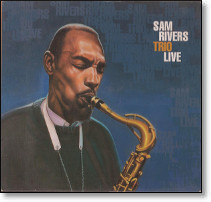
Sam Rivers: Trio Live (1973 [1998], Impulse!):
Originally released 1978 as The Live Trio Sessions, the
first set ("Hues of Melanin") reordered, moving the piano part
up front, then tenor sax, then the long soprano sax, flute, and
vocal sections. With Cecil McBee and Barry Altschul. Ends with
"Suite for Molde," from the Norwegian jazz festival, with Arild
Andersen taking over at bass. It, too, is split between a flute
section and the final tenor sax section. Listening to the former
makes you wonder if he wasn't the greatest jazz flautist ever.
Listening to the latter makes you wonder why he ever played
anything else.
A-
Sam Rivers: Hues (1971-73 [1975], Impulse!): Scraps
from four live performanes, including two tracks from Molde. Cover
pictures him with a flute, but only two lute tracks here, plus two
piano, two soprano sax, four tenor sax -- in other words, they pieced
together a typical trio concert, using three bass-drums pairs.
B+(**)
Sam Rivers: Crystals (1974, Impulse!): Big band
album, not conventional but 6 brass (including Joe Daley on tuba
and euphonium), five reeds (with everyone doubling on flute),
bass, drums, extra percussion, but no piano or guitar. Doesn't
seem like it's going to work at first, but then it does.
B+(**)
Sam Rivers: The Quest (1976, RED): Trio with Dave
Holland (bass) and Barry Altschul (drums). Rivers cycles through
his instruments, impressive on each, but I can't help but think
he'd get more from his rhythm sectio if he played more tenor sax.
B+(**)
Sam Rivers: Paragon (1977, Fluid): Trio with Dave
Holland (bass/cello) and Barry Altschul (drums). Rotates through
his four instruments on the first four tracks, then recapitulates
them all on the 12:15 title cut.
B+(***)
Sam Rivers: Waves (1978 [1979], Tomato): Quartet with
Joe Daley (tuba), Dave Holland (bass/cello), and Thurman Barker (drums).
Starts on piano. Rivers cycles around his instruments, impressive on
each.
B+(***)
Sam Rivers: Contrasts (1979 [1980], ECM): Plays flute,
soprano and tenor sax, backed by trombone (George Lewis), bass (Dave
Holland), and drums (Thurman Barker). Somewhat buttoned down, so it
takes a while to sink in, and fully appreciate the trombone.
A-
Sam Rivers Quartet: Crosscurrent: Live at Jazz Unité
(1981 [1982], Blue Marge): Recorded live in Paris, with Jerry Byrd
(guitar), Rael Wesley Grant (electric bass), and Steve Ellington
(drums). Rivers makes his usual round of instruments, with the soprano
sax meshing especially well with the guitars.
A-
Sam Rivers/Noël Akchote/Tony Hymas/Paul Rogers/Jacques Thollot:
Configuration (1996, Nato): Guitar, piano, bass, drums,
with Rivers alternating between tenor sax, soprano sax, and flute.
B+(**)
Sam Rivers: Concept (1995-96 [1997], RivBea): Nine
tracks recorded over five sessions, most with Doug Matthews (bass or
bass clarinet) and Anthony Cole (drums, but also plays tenor sax).
B+(**)
Sam Rivers & Alexander von Schlippenbach: Tangens
(1997 [1998], FMP): Duets, tenor/soprano sax/flute and piano.
B+(***)
Sam Rivers/Doug Matthews/Anthony Cole/Jonathan Powell/David Manson:
Fluid Motion (2002, Isospin Labs): Soprano/tenor sax, bass,
drums, trumpet, trombone: only Rivers well known, but feels like a band
album, more mainstream with everyone pitching in.
B+(***)
Sam Rivers: Celebration (2003 [2004], Posi-Tone):
Live shot from Jazz Bakery, trio with Doug Matthews and Anthony Cole,
close in spirit to his 1970s albums, with the leader playing piano
and flute as well as tenor and soprano sax -- and mixing things up,
drummer Cole also plays tenor sax and piano, while bassist Matthews
goes electric, also playing bass violin and bass clarinet.
B+(**)
Sam Rivers/Adam Rudolph/Harris Eisenstadt: Vista (2003
[2004], Meta): Starts off on flute, also plays tenor and soprano sax,
with two percussionists, Rudolph using hand drums.
B+(***)
Sam Rivers/Ben Street/Kresten Osgood + Bryan Carrott: Purple
Violets (2004 [2005], Stunt): Trio plus vibes.
B+(**)
Grade (or other) changes:
Jessie Ware: What's Your Pleasure? (2020, Interscope):
British dance-pop diva, fourth album, starts retro-disco, ends up more
new wave, the cool taking a while to carry the day.
[was: B+(***)] A-
Unpacking: Found in the mail last week:
- Duotrio: In the Bright and Deep (Blujazz)
- Kenny Kotwitz & the LA Jazz Quintet: When Lights Are Low (PMRecords) [08-01]
- Paulette McWilliams: A Woman's Story (Blujazz)
- Jose Rizo's Mongorama: Mariposas Cantan (Saungu) [09-16]
Ask a question, or send a comment.
Sunday, July 26, 2020
Weekend Roundup
A good headline to sum up the week comes from Philip Rucker:
Trump's week of retreat: The president reverses course as the
coronavirus surges out of control. Rucker lists various things
that Trump had to backpeddle on -- wearing masks, opening schools,
packing his convention hall in Jacksonville, insisting Congress
cut payroll taxes. You know, things that any reasonable adviser
could have predicted weeks or months ago. Turns out the will
doesn't always triumph over reality. And speaking of reality:
Coronavirus updates: US deaths top 1,000 for fourth consecutive
day. Also: Rebecca Rainey:
New unemployment claims rose last week to 1.4M, ending months of
declines.
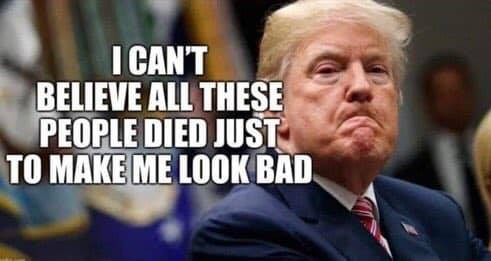 Here's a meme which pretty succinctly sums up where the President's
head is at these days. No idea where it originated, but Sue Katz
posted it on Facebook, and Laura Tillem forwarded it.
Here's a meme which pretty succinctly sums up where the President's
head is at these days. No idea where it originated, but Sue Katz
posted it on Facebook, and Laura Tillem forwarded it.
Here's a tweet, attributed to Richard Feynman:
Schrödinger's Douchebag:
A guy who says offensive things and decides whether he was joking
based on the reaction of people around him.
Or in Trump's case, since he isn't much good at judging reactions
of people around him, based on subsequent polling, or less formally
on how Fox's talking heads decide to spin it.
Some scattered links this week:
James Arkin:
Republicans race to head off Kansas Senate nightmare: Conventional
thinking here is that if Kris Kobach wins the Republican primary, he's
likely to lose an otherwise safe Senate seat to a Democrat, just as he
lost a normally safe governorship to Democrat Laura Kelly in 2018.
So now you have Mitch McConnell's PAC and others trying to prop up
Roger Marshall's campaign against Kobach. There's also a report of
"a super PAC with links to Democrats last week began a $3 million,
meddling ad campaign aimed at boosting Kobach and damaging Marshall" --
strikes me as a serious waste of good money, if that's what it is.
It's so easy to attack both that it's hard to be clear on who's doing
what why. I've seen ads about Kobach's ties to "white nationalists,"
and wondered whether the ad might end with "I'm Kris Kobach, and I
approved this message." (It doesn't, but if it did, I doubt it would
hurt his base.) Meanwhile Bob Hamilton's spending $2 million on ads
where he out-Trumps everyone. (Kobach was the first and only KS pol
to endorse Trump before the 2016 primary, and made a widely reported
pilgrimage to Trump to show off his binders, but evidently creeped
Trump out so much all he got was co-chairman of a "voting fraud"
commission, which he then ran into the ground without producing a
report. "Doc" Marshall's Trumpiest idea was to make family take
hydroxychloroquine, which speaks volumes about how far he'll go to
suck up to Trump.) More on Kansas:
Kate Aronoff:
Dean Baker:
Thoughts on Zachary Carter's The Price of Peace: Money, Democracy,
and the Life of John Maynard Keynes:
Carter buys the often-told story that bailing out the banks in the
Great Recession saved us from a Second Great Depression. No biographer
of Keynes should ever say anything like this.
First and foremost, Keynes taught us how to get out of the first
Great Depression. The secret is spending money. If the government had
gone on a huge spending spree in 1930, in response to the initial
crash, instead of waiting to go full Keynesian in response to World
War II, we never would have had the first Great Depression.
If we had let the market work its magic on Citigroup, Goldman, and
the rest, there is no doubt that the initial downturn would have been
worse. But if we responded with a massive public investment program
in clean energy, health care, child care and other areas, we quickly
would have recovered. And, we would have eliminated a massive source
of economic waste in the bloated financial sector. It is also worth
noting that the bloated financial sector is a major generator of
inequality. It is where many of the seven, eight, and even nine figure
paychecks can be found.
We should be clear; the bailout was about saving the very rich and
their institutions. We could have rescued the economy just fine without
them.
This review is also available as
There is nothing natural about "the market". Also see:
Keynes and corporate power: David Dayen in conversation with Zach
Carter. Dayen also has a new book, Monopolized: Life in the
Age of Corporate Power.
The $24 an hour minimum wage: While $15/hour is the current popular
political demand, $24 would be closer to the mark had the minimum wage
from 1968 reflected productivity growth since then. Zack Beauchamp:
Portland, polarization, and the crisis of the Republican Party: "We
are witnessing a crisis of democracy that is perfectly acceptable to a
significant portion of the population -- as long as it hurts their
enemies." More links follow, and more still (more generally about DHS)
under Fred Kaplan below:
Spencer Ackerman/Winston Ross:
'It's spooky right now': Inside the creepy Federal crackdown on Portland
protesters. Anne Appelbaum:
Trump is putting o a show in Portland. Jamelle Bouie:
The border war in Portland. Andrew Manuel Crespo:
The federal police in Portland don't even understand what 'arrests'
are: "The government cannot lawfully exercise its power of arrest
if it doesn't realize it is, in fact, arresting people in the first
place." Ryan Devereaux:
Before Portland, Trump's shock troops went after border activists. Robert Evans:
What you need to know about the battle of Portland. Elizabeth Goitein:
The president's private army. Garrett M Graff:
The federal crackdown in Portland is 'legal.' That's the problem with
it. Quinta Jurecic/Benjamin Wittes:
Nothing can justify the attack on Portland. Ken Klippenstein:
The federal response to protests extends far beyond Portland. Amanda Marcotte:
"Violent anarchists" are the new "migrant caravans" -- and will flop just
as badly. The second clause is wishful thinking, but the similarity
is that both give Fox News something to talk about when reporting on
reality is too challenging. Brentin Mock:
Philadelphia's top prosecutor is prepared to arrest federal agents:
I've been wondering about why Portland hasn't attempted to arrest
federal agents, given that every level of state and local government
is opposed to their presence, and that their actions, if performed
by anyone else, would appear to be illegal. For that matter, under
ALEC's "stand your ground" laws, aren't you entitled to shoot armed,
unidentified goons trying to force you into minivans? On the other
hand, see Graff and Jurecic/Wittes above. Tina Nguyen:
Trump directs a campaign ad in Portland. Sergio Olmos/Rick Rojas/Mike Baker:
From Antifa to mothers in helmets, diverse elements fuel Portland
protests. Caitlin Oprysko:
Trump announces plan to send federal law enforcement to Chicago,
Albuquerque. Stuart Schrader:
Trump has brought America's dirty wars home: "The authoritarian tactics
we've exported around the world in the name of national security are now
being deployed in Portland." Matt Shuham:
Judge restrains Feds from targeting Portland journos, legal observers.
Tierney Sneed/Matt Shuham:
Inspectors General announce probes into Feds' use of force in Portland, DC
protests. Alex Ward:
Trump's deployment of federal agents in Portland is exactly how not to
police protests. --:
The unmarked federal agents arresting people in Portland, explained.
Kelly Weill/Winston Ross:
Who actually wants Trump to send in the Feds? Police unions. Jamelle Bouie:
There is a 'great silent majority.' But it stands against Trump. David Cole:
Less punishment, more justice: Review of two books: Alexandra Natapoff:
Punishment Without Crime: How Our Massive Misdemeanor System Traps the
Innocent and Makes America More Unequal; and Rachel Elise Barkow:
Prisoners of Politics: Breaking the Cycle of Mass Incarceration.
Sean Collins:
Trump once flirted with white nationalism. Now it's a centerpiece of
his White House. Chas Danner:
What we know about the Austin BLM protest shooting. EJ Dionne:
Why progressives should welcome anti-Trump Republicans: Easy and
sensible to say, but "progressives" are very wary of being sold out
by mainstream Democrats, who have often cloaked their treachery with
claims about how it's necessary to compromise with Republicans. Also,
the only cases in recent history where Republicans courted Democrats
were projects which materially hurt the Democratic base (e.g., "trade
deals"), and therefore damage the credibility of Democratic politicians
with their voters. I think you can break "anti-Trump Republicans" down
into three camps: those who personally can't stand Trump, but have no
qualms with the conservative Republican agenda -- these will vote for
Biden, but not other Democrats; those who realize that the Republican
right-wing project has become dysfunctional -- these may see value in
electing Democrats down the ballot, but worry about left-wingers; and
those who simply want viable solutions, wherever they come from --
these are potentially Democrats, to the extent that Democrats work
to find real solutions to real problems. David A Fahrenthold/Joshua Partlow/Jonathan O'Connell:
Spin, deride, attack: How Trump's handling of Trump University presaged
his presidency. Lee Fang:
Meat industry campaign cash flows to officials seeking to quash Covid-19
lawsuits. David Gelles/Jesse Drucker:
Corporate insiders pocket $1 billion in rush for coronavirus vaccine.
Susan B Glasser:
"Person. Woman. Man. Camera. TV": Trump's mental health is a test for
America.
Alexis Goldstein:
The government is walking blind into the coronavirus housing crisis:
"The 2008 financial crash offered some stark lessons about evictions and
foreclosures, but lawmakers didn't learn a thing." Elliot Hannon:
72 Republicans join Democrats in vote to remove Confederate statues
from Capitol. Fred Kaplan:
Don't pick a cold war you can't win: "Trump and Pompeo are ratcheting
up tensions with China, but have no way to back up their threats."
Break up the Department of Homeland Security: "Trump has turned a
Bush-era bureaucratic blunder into his personal goon squad."
The DHS was a sham from the get-go. It was the brainchild of Democratic
Sen. Joseph Lieberman, who proposed the new department in late 2001, just
after the 9/11 attacks, as a way of showing that the Republicans in the
White House weren't the only ones trying to tackle terrorism. President
George W. Bush opposed the idea, seeing it as burdening the government
with another bureaucratic layer. But then, the 9/11 Commission hearings
revealed that al-Qaida succeeded in toppling the World Trade Center in
part because the FBI, CIA, and other agencies hadn't shared intelligence
about the hijackers' movements prior to the attack. Coordination and
consolidation were suddenly seen as nostrums to our problems.
So, under pressure, in late 2002, Bush signed Lieberman's idea into
law. DHS wound up subsuming 22 agencies from eight federal departments --
with a combined budget of $40 billion and a payroll of 183,000 employees --
into one hydra-headed behemoth.
One can imagine that Lieberman's intent was to consolidate a national
state police, much like the "interior" departments of other countries
(many dictatorships). But the FBI and CIA managed to escape inclusion
and subordination. In the short term, the worst effect was demoting
FEMA from Cabinet-level, which became especially obvious when Katrina
hit in 2005. Related:
Jonathan Blitzer:
Is it time to defund the Department of Homeland Security? Barbara Boxer:
DHS was a mistake. I regret voting for it. "I never imagined a
president like Trump when I voted to create the Department of Homeland
Security." Sure, but GW Bush was president at the time, and Dick Cheney
was VP, and the CIA was kidnapping suspects and rendering them to dark
sites and Guantanamo, so what happened wasn't all that far fetched. Masha Gessen:
Homeland Security was destined to become a secret police force.
"Homeland" is an anxious, combative word: it denotes a place under
assault, in need of aggressive defense from shape-shifting dangers. . . .
The nation used to protect itself against other nations and their
hostile military forces, but now it had to fear individuals. This is
the premise on which secret police forces are built. Their stated
purpose is to find danger where normal human activity appears to be
taking place. . . . The logic of the secret police, however, dictates
that it perpetually has to look in new places for threats. . . .
The C.B.P. is the largest law-enforcement agency in the country.
Its leader -- who at the same briefing stated that his troops are
highly trained and experienced in putting down riots -- and his boss,
Chad Wolf, were telling the nation that they are terrified of the
protesters. These men represent a government agency born of fear.
Their tactics are designed to engender an equal amount of fear in
the people they see as their enemies. The secret police is always
a terror-production machine.
David A Graham:
America gets an interior ministry. Alexander Sammon:
Biden must bring an end to the Bush era: "It was W who gave federal
thugs the authority to terrorize Portland. Undoing Trumpism will require
Biden and the Democrats to repeal Bush's signature legislation." He means
the DHS, but I'd point to Obama's failure to break meaningfully with
Bush's Global War on Terror. Obama may not have liked the term, but he
stressed continuity as early as his decision to keep Robert Gates as
Secretary of Defense. "Homeland Security" has always been subordinate
to war abroad, so you couldn't prevent the possibility of abuses at
home without stopping the war abroad. Lots of things reflect that war,
including police brutality, America's obsession with guns, the opioid
crisis, paranoia over immigration, and much more. Ed Kilgore:
Ezra Klein:
Sheelah Kolhatkar:
The high-finance mogul in charge of our economic recovery: "How
Treasury Secretary Steve Mnuchin became one of the most consequential
policymakers in the world." One of those deep profile pieces. Some
things I didn't know include how Mnuchin made a fortune driving Sears
into bankruptcy, and how many times he made business deals with George
Soros. Mark Landler/Lara Jakes/Maggie Haberman:
Trump's request of an ambassador: Get the British Open for me. Jill Lepore:
The invention of the police: "Why did American policing get so big,
so fast? The answer, mainly, is slavery."
There are nearly seven hundred thousand police officers in the United
States, about two for every thousand people, a rate that is lower than
the European average. The difference is guns. Police in Finland fired
six bullets in all of 2013; in an encounter on a single day in the year
2015, in Pasco, Washington, three policemen fired seventeen bullets when
they shot and killed an unarmed thirty-five-year-old orchard worker from
Mexico. Five years ago, when the Guardian counted police killings,
it reported that, "in the first 24 days of 2015, police in the US fatally
shot more people than police did in England and Wales, combined, over the
past 24 years." American police are armed to the teeth, with more than
seven billion dollars' worth of surplus military equipment off-loaded by
the Pentagon to eight thousand law-enforcement agencies since 1997. At
the same time, they face the most heavily armed civilian population in
the world: one in three Americans owns a gun, typically more than one.
Gun violence undermines civilian life and debases everyone. A study found
that, given the ravages of stress, white male police officers in Buffalo
have a life expectancy twenty-two years shorter than that of the average
American male. The debate about policing also has to do with all the
money that's spent paying heavily armed agents of the state to do things
that they aren't trained to do and that other institutions would do better.
History haunts this debate like a bullet-riddled ghost.
Also:
Two kinds of police appeared on mid-century American television. The
good guys solved crime on prime-time police procedurals like "Dragnet,"
starting in 1951, and "Adam-12," beginning in 1968 (both featured the
L.A.P.D.). The bad guys shocked America's conscience on the nightly
news: Arkansas state troopers barring Black students from entering
Little Rock Central High School, in 1957; Birmingham police clubbing
and arresting some seven hundred Black children protesting segregation,
in 1963; and Alabama state troopers beating voting-rights marchers at
Selma, in 1965. These two faces of policing help explain how, in the
nineteen-sixties, the more people protested police brutality, the more
money governments gave to police departments.
That led into Lyndon Johnson's 1965 "war on crime." We now know
that police in the South weren't notably more violent than police in
the North, as evidence in "riots" in Detroit, Watts, and elsewhere.
The big difference was that the civil rights protests framed police
violence clearly, whereas the media never got clear pictures of
police violence against ordinary people in the North. To a large
extent, what's different now is that ubiquitous cell phones let
us see police violence that until recently had been hidden and
covered up. Well, also that fifty years after civil rights had
been secured in law, we're sick and tired (and frankly disgusted)
when we see this shit still happening. Also relevant here:
Martin Longman:
David Masciotra:
Get over your Russia obsession, liberals: Vladimir Putin's not
responsible for America's sorry state: "Did Putin turn America
into a delusional nation that couldn't handle a pandemic? Or did he
just watch and laugh?" The former can pretty clearly be traced back
to Reagan, whose "morning in America" slogan signaled his intent
to live in a fantasy world, although Reagan's roots go back to the
beginning of the Cold War -- the decision to champion the powers
of capital over the rights of workers both abroad and at home,
even over traditional American values like democracy and freedom.
As for Putin laughing at us, or more generally plotting to deliver
the government to Trump out of a cynical desire to undermine or
just embarrass American democracy, I've never seen him act that
frivolously. Sure, he may have thought the easily corruptible
Trump would be easier to deal with than Hillary Clinton, and he
may have relished the idea of giving America a dose of its own
election-interfering medicine. The problem I have with obsessive
anti-Putin liberals is that they hardly ever manage to articulate
their misgivings about Putin in anything other than Cold War
clichés, and that risks starting another conflict -- one that
people of neither nation wants, or that anyone other than the
munitions makers might profit from. Theodoric Meyer/Adam Cancryn:
Chris Christie cashes in on coronavirus lobbying. Harold Meyerson:
Who should say when a workplace is safe? The workers, that's who.
Ian Millhiser:
Conor Murray:
China is systematically detaining Uighurs -- and the world isn't doing
enough about it. Well, the "world" can't do anything about it,
because the five permanent, veto-wielding UN powers have made it
impossible for the UN (or any international institution, like the
ICC or the World Court) to take an effective stand on human rights
issues. While China and Russia have often been on the defensive on
such issues, the real culprit is the US, which uses its veto to
shield Israel, conducts a "war on terror" over most of the Middle
East and North Africa, and has a long history of backing coups to
install dictators in Latin America, Africa, and Asia (as well as
a history of meddling in democratic elections, from Italy to the
Ukraine). The US is certainly quick to condemn human rights abuses
in countries that don't show sufficient deference to it, while
casting a blind eye to its so-called allies -- hence Venezuela
is a violator but Guatemala is just fine. Nor is US culpability
limited to its foreign policy. The US, after all, has more of
its citizens incarcerated than any other nation -- including
China, regardless of whatever evil they've done in Xingiang and
Tibet. The "world" did start to make some progress on apartheid
in South Africa, but that's proven to be a one-shot. Meanwhile,
any time you hear about Uighurs in the American press, you can
suspect that there's an anti-China political agenda behind it,
rather than a pro-human rights one. The only way to change that
would be for the US to respect its own human rights, and to work
to build international institutions that can do so credibly
elsewhere. That's not going to happen under Trump. Not likely
to happen with Biden, either. Nicole Narea:
How politics, inequity, and complacency undermined Texas's fight against
Covid-19. Anna North:
Child care is broken. Biden has a plan to fix it. Osita Nwanevu:
Trump's polling decline is tying the conservative media in knots. Norm Ornstein:
The November election is going to be a mess. Paul R Pillar:
Human rights get the Pompeo treatment. Adam K Raymond:
Aja Romano:
How "Karen" became a symbol of racism: I clicked on this because
the suddenly ubiquitous use of "Karen" as a term of derision never
made any sense to me. Still doesn't, even after I referred to Romano's
pre-racist primer,
Karen: The anti-vaxxer soccer mom with speak-to-the-manager hair,
explained, which points out: "The current use of the 'Karen'
meme is almost always to call out the perceived entitlement and
rude behavior of white women." Sure, I can see a use for that,
but why attach it to a name that has no bearing on it (unlike,
say, Scrooge)? Indeed, why make it easier to lob insults? Isn't
that just a way of forming a clique? Or am I just being too much
of a Tom? Luke Savage:
Michael Brooks made the left brighter: I can't say as I was
aware of him, but this is one of many testimonies since Brooks died,
at age 36. He wrote the book, Against the Web: A Cosmopolitan
Answer to the New Right, but was evidently best known for his
podcasts. Savage previously reviewed the book:
The intellectual dark web's "maverick free thinkers" are just defenders
of the status quo. More on Brooks:
Theodore Schleifer:
Silicon Valley's richest are getting richer just as the pandemic is
getting worse: e.g., Jeff Bezos, whose wealth shot up $13 billion
in one day. Dylan Scott:
Why America's public health system can't withstand Trump. Refers to
and expands upon:
Michael D Shear/Noah Weiland/Eric Lipton/Maggie Haberman/David
E Sanger:
Inside Trump's failure: The rush to abandon leadership role on the
virus. Finds that the critical decision was made in April, when
Trump decided to downplay the crisis in hopes that a show of confidence
would get the economy moving again, and put his reëlection campaign
back on track.
Not until early June did White House officials even begin to recognize
that their assumptions about the course of the pandemic had proved
wrong. Even now there are internal divisions over how far to go in
having officials publicly acknowledge the reality of the situation.
Robert J Shapiro:
Investors are doing great under Trump, but what about the rest of
us? Sometime in the 1990s you started hearing the term "Greenspan
put" -- essentially a guarantee that whenever the stock market took a
dip, the Fed would intervene to prop it up. As the 2008 meltdown
worsened, the Fed intervened massively. This time the Fed was even
faster on the trigger, allowing the stock market, after its March
collapse, to recover much faster than the economy at large.
Today, much like the last time, the extraordinary measures used to
boost the stock and bond markets are unfolding in plain sight. But
since the main mechanisms are the esoteric operations of the Federal
Reserve, it's hard for most people to sort them out. It's actually
pretty straightforward, though. From March through June (our latest
data), the Fed flooded the financial markets with capital by buying
up $2.8 trillion in Treasury and agency mortgage-backed securities
and some corporate bonds. These purchases enabled banks to vastly
expand credit in the form of loans to businesses at easy terms and
large stock and bond purchases by institutional investors. The
official term for this approach is quantitative easing (QE),
operations pioneered by the Fed for the last financial crisis and
used again now -- but now on steroids. . . .
The Fed has gone even further to support bond investors by declaring
its readiness to directly buy the corporate paper. While the Fed's
actual purchases of corporate bonds have been small, its pledge to
support the market for those bonds stopped the normal downward pressures
on their prices, especially for junk bonds. That's why private investors
have dived back into that market and bid up the prices of corporate bonds
to nearly their recent historic highs. And many of the country's biggest
corporations are taking full advantage of this implicit government
guarantee for their debts: The New York Times reports that through
late June "giant U.S. corporations had borrowed roughly $850 billion in
bond markets this year, double the pace from last year." Their shareholders
will accrue most of the benefits.
David K Shipler:
Beware of a cornered Trump: "The closer defeat looms, the more
deranged his administration will become."
The president of what is supposed to be the greatest country in all
of human history cannot tell the difference between image and reality,
or cares more about image than reality, as he orders a halt in reporting
COVID-19 hospitalizations to the CDC and laments the increase in
coronavirus testing because it makes the case numbers go higher. Is
it possible that his mental defect means that he doesn't realize that
the actual incidence of infection is a fact independent of how many
are detected by tests? Or is he just trying to fool his fellow Americans?
And how many will be fooled? Or frightened?
I haven't figured out a way of expressing just how far off the rails
this MAGA idea has gone. Shipler is right that his obsequious lackeys
only confirm his delusions, but so does Fox News. Isaac Stanley-Becker/Griff Witte:
Why Georgia Gov. Brian Kemp stands alone on masks. I think it was
clear 2-3 weeks ago that the anti-maskers lost their case -- well before
Trump donned one himself. I guess Kemp is still running for dumbest
jackass. More on masks:
Emily Stewart:
Leah C Stokes:
An FBI investigation shows Ohio's abysmal energy law was fueled by
corruption. Steve Vladeck/Benjamin Wittes:
DHS authorizes domestic surveillance to protect statues and monuments.
Alex Ward:
What Alexander Hamilton has to do with the EU's $850 billion coronavirus
stimulus plan. A change from the usual practice of Germany screwing
all the weaker economies. Lawrence Wright:
How pandemics wreak havoc -- and open minds: "The plague marked
the end of the Middle Ages and the start of a great cultural renewal.
Could the coronavirus, for all its destruction, offer a similar
opportunity for radical change?" Another article on same theme:
Jacob Soll:
Can America benefit from Covid? Ask 14th-Century Florence. Matthew Yglesias:
Economists say congress should think big on the next economic rescue.
One thing that's clear is that the presumptive trillion-dollar cap on what
can be done, which hobbled Obama's response to the 2008 meltdown, is a
thing of the past. Economists were pretty clear in 2009 that more would
be needed, but politicians (and Larry Summers) didn't dare.
Judy Shelton, Trump's troubling Federal Reserve nominee, explained.
/Constance Grady:
Fact-checking the alternate history and politics of Curtis Sittenfeld's
Rodham. Just my opinion, but I don't think Hillary Rodham would
have had much of a chance of becoming a significant political figure
in her own right. Not impossible, because she's not totally lacking
in political talent, and would have had useful connections on her own,
but not very likely. Bill Clinton didn't have much of an organization
in 1992, but by 1996 he did, and Hillary built her career on taking
it over. The more interesting question is whether she would have done
better after 2000 by divorcing Bill. I could imagine that playing out
several different ways, but she didn't, so we only know that one path.
As for one question discussed here -- whether her preëminence starved
other women of the opportunity to run -- it probably did until she
lost, after which it became an incentive for other women to prove
they could do better. Dan Zak:
American exceptionalism was our preexisting condition. Li Zhou:
Ask a question, or send a comment.
Monday, July 20, 2020
Music Week
July archive
(in progress).
Music: Current count 33650 [33607] rated (+43), 224 [225] unrated (-1).
Seems like the summer is passing very fast. Probably a reflection of
how little I get done most days. About all I can claim for this past week
is:
Answered
two questions: one on bebop
pianist Hampton Hawes, the other on all-time favorite albums. Working on
the latter, I fiddled a bit with my 2008 list,
1,000 Albums for a Long and Happy
Life. Left it unstable, with some newer albums added but none deleted,
so it's up to 1,050 items now. Published Joe Yanosik's
A Consumer Guide to SONIC YOUTH
Live Albums, in my
guests corner. Wrote up another bloated
Weekend Roundup. Added midyear lists to
metacritic file: Billboard,
Complex, Stereogum. Reviewed the forty-odd records below.
Did nothing whatsoever on my other writing projects. and nothing on
website projects. Didn't shop, or cook much, or deal with any of the
few house projects I'm still contemplating. Managed just one phone
call.
Have one question in the queue, a pretty general one about Europe.
Ask more.
When I was writing about Hawes, it occurred to me that the one album
I hadn't been able to find on Napster might be on YouTube, and indeed it
was. After playing it, I did a search for whole albums on YouTube. First
one I found that caught my attention was Fat Jazz by Jackie McLean,
and that turned me loose on a McLean dig. Every record sounded real good,
but I shut them down after one play each, with just enough reservation
to keep them off the A-list. Further listening would very likely promote
one or more, but the full
grade list suggests
better places to start.
Had some technical problems with the NoBusiness CDs, although the
problem could be in my CD player. It had trouble recognizing several
CDs, and got stuck on one. Wound up going to Bandcamp for a second
spin of
Carrier.
Michael Tatum mentioned he's planning on writing something about
records from Christgau's
1985 Dean's List.
I was thinking that was a year when I paid relatively little attention
to new music, but not much there I didn't have rated. One was Jimmy
G. and the Tackheads: Federation of Tackheads, although I'm
pretty sure I did have the LP at some point. Same for Harold Budd
& Brian Eno's The Pearl, and Steven Van Zandt's Sun
City. Maybe I wasn't as out of it as I thought. I moved from
New Jersey to Massachusetts end of 1984, so it became easier to find
better record stores. Also got a nice raise with the move.
New records reviewed this week:
Riz Ahmed: The Long Goodbye (2020, Mongrel): British
rapper, Pakistani parents, also known as Riz MC, one half of Swet Shop
Boys, even better known as an actor (e.g., HBO's The Night Of).
Second album, short (14 cuts, 26:58), a Clash critic described
it as "a tightly packed, lightning-quick swing at the racism of British
society."
B+(*)
Conrad Bauer/Matthias Bauer/Dag Magnus Narvesen: The
Gift (2018 [2020], NoBusiness): German trombonist, actual
name Konrad, better known as Conny, a major figure in the German
avant-garde since 1973 (especially in Zentralquartett). With bass
and drums.
B+(**) [cdr]
Bombay Bicycle Club: Everything Else Has Gone Wrong
(2020, Island): British indie band, fifth album since 2009.
B
Car Seat Headrest: Making a Door Less Open (2020,
Matador): Will Toledo started with eight lo-fi download releases
(2010-13) before being picked up by Matador and given a budget,
at which point he became a semi-popular blip. I was less impressed,
so when this didn't get much reaction, I didn't bother. Turns out
it's pretty sharp.
A-
Dramarama: Color TV (2020, Pasadena): New wave band
from New Jersey in the 1980s, recorded two good 1985-87 albums, a
couple more before hanging it up in 1994. Regrouped for another in
2005, and now this one. Singer-songwriter John Easdale is constant.
B+(*)
Agustí Fernández/Liudas Mockunas: Improdimensions
(2019 [2020], NoBusiness): Duo, piano and reeds (contrabass clarinet,
tenor and soprano sax).
B+(***) [cdr]
David Guetta/Morten: New Rave (2020, Parlophone, EP):
French DJ, seven albums since 2002, a series of compilations called
Fuck Me I'm Famous, more than 100 singles, EPs, and production
credits. Collaborator is Dieser Morten, but that's about all I know.
Dense, catchy, 4 cuts, 12:20.
B+(**)
Horse Lords: The Common Task (2020, Northern Spy):
Fusion group from Baltimore, sax-guitar-bass-drums with most also
into electronics. Fourth album, draws on Appalachia and Africa,
arcane tunings, polyrhythms. Can build riff pieces, and run them
into the ground.
B+(*)
Jockstrap: Wicked City (2020, Warp, EP): London duo:
Georgia Ellery and Taylor Skye. Second EP, five cuts, 20:45. Glitch
pop, very scattershot, something I'd normally hate but too ridiculous
for that.
B
Camden Joy: Updated Just Now (2020, self-released, EP):
Singer-songwriter Tom Adelman, has written six books, mostly fictionalized
rock crit -- I'm pretty sure I read his The Last Rock Star Book or Liz
Phair: A Rant (1998), although I can't recall any details. First
record (at least under this alias), seven songs, 24:50, rough and sloppy
folk-rock.
B+(**)
Okkyung Lee: Yeo-Neun (2020, Shelter Press): Korean
cellist, moved to US in 1993, based in New York, mostly plays in jazz
contexts although this could be classical chamber music, with hints
of Korean trad. With harp (Maeve Gilchrist), bass (Eivind Opsvik),
and piano (Jacob Sacks).
B+(**)
Luka Productions & Kandiafa: Music From Saharan WhatsApp
06 (2020, Sahel Sounds, EP): Sixth installment in the label's
fast-disappearing monthly EP series, a duo with Luka Guindo (vocals,
synth, percussion) and Abdoulaye "Kandiafa" Kone (ngoni). Four songs,
17:51. Fairly minimal but quite pleasant.
B+(**) [bc]
Brad Mehldau: Suite: April 2020 (2020, Nonesuch):
Solo piano, of the historical moment, "some experiences and feelings
that are both new and common to many of us." Twelve parts follow his
day from "Waking Up" through "The Day Moves By" to "Lullaby." Three
covers follow, from Neil Young, Billy Joel, and Jerome Kern ("Look
for the Silver Lining"). I'm rarely satisfied with solo piano, and
when I am it's usually a pianist like James P. Johnson or Earl Hines
who suffices as a whole rhythm section. But there's always a exception,
and this one works especially well for right now.
A-
Quinsin Nachoff: Pivotal Arc (2018 [2020], Whirlwind):
Saxophonist, last two albums especially impressive, wrote this long
series for strings -- specifically Molinari String Quartet, and solo
violinist Nathalie Bonin. Does get immeasurably better on the title
track, when the saxophone finally enters.
B+(*) [08-07]
No Age: Goons Be Gone (2020, Drag City): Noise pop
duo from Los Angeles, formed 2005, released a consistent stream of
fine albums. Not sure why this one has fared so poorly with critics.
Maybe a bit sludgy, but has their basic sound down pat.
B+(**)
Joshua Redman/Brad Mehldau/Christian McBride/Brian Blade: Round
Again (2019 [2020], Nonesuch): Big name quartet -- tenor sax,
piano, bass, drums -- joining the label's two main stars with two more
prominent leaders, but also reuniting the quartet from Redman's third
album, MoodSwing (1994). All contribute songs (Redman 3, Mehldau
2, 1 each for the others), Mehldau has some fine solos, Redman more.
Ends a bit soft, but reminds us that the '90s can still hold their own.
B+(***)
Rose City Band: Summerlong (2020, Thrill Jockey):
Portland group (of course), originally a side project for Ripley
Johnson (Wooden Shjips, Moon Duo), evidently on his move from San
Francisco. Second album, has a rep for psychedelia but this is
pretty mellow, a bit like the Eagles but with less sunshine and
ego.
B+(*)
The Streets: None of Us Are Getting Out of This Life Alive
(2020, Island): UK rapper Mike Skinner, six albums 2002-11, various
projects before returning to his calling. Starts slow, ends strong.
B+(**)
Threadbare [Jason Stein/Ben Cruz/Emerson Hunton]: Silver
Dollar (2019 [2020], NoBusiness): Bass clarinte, guitar,
drums. Cruz and Hunton did the composing (4-3, plus 1 joint), but
Stein continues his impressive run of albums.
A- [cd]
Etuk Ubong: Africa Today (2019 [2020], Night Dreamer):
Nigerian trumpet player, also sings, played with Femi Kuti, hailed
by Seun Kuti, develops a strong Afrobeat groove.
B+(**)
Summer Walker: Life on Earth (2020, LVRN/Interscope,
EP): R&B singer-songwriter, from Atlanta, well-regarded album
last year, followed it up with this 5-track, 16:25 EP.
B
Larry Willis: I Fall in Love Too Easily (2019 [2020],
High Note): Recording date not stated, but billed as "The Final Session
at Rudy Van Gelder's." Van Gelder died in 2016, but several more records
were recorded in his famous studio, at least through 2018. On the other
hand, Willis died in 2019. Quintet with Jeremy Pelt (trumpet), Joe Ford
(alto sax), Blake Meister (bass), and Victor Lewis (drums). The horns
have some moments, but the most touching ones are when they drop out,
leaving the piano.
B+(**)
Wire: 10:20 (2010-20 [2020], Pink Flag): Outtakes,
four from the sessions that produced Red Barked Tree (2010),
four from Mind Hive (2020).
B+(*)
Yaeji: What We Drew (2020, XL): Kathy Yaeji Lee, born
in New York, parents Korean, lived in Atlanta, Japan, and Korea before
returning to Brooklyn. Produces electronica, sings, first album after
two EPs, title includes a string of Hangul I'm ignoring.
B+(*)
Recent reissues, compilations, and vault discoveries:
Vincent Chancey/Wilber Morris/Warren Smith: The Spell: The
Vincent Chancey Trio Live 1987 (1987 [2020], NoBusiness):
French horn player, one of few, played for Sun Ra, shows up in a
fair number of big bands and brass ensembles (e.g., Lester Bowie's
Brass Fantasy, rarely as leader -- as exampled here, the instrument
doesn't have much oomph. With bass and percussion.
B+(*) [cdr]
DUX Orchestra: Duck Walks Dog (With Mixed Results)
(1994 [2020], NoBusiness): Septet led by two baritone saxophonists
(Dave Sewelson and Mats Gustafsson), with Will Connell Jr. (alto
clarinet), guitar, piano, bass, and drums. Kicks up a bit of a
ruckus.
B+(**) [cdr]
Sam Rivers Trio: Ricochet [Sam Rivers Archive Project, Volume
3] (1978 [2020], NoBusiness): Tenor saxophonist (1923-2011),
got a fairly late start, recording his brilliant debut Fuschia Swing
Song at age 41, but worked into his mid-80s. His archives have been
notable so far, with this, a trio with Dave Holland and Barry Altschul,
no exception. Does include a fairly substantial amount of Rivers on
piano and flute.
B+(***) [cd]
Old music:
Artists United Against Apartheid: Sun City (1985,
Manhattan): Organized by Little Steven (Van Zandt) around a single
supporting the international boycott of South African resort Sun
City -- lyrics don't go much beyond "I'm not going to play Sun City,"
but the mass of singers and musicians, especially the drums, carry
it. Original album offered two versions, plus extra pieces by Peter
Gabriel/Shankar, Keith LeBlanc, Gil Scott-Heron/Melle Mel/Duke Bootee,
Miles Davis, and Bono, and eventually got expanded further in a
"Deluxe Edition." The boycott did much to make people around the
world aware of apartheid, leading to its end by 1994.
A-
Harold Budd/Brian Eno: The Pearl (1984, Editions EG):
Budd was a minimalist composer from California, drifted toward ambient,
recording one of Eno's first batch of ambient albums (1980). Measured
and relaxed. Might have seemed like something more at the time.
B+(**)
Jimmy G. and the Tackheads: The Federation of Tackheads
(1985, Capitol): One-shot Parliament-Funkadelic spinoff led by Jimmy
Giles (George Clinton's younger brother), who plays bass, programs
drums, and is the lead of many vocalists. Pedro Bell cover art.
A-
Hampton Hawes: The Green Leaves of Summer (1964,
Contemporary): Trio, with Monk Montgomery (bass) and Steve Ellington
(drums). One original blues, seven scattered standards, "St. Thomas"
a hit.
B+(**) [yt]
Jackie McLean: Strange Blues (1957 [1967], Prestige):
Alto saxophonist, scraps from two sessions, one a quartet with Mal
Waldron (piano), the other with a rhythm section I don't recognize
plus Webster Young (trumpet) and Ray Draper (tuba).
B+(**)
Jackie McLean: Fat Jazz (1957 [1958], Jubilee):
Sextet, with Webster Young (trumpet), Ray Draper (tuba), Gil Coggins
(piano), bass, and drums, with Young and Draper originals.
B+(**)
Jackie McLean: Vertigo (1959-63 [2000], Blue Note):
Expands on a 1981 album which had picked up scraps, one a Walter Davis
tune from 1959, five from 1963 session with Herbie Hancock and Donald
Byrd, and adds five more tracks from a shelved album from 1962 with
Sonny Clark and Kenny Dorham. The pieces fit together seamlessly, all
respectable hard bop.
B+(***)
Jackie McLean Quartet: Tune Up (1966 [1993],
SteepleChase): Live shot from Baltimore, with LaMont Johnson (piano),
Scotty Holt (bass), and Billy Higgins (drums). Sound strikes me as a
bit off, but when he unloads on "Jack's Tune" I see no point in
quibbling.
B+(**)
Jackie McLean feat. Dexter Gordon: Vol. 2: The Source
(1973 [1987], SteepleChase): Live at Jazzhus Montmartre in Copenhagen,
two stellar saxophonists, alto and tenor, with Kenny Drew, NHØP, and
Alex Riel. A 1976 US release, on Inner City, was just The Source,
but is the same as the shorter 1974 LP release. The summit did produce
two LPs, but the first was The Meeting: Vol. 1, so it makes
more sense to bring Vol. to the front. Or better still, look
for Montmartre Summit 1973, which gives you both on 2-CD.
B+(***)
Jackie McLean/Dexter Gordon: Montmartre Summit 1973
(1973 [1991], SteepleChase, 2CD): Combines Vol. 1: The Meeting
with Vol. 2: The Source in a handy single package.
B+(***)
Jackie McLean: A Ghetto Lullaby (1973 [1991],
SteepleChase): Live in Copenhagen, scene of 1972's exceptional
Live at Montmartre, with Kenny Drew (piano) and Alex Riel
(drums) returning, and taking over the bass slot: Niels-Henning
Ørsted Pederson.
B+(***)
Jackie McLean & the Cosmic Brotherhood: New York
Calling (1974 [1987], SteepleChase): Sextet, one of his
son René McLean's first appearances (alto/soprano sax), with
Billy Skinner (trumpet), Billy Gault (piano), bass, and drums.
B+(***)
Jackie McLean With The Great Jazz Trio: New Wine in Old
Bottles (1978, East Wind): Hank Jones formed GJT in 1976
and recorded a lot with it (22 albums 1976-84, 17 more 1988-2010,
with various lineups but originally and here with Ron Carter and
Tony Williams.
B+(***) [yt]
Unpacking: Found in the mail last week:
- Max Bessesen: Trouble (Ropeadope) [09-04]
- John Hollenbeck: Songs You Like a Lot (Flexatonic) [08-14]
- Simon Moullier: Spirit Song (Outside In Music) [10-09]
- Lawrence Sieberth Quartet: An Evening in Paris (Musik Blöc [09-24]
- Ike Sturm/Jesse Lewis: Endless Field (Biophilia)
- Tropos: Axioms // 75 AB (Biophilia)
Ask a question, or send a comment.
Sunday, July 19, 2020
Weekend Roundup
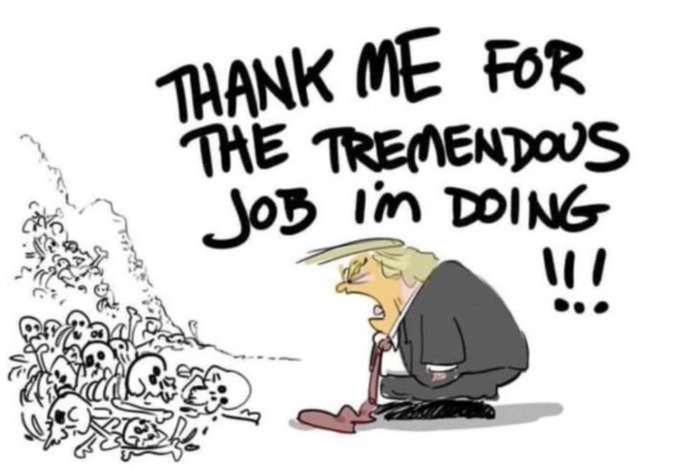 Featured headline this week: Griff Witte/Ben Guarino:
It's not only coronavirus cases that are rising. Now covid deaths are,
too. When I posted last week's headline,
Florida shatters single-day infection record with 15,300 new cases,
denialists responded that it wasn't a problem, because the death rate
hadn't risen. That wasn't very clever. Bad as the disease is, it does
take a week or two to kill, and that sort of lag time has followed the
infection curve from the very start. Moreover, infections continue to
rise: see Hannah Knowles/Derek Hawkins/Jacqueline Dupree:
Coronavirus updates: Halfway through the year, the pandemic's only
intensifying in many states.
Featured headline this week: Griff Witte/Ben Guarino:
It's not only coronavirus cases that are rising. Now covid deaths are,
too. When I posted last week's headline,
Florida shatters single-day infection record with 15,300 new cases,
denialists responded that it wasn't a problem, because the death rate
hadn't risen. That wasn't very clever. Bad as the disease is, it does
take a week or two to kill, and that sort of lag time has followed the
infection curve from the very start. Moreover, infections continue to
rise: see Hannah Knowles/Derek Hawkins/Jacqueline Dupree:
Coronavirus updates: Halfway through the year, the pandemic's only
intensifying in many states.
I probably scraped the cartoon on the right from Twitter. It
seemed to capture the moment and the person exceptionally well.
Not sure who did it. Google shows several Pinterest lists it's
on, and various Twitter threads. I didn't care for the meme that
attributed Covid-19 deaths to Trump's inaction in and before
March -- I figured any politician would have been blind-sided --
but it's harder to excuse him from the second peak (if that's
all it is) we're going through now. But that's secondary here,
to the all-important stroking of Trump's fragile ego. Of course
he's incompetent: Republican orthodoxy demands that government
fail whenever called on in an emergency. But why does he have
to be so needy? He's an embarrassment, and that's finally,
albeit still slowly, sinking in even to the people who hitched
their hopes to his dumb luck.
On the other hand, I believe that there is more behind America's
abysmal failure to contain the Covid-19 pandemic than just the
buffoon in the White House. There's a Lincoln Project widget I've
seen on
Twitter
that provides a running bar graph of total Covid-19 cases in OECD
countries. It starts with South Korea as the highest country, then
Japan and Italy have their moments, but the USA soon overtakes and
buries the rest. Still, the rise of the UK to second place is as
steady. For an explanation of this, Pankaj Mishra takes a
more unified view of Anglo-America in:
Flailing states. Writing for an English audience who hate being
left out, Mishra glosses over differences which are evident even in
the chart. The UK does still have a functioning, albeit not especially
well funded, public health system, which even Boris Johnson showed
some appreciation for after they saved his life. Still, every march
to the right in America has been felt in the UK. Some samples:
Anglo-America's dingy realities -- deindustrialisation, low-wage work,
underemployment, hyper-incarceration and enfeebled or exclusionary
health systems -- have long been evident. Nevertheless, the moral,
political and material squalor of two of the wealthiest and most
powerful societies in history still comes as a shock to some. In a
widely circulated essay in the Atlantic, George Packer claimed
that 'every morning in the endless month of March, Americans woke up
to find themselves citizens of a failed state.' In fact, the state
has been AWOL for decades, and the market has been entrusted with the
tasks most societies reserve almost exclusively for government:
healthcare, pensions, low-income housing, education, social services
and incarceration. . . .
The escalating warning signs -- that absolute cultural power
provincialises, if not corrupts, by deepening ignorance about both
foreign countries and political and economic realities at home --
can no longer be avoided as the US and Britain cope with mass death
and the destruction of livelihoods. Covid-19 shattered what John
Stuart Mill called 'the deep slumber of a decided opinion,' forcing
many to realise that they live in a broken society, with a carefully
dismantled state. As the Süddeutsche Zeitung put it in May,
unequal and unhealthy societies are 'a good breeding ground for the
pandemic.' Profit-maximising individuals and businesses, it turns out,
can't be trusted to create a just and efficient healthcare system, or
to extend social security to those who need it most. . . .
The pandemic, which has killed 130,000 people in the US, including
a disproportionate number of African Americans, has now shown, far
more explicitly than Katrina did in 2005 or the financial crisis in
2008, that the Reagan-Thatcher model, which privatised risk and shifted
the state's responsibility onto the individual, condemns an unconscionable
number of people to premature death or to a desperate struggle for
existence. . . .
However, after the most radical upheaval of our times, even the
bleakest account of the German-invented social state seems a more
useful guide to the world to come than moist-eyed histories of
Anglo-America's engines of universal progress. Screeching ideological
U-turns have recently taken place in both countries. Adopting a
German-style wage-subsidy scheme, and channelling FDR rather than
Churchill, Boris Johnson now claims that 'there is such a thing as
society' and promises a 'New Deal' for Britain. Biden, abandoning
his Obama-lite centrism, has rushed to plagiarise Bernie Sanders's
manifesto. In anticipation of his victory in November, the Democratic
Party belatedly plans to forge a minimal social state in the US through
robust worker-protection laws, expanded government-backed health
insurance, if not single-payer healthcare, and colossal investment
in public-health jobs and childcare programmes.
Mishra skips around, through quite a few countries for examples,
including a bit on how democracy doesn't guarantee anything. What
does work is having a government which sees its role to provide
for the public welfare of all, and having a society which looks to
the government for justice, security, help, and improvement, again
for all. Democracy, by giving everyone an equal stake, should lead
to healthier, more equal societies, but democracy can be corrupted
and conned by privileging money, as we've seen. What the pandemic
has done has been to split the world open according to how inequal
nations are, with the most inequal ones paying the harshest price.
This comes as no surprise to recent critics of inequality, such as
Richard Wilkinson/Kate Pickett, The Spirit Level: Why Greater
Equality Makes Societies Stronger. Even mainstream Democrats
seem to have some intuitive understanding of this, as evidenced by
their relief proposals. On the other hand, people who are totally
oblivious to the problem of inequality have been utterly gobsmacked
by the pandemic -- none more so than Trump.
Some scattered links this week:
David Atkins:
Why is Trump sending stormtroopers into Portland?
In one of the most alarming developments of Trump's presidency, dozens
of federal agents in full camouflage seized protesters and threw them
into unmarked cars, taking them to locations unknown without specifying
a reason for arrest. It appears that at least some of the agents involved
belonged to the US Customs and Border Protection (colloquially known as
Border Patrol), an organization that obviously has no business whatsoever
conducted counterinsurgency tactics against peaceful American protesters
in Portland, Oregon. Neither the mayor of Portland nor the governor of
Oregon wanted them there; in fact, they specifically requested that they
leave.
Atkins asks why Trump is doing this, and rolls out some theories,
saving the "ridiculous" but "also likely closest to the truth" for last:
But if Fox News were the sum of your reality, you would believe that
emergency action needed to be taken before the residents started to
erect a Thunderdome and the services of Snake Plissken would be required.
You would send in the troops despite the potential cost out of a belief
that relieved Americans would be desperately grateful for your embrace
of "law and order" (even if it were heavy on the "order" and light on
the "law.") You would do whatever it took to bring the situation to heel,
and figure the public approval would follow from the new Pax Trumpiana.
After all, Fox News declared it must be so.
Atkins followed this post up with a more speculative one:
Trump may use DHS stormtroopers to stop people from voting.
I don't see how he can do this, at least on a scale that might sway
the election, without generating a huge backlash. More on Portland:
Ryan Bort:
So long, Jeff Sessions: Trump's former attorney general lost the
Republican Senate primary to Tommy Tuberville, who was endorsed by
Trump. John Bresnahan/Ally Mutnick:
Kansas Republican Rep. Steve Watkins charged with voter fraud.
Watkins' father is also being investigated for campaign finance
violations. Philip Bump:
In a pair of interviews, Trump highlights white victimhood. Megan Cassella:
America's hidden economic crisis: Widespread wage cuts. Jane Coaston:
The Lincoln Project, the rogue former Republicans trying to take down
Trump, explained. More on Lincoln Project:
Sean Collins:
Rep. John Lewis, civil rights leader and moral center of Congress, has
died at 80: "He is remembered as a Freedom Rider, voting rights
champion, and the 'conscience of the Congress.'" Also on Lewis:
Sumner Concepcion:
5 key takeaways from Trump's lengthy off-the-rails interview on Fox
News:
- Doubling down on his claim of the coronavirus "disappearing" someday
- Defending the Confederate flag
- Piling on more attacks against Biden
- Griping about his inability to hold rallies amid the COVID-19 pandemic
- Refusing to guarantee he will accept the results of the November
election
The last was the more-or-less new one. But it's worth nothing that he
did the same thing in 2016, and he trapped Hillary Clinton into declaring
that she would accept the results, and true to her word, she gave up
meekly and vanished from sight. Igor Derysh:
Trump Victory Committee paid nearly $400,000 to Trump's Washington hotel
in second quarter. "Trump's properties have earned well over $20
million in political spending since he took office, per CPR data." I
suppose his defense is "that's chump change," but the thought counts.
Trump says it's "terrible" to question why Black people are killed by
police: "So are white people": He refers to "white people" five
times in 20 seconds, per the CBS tweet. Question: "Why are African
Americans still dying at the hands of law enforcement in this country?"
Trump's complete answer: "So are white people. So are white people.
What a terrible question to ask. So are white people. More white
people by the way. More white people." Maybe he could have recovered
a bit by adding, "Bottom line, police kill more people of all races
than they should. And sure, statistics say they're more likely to
kill a black person than a white, but the answer isn't to make them
discriminate more carefully based on race. The answers is for them
to kill a lot fewer people." Still, when your first thought to a
question about discrimination against black is to bring up "white
people," you're a racist. QED. Tom Engelhardt:
Donald J Trump, or Osama bin Laden's revenge. Starts with a
stroll through Trump's sculpture "garden of heroes" (which
Masha Gessen wrote up in sufficient detail last week, then
considers the fate Osama bin Laden hoped we would have in leading
America into "the graveyard of empires" in Afghanistan. David S Fogelsong:
With fear and favor: The Russophobia of 'The New York Times':
"Disregarding all past experience, journalists, politicians, and
foreign policy experts have simply assumed that the claims of
Russian bounties for killing American troops are true. They -- and
we -- should know better." Matt Ford:
The Supreme Court's unconscionable rush to kill a prisoner.
The federal government ended its 13-year moratorium on executions on
Tuesday morning by killing Daniel Lewis Lee at the federal death chamber
in Terre Haute, Indiana. Lewis is the first in a series of federal
prisoners slated to die in the next few days as part of a renewed push
by the Trump administration to carry out death sentences at the federal
level, even as the practice falls out of favor nationwide.
Melissa Gira Grant:
The dark obsessions of QAnon are merging with mainstream conservatism:
"With Republican candidates and Trump embracing the strange, child
trafficking-fixated movement, it can no longer be dismissed as merely
a conspiracy theory." Maggie Haberman:
Trump replaces Brad Parscale as campaign manager, elevating Bill
Stepien. Parscale got a lot of credit for Trump's 2016 win with
his Facebook operation, so naturally got promoted to head the whole
campaign operation, finding himself in way over his head.
Jeff Hauser/Max Moran/Andrea Beaty:
Better policy ideas alone won't stop monopolies. Outlines the
obstacles antitrust enforcement faces, especially in the courts but
also in the bureaucracy. But the conclusion I'd draw from this is
that that's why better policy ideas are needed. Why not develop some
policies that would prevent monopolies from forming in the first
place? Ending patents, promoting open source software and research,
giving employees more power on boards and as owners, making it much
more difficult to acquire companies (e.g., limiting debt financing
of purchase price), allowing bankrupt companies to return under
employee management, publicly-sponsored non-profit cooperatives --
those are all things that would help. Certainly way better than
waiting for monpolies to form and trying to prosecute the worst
offenders. Mara Hvistendahl:
Masks off: How the brothers who fueled the reopen protests built a
volatile far-right network. On Ben Dorr and brothers Aaron, Chris,
and Matthew. When Trump was elected, we saw an outpouring of protests
styling themselves as the Resistance. It seems inevitable that when/if
Trump loses, the right will organize its own Resistance -- smaller but
more menacing, much like the Dorrs here. I expect thay'll make the Tea
Party look like a polite afternoon klatch. Tyshia Ingram:
The case for unschooling: "Why the hands off alternative to
homeschooling might get parents through the Covid-19 pandemic."
I was intrigued by this because my own experience with the school
system was mostly negative. My impression is that schooling has
become even more demanding and oppressive since then, especially
with "No Child Left Behind"'s focus on testing. So my initial
reaction when schools shut down this Spring was that maybe kids
could use a break. On the other hand, to make this work, I don't
doubt that children and adolescents need access to and support
from people who do have decent educations. My parents weren't
much help, but after I dropped out of high school I found my own
way. Would certainly be easier today with the Internet. By the
way, after I dropped out, I spent a lot of time reading about
education. The term "unschooling" comes from John Holt, who was
one of the pioneering writers I read back then. Teaching as a
Subversive Activity, by Neil Postman and Charles Weingartner,
was my favorite. Elahe Izadi/Jeremy Barr:
Bari Weiss resigns from New York Times, says 'Twitter has become its
ultimate editor': I can't say as Weiss was even on my radar, but
she was prominently mentioned in the Harper's letter controversy,
and evidently decided to exploit that moment of fame by "canceling"
herself. She was evidently most famous as the main pro-Zionist voice
on their opinion staff, not that the Times' biases there are likely
to change in the near future. Some reaction:
Henry Olsen:
McCarthyism is back. This time, it's woke. The Weiss resignation
(and/or
Andrew Sullivan's resignation from New York Magazine) stirred up
a hornet's nest of outrage among Washington Post opinion writers --
scroll down for links from Matt Bai, Hugh Hewitt, Kathleen Parker,
Megan McArdle, and Jennifer Rubin -- but this is about as off the
deep end as any. Olsen has no more grasp of McCarthyism than Clarence
Thomas did of lynching when he decried having to face unflattering
testimony. Although I am glad that McCarthyism is still being viewed
as something bad. For a better grounded use of the term, see
Peter Beinart:
Trumpism is the new McCarthyism. Sullivan's farewell letter,
which doubles as promo for his new subscription newsletter, is
here. Avi Selk:
A New York Times columnist blamed a far-left 'mob' for her woes. But
maybe she deserves them. In any case, the talking point will set
her up for lucrative ventures further right. Alex Shephard:
The self-cancellation of Bari Weiss: "Like much of her writing,
the New York Times editor's resignation letter is long on accusation
and thin on evidence." As Shephard concludes, her resignation will
"make the perfect ending for her next book." Philip Weiss:
Bari Weiss leaves the 'NYT' and that's bad for Zionists: "Weiss
is such a gifted careerist that even this moment feels like shtik:
Bari Weiss playing her own persecutino for the greater glory of Bari
Weiss." Jen Kirby:
Israel's West Bank annexation plan and why it's stalled, explained by
an expert: Interview with Brent E Sasley ("a professor at the
University of Texas at Arlington and an expert on Israeli politics").
Ezra Klein:
What a post-Trump Republican Party might look like: Interview with
Oren Cass, who was a Romney consultant and author of The Once and
Future Worker: A Vision for the Renewal of Work in America, on "why
conservatives need to challenge free-market economic orthodoxy." He
doesn't say much about the Republican party (either the financiers or
the rank-and-file), but does offer a bunch of dubious economic ideas.
Some such rethinking is in order (although few ideas have fared worse
than supply-side focus), but even if Trump loses badly, I don't see
many Republicans (either rich or poor) taking the hint to rethink
economic policy. Rather, they'll try to pin their loss on media focus
on Trump's gaffes, limiting them as much as possible to Covid-19.
Most importantly, the real power base behind the GOP -- which is
Fox News -- will pivot to attack mode, and try to gin up another Tea
Party, as they did in 2009. And once again, they'll do that not for
tactical reasons but because they have to fill up 24/7 of air time,
and outrage sells, and it doesn't matter to them if their market is
a hopeless minority -- just so it's big enough to be profitable. Andy Kroll:
The plot against America: The GOP's plan to suppress the vote and
sabotage the election. Paul Krugman:
Why do the rich have so much power? Nancy LeTourneau:
The pandemic is making Republican lawmakers much more vulnerable:
All of that is happening as the news of a potential landslide in the
2020 election continues to build. There's been a lot of talk about how
several incumbent Republican senators are extremely vulnerable in their
quest for reelection. But today, the Cook Political Report made some
changes to their House ratings -- with 20 seats moving towards the
Democrats. . . .
So when Greg Dworkin's friend
suggested that this wasn't so much an election as a countdown, it
resonated deeply. The hope that we can turn things around in a few months
is palpable. But what will happen over those months is terrifying. The
clock is ticking.
Perhaps the saddest part of all of this is that it begs the question:
"Why did it have to get this bad?" I'm sure that future historians will
write volumes in an attempt to answer that question. But something is
deeply wrong with our democratic republic when it takes a pandemic costing
the lives of hundreds of thousands of Americans to get us to wake up and
smell the stench emanating from the president and his congressional enablers.
Dahlia Lithwick:
Mary Trump's book shows how Donald Trump gets away with it: "The
problem with a fraud as big as this president is that once you start
collaborating with him, it's impossible to get out." I must admit I'm
enjoying the reviews of niece Mary Trump's book, Too Much and Never
Enough: How My Family Created the World's Most Dangerous Man, not
least because it seems so close and personal, even if the title could
apply equally to nearly every silver-spooned baby boomer in the land.
Lithwick writes:
Donald Trump ogled his own niece in a bathing suit and sought to fill
one of his books with hit lists of "ugly" women who had rebuffed him;
Donald Trump paid someone to take his SATs; Maryanne Trump Barry, a
retired federal appeals court judge, once described her brother as a
"clown" with no principles; Donald Trump was a vicious bully even as
a child; Freddy Trump -- the author's father -- died alone in a hospital
while Donald went to a movie. The details are new, and graphic, yes, but
very little about it is surprising: The president is a lifelong liar and
cheater, propped up by a father who was as relentless in his need for
success as Donald Trump was to earn his approval. . . .
But as it became clear that Donald had no real business acumen -- as
his Atlantic City casinos cratered and his father unlawfully poured secret
funds into saving them -- Mary realized that Fred also depended on the
glittery tabloid success at which Donald excelled. Fred continued to prop
up his son's smoke-and-mirrors empire because, as Mary writes, "Fred had
become so invested in the fantasy of Donald's success that he and Donald
were inextricably linked. Facing reality would have required acknowledging
his own responsibility, which he would never do. He had gone all in, and
although any rational person would have folded, Fred was determined to
double down." . . .
And as Mary Trump is quick to observe, the sheer stuck-ness of his
enablers means that Trump never, ever learns his lesson. Being cosseted,
lied to, defended, and puffed up means that Donald Trump knows that, "no
matter what happens, no matter how much damage he leaves in his wake,
he will be OK." He fails up, in other words, because everyone
around him, psychologically normal beings all, ends up so enmeshed with
his delusions that they must do anything necessary to protect them.
Trump's superpower isn't great vision or great leadership but rather
that he is so tiny. Taking him on for transactional purposes may seem
like not that big a deal at first, but the moment you put him in your
pocket, you become his slave. It is impossible to escape his orbit
without having to admit a spectacular failure in moral and strategic
judgment, which almost no one can stomach. Donald Trump's emptiness
is simply a mirror of the emptiness of everyone who propped him up.
More:
German Lopez:
Florida now has more Covid-19 cases than any other state. Here's what
went wrong. "The percentage of positive tests is now nearly 19
percent," which means they're not testing enough (recommended maximum
is 5 percent), not too much. More Covid-19 stories:
Nick Martin:
Ivanka Trump and Lockheed Martin want you to reach for the stars and
stop collecting unemployment. Actually, "find something new" isn't
a totally stupid idea. It seems likely that the economy will eventually
adapt to Covid-19 and look different than the one before the pandemic.
As such, those who can shift their trajectories toward emerging careers
will benefit both for themselves and for the future society. Extended
unemployment compensation and benefits could help. But companies like
Lockheed Martin are just trying to scam the program for themselves. Dylan Matthews:
Trump reduced fines for nursing homes that put residents at risk. Then
Covid-19 happened. Jane Mayer:
How Trump is helping tycoons exploit the pandemic: "The secretive
titan behind one of America's largest poultry companies, who is also
one of the President's top donors, is ruthlessly leveraging the
coronavirus crisis -- and his vast fortune -- to strip workers of
protections." Sara Morrison:
Lawmakers are very upset about this week's massive Twitter breach:
Maybe because the folks who got hacked are rich and famous?
Everything you need to know about Palantir, the secretive company coming
for all your data.
Palantir is also controversial because its co-founder and board chair,
Peter Thiel, is controversial. Thiel, who was one of Facebook's first
outside investors and maintains a position on its board of directors,
has seen his share of criticism over the years, but the libertarian
billionaire really came into the public eye in 2016 when he revealed
himself as the money behind Hulk Hogan's privacy lawsuit against Gawker
(which would ultimately kill the site) and an early Trump supporter.
As most of liberal Silicon Valley's big names publicly came out against
Trump, Thiel was one of relatively few public figures who supported his
candidacy. After speaking at the Republican National Convention, he gave
the Trump campaign $1.25 million, and when Trump won the election, New
York magazine said he was "poised to become a national villain." Thiel
has been rewarded for his support: He was chosen to be a member of the
president's transition team; in the early days of the Trump presidency,
Politico dubbed Thiel "Donald Trump's 'shadow president' in Silicon Valley";
and Thiel's chief of staff and protégé, Michael Kratsios, served as the
White House's chief technology officer from 2017 until this month, when
he was named acting undersecretary for research and engineering at the
Department of Defense.
The article notes that "Palantir even sued the US Army in 2016 to
force it to consider using its intelligence software after the Army
chose to go with its own," and "won the suit, and then it won an $800
million contract." Elie Mystal:
The Trump administration is on a capital punishment killing spree:
"After 17 years, attorney general Bill Barr has resumed federal executions --
and the conservative on the Supreme Court approve." Terry Nguyen:
Boycotts show us what matters to Americans.
Tina Nguyen:
Trump keeps fighting a Confederate lag battle many supporters have
conceded. I thought Nikki Haley made a courageous move in ditching
the Confederate flag after a mass shooting in Charlestown while she
was governor, but it became merely savvy when literally no one tried
to save the flag. As a northerner whose ancestors came to the US well
after the Civil War, you'd expect Trump to have even less interest in
the Confederacy. But some polling here shows not only that a majority
of Americans view the Confederate flag as a racist symbol, there is
no significant difference between North and South -- but there is one
between Republicans and Democrats. John Nichols:
Why the hell is the Supreme Court allowing a new poll tax to disenfranchise
Florida voters? Anna North:
America's child care problem is an economic problem. Subhed bullet
list:
- More than 41 million workers have kids under 18. Almost all of them
lost child care as a result of the pandemic.
- In normal times, inadequate child care is the equivalent of a 5
percent pay cut for parents. Now it's much worse.
- By late June, 13 percent of parents had cut back hours or quit
their jobs
- 80 percent of moms say they're handling the majority of homeschooling
responsibilities in their families
- And about 16 percent of parents are taking care of kids alone,
without a partner
- Add to that parents needing and looking for jobs: More than 11
percent of women are unemployed right now
- Meanwhile, 40 percent of child care programs say they will have
to close permanently without outside help
- More than 250,000 child care workers have lost their jobs
- When it comes to schools, the news is just as grim: At least 3
of the country's biggest school districts will be partially or fully
remote in the fall
- With fewer options for child care, parents could lose hundreds
of thousands of dollars over their lifetime
- Trump has offered zero solutios to solve the problem
All originally in bold. Thought that would be too much clutter, but
kept one that seemed to stand out. JC Pan:
In defense of free stuff during (and after) the pandemic: "The mass
expansion of public goods is long past due, so pay people to say home,
give them free health care, and stop charging tuition." Alex Pareene:
Throw the bums out: "We are in the midst of a world-historic failure
of governance. Why isn't anyone in charge acting like they are responsible
for it?" Picture is Andrew Cuomo, and his "three-dimensional foam mount
repreenting the pandemic's toll on the state." I'm not one inclined to
defend Cuomo, but I really doubt a random reshuffling of politicians
would do us any good. There may be exceptions, but in damn near all of
the country, there's a big difference between Republican and Democratic
"bums." Heather Digby Parton:
Trump's unhinged Rose Garden campaign rally: His sideshow act is getting
truly pathetic: "He can't hold rallies, so he forced the press corps
to sit through one. Then he said Joe Biden will ban windows." Kim Phillips-Fein:
Rethinking the solution to New York's fiscal crisis. Abraham Ratnet:
Trumpism is an aesthetic, not an ideology -- and it will survive Donald
Trump. I'm half convinced: ideology involves too much thinking for
Trump followers. But at least I can imagine an ideology. I'm finding it
much harder to come up with a Trump aesthetic. Sure, there's no great
shortage of Trump kitsch, from his Goya pandering to his gold toilets,
but is that really an aesthetic? I've long been wary of efforts to
ideologize and/or aestheticize politics, not least because the Nazis
and Fascists put so much effort into doing just that. (I don't like
lumping them, but in this regard one could also include various
Communist parties -- with Korea the most comprehensive.) But with
Trump's followers, what you mostly get are Trilling's "irritable
mental gestures" -- well, sometimes physical gestures as well. All
they have is a psychology, and sure, that will survive Trump, not
because Trump invented it but because Trump was as mired in it as
they are. He never was the leader of a movement. He just caught the
spotlight as the guy acting out most flagrantly. David Roberts:
Michael Scherer/Josh Dawsey:
From 'Sleepy Joe' to a destroyer of the 'American way of life,' Trump's
attacks on Biden make a dystopian shift. Jon Schwarz:
Political correctness is destroying America! (Just not how you think.)
What he means is that the right, and for that matter the center, work at
least as hard at patrolling use of language among their followers. You
don't have to spend much time watching Fox News to see that everyone in
every time slot echo the same talking points, offering the same spin on
and definition of events and ideas. The modern term for this is message
discipline. The exclusive association of PC with the left goes back to
the Leninist Communist Parties, where approved speech was deemed to be
correct, and because correct implies fidelity to a higher authority, like
nature or reality (or God or Party). The use in recent America has been
far more haphazard, mostly as people have sought to avoid and deplore
slurs, occasionally resorting to indirect or infelicitous phrases. This
is contentious because parties on all sides understand that controlling
the language used to define an issue often determines the outcome. But
it also becomes pedantic when debates reduce issues to terminology --
itself a common, if unappealing, debate technique. Schwarz provides many
examples of Republicans dictating their followers' speech, as well as a
few where mainstream Democrats have joined them (e.g., deference to God
and Country, to the military and the police). Still, I'm not sure that
calling this PC is helpful. For example, insisting that climate change
is a hoax is more properly propaganda, its message discipline enforced
as dogma. It is in no sense of the word correct.
Dylan Scott:
Alex Shephard:
Donald Trump Jr wages a culture war on the publishing industry:
"He evidently believes that he can make more money self-publishing --
especially if he portrays the move as a rebuke of liberal elites."
Trump has a new book, to be released during the Republican convention,
Liberal Privilege: Joe Biden and the Democrat's Defense of the
Indefensible
(sic?).
David Sirota:
Wall Street is deeply grateful for the Supreme Court's recent little-noticed
ruling.
Chief Justice John Roberts has created the most conservative court in
modern history: In just the last few weeks, his court has helped financial
firms bilk pension funds, strengthened fossil fuel companies' power to
fast-track pipelines, limited the power of regulatory agencies that police
Wall Street, and stealthily let Donald Trump hide his tax returns. As a
reward for Roberts's continued defense of the wealthy and powerful, much
of the national media has obediently depicted him as a great hero of
moderation, because he sort of seemed to snub Trump in a handful of
other rulings.
Roger Sollenberger:
Fox News peddled misinformation about the coronavirus 253 times in
five days. Well, that's what you get for counting. Emily Stewart:
The PPP worked how it was supposed to. That's the problem.
"America's plan to save small business in the pandemic was flawed
from the start." Matthew Avery Sutton:
The truth about Trump's evangelical support: Review of recent books
on evangelical Christians: Kristin Kobes Du Mez: Jesus and John Wayne:
How White Evangelicals Corrupted a Faith and Fractured a Nation;
Sarah Posner: Unholy: Why White Evangelicals Worship at the Altar
of Donald Trump; and Samuel L Perry/Andrew L Whitehead: Taking
America Back for God: Christian Nationalism in the United States.
Derek Thompson:
A lot of Americans are about to lose their homes: "The current
housing crisis could get messy quickly, but fixing it shouldn't be
complicated, if Congress intervenes." Paul Waldman:
If you aren't filled with rage at Trump, you aren't paying attention.
Before the pandemic, Trump was one of the worst presidents in our history.
But now he has laid waste to our country, with his unique combination of
incompetence and malevolence -- and he's not done yet. Once we finally rid
ourselves of him, it will take years to recover. But as we do, we should
never for a moment forget what he was and what he did to us. And we should
never stop being angry about it.
Same thing could have been said about Bush in 2008, but Obama chose
not to remind people of the wars and recession and environmental and
climate degradation and collapsing infrastructure and education and
increasing inequality he was to no small extent responsible for. He
not only let people forget the perils of electing Republicans, he let
them transfer blame to his own party and self, allowing Republicans
to stage a resurgence which led to Trump in 2016. Alex Ward:
Libby Watson:
The Democrats' baffling silence as millions of Americans lose their
health insurance: "Five million have lost coverage amid the
pandemic -- a number that's expected to triple by year's end. But
the party leadership isn't reacting as though it's a crisis." Moira Weigel:
The pioneers of the misinformation industry: Book review of Claire
Bond Potter: Political Junkies: From Talk Radio to Twitter, How
Alternative Media Hooked Us on Politics and Broke Our Democracy;
and Matthew Lysiak: The Drudge Revolution: The Untold Story of How
Talk Radio, Fox News, and a Gift Shop Clerk with an Internet Connection
Took Down the Mainstream Media. "Potter, a professor at the New
School, keeps a (mostly) neutral, academic distance from her subjects,
while Lysiak has written a sympathetic biography that moves at the
speed of a screenplay." Erik Wemple:
Tucker Carlson whitewashes the racism of his show and his former top
writer. Erica Werner/Jeff Stein:
Trump administration pushing to block new money for testing, tracing
and CDC in upcoming coronavirus relief bill. This seems beyond
stupid. It's part of negotiations on a follow up to the CARES act,
which expires at the end of the month (more on it below). Trump is
also insisting on a payroll tax cut, which seems especially dumb
given the more pressing needs of the unemployed, and "another round
of stimulus checks" (same problem, plus until the virus is contained
there won't be much economy to stimulate). Richard D Wolfe:
Why government mostly helps people who need it the least . . . even
during a crisis. Mostly on the stock market, which the Fed and
the Trump administration have struggled mightily to re-inflate after
the panic in March, even though an overvalued stock market is useless
to fighting the pandemic or even re-opening the economy. Trump thinks
it makes him look good, and maybe it does to people who own a lot of
stocks. The re-inflated stock market is a big part of the reason the
share of wealth owned by billionaires has increased dramatically while
virtually everyone else has suffered. Matthew Yglesias:
Li Zhou:
Congress is running out of time to extend expanded unemployment
insurance. Also on CARES:
Ask a question, or send a comment.
Monday, July 13, 2020
Music Week
July archive
(in progress).
Music: Current count 33607 [33567] rated (+40), 225 [212] unrated (+13).
Trumpet player Eddie Gale (78) died last week. He had a spotty
recording career, but always came up with something interesting
when he appeared. He achieved a measure of fame for his role on
Cecil Taylor's 1966 album Unit Structures, then followed
that with two excellent albums on Blue Note: Ghetto Music
(1968) and Black Rhythm Happening (1969). He had a revival
c. 2004 with reissue of his albums on Water and a new one, Afro
Fire.
I added a lengthy midyear list by
Stephen Thomas Erlewine to my
metacritic file (code SE).
He added first mentions of 10 new albums (mostly country), plus a
bunch of
reissues and vault music.
He shows some favor there for lavish box sets, and also seems to get
good service from Ace, Bear Family, Cherry Red, and Omnivore. I'm so
jealous.
Robert Christgau published his
July Consumer Guide mid-week. I was originally pleased to see that
for four 2020 releases I had previously rated A- got the same grade from
him (Chicago Farmer, Bob Dylan, Hinds, Waxahatchie), and that the other
new records I had graded lower also got lower grades from him (Terry
Allen, Jason Isbell). That also left some things I hadn't heard (or in
some cases hadn't heard of), but further digging revealed that I had
given the Daniele Luppi/Parquet Courts EP a B+(***) back in
January 2018. I played
most of the rest, still procrastinatig on the Sonic Youth bootleg
(one of way too many for my purposes, although I may reconsider when
I get around to formatting Joe Yanosik's
Consumer Guide for
his corner of my website) and Joe
Levy's Uprising 2020 playlist (not my idea of a real thing,
although so immediately relevant to the times I expect to listen
to it).
I got to the Thiago Nassif and Moor Jewelry A- records after my
cut-off, but figured why make you wait, especially given that there
are other ways to find my grade. Usually takes me 8-16 hours to catch
everything up after my break, so I always listen to a few records
during that time. (Four more in the scratch file at present, not
counting these two.)
Quite a bit of unpacking below, many from Lithuania. Also got a
hard copy of Luis Lopes' Believe, Believe, which I had given
a B+(***) to based on streaming. I looked for records by the late
bassist Simon H. Fell. Found quite a few, but mostly Bandcamp with
most tracks missing, so didn't manage to review much. Took a dive
into pianist Hampton Hawes, thanks to a
question. I will answer that (and
whatever else comes in) later during the week. I've gotten into a
rut where I start each day off by playing something classic, then
when I settle down in front of the computer, find it easier to
dial up something to stream. I'll make a conscious effort to
catch up a bit next week.
New records reviewed this week:
Anteloper: Tour Beats Vol. 1 (2020, International
Anthem, EP): Duo, Jaimie Branch (trumpet) and Jason Nazary (drums),
did an album in 2018 (Kudu), add 4 cuts (22:38) here. Mostly
electronics for both of them, although her riffing over the beats
is pretty surefire.
B+(*)
Arca: Kick I (2020, XL): Venezuelan electronica
producer Alejandra Ghersi, born in Caracas, lived in Connecticut
for a few years before returning, wound up in Barcelona. Fourth
album. Arch, arty, arcane. Doubt it's something I would ever grow
to like much, but there's something pretty unique about it.
B+(*)
Bananagun: The True Story of Bananagun (2020, Full
Time Hobby): Australian group, first album, elements of jangle pop.
B+(*)
Beauty Pill: Sorry You're Here (2020, Taffety Punk
Theatre Company): Washington DC band, principally Chad Clark, released
an EP in 2001 leading up to a 2004 album, then nothing until 2015, and
LP/EP releases this year. Mostly electronics, some spoken word or other
trip-hoppy vocal shadings, quietly impressive if not quite convincing.
Does make me wonder if I underrated their 2015 album. [PS: Not much.]
B+(***)
Beauty Pill: Please Advise (2020, Northern Spy, EP):
Five songs (22:31), all proper with vocals, electronics give way to
guitar.
B+(*)
Clint Black: Out of Sane (2020, Blacktop/Thirty Tigers):
Country singer-songwriter, 1989 debut a big hit, twelfth album (skipping
two Xmas joints). I hadn't heard anything by him since a dreadful 2004
album (his eighth and last top-10 country chart). This one sounds good
enough, not that better songs wouldn't help.
B+(*)
Clem Snide: Forever Just Beyond (2020, Ramseur):
Vehicle for singer-songwriter Eef Barzelay since 1998, not the first
band named from William S. Burroughs. Plain-spoken, not sure you can
even call it Americana, leans on God (per the title), not sure that
qualifies one way or the other, but leaves me out.
B+(**)
Jeff Cosgrove/John Medeski/Jeff Lederer: History Gets Ahead
of the Story (2018 [2020], Grizzley Music): Drums, organ, and
saxophones/flute. Ten songs, all by William Parker -- a bit surprising,
given the lack of avant frills. Parker's long struck me as a composer
who likes to keep it simple, which is why his tunes hold up in such a
different context.
B+(***) [cd] [07-17]
Dream Wife: So When You Gonna . . . (2020, Lucky Number):
London-based girl group, lead singer Rakel Mjöll originally hailing from
Iceland, has a couple cute quirks to her voice, which give way to smart
lyrics and occasional philosophical depth, like how uniquely woderful
now is, and why her body is hers alone.
A-
Baxter Dury: The Night Chancers (2020, Heavenly):
English singer-songwriter, son of the late new wave genius Ian Dury,
sixth album since 2002, talks his way through most songs, against
swank orchestra and chorus. Bears signs of inheritance, raised in
an evolved culture, which makes what he does seem inevitable rather
than extraordinary.
B+(*)
Field Music: Making a New World (2020, Memphis
Industries): English band, first album 2005, seventh album, fond
of keyboards.
B+(*)
Khruangbin: Mordechai (2020, Dead Oceans): Houston
group, bass-guitar-drums, all sing but not very much, group name a
Thai word for "flying thing" (e.g., airplane), suggested by Laura
Lee, whose interest in Asian music led her to learn Thai. Third album,
wouldn't call it exotica but they do amble in their own orbit.
B+(*)
King Krule: Man Alive! (2020, True Panther Sounds):
English singer-songwriter Archy Marshall, fourth album, third as King
Krule. Has a rep for drawing on punk and hip-hop, but mostly comes up
with Nick Cave dark tones.
B
Stephen Malkmus: Groove Denied (2019, Matador):
The genius behind Pavement (1992-99), followed that up with seven
albums declining credited to Stephen Malkmus and the Jicks (2001-18),
goes completely solo here, playing all instruments and singing (such
as he does -- can't say practice makes perfect, but it does help).
Can't say as this had any appeal to me when it came out, but has
its own unique sloughed off charm. Also, a bit of groove.
B+(**)
Stephen T. Malkmus: Traditional Techniques (2020,
Matador): Another solo joint, title no less ironic, middle initial
a quirk I'd like to suppress in the filing, but probably can't.
B+(*)
Moor Jewelry: True Opera (2020, Don Giovanni):
Collaboration between lapsed poet Moor Mother (Camae Ayewa) and
noise producer Mental Jewelry (Steven Montenegro), who did a
previous EP called Crime Waves. Ten cuts (25:59), could
pass for punk but is much more expansive.
A-
Thiago Nassif: Mente (2020, Gearbox): Brazilian
singer-songwriter, plays guitar, drums, trumpet, electronics;
shares production duties with Arto Lindsay, who helps out as do
a couple dozen others, for a mix of tropicalia, no wave, and
ever so catchy skronk.
A-
Carlos Niño & Miguel Atwood-Ferguson: Chicago Waves
(2018 [2020], International Anthem): Labels in Chicago, musicians from
Los Angeles, DJs, play various instruments, have worked together at least
since 2007. Improvised set, recorded live.
B+(*)
Pearl Jam: Gigaton (2020, Monkeywrench/Republic):
Grunge band from Seattle, always figured they were Dave Clark 5 to
Nirvana's Beatles, not that I ever liked Nirvana as much as I did
DC5. Bought one album Christgau liked (Vitalogy), gave it a B+,
never played it again, or anything else by this group. Didn't even
list anything by them after 2000 (five albums, chart peaks 5 or
better), and only played this after it became the top black line in my
metacritic file (Baxter Dury is next, followed by Khruangbin and King
Krule). Not bad, nor especially interesting, and by the end I was
reminded of how tedious Eddie Vedder's voice is.
B
Margo Price: That's How Rumors Get Started (2020,
Loma Vista): Country singer, grew up in Illinois, moved to Nashville
at 20, waited tables and worked the ropes, releasing a pretty good
album in 2016. This makes three, new label, fancier production,
rocks harder, soars higher, says less.
B+(*)
Tenille Townes: The Lemonade Stand (2020, Columbia
Nashville): Canadian country singer-songwriter, from Alberta, last
name Nadkrynechny. Third album, first from Nashville.
B+(**)
The Weeknd: After Hours (2020, Republic): Canadian
r&b singer Abel Tesfaye, had an early star-making mixtape in 2011
(House of Balloons), has developed into a best-selling falsetto
crooner -- remarkably consistent, at least until the closer drags its
butt.
B
Gillian Welch & David Rawlings: All the Good Times Are
Past & Gone (2020, Acony): Title often truncated, but
the cover bears me out. Folkies, her sixth album since 1996, he's
been around the whole time but this seems to be the first with him
named, and he does get more leads. Ten tracks, all acoustic covers,
two Dylan, two trad., one Prine, "Jackson."
B+(**)
X: Alphabetland (2020, Fat Possum): Los Angeles punk
band, a big deal in some quarters 1980-82, last charted in 1987, one
more album in 1993, have reunited occasionally since 2004, this their
first new album in 27 years. Memorable names: DJ Bonebrake (drums),
Exene Cervenka (vocals), John Doe (bass, vocals), Billy Zoom (guitar,
sax, piano). Eleven short songs, adds up to 27:00. They've done a
remarkable job keeping their sound preserved.
B+(*)
Yonic South: Wild Cobs (2019, La Tempesta, EP):
Postpunk band from "Stanzini, Shitaly" (or Brescia, Italy), first
EP (4 songs, 16:27), crisp but they do like to riff.
B+(**)
Yonic South: Twix and Dive (2020, La Tempesta, EP):
Four more songs (13:40), "from Oasis covers and Anfield soundtracks
to psych noise ballads and Techno Viking dedications," ending with
a bit of patter extolling "this beautiful arena" -- how can you get
more anachronistic than that?
B+(**)
Recent reissues, compilations, and vault discoveries:
Nublu Orchestra Conducted by Butch Morris: Live in Bergamo
(2008 [2020], Nublu): Band named for a club on Avenue C in New York,
goes back further but debuted with eponymous 2007 album, where various
musicians would gather and improvise under the direction ("conduction")
of Morris. This was the seventh to be released, "Conduction No. 175,"
in Italy, with ten musicians, out of 199 through June 20, 2011. (Morris
died in 2013.) One 34:27 piece, plus three encores (16:18). Not a dull
moment.
B+(***)
Old music:
Simon H. Fell: The Exploding Flask of Muesli: Electroacoustic
& Electronic Works 1994-2002 (1994-2002 [2013], Bruce's
Fingers): Not sure how representative this is of the late bassist's
work, as most of his work is hard to find. I'm not even sure how much
there is -- a "selected discography" on his website lists 90 albums
(1985-2015). Interesting moments, but feels like a sideline.
B+(*)
Simon H. Fell: Le Bruit De La Musique (2015 [2016],
Confront): Solo bass, a single 37:19 piece.
B+(*)
Hampton Hawes: Everybody Likes Hampton Hawes: Vol. 3: The
Trio (1956 [1990], Contemporary/OJC): Bebop pianist (1928-77)
from Los Angeles, father a minister, mother a church pianist, made
a big splash with his 1955 Trio album, adding two more in
this series, with Red Mitchell (bass) and Chuck Thompson (drums).
B+(**)
Hampton Hawes Quartet: All Night Session! Volume 1
(1956 [1991], Contemporary/OJC): The first of three volumes from a
November 12, 1956 session, with Jim Hall (guitar), Red Mitchell (bass),
and Bruz Freeman (drums). Five pieces, stretches out a bit.
B+(***)
Hampton Hawes Quartet: All Night Session! Volume 2
(1956 [1992], Contemporary/OJC): Seven more songs. Lively piano and
delicate guitar (Jim Hall).
B+(**)
Hampton Hawes Trio: The Séance (1966 [1990],
Contemporary/OJC): With Red Mitchell (bass) and Donald Bailey (drums),
another smart and lively session.
B+(***)
Hampton Hawes: Trio at Montreux (1971 [1976], Jas):
With Henry Franklin (bass) and Mike Carvin (drums).
B+(**)
Hampton Hawes/Cecil McBee/Roy Haynes: Live at the Jazz Showcase
in Chicago: Volume Two (1973 [1989], Enja): Piano, bass, drums.
Six songs, three over ten minutes -- none of the entries at Discogs quite
match the digital (dated 1998), nor do any credit the vocal (which is
just as well forgotten).
B+(**)
Hampton Hawes: Something Special (1976 [1994],
Contemporary): Less than a year before his untimely death, another
quartet with guitar (Denny Diaz), bass (Leroy Vinnegar), and drums
(Al Williams). Excellent piano, especially on tunes like "St. Thomas."
B+(***)
William Parker: In Order to Survive (1993 [1995],
Black Saint): Bassist, used this album title for a group name later
in the 1990s, and again for a 2019 live album, signifying a quintet
with Lewis Barnes (trumpet), Rob Brown (alto sax), Cooper-Moore
(piano), and a drummer (Denis Charles plays on 3 cuts here, Jackson
Krall on the 4th). This particular album also has Grachan Moncur III
on trombone. The dazzling opener runs 38:47, with three more pieces
bringing the total to 72:03.
A-
William Parker/Giorgio Dini: Temporary (2009, Silta):
Bass duo, with a short "Intermezzo" with Parker on shakuhachi.
B+(*)
Jessie Ware: Glasshouse (2017, Interscope): Third
album, skipped it after having been unimpressed by her first two.
Opener is overbearing, but "Selfish Love" is a choice cut. Maybe
"Sam" too, but as a ballad to her baby it won't break through on
the dance floor.
B+(*)
Grade (or other) changes:
Beauty Pill: Beauty Pill Describes Things as They Are
(2015, Butterscotch): Panned this, then Maura Johnston put it top-10
and Robert Christgau gave it an A. Sure, something more there, but
one still has to dig deeper than I'm ever likely to do.
[was: B] B+(*)
Unpacking: Found in the mail last week:
- Conrad Bauer/Matthias Bauer/Dag Magnus Narvesen: The Gift (NoBusiness): cdr (lp only)
- Adam Caine Quartet: Transmissions (NoBusiness)
- François Carrier/Masayo Koketsu/Daisuke Fuwa/Takashi Itani: Japan Suite (NoBusiness)
- Vincent Chancey: The Spell: The Vincent Chancey Trio Live 1987 (NoBusiness) *
- DUX Orchestra: Duck Walks Dog (With Mixed Results) (1994, NoBusiness): cdr (lp only)
- Falkner Evans: Marbles (CAP)
- John Fedchock NY Sextet: Into the Shadows (Summit) [07-17]
- Agustí Fernández/Liudas Mockunas: Improdimensions (NoBusiness): cdr (lp only)
- Gato Libre: Kaneko (Libra) [07-10]
- Sue Anne Gershenzon: You Must Believe in Spring (self-released) [08-01]
- Keys & Screws [Thomas Borgmann/Jan Roder/Willi Kellers]: Some More Jazz (NoBusiness): cdr (lp only)
- Luís Lopes Humanization 4tet: Believe, Believe (Clean Feed)
- Sam Rivers: Richochet [Sam Rivers Archive Project, Volume 3] (1978, NoBusiness)
- Jason Robinson & Eric Hofbauer: Two Hours Early, Ten Minutes Late: Duo Music of Ken Aldcroft (Accretions)
- Benny Rubin Jr. Quartet: Know Say or See (Benny Jr. Music)
- Threadbare [Jason Stein/Ben Cruz/Emerson Hunton]: Silver Dollar (NoBusiness)
Ask a question, or send a comment.
Sunday, July 12, 2020
Weekend Roundup
Today's headline:
Florida shatters single-day infection record with 15,300 new cases.
I don't generally like linking to video, but
here's Florida Gov. Ron DeSantis bragging about how safe Florida
is (video seems to be from May 20), and how the alarmists have been
disproven.
Some scattered links this week:
Zeeshan Aleem:
The Goya Foods free speech controversy, explained: "Goya Foods' CEO
says his speech is being suppressed by a boycott. It's not." I don't
care much one way or the other, but when corporate spokespeople make
inflammatory political comments, which is their right if not evidence
of good sense, others have a right to get upset and withhold their
business. For past examples, look at what right-wing pundits had to
say about Nike. While I don't care much, I did include this link
because I wanted to add this tweet from Charles M Blow:
Once more: THERE IS NO SUCH THING AS CANCEL CULTURE. There is free
speech. You can say and do as you pls, and others can choose never
to deal this you, your company or your products EVER again. The
rich and powerful are just upset that the masses can now organize
their dissent.
Jay Ambrose:
Slavery is not all that America is about: Another right-wing pundit,
can't find much about him but he started appearing in the Wichita Eagle
recently, sandwiched between Cal Thomas and Marc Thiessen. This piece
is especially wretched. It starts:
The New York Times last year came up with a project to debase America,
to say this country is about nothing but slavery, that the institution
has determined everything we are, that it instructs us to this day on
the maltreatment of Black people. The Revolutionary War was fought to
keep it going, and the pretenses of liberty and equality have been just
that, pretenses. Slavery even fashioned a capitalism that maintains its
evils and built our economy, we learn.
Black Americans are the real purveyors of the ideas of liberty and
equality, not racist whites, we are also instructed in the so-called
1619 Project that started with a bunch of essays in The Times Sunday
magazine. . . .
The really scary thing is The Times has so arranged things that a
book of the project's contents will be taught in public high schools.
That will help to further dislodge future generations from any
understanding of how our values fought slavery instead of bowing to
it, that many have understood that slavery and Jim Crow are our vilest
faults without saying we have no virtues.
It is certainly important to recognize our faults but also to
acknowledge, as Black American pundit Thomas Sowell has pointed out,
that Black Americans were making far more progress on their own
initiative before some liberal politicians in the 1960s entered in
to do misconceived things for votes and guilt atonement.
The key word here is "debase": Ambrose thinks the only reason for
writing about slavery is to make America look bad. He further surmises
that if schoolchildren were exposed to this history, they'd -- well,
I'm just guessing here -- grow up with some kind of guilt complex
about being American. And why would that be such a bad thing? Well --
another guess, but less of a leap -- they might doubt their conservative
leaders about how virtuous America has always been. Maybe 1619 Project
tilts a bit too hard the other way, but their view hasn't been given
much airing, and it uncovered a lot of forgotten (or ignored) history.
The last part of the quote is even more scurrilous. It's true that
blacks were making progress before the 1964 Civil Rights Act: that's
why the Act was passed, to secure as well as to advance that progress.
And if some whites voted for it for "guilt atonement," they often did
have much to feel guilty about. But one should also mention that many
felt anger about the extremely public violence segregationists used to
deny Americans rights we supposedly all cherish. The implication that
the Civil Rights Act ended that progress is ludicrous. Progress since
then has been erratic and sometimes glacial, but the obstacles have
always come from conservatives like Ambrose, who feel my guilt and
take no responsibility for their ancestors or, indeed, their racist
selves.
Ambrose's one attempt to argue with the 1619 historiography is his
citation of Gordon Wood ("who says there is not a single quote anywhere
to be found of a colonist saying the war could save slavery"). Wood is
my "go to" historian of the Revolution and the early republic (at least
since Richard B. Morris passed), so I respect his criticism of the 1619
Project, but find that he invalidates very little of its historical
contribution. See:
An interview with historian Gordon Wood on the New York Times' 1619
Project. Dean Baker:
Is it impossible to envision a world without patent monopolies?
Elisabeth Rosenthal, at the
New York Times, thinks not.
While her points are all well-taken, the amazing part is that she
never considers the simplest solution, just don't give the companies
patent monopolies in the first place. The story here is the government
is paying for most of the research upfront. While it has to pay for
it a second time by giving the companies patent monopolies.
There is no reason that the government can't simply make it a
condition of the funding that all research findings are fully open
and that any patents will be in the public domain so that any vaccines
will be available as a cheap generic from the day it comes on the
market. Not only does this ensure that a vaccine will be affordable,
it will likely mean more rapid progress since all researchers will
be able to immediately learn from the success or failures of other
researchers.
I'd go further and add that even when government does not fund
the research, prospective patents are not necessary to encourage
research and development and are often counterproductive. Moreover,
the efficiencies within any given country from publicly funding
research and publishing findings others can freely build upon
would be multiplied many times over if adopted everywhere. One
more point is that ending patents would significantly change the
dynamics of "free trade" pacts, which often are more preoccupied
with forcing adherence to an international tribute system to
owners of "intellectual property," even at the expense of free
trade. Zack Beauchamp:
What the police really believe: "Inside the distinctive, largely unknown
ideology of American policing -- and how it justifies racist violence." Jamelle Bouie:
Maybe this isn't such a good time to prosecute a culture war Ronald Brownstein:
Trump's America is slipping away: "He's trying to assemble a winning
coalition with a dwindling number of sympathetic white voters." Nixon,
with Kevin Phillips crunching the numbers, figured that if he could add
Southern whites and Northern ethnics (mostly Catholics) to the Republican
core he'd have a coalition capable of winning for decades. He came up
with the basic pitch in 1972, and Reagan clinched the deal in the 1980s
before, well, they proved basically incompetent at running the government.
Since then they've mastered the mechanics of tilting elections their way,
and they've repeatedly doubled down on the demagoguery, recovering quickly
from the inevitable setbacks when their record came into focus. Trump is
still using the Nixon/Reagan coalition plan. He won in 2016 by hitting it
hard, while facing a uniquely compromised opponent running on a lacklustre
record of indifference to average Americans. And no, he has no new ideas
on coalition-building, even though (as the article points out) the numbers
have shifted significantly away from his favor. Kate Conger/Jack Healy/Lucy Tompkins:
Churches were eager to reopen. Now they are confronting coronavirus
cases. David Dayen:
Just one week to stop a calamity. Technically, two weeks until the
federal "stimulus" payments expire, but the Senate is adjourned for
another week, so no discussion until then. Matt Ford:
Fear of a Forever-Trump administration: "There doesn't seem to be
much faith in the peaceful transition of power, if the burgeoning canon
of postelection pulp horror is any guide." I think we've gotten carried
away with projecting Trump's authoritarian tastes and temperament into
a threat to end democracy. While Trump himself may be so inclined, and
while his personality cult gives him some leeway to act out, I don't
see any ideological or institutional support for such a change. What
I do see is a Republican Party dedicated to bending the rules, trying
to tailor the electorate to its taste and scheming to grab pockets of
power that will allow them to survive momentary lapses. I also see
many people who are willing to follow any crackpot who flatters them
and promises them dominance over myriad threats. Least of all is
Trump's personal cult, which while substantial is still a minority
taste, and more generally an embarrassment even to his sponsors. If
fascism does come to America, they'll pick a more agreeable (and more
competent) front man than Trump. Masha Gessen:
A theme park of Donald Trump's dreams: Trump's executive order to
establish a National Garden of American Heroes. It includes an initial
list of people to be represented in stone. It's a peculiar list, with
a judicious selection of women (Susan B Anthony, Clara Barton, Amelia
Earhart, Dolley Madison, Christa McAuliffe, Betsy Ross, Harriet Beecher
Stowe, Harriet Tubman) and blacks (Frederick Douglass, Martin Luther
King Jr, Jackie Robinson, Tubman, Booker T Washington), without any
Confederate leaders or ideologues, but the only 20th century president
is Ronald Reagan, and the only Supreme Court Justice is Antonin Scalia.
As Gessen notes, the only writer is Stowe, and there are no artists or
scientists. Also, no Indians (but also no Andrew Jackson or George
Armstrong Custer, although Davy Crockett made the list). I'll add that
there are no major business figures, and the only inventors are the
Wright Brothers. Also, one name I had to look up: Joshua Lawrence
Chamberlain (a governor of Maine). Other relative obscurities are
McAuliffe (the much touted teacher-astronaut blown up by NASA) and
Audie Murphy (a WWII soldier who capitalized on his Medal of Honor
to become a minor Hollywood actor). As Gessen sums up: "a skeletal,
heroic history, with a lot of shooting, a lot of flying, and very
little government." Brittany Gibson:
One billionaire vs. the mail: "A new report details Charles Koch's
50-year war on the US Postal Service." David A Graham:
Donald Trump's lost cause. Stanley B Greenberg:
The Tea Party's last stand. "The right wing's current pathetic
defense of President Trump contrasts sharply with the Tea Party
revolt against the election and re-election of President Barack
Obama." The Tea Party only worked as an attack vehicle. They never
had any program to advance. They simply meant to oppose whatever
it was Democrats wanted, starting with recovery from the recession.
Even today, Trump appeals to them not for any program but because
Trump is the embodiment of their nihilistic worldview. Greenberg
writes: "President Trump is trapped by a pandemic and protests
that only magnify his insecurity and weak hold on his own party --
and by his need to provoke a Tea Party to make its last stand."
But the Tea Party can't save Trump, because they can't turn their
intensity into votes. On the other hand, Trump's demise won't be
their end. They will find even more to hate in the next wave of
Democrats. The open question is whether the media will take them
seriously next time around, allowing them to magnify their impact.
A big part of the reason they were able to pull that off in 2009
was Obama's efforts to "reach across the aisle" and "heal the
divide" -- by their very existence they proved Obama wrong. Better
to dismiss them as the whiny dead-enders they are. Glenn Greenwald:
How the House Armed Services Committee, in the middle of a pandemic,
approved a huge military budget and more war in Afghanistan.
Jonathan Guyer:
How Biden's foreign-policy team got rich: "Strategic consultants
will define Biden's relationship to the world." Jack Healy/Adam Liptak:
Landmark Supreme Court ruling affirms Native American rights in
Oklahoma. Sean Illing:
Is evangelical support for Trump a contradiction?: "A religious
historian explains why Trump wasn't a trade-off for American evangelicals."
Interview with Kristen Kobes Du Mez, author of Jesus and John Wayne:
How White Evangelicals Corrupted a Faith and Fractured a Nation.
According to Du Mez, evangelical leaders have spent decades using the
tools of pop culture -- films, music, television, and the internet --
to grow the movement. The result, she says, is a Christianity that
mirrors that culture. Instead of modeling their lives on Christ,
evangelicals have made heroes of people like John Wayne and Mel
Gibson, people who project a more militant and more nationalist
image. In that sense, Trump's strongman shtick is a near-perfect
expression of their values.
That doesn't even sound like values to me, but I've long noted
a division among Christians between those who care for and seek
to help their neighbors and those who wish to consign them to hell.
The prevalence of revenge fantasies in American culture certainly
feeds that tendency. Umair Irfan:
Why extreme heat is so alarming for the fight against Covid-19.
Interesting that the focus here isn't about global warming, even
though the impetus is a 120F forecast for Phoenix, which would be
a record high (tying the third highest temperature ever in Phoenix,
the highest being 122F). On the other hand, Arizona is the worst
Covid-19 hotspot in the nation, and probably the world. Remember
how Trump was talking about the virus vanishing when it warms up? Jen Kirby:
Ezra Klein:
Masha Gessen on the frightening fragility of America's political
institutions: Interview, based on Gessen's new book Autocracy:
Rules for Survival.
Bonnie Kristian:
The real story about Russian bounties on US troops isn't whether Trump
knew about it,
Robert Kuttner:
Dave Lindorff:
Why the high dudgeon over alleged Russian bounties for Taliban slaying
of US troops: This was my second thought on hearing of the story,
but I've been waiting for someone else to quote: "Paying for scalps
has a venerable tradition in the US. Ask any Native American." My first
thought was that the US did something damn similar when the Russians
occupied Afghanistan. Maybe not bounties per sé, but the CIA certainly
pressed its client mujahideen to focus on inflicting blood losses on
Russia.
Martin Longman:
The spiraling downward trend of Donald Trump's political life:
"My best guess is that for the rest of the campaign, every day is
going to be worse for Trump than the last. And that means every
day will technically be the worst day of Trump's political life."
Annie Lowrey:
The pandemic proved that cash payments work: "An extra $600 a week
buys freedom from fear."
Farhad Manjoo:
I've seen a future without cars, and it's amazing. When I was
growing up, cars meant everything. Even now, when our car use as
atrophied to the point I've only filled it up once since March, I
can't imagine doing the things we need to do without one. On the
other hand, when I was growing up, I had an aunt who didn't drive,
and today I have a nephew who doesn't drive, and both managed to
deal with the trade-offs. Before I could drive, I was able to get
around most of Wichita on bike. And I've had a couple of stretches
without a car: two years at college in St. Louis, and three years
living in Manhattan. Manjoo's article actually limits itself to
Manhattan, where the cost/benefit ratio of having a car is higher
than anywhere else in America, and the externalities of others' cars
are even greater. His idea is freshly illustrated, but I'd like to
point out that it isn't new: Paul and Percival Goodman wrote it up
c. 1950, and included it in Paul Goodman's Utopian Essays &
Practical Proposals (1962). Even now, Manjoo concedes: "With
a population that is already quite used to getting along without
cars, the island is just about the only place in the country where
you could even consider calling for the banishment of cars."
Dylan Matthews:
Congress's Covid-19 rescue plan was bigger than the New Deal. It's about
to end.
Terrence McCoy:
They lost the Civil War and fled to Brazil. Their descendants refuse to
take down the Confederate flag. "It's one of history's lesser-known
episodes. After the Civil War, thousands of defeated Southerners came to
Brazil to self-exile in a country that still practiced slavery." Somehow
I missed this story, although I did know about the "loyalists" who left
America for Canada during/after the Revolution, "fundamentalist" Mormons
to settled in Mexico, and Nazis who made their way to Paraguay and other
South American countries. I'd guess some Confederates landed in Cuba as
well, given that Cuba was the last place in the America to abolish
slavery, and that slaveholders in the 1850s were so anxious to annex
it as a slave state.
John Merrick:
Mike Davis tried to warn us about a virus-induced apocalypse. He
did so in a book called The Monster at Our Door: The Global Threat
of Avian Flu (2005). Now he returns with a "substantially expanded
edition," The Monster Enters: Covid-19, Avian Flu and the Plagues
of Capitalism. By the way, that last bit didn't come from nowhere.
That was the subject of his 2001 book Late Victorian Holocausts:
El Niño Famines and the Making of the Third World.
Ian Millhiser:
Lee Moran:
GOP state lawmaker: 'I want to see more people' get coronavirus.
Sean Murphy:
Health official: Trump rally 'likely' source of virus surge.
Ellen Nakashima:
Trump confirms cyberattack on Russian trolls to deter them during 2018
midterms.
Nicole Narea:
Ella Nilsen:
How Joe Biden and Bernie Sanders joined forces to craft a bold,
progressive agenda.
Osita Nwanevu:
Ashley Parker/Philip Rucker/Josh Dawsey:
Trump the victim: President complains in private about the pandemic
hurting him.
Callers on President Trump in recent weeks have come to expect what
several allies and advisers describe as a "woe-is-me" preamble.
The president rants about the deadly coronavirus destroying "the
greatest economy," one he claims to have personally built. He laments
the unfair "fake news" media, which he vents never gives him any credit.
And he bemoans the "sick, twisted" police officers in Minneapolis,
whose killing of an unarmed black man in their custody provoked the
nationwide racial justice protests that have confounded the president.
Gone, say these advisers and confidants, many speaking on the
condition of anonymity to detail private conversations, are the usual
pleasantries and greetings.
Instead, Trump often launches into a monologue placing himself at
the center of the nation's turmoil. The president has cast himself in
the starring role of the blameless victim -- of a deadly pandemic, of
a stalled economy, of deep-seated racial unrest, all of which happened
to him rather than the country.
Andrew Prokop:
The past 24 hours in Trump legal issues and controversies, explained:
"Supreme Court decisions, closed-door testimony, and developments for
Michael Flynn and Michael Cohen."
Nathan Robinson:
Trump's Mount Rushmore speech was a grim preview of his re-election
strategy.
Jeffrey Sachs:
Keynes and the good life. Review of two recent books: Zachary D
Carter: The Price of Peace: Money, Democracy, and the Life of John
Maynard Keynes, and James Crotty: Keynes Against Capitalism:
His Economic Case for Liberal Socialism.
Dylan Scott:
Covid-19 cases are rising, but deaths are falling. What's going on?
Alex Shephard:
Mary Trump diagnoses the president: "A dark new family history from
Donald Trump's niece may be the most intimate psychological portrait of
him yet." Her book is Too Much and Never Enough: How My Family Created
the World's Most Dangerous Man. She also happens to be a clinical
psychologist, so sure she goes there. After considering the pathetic
demise of Trump's older brother (Fred Trump Jr., Mary's father):
Donald was the one Trump child who lived up to Fred Sr.'s expectations
(he would also be the only one Fred Sr. would remember when suffering,
late in life, from dementia). While the other Trump children gained
little from their extremely wealthy father for most of his life (Maryanne,
who became a federal judge, at one point was reduced to begging her mother
for spare change), Donald was endlessly rewarded for his mendacity and
aggression in the rough-and-tumble world of New York real estate. Fred
Sr. showered his son with money, allowing him to create the illusion that
he was self-made, a brilliant dealmaker. This phony personal brand would
be the foundation of Donald's successful presidential campaign.
Seems like I've heard that story before: sounds a lot like spree
killer Andrew Cunanan in The Assassination of Gianni Versace,
although Trump's money saved him from taking such a murderous turn.
The review continues:
But Donald, in Mary's telling, was the most wounded of the Trump
children. He was also the most pathetic. He became profoundly needy
as a result of childhood neglect but lacked the means of processing
his emotions. He got stuck in an endless feedback loop of
self-aggrandizement and self-loathing, seeking out sycophants to
assure him that he really was great -- even though, deep down, he knew
he was unloved and incapable of executing even the most basic tasks.
This too is a familiar story: the basis of the recurring Seth
Meyers features of
exclusive access to the tiny voice in the back of Trump's head.
David Sirota:
Trump's Labor Secretary is reaching cartoonish levels of supervillainry.
Eugene Scalia.
Bhaskar Sunkara:
Stop trying to fight racism with corporate diversity consultants:
"Inclusivity seminars and books like White Fragility protect power;
they don't challenge it. We're being hustled."
Margaret Talbot:
The study that debunks most anti-abortion arguments.
Jeffrey Toobin:
Why the Mueller investigation failed: "President Trump's obstructions
of justice were broader than those of Richard Nixon or Bill Clinton, and
the special counsel's investigation proved it. How come the report didn't
say so?" This is a substantial article covering the Mueller investigation
and Attorney General William Barr's handling of the report. Presumably
it's related to Toobin's new book, True Crimes and Misdemeanors: The
Investigation of Donald Trump, out August 4.
According to the Administration, Mueller and his team displayed an
unseemly eagerness to uncover crimes that never existed. In fact, the
opposite is true. Mueller had an abundance of legitimate targets to
investigate, and his failures emerged from an excess of caution, not
of zeal. Especially when it came to Trump, Mueller avoided confrontations
that he should have welcomed. He never issued a grand-jury subpoena for
the President's testimony, and even though his office built a compelling
case for Trump's having committed obstruction of justice, Mueller came
up with reasons not to say so in his report. In light of this, Trump
shouldn't be denouncing Mueller -- he should be thanking him.
David Wallace-Wells:
America is refusing to learn how to fight the coronavirus.
Laura Weiss:
How America exports police violence around the world.
Philip Weiss:
Conor P Williams:
To DeVos, the virus is an excuse to strip public money from public
schools: "The policy is in line with conservative goals of converting
public dollars into private K-12 scholarships." More on DeVos:
Robin Wright:
Trump's impeachment revenge: Alexander Vindman is bullied into
retiring.
Matthew Yglesias:
There's also this:
A letter on justice and open debate. It appeared in Harper's,
and was signed by 152 people, mostly authors, between a third and
a half names I readily recognize. Unfortunately, half of those I
recognize mostly for their support of American (and often Israeli)
military ventures abroad and/or their propensity to attack the left
(often including Sanders supporters within the Democratic Party).
This adds an air of disingenuity to what otherwise appears to be
an innocuous (albeit deliberately vague) defense of free speech.
The middle paragraph could offer some clues if you could map the
unnamed censorious forces seeking to punish the unnamed actors for
their unspecified offenses: although Trump is the only named threat,
I wouldn't be surprised to find many more worried by what the left
might provoke than by what the right actually does, and some may
even fear winding up on the wrong side of justice. Take Yascha
Mounk's tweet, for example:
If the crazy attempts to shame and fire people for signing this
reasonably anodyne letter don't convince you that our current
intellectual atmosphere is deeply unhealthy, then you're more
invested in parroting the propagandistic line of the moment
than in acknowledging the truth.
Tom Scocca replied:
The use of "shame and fire" here is the whole damn game. Treating them
as interchangeable is, in fact, a cynical attack on free discourse.
Osita Nwanevu's piece on "reactionary liberalism" (see above) fits
in here, without actually making the connection. Many of the signatories
fit that mold, and they're the main reason people like myself have taken
exception to the letter. I actually share a wariness about overly harsh
and arbitrary punishments.
Also relevant here is Alex Shephard:
The problem with Yascha Mounk's Persuasion, which does discuss the
Harper's letter.
Persuasion has the feel of a club of no-longer-coddled elites, banded
together in an attempt to maintain their status in a rapidly changing
world. At this point, it doesn't seem to be about changing minds. It
may be dressed up as a new institution for promoting a free society,
but so far its cause célèbre is the process by which op-eds are
published. Liberalism deserves better.
Ask a question, or send a comment.
Monday, July 6, 2020
Music Week
July archive
(in progress).
Music: Current count 33567 [33526] rated (+41), 212 [211] unrated (+1).
I've been ambivalent about adding mid-year lists to the
metacritic file.
Last couple years I actually started with those lists, but this
year I've been collecting ratings pretty extensively, so the
current file should provide you with a fairly accurate account
of critical consensus on records so far. More importantly, the
method should continue to work week in, week out through the
end of the year. Right now, the ratings (with points in braces,
and, where available, my grades in brackets):
- Run the Jewels: RTJ4 (Jewel Runners/RBC/BMG) {58} [A-]
- Fiona Apple: Fetch the Bolt Cutters (Epic) {54} [A-]
- Waxahatchee: Saint Cloud (Merge) {46} [A-]
- Bob Dylan: Rough and Rowdy Ways (Columbia) {40} [A-]
- Phoebe Bridgers: Punisher (Dead Oceans) {38} [**]
- Dua Lipa: Future Nostalgia (Warner) {34} [A-]
- Lucinda Williams: Good Souls Better Angels (Highway 20) {34} [A-]
- Haim: Women in Music Pt III (Columbia) {33} [**]
- Perfume Genius: Set My Heart on Fire Immediately (Matador) {31} [*]
- Caribou: Suddenly (Merge) {30} [**]
- Tame Impala: The Slow Rush (Interscope) {28} [*]
- Drive-By Truckers: The Unraveling (ATO) {27} [A-]
- Thundercat: It Is What It Is (Brainfeeder) {27} [B]
- Jessie Ware: What's Your Pleasure? (Interscope) {26} [***]
- Shabaka and the Ancestors: We Are Sent Here by History (Impulse!) {25} [A-]
- Soccer Mommy: Color Theory (Loma Vista) {25} [***]
- Yves Tumor: Heaven to a Tortured Mind(Warp) {25} [**]
- Charli XCX: How I'm Feeling Now (Asylum) {25} [***]
- Moses Sumney: Grae (Jagjaguwar) {23} [B]
- Gil Scott-Heron: We're New Again: A Reimagining by Makaya McCraven (XL) {22} [**]
- Grimes: Miss Anthropocene (4AD) {22} [***]
- Lady Gaga: Chromatica (Interscope) {21} [***]
- Pearl Jam: Gigaton (Monkeywrench/Republic) {20} []
- Jehnny Beth: To Love Is to Live (Caroline) {19} [*]
- Cornershop: England Is a Garden (Ample Play) {19} [A-]
- Destroyer: Have We Met (Merge) {19} [*]
- Halsey: Manic (Capitol) {19} [***]
- Laura Marling: Song for Our Daughter (Chrysalis/Partisan) {19} [**]
- Mac Miller: Circles (Warner) {19} [A-]
- Rina Sawayama: Sawayama (Dirty Hit) {19} [B-]
- US Girls: Heavy Light (4AD) {19} [B-]
- Hayley Williams: Petals of Armor (Atlantic) {19} [*]
Well, it's skewed somewhat. Some of the lists I monitor are from
friendly sources, and that moves the consensus a bit toward things
that are more likely to interest me. Also, I don't skip sources that
focus exclusively on metal or classical, though I occasionally pick
up samples of each from elsewhere. The idea is less to sample public
opinion than it is to sift through it to find things that might be
interesting to review. And while this top-32 (despite the numbers,
everything from 24-32 are tied). But I also feel entitled to add in
some points myself (matching the points for Robert Christgau's grades;
all other sources are treated as one point each mention as noted in
the legend).
I skewed the results further by adding in mid-year lists scraped
from the Expert Witness Facebook group, comments to a July 2 post.
I picked up lists from:
Steve Alter,
Kevin Bozelka,
Jeffrey D. Callahan,
Joey Daniewicz,
Chris Gray,
Paul Hayden,
Eric Johnson,
Tom Lane,
Brad Luen,
Eric Marcus,
Greg Morton,
Stan Piccirilli,
Harden Smith,
John Speranza,
Thomas Walker, plus a few bits from others I had already been
following (especially
Chris Monsen). In compiling these lists, I've omitted records that
didn't qualify by my relaxed 2020 standards (which include all
December 2019 releases and any other 2019 releases that didn't
appear in my 2019
EOY aggregate). Also
note that the lists almost always identify records by artist name
only, so I had to guess here and there. (Old releases I didn't
tally were:
Constantinople & Ablaye Cissoko,
Kefaya + Elaha Soroor,
Jeffrey Lewis & the Voltage,
Post Malone,
Red Velvet,
Matana Roberts,
Kalie Shorr.)
All this skewing probably contributed to me grading 10 (of 32)
records A-, 6 more B+(***). If you subtract my points, Christgau's,
the Expert Witness lists, Monsen,
Phil Overeem, and
Tim Niland, the list would run:
Phoebe Bridgers {33},
Run the Jewels {32},
Fiona Apple/Haim {31},
Perfume Genius/Waxahatchie {30},
Caribou {28},
Bob Dylan/Tame Impala {27},
Thundercat {25},
Dua Lipa {24},
Yves Tumor/Charli XCX {22},
Moses Sumney {21},
Pearl Jam/Soccer Mommy {20},
US Girls/Jessie Ware {19}.
The new records below mostly came from the Expert Witness lists --
expecially from Monsen (6). The other big block is a bunch of records
by the late Freddy Cole. I've long recommended two later records --
The Dreamer in Me (2009) and Freddy Cole Sings Mr. B (2010) --
so I was especially surprised to find my favorite among the rest was
his 1964 debut. Milt Hinton and Osie Johnson are names I know well, but
this also made me want to explore saxophonist Sam "The Man" Taylor.
He recorded quite a bit, but only has one compilation on Napster, and
I passed on it due to lack of discography.
Ennio
Morricone (91) has died. He was possibly the most famous soundtrack
composer of the last 50-60 years. I've always harbored an active dislike
for soundtrack albums, which is probably why I've never delved into his,
despite much enjoying his music in the context of the movies. I can
recommend his 1987 compilation on Virgin, Film Music, Volume 1.
Another recent death was English bassist Simon H. Fell (61), another
musician I've heard very little from. I dutifully listed 12 of his titles,
all highly touted by Penguin Guide, in my shopping list/database,
but never found a one of them, so I've only heard one more recent album --
SFE (2011, Clean Feed) [B+(***)]. That's not likely to change much.
I see that selections from most of his albums are available on
Bandcamp, but none complete enough for me to review.
I am toying with the idea of taking notes on fractional albums, since
that would seem to offer a way to glimpse much of the work that I find
currently inaccessible. I currently use U to designate records that I
possess a copy of but haven't graded yet. I'm tempted to add a new U+
for records I've only heard part of but would like to hear more, and
U- for records I've heard enough of to doubt any further interest. One
reason I haven't done this is that I'm not sure how the programs would
deal with the introduction of a new grade. I wouldn't want to count
U+ or U- albums as graded, or as ungraded (a number I've been trying
to whittle down, without much success lately).
One question in the queue, which I'll probably get to this week.
By all means,
please ask more.
New records reviewed this week:
6lack: 6pc Hot Ep (2020, Interscope, EP): Atlanta
rapper Ricardo Valentine, two albums, came up with this 6 song,
18:48 EP. Starts impressive, drags at the end.
B+(*)
Juhani Aaltonen/Jonas Kullhammar/Christian Meaas Svendsen/Ilmari
Heikinheimo: The Father, the Sons & the Junnu (2019
[2020], Moserobie): Two tenor saxophonists, the former also playing
flute, the latter baritone sax, with bass and drums. Order from spine.
Cover interleaves names with title, tagging Kullhammar as father and
the much older Aaltonen as Junnu. Two masters. And while I prefer his
sax, Aaltonen's flute remains impressive as ever.
A- [cd]
Aardvark Jazz Orchestra: Faces of Souls (2015-19
[2020], Leo): Long-running Boston group, first two records (1993-95)
under leader Mark Harvey's name, but group seems to date back to
1972 ("48 years"). Harvey started out on trumpet, but plays piano
here, and composed everything. This was cobbled together from four
sets, so the personnel shifts a bit, but you usually get around 15
musicians, playing dirge-like suites. A group I should explore.
B+(*)
Aksak Maboul: Figures (2020, Crammed Discs): Belgian
experimental pop group, principally Marc Hollander and Vincent Kenis,
recorded two 1977-80 albums, released an earlier shelved one in 2014,
recently revived for a new album. In the meantime, Hollander runs
Crammed Discs, and Kenis produced their Congotronics albums.
Long, complex, more Euro than African, may grow on you, but hard for
me to pass a snap judgment.
B+(**)
James Carney Sextet: Pure Heart (2020, Sunnyside):
Pianist, from Syracuse, New York, based in New York City, eighth
album since 1993. With Stephanie Richards (trumpet), Oscar Noriega
(bass clarinet/alto sax), Ravi Coltrane (tenor/soprano/sopranino
saxes), Dezron Douglas (bass), and Tom Rainey (drums). Sophisticated
postbop, the rhythm section never finding the beat nor losing it
completely, the horns swooping in and out of the chaos.
B+(***)
Drakeo the Ruler: Thank You for Using GTL (2020,
Stinc Team): Rapper Darrell Caldwell, from Los Angeles, resume
starts with "first arrested at the age of 12." Has been in and
out of jail ever since, recording several mixtapes when he got
out. He was acquitted of murder in 2019, but the charges were
refiled as "criminal gang conspiracy," and he was still in jail
when he recorded this, using GTL (Global Tel Link)'s ICS (Inmate
Calling Service), with JoogSZN producing. Feels claustrophobic,
lots of pressure, little hope.
B+(**)
Hegge: Feeling (2020, Particular): Norwegian bassist
Bjørn Marius Hegge, who wrote all but two songs -- Jonas Kullhammar
(tenor sax) and Vigleik Storaas (piano) wrote those; also in the band:
Martin Myhre Olsen (alto/soprano sax) and Håkon Mjåset Johansen (drums).
Upbeat, playful even.
B+(***)
Derrick Hodge: Color of Noize (2020, Blue Note):
Bass guitarist, third album (fourth counting R+R=Now), side credits
with Terence Blanchard, Robert Glasper, and a few more.
B
John Pål Inderberg Trio: Radio Inderberg (2019 [2020],
AMP Music): Norwegian baritone saxophonist, albums date from 1995,
including a couple with Lee Konitz. Trio with bass (Trygve Waldemar
Fiske) and drums (Håkon Mjåset Johansen). Mostly trad pieces, some
by group, covers of Konitz, Monk, and Lars Gullin.
B+(***)
Edward "Kidd" Jordan/Joel Futterman/William Parker/Hamid Drake:
A Tribute to Alvin Fielder: Live at Vision Festival XXIV
(2019 [2020], Mahakala Music): Fielder (1935-2019) was a drummer,
born in Mississippi, a charter member of AACM, only one record as
leader but a fair number, especially with Jordan (tenor sax) and/or
Futterman (piano), who are the stars in this 45:03 blow out. Kidd's
closing comments are every bit as good.
B+(***)
Machine Girl: U-Void Synthesizer (2020, 1818199 DK2):
Real name: Matt Stepheson. Seventh album since 2014. Tags: electronic,
breakcore, death metal, drum and bass, footwork, hardcore, juke, jungle,
punk, thrash metal. More annoying than not, although "Scroll of Sorrow"
has some redeeming merit.
B-
Nicole Mitchell/Lisa E. Harris: EarthSeed (2017
[2020], FPE): Flute player from Chicago, has recorded a lot since
2011, often overcoming my wariness of her instrument. Lyrics are
drawn from Octavia E. Butler's dystopian novels, sung by Harris,
an operatic soprano I often find unbearable, and Julian Otis. Not
without the occasional patch of musical interest.
C-
Noshir Mody: An Idealist's Handbook: Identity, Love and Hope
in America 2020 (2020, self-released): Guitarist, originally
from Mumbai, based in New York since 1995. Several previous albums,
one in the group EthniFusion. Kate Victor sings.
B [cd]
Hedvig Mollestad: Ekhidna (2020, Rune Grammofon):
Norwegian guitarist, full name adds Thomassen, six Trio albums since
2011, this just under her name, with new bass and drums, keyboards
(not very noticeable), and Susana Santos Silva on trumpet (fiery).
The fast ones are as fierce as ever. Two change-of-pace stretches
threw me at first.
A-
Willie Nelson: First Rose of Spring (2020, Legacy):
"Seventhieth solo album" (per Wikipedia), two new originals (co-written
with producer Buddy Cannon). All good, nothing great, seems like he's
hit a plateau he can sustain until he drops.
B+(***)
Pere Ubu: By Order of Mayor Pawlicki: Live in Jarocin
(2017 [2020], Cherry Red): Last year's The Long Goodbye was
supposedly the end of the road for this band, which started out in
1975 in Ohio, and produced one of my all-time favorite albums --
The Modern Dance (1978). Singer David Thomas keeps the sound
together as others have come and gone. One feature here is that they
went back to the 1970s for the song list. Great songs, but it's all
rather messy.
B+(**)
Francis Quinlan: Likewise (2020, Saddle Creek):
Singer/songwriter, from New Jersey/Pennsylvania, first solo album,
formerly fronted Hop Along.
B+(*)
Jorge Roeder: El Suelo Mio (2020, T-Town): Peruvian
bassist, based in New York, has side credits with Brad Shepik, Julian
Lage, Shai Maestro, and others. First album as leader, solo, 13 pieces
in the 2:20-5:05 range.
B+(*)
Randy Rogers & Wade Bowen: Hold My Beer, Vol. 2
(2020, Lil' Buddy Toons): Two Texans play trad country, lots of fiddle
and pedal steel, name dropping Jones and Haggard. Five years after
Vol. 1. Typical line: "I got a warm beer and a cold woman/ wish
it was the other way around."
B+(*)
Claire Rousay: A Heavenly Touch (2020, Already Dead):
Based in San Antonio, "a person who performs and records," exploring
"queerness, human relationships, and self-perception through the use
of physical objects and their potential sounds." Discogs lists 8 albums
since 2019, some with jazz connections. Mostly found sounds, road noise,
dog barks, booms, a bit of "Tenderly" wafting through the breeze.
B
Sault: Untitled (Black Is) (2020, Forever Living
Originals): UK group, oft described as "elusive," released two albums
in 2019 that reminded me of prime Chic. No such comparisons possible
here, although the political moment does occasionally come to the
fore. "Don't shoot/ guns down."
B+(***) [bc]
Øyvind Skarbø/Fredrik Ljungkvist/Kris Davis/Ole Morten Vågan:
Inland Empire (2016 [2020], Clean Feed): Drums, tenor
sax/clarinet, piano, bass. Recorded in Norway, everyone contributed
pieces and shared credit on the title track.
B+(**)
Stephane Spira/Giovanni Mirabassi: Improkofiev (2020,
Jazzmax): Soprano sax and piano, quartet with bass (Steve Wood) and
drums (Donald Konyomanou), plus flugelhorn on one track. Title is a
suite with "excerpts from violin concerto no. 1." Other pieces cover
Erik Satie and Carla Bley.
B+(**)
Grant Stewart Quartet: Rise and Shine (2019 [2020],
Cellar Live): Mainstream tenor saxophonist, young enough his oldies
are more likely post-bop than pre-bop. Backed by Tardo Hammer (piano),
Peter Washington (bass), and Phil Stewart (drums). Includes a vocal
(Lucy Yeghiazaryan) for the radio programmers.
B+(**)
Jessie Ware: What's Your Pleasure? (2020, Interscope):
British dance-pop diva, fourth album, starts retro-disco, ending up
more new wave.
B+(***)
Bobby Watson: Keepin' It Real (2020, Smoke Sessions):
Alto saxophonist, from Kansas City, broke in with Art Blakey in the
late 1970s, widely acclaimed in the 1980s including a Penguin Guide
crown for Love Remains (1986), recorded for Blue Note and Columbia
in the 1990s, flirting with fusion (Post-Motown Bop was a good
title, but not much of an album). Floundered before landing here, a
label which encouraged him to revert to his inner Bird. With Josh Evans
or Giveton Gelin (trumpet), Victor Gould (piano), Curtis Lundy (bass),
Victor Jones (drums). Calls the group New Horizon, probably because
his head's still stuck in the 1990s.
B
Westside Gunn: Flygod Is an Awesome God II (2020,
Griselda): Buffalo rapper Alvin Worthy, used FLYGOD as an alias, also
title of his 2016 album, also appears on several mixtapes including
this one's 2019 predecessor.
B+(*)
Hailey Whitters: The Dream (2020, Pigasus): Country
singer-songwriter from Iowa, second album, Wikipedia pegs her sales
at 300. Started off just guitar and voice, which seemed to be her
metier, so I was surprised when the drums kicked in. Plain-spoken,
common touch, could amount to something.
B+(**)
Recent reissues, compilations, and vault discoveries:
The Mark Harvey Group: A Rite for All Souls (1971
[2020], Americas Musicworks, 2CD): Trumpet player, based in Boston,
best known as the founder of Aardvark Jazz Orchestra ("now in its
48th season"). This group was founded in 1969, ran for a few years,
left one 1972 live album before this "long lost recording" came to
light. Started "playing hard-bop and jazz-rock," but this is mostly
free, with scratchy sax (Peter Bloom), lots of percussion, some
spoken word.
B+(***) [cd] [07-17]
Old music:
Freddy Cole: "Waiter, Ask the Man to Play the Blues": Freddy
Cole Plays & Sings Some Lonely Ballads (1964, Dot): Twelve
years younger than his famous brother, Nat "King" Cole, also plays piano,
cut his first single in 1952 but no LP until this set, the only one to
appear before his brother's death. Close to the mark, a small jazz combo
playing cocktail blues, but a path his brother never quite took. With
Sam Taylor on tenor sax, Milt Hinton and Osie Johnson in the rhythm
section.
A-
Freddy Cole: The Cole Nobody Knows (1973, First Shot):
Third album (second was On Second Thought), third label, backed
with guitar/bass/drums, recycled the title cut from his first album in
a closing medley.
B
Freddy Cole: One More Love Song (1978, Poker):
Backed by an anonymous big band, arranged by Jerry Van Rooyen and
Tony Nolte. Nice voice.
B
Freddy Cole: I'm Not My Brother, I'm Me (1990 [2004],
High Note): But he keeps the distinctions subtle, mostly that he was
approaching 60 here, whereas brother Nat died at 45. The voice is damn
close, he plays similar piano, in a guitar-bass trio (Ed Zad and Eddie
Edwards). His best original ("Fried Potatoes") echoes "Frim Fram Sauce"
(but with a little more meat). He works in a short medley and offers
a touching tribute, setting up the title song, which he aces.
B+(***)
Freddy Cole: This Is the Life (1993 [2003], Savoy Jazz):
Originally released on Muse, beginning a long, career-defining relationship
that continued on High Note. One plus here is the supporting cast: six
musicians plus Cole on piano, most notably Houston Person on tenor sax.
Mostly ballads, tends toward smooth, clearly enjoys the title song.
B+(**)
Freddy Cole: To the Ends of the Earth (1997, Fantasy):
Between the demise of Muse and the founding of High Note, Cole recorded
five 1995-98 albums for Fantasy. Produced by Todd Barkan, who employed
big band numbers (including help from Cyrus Chestnut on piano) while
still making it sound intimate.
B+(**)
Freddy Cole: Love Makes the Changes (1998, Fantasy):
Todd Barkan produced again, with Cedar Walton helping with piano and
arranging, with Eric Alexander and Grover Washington on sax. Four
originals, Among the covers, Billy Joel's "Just the Way You Are" is
likely to enter the standards canon.
B+(***)
Freddy Cole: Le Grand Freddy: Freddy Cole Sings the Music of
Michel Legrand (1994-99 [1999], Fantasy): Eleven songs from
the French composer, nine with lyrics by Alan Bergman. Many of the
same musicians from earlier Todd Barkan albums, including Cedar Walton
and Cyrus Chestnut on piano, and Grover Washington Jr. on tenor sax.
B+(**)
Freddy Cole: This Love of Mine (2005, High Note):
First album with Joe Fields' new label, which served him well for
the rest of his career. Typical songs, strong voice, lets John
DiMartino handle the piano and most of the arranging. Eric Alexander
and Fathead Newman play tenor sax.
B+(***)
Freddy Cole: He Was the King (2016, High Note):
Finally, enough distance to record an explicit treat to his brother.
Most I recall clearly as Nat "King" Cole hits, but the only Cole
credit is to Freddy's title song, previously recorded in 1990,
where it leads into "I'm Not My Brother, I'm Me." Harry Allen
and Houston Person play tenor sax.
B+(*)
Unpacking: Found in the mail last week:
- Gregory Dudzienski Quartet: Beautiful Moments (OA2) [07-17]
- Bartosz Hadala Group: Three Short Stories (Zecernia)
- Jeremy Levy Jazz Orchestra: The Planets: Reimagined (OA2) [07-17]
- Quinsin Nachoff: Pivotal Arc (Whirlwind) [08-07]
- Owl Xounds Exploding Galaxy: The Coalescence (ESP-Disk)
- Soft Machine: Live at the Baked Potato (Moonjune)
Ask a question, or send a comment.
Sunday, July 5, 2020
Weekend Roundup
The Wichita Eagle doesn't publish a paper edition on Saturdays any
more, so I had to scrounge around for something to read with breakfast.
Picked up the 4 June 2020 London Review of Books, and started
reading Eliot Weinberg's lead article, "The American Virus":
As confirmed American coronavirus deaths pass 67,000, the president
declares, in an interview with Fox News held inside the Lincoln
Memorial, where events are traditionally banned: "They always said
nobody got treated worse than Lincoln. I believe I am treated worse."
A Twitter wit writes that, for the massive marble sculpture looming
above, "It was the second worst thing Lincoln ever watched."
Internal White House documents predict three thousand American
deaths a day by the end off May. The president weeets: "Getting great
reviews, finally, for how well we are handling the pandemic." He
retweets that the Trump Turnberry golf course has been named by
Golf World magazine as the best golf course in the UK and
Ireland for 2020. . . .
Republicans continue the fight against voting by mail. (The
president has said that if this were universally allowed, "you'd never
have a Republican elected in this country again," though he himself
mails in his ballot.) In Wisconsin in April, the Republican-majority
Supreme Court had demanded that voters appear in person, leading to a
spike in infections. In Texas, which permits voting by mail for the
ill, the attorney general rules that fear of Covid-19 is an "emotional
reaction . . . and does not, by itself, amount to a 'sickness.'"
Signs at the many protests at state capitols against the lockdown,
where crowds wave Confederate and "Don't Tread on Me" flags and
(legally) carry assault riffles:
- FAKE CRISIS
- COVID-19 IS A LIE
- MY RIGHTS DON'T END WHERE YOUR FEAR BEGINS
- FAUCI IS NOT OUR PRESIDENT
- MY BODY MY CHOICE
- JESUS IS MY VACCINE
- KEEP TEXAS FREE FROM TYRANNY
- GIVE ME LIBERTY OR GIVE ME COVID-19
- SOCIALISM SUCKS
- SACRIFICE THE WEAK: REOPEN
- ARBEIT MACHT FREI
- A WANT A HAIRCUT
In the ten days after the Republican governor of Georgia, Brian
Kemp, reopens gyms, spas, hair salons, tattoo parlours and other
essential services, confirmed coronavirus cases in the state rise by
42 per cent.
Of course, this is one news, but not very old. The death count has
nearly doubled since this was written (132,000 on Saturday; the 67,000
figure dates to April 25). The anti-lockdown demonstrations receded as
all states followed Georgia in re-opening non-essential businesses,
mostly with the same increase in infections. One thing that hasn't
changed is Trump's fetish for large statues, once again selecting a
large stone Lincoln for his July 4 spectacle. (See: Jordan Muller:
Trump seeks to claim the mantle of history in fiery Mount Rushmore
address.)
But the Fourth of July celebrations were a side show. The big article
this week is Derek Hawkins/Marisa Iati/Jacqueline Dupree:
Seven-day average case total in the US sets record for 27th straight
day.
Some scattered links this week:
Kate Aronoff:
David Atkins:
Universal basic income continues to gain mainstream support due to
COVID-19. By the way, I just finished Rutger Bregman's Utopia
for Realists: How We Can Build the Ideal World, which starts with
UBI, which pointed out that the idea was widely considered in the early
1970s: he cites Nixon's interest, but my recollection is more McGovern.
I recall reading several books on it back then, especially by Robert
Theobald (1929-99), best known for Free Men and Free Markets
(1963). For a new piece on UBI: Luke Savage:
Want to fight poverty? Give poor people money.
Why a movement like Trumpism doesn't have a future. The takeaway
from the Mt. Rushmore speech:
It is no accident that the same president who delivered this revanchist,
defensive Fourth of July message also could not articulate a single
second-term policy priority in front of a friendly interviewer. The
gauzy haze of nostalgia that it activates in the conservative mind can
be good at whipping up certain kinds of votes, but it cannot serve as
the basis for a coherent policy platform. It can encode certain
sentiments -- that America should be primarily for white evangelical
Christians and run primarily by older white men -- but those sentiments
are not only deeply unpopular, they run contrary to the actual words
of most of the country's founding documents and the majority of the
last century's constitutional jurisprudence.
Trump has failed on policy at every level because his vision is
difficult to translate into legislation, and when articulated almost
impossible to enact democratically. As a substitute for literally
Making America White Again, building a big wall, enacting travel bans
on certain countries or putting migrant children into cages is not
only unpopular and villainous, it's also difficult to do legislatively
and simply ineffectual in accomplishing the task. That's why these
sorts of right-wing populist jabs have historically been culture war
red meat designed to keep the bigots distracted while the rich people
in charge made off the loot in the form of subsidies and tax cuts. So
has it been also with Trump: his base gets to feel like they owned the
"libs," but in actuality the only structurally significant outcomes
have been tax cuts and giveaways for rich corporate executives and
a raft of corporate-friendly judges. Meanwhile, everyone else gets
the shaft economically -- including his own downwardly-mobile
supporters. . . .
Trump's vision has no future at all and cannot be negotiated or
compromised with. Even if it weren't morally repulsive, it would
still be a dead-end for what politics is supposed to be all about:
solving problems. During more frivolous times that might not be
seem like such a big deal: after all, in 2016 many people voted
for Trump out of a sense of "let's see what happens" bored amusement.
Many thought that the country essentially ran itself, so why not
put a showman in charge? Well, we've now seen what happens.
The Trump administration is giving up on fighting the pandemic:
The term narrowly considered, meaning the political operatives in and
near the White House: the conscious, political direction. But the term
is more often used to refer to the whole executive branch, which still
harbors countless anonymous bureaucrats who are merely doing their jobs,
or trying to (despite political obstacles). Mike Baker/Jennifer Valentino-DeVries/Manny Fernandez/Michael
LaForgia:
Three words. 70 cases. The tragic history of 'I can't breathe.' Dan Balz:
Trump turned July Fourth into a partisan event. The damage could be
long-lasting. William J Barber/Phyllis Bennis:
The police and the pentagon are bringing our wars home. Medea Benjamin/Nicolas JS Davies:
Trump's record on foreign policy: Lost wars, new conflicts, and broken
promises. Matt Bruenig:
The racial wealth gap is about the upper classes. James Bruno:
Netanyahu wants to annex the West Bank. Will Joe Biden stop him?
Argues: "The Democratic nominee needs to be clear: the move would come
with real consequences if he's elected." I doubt that: annexation will
be baked into "the facts on the ground" by the time Biden can take
office, and he has never shown any evidence of standing up to (or even
questioning) Israel. Moreover, while the US has given lip service to
a "two-state solution" for a long time, the US has never really done
anything to make it happen. The problem Netanyahu faces most immediately
is losing European support to BDS -- that would be a "real consequence."
Longer term, Israel risks losing its bedrock Democratic Party base --
not Biden directly, but people Biden will ultimately depend on, and
who will eventually follow him. Netanyahu may think annexation will
be the great finale of his career, but it will leave his successors
in an impossible situation, as a pariah nation with an unassimilable
and rebellious underclass. On some level, he must realize that every
Black Lives Matter placcard that's appeared all around the world the
last few months can easily be repurposed to point a finger at him.
Jonathan Chait:
Trump blames losing campaign on listening to 'woke Jared': "Trump
decides to ignore his son-in-law and focus on voters who fear he isn't
racist enough." Jane Coaston:
Social conservatives feel betrayed by the Supreme Court -- and the GOP
that appointed it. EJ Dionne Jr:
A vicious culture war is all Trump has left. Also: Zeeshan Aleem:
Trump is going all in on divisive culture wars. That might not work this
time.
In his speeches this weekend, Trump positioned himself as a guardian
of American identity, depicting protests against police brutality and
racism -- which have slowed significantly in recent weeks, and have
been largely peaceful -- in paranoid and cartoonish terms as a "fascist"
threat to the republic.
It should be noted that Trump's claims of the existence of "far-left
fascism" are fundamentally incoherent: fascism is a right-wing form of
ultranationalism calling for a rebirth of a nation or race, and that
has nothing to do with liberal and left-wing calls for an end to police
brutality and racism. But that didn't stop Trump from making it the
central message of his speeches, which aimed to sensationalize the
issue of protests and statue-toppling.
Speaking at Mount Rushmore, amid peaceful protests led by members
of the Sioux Nation meant to underscore the fact the monument was built
on stolen and sacred land, Trump promised that the South Dakota monument
"will never be desecrated." And he went on to describe the ongoing
re-evaluation of public symbols of racism in American life as a threat
to civilization.
W Ralph Eubanks:
The Confederate flag finally falls in Mississippi. M Steven Fish/Neil A Abrams/Laila M Aghaie:
Make liberalism great again: "Liberals around the world have let
right-wing authoritarians claim patriotism as their own, with disastrous
consequences. It's time to take it back." This is a long article, only
given a cursory glance, partly because while I'm not unsympathetic to
those who would like to present a progressive agenda in the context of
America's oft-stated, rarely-realized ideals -- cf. Jill Lepore's This
America: The Case for the Nation, backed by her longer These Truths:
A History of the United States, or (much better) Ganesh Sitaraman's
The Crisis of the Middle-Class Constitution -- I don't find it
very satisfactory to go to all that trouble only to end up with another
paean to old-fashioned, left-hating liberalism. But also, deep down, I
just don't care much for the idea of patriotism, which has been left to
the right to debase as knee-jerk militarist idolatry precisely because
both liberals and the left (who are really just liberals who emphasize
that universal rights means everyone, not just individuals) feel any
real need to limit their horizons to a single nation. Consequently,
much of the framing pushed here sounds like bullshit, more or less on
the same level as the right-wing's patriotic claims. Nima Gerami:
To defeat systemic racism, America must end endless war. Well,
America's systemic racism predates "endless war," even the sporadic
imperial wars against Mexico (1848) and Cuba/Philippines (1898),
which it colored and conditioned -- one can trace it back to the
Indian wars of the 17th century. Still, every new war gins up yet
another wave of racism, as we've seen clearly in Korea, Vietnam,
and the Middle East (despite the efforts of Bush et seq. to exempt
"our allies" in and around Saudi Arabia). By the way, "endless
war" perpetuates much more than racism. Most obviously, there's
gun violence. Also see:
Amy Goldstein:
Voters in deep-red Oklahoma approve Medicaid expansion. I have no
doubt this would pass in Kansas if the voters are given the chance.
Almost passed in the legislature this year, spoiled only by Senate
majority leader Susan Wagle refusing to schedule a vote. Graig Graziosi:
Trump ally Herman Cain who attended Tulsa rally hospitalized with
coronavirus. Of course, he didn't necessary get the virus there.
He also traveled to "a lot of places" that week, including hotspot
Arizona. Related?
Miranda Green:
It will take years to undo the damage from Trump's environmental
rollback: "Even if Democrats win back the White House and the
Senate, it will be a long struggle to restore the regulations the
Republican-controlled EPA has erased." Glenn Greenwald:
House Democrats, working with Liz Cheney, restrict Trump's planned
withdrawal of troops from Afghanistan and Germany. Jason Crow (D-CO)
co-sponsored the amendment with Cheney. This particular amendment was
approved 45-11, opposed by 8 Republicans and 3 Democrats. Ryan Grim:
National Review is trying to rewrite its own racist history.
One thing I've long been struck by is how virulently racist 1950s
conservatives were, especially William F Buckley. (Nancy McLean's
Democracy in Chains: The Deep History of the Radical Right's
Stealth Plan for America has many examples.) Barry Goldwater
denied that he was a racist when opposing civil rights laws --
something I could never square with his supposedly principled
positions on individual freedom, but which made sense given how
inextricably the 1950s conservative project was bound up with
the support of segregation and white supremacy. Gabrielle Gurley:
This time, it's the Democrats' infrastructure week: "House Democrats
steered an ambitious transportation and infrastructure plan through the
chamber. Structured more like a wish list, it's dead on arrival in the
Senate." Bob Harris/Jon Schwarz:
Carl Reiner's life should remind us: If you like laughing, thank FDR
and the New Deal. The comedian died at 94 last week. He got his
start in a WPA class for would-be actors. The New Deal had a number
of programs to support the arts in the 1930s. A similar effort would
be a great idea today, but doesn't seem to be on anyone's agenda. It
is currently impossible for most musicians to make their usual living
performing, but they could be paid to record music and make it freely
available over the Internet. Jeet Heer:
Trolling Trump, the Lincoln Project also peddles militarism:
"The Never Trump super PAC makes entertaining ads that get under
the president's skin -- but progressives should take a closer look
at their agenda." When asked about the maxim that "the enemy of my
enemy is my friend," Richard Stallman noted that was, at best, an
heuristic. I doubt it's even that useful. It's easy to get seduced
by people who hate Trump for totally wrong reasons, like for making
conservatives look bad, or for failing to be a monomaniacal hawk
like John Bolton.
Writing in The Atlantic, conservative writer Andrew Ferguson,
no fan of the president,
criticized the Lincoln Project for fighting Trump with Trumpian
means. He described the ads as "personally abusive, overwrought,
pointlessly salacious, and trip-wired with non sequiturs."
This ethical critique has merit, but the real problem with the
Lincoln Project is political. To the extent that the ads articulate
any political vision, it is a desire to return to the hard-line
military aggression of the George W. Bush era.
On Tuesday, the Lincoln Project released an ad addressing
accusations that Trump hasn't protected American troops in
Afghanistan from a bounty on their lives supposedly placed by
the Russian government. The ad, titled "Betrayed," features Dr.
Dan Barkhuff, a physician and former Navy SEAL. "Months ago,
Donald Trump learned the Russians were paying a bounty for dead
American soldiers in Afghanistan and chose to do nothing about
it," Barkhuff said. "Any commander in chief with a spine would
be stomping the living shit out of some Russians right now --
diplomatically, economically, or, if necessary, with the sort of
asymmetric warfare they're using to send our kids home in body
bags." He added, "Mr. Trump, you're either a coward who can't
stand up to an ex-KGB goon, or you're complicit. Which is it?"
The article cites a bunch of liberals who applauded this ad.
On some level, I don't care why people decide to oppose Trump,
but I do worry about people who encourage Biden to be even more
hawkish than Trump, both because it's the wrong stance to take
and because I'm convinced that Hillary Clinton's commander-in-chief
posturing and long history of applauding belligerence cost her
the 2016 election. Biden's record is little better, which is all
the more reason to downplay his past mistakes. For some better
advise, see: John Nichols:
Anti-war groups push Biden and the Democrats to rethink foreign
policy. Sean Illing:
How Black Lives Matter fits into the long history of American radicalism:
Interview with Michael Kazin. Umair Irfan:
The "Godzilla" Saharan dust cloud over the US, explained: "The giant
dust cloud is part of a system that feeds the ocean, fertilizes the
rainforest, and suppresses hurricanes." Mugambi Jouet:
The Trump cult is loyal to an ideology, not the man: "A rise in
extreme polarization culminated in Trump -- and likely won't be
vanquished by Biden." This is an idea that's going around, but it
doesn't make much sense to me. Although some of Trump's followers --
someone like Steve Bannon -- could conjure up something that looks
like an ideology, Trump couldn't begin to articulate it. He's just
a rich guy who likes being in front of the camera, spouting the
received prejudices and irritable mental gestures he's picked up
watching Fox. His fans share those prejudices, and appreciate that
he's able to say what they can't -- they may even think that he's
fighting for them, but he's really just stroking his own ego. Once
he's gone, others will try to pick up the mantle, but I don't see
how anyone else can keep his movement together. On the other hand,
I doubt Trump will fade away like GW Bush did. He's going to rule
right-wing media until he dies or is incapacitated, so, sure, his
cult will be with us for a while. But it won't be an ideology. Jen Kirby:
Ezra Klein:
Natasha Korecki/Marc Caputo:
A Sun Belt time bomb threatens Trump's reelection: "Rising Covid-19
caseloads in Florida, Arizona and Texas raise fresh doubts about the
president's reelection prospects." Favorite line here: "Trump's campaign
accuses Democrats of exploiting tragedy." Josh Kovensky:
Trump admin scales back mandate that health insurers cover Covid tests.
Michael Kranish:
New York court sides with publisher of explosive book by President
Trump's niece. Kranish previously wrote about the book:
Mary Trump once stood up to her uncle Donald. Now her book describes a
'nightmare' of family dysfunction. Martin Longman:
What if Trump decides not to seek a second term? "It's not as crazy
of an idea as it sounds" -- but, really it is. Trump filed for reëlection
the day after his inauguration. Running for a second term is the only
thing he's actually wanted to do as president. He lets his underlings run
everything else, at least until they become too embarrassing, in which
case he makes them find more pliable and less competent replacements. So
what if he's going to lose? He stayed true to his blindest and dumbest
followers, and he certainly knows how to monetize whatever treachery
undid him. As for the Republicans, it's too late for them to find a
credible replacement. Sure, they could go with Mitt Romney, and piss
off his base. Or they could elevate Mike Pence, and bore them to death.
In any case, they're stuck with Trump's record, which is arguably worse
than the man himself (not that such distinctions matter to most of us).
Longman also wrote:
What happens when Trump stops believing he can win reelection?
Problem there is that the "chaos and malevolence" is coming anyway.
Trump can't help himself (not that he would if he could). Related:
Robert Kuttner:
Trump to Trump: You're fired!. Also not going to happen. Although
I did imagine that he might resign after getting reëlected, to get a
jump on cashing in. Or maybe after getting trounced, to give Pence a
presidential legacy, although he'd really just be running out the
clock, like a third-string quarterback. German Lopez:
Just 2 states meet these basic criteria to reopen and stay safe:
New York and Rhode Island meet 4 (of 5) criteria; 21 states and DC
meet 2 or 3; 27 states 0 or 1. Only 2 states and DC have "a sustained
two-week drop in coronavirus cases": Massachusetts and Rhode Island.
Eric Margolis:
The coming ecosystem collapse is already here for coral. Alan MacLeod:
In 'Russia bounty' story, evidence-free claims from nameless spies became
fact overnight. A story claiming "Russia secret offered Afghan militants
bounties to kill U.S. troops" was planted in the New York Times and picked
up everywhere, including among liberals who figured they could spin it into
their favored story lines: that Trump is a Putin puppet, or (more plausibly)
incompetent and indifferent. My initial reaction was that the story was a
crock, meant purely to sabotage the US withdrawal from Afghanistan and/or
to ratchet up cold war tensions with Russia, and nothing since then -- an
investigation that found one soldier who might have been affected, or a
"confirmation" from the Taliban -- has changed my mind. There are lots of
good reasons for being critical of Russia, but this one makes no sense.
For more:
Louis Menand:
This fourth of July, consider Trump's lobster fib.
It's not hard to understand Trump. It is hard to understand the people
in his Administration who enable the blather and the misinformation,
who spin-cycle it to bleach out the most offensive or dangerous
implications, and who parrot it dutifully. For the first two years of
Trump's Presidency, some of these people were known as "the adults in
the room." To an admittedly remote observer, those people looked
indistinguishable from opportunists willing to suppress their opinions
in the hopes of becoming Presidential puppet masters. They were dreaming.
All of them have departed with their reputations scarred.
Stephen Miles:
It's bad politics for Democrats to be hawkish on foreign policy.
Cites Elliot Engel ("one of only two dozen House Democrats out of 1888
who ultimately voted against the Iran deal"), defeated in last week's
primary, as a cautionary example, but the point should be made much
more generally. Hawkish Democrats are especially suspect, not least
because they usually frame their interventionist appeals as acts of
humanitarianism, and such crises are numerous and inevitable. Besides,
there's nothing many Americans hate more than "helping" unappreciative
others. Republicans may be more supportive of funding America's imperial
overreach, but they usually withhold actual war until they can gin up
a popular desire for spite and revenge -- something Americans do believe
in. Ian Millhiser:
Jeanne Morefield:
'Never in my country': COVID-19 and American Exceptionalism.
Senator Bernie Sanders' reasonable suggestion that the U.S., like Denmark,
should nationalize its healthcare system is dismissed as the fanciful pipe
dream of an aging socialist rather than an obvious solution to a human
problem embraced by nearly every other nation in the world. The Seattle
healthcare professional who expressed shock that even "Third World
countries" are "better equipped" than we are to confront COVID-19 betrays
a stunning ignorance of the diversity of healthcare systems within
developing countries. Cuba, for instance, has responded to this crisis
with an efficiency and humanity that puts the U.S. to shame.
Indeed, the U.S. is only beginning to feel the full impact of COVID-19's
explosive confrontation with our exceptionalism: if the unemployment rate
really does reach 32 percent, as has been predicted, millions of people
will not only lose their jobs but their health insurance as well. In the
middle of a pandemic.
Over 150 years apart, political commentators Edmund Burke and Aimé
Césaire referred to this blindness as the byproduct of imperialism.
Both used the exact same language to describe it; as a "gangrene" that
"poisons" the colonizing body politic. From their different historical
perspectives, Burke and Césaire observed how colonization boomerangs
back on colonial society itself, causing irreversible damage to nations
that consider themselves humane and enlightened, drawing them deeper
into denial and self-delusion.
Anna North:
Roe v. Wade isn't safe: "The Supreme Court just struck down an anti-abortion
law. Here's why access is still at risk." JC Pan:
Democrats can't quit their addiction to big-money donors: "The
urgency of beating Trump in November has once again set campaign
finance reform on the back burner." After 2008 would have been an
ideal time for Democrats to clamp down on money in campaigning, but
Obama had raised significantly more money than McCain, and was
looking forward to repeating his dominance in 2012, and members of
Congress in both parties were united in their ability to raise more
funds than their opponents. Further complication comes from a Supreme
Court firmly committed to protecting corruption in at least two ways:
equating money with free speech, and making it virtually impossible
to convict anyone of taking bribes. Daniel Politi:
Washington NFL team launches review of racist nickname: You mean
the Redskins? I remember that name being questioned fifty years ago.
On the other hand, the proposed replacements, starting with Warriors,
are often worse. John Quiggin:
Trumpism after Trump. More notes and conjecture than an argument.
Quiggin has also signed up to write a book on
The Economic Consequences of the Pandemic. If, as he assumes,
Biden will be the next president, with a workable majority in
Congress, the real question has less to do with rump Trumpism than
his third assumption: whether "mainstream Democrats recognize the
need for radical change, and Biden will align with the mainstream
position as he always has done." Quiggin's book will presumably
argue for "radical change" under those conditions. David Roberts:
House Democrats just put out the most detailed climate plan in US political
history: "A new select committee report is perfectly in tune with the
growing climate policy alignment on the left around standards, investments,
and justice." Paul Rosenberg:
The secret of his success: Donald Trump's six weird tricks for authoritarian
rule: Interview with Jennifer Mercieca, author of: Demagogue for
President: The Rhetorical Genius of Donald Trump. Daid Rothkopf:
'The most ignorant and unfit': What made America's worst ever leader?
Starts with a convenient quote from Michelle Obama: "Being president
doesn't change who you are, it reveals who you are." Rothkopf sifts
through various historian surveys of the worst presidents ever -- poor
lists, if you ask me, prejudiced against the mediocrities of the 19th
century while omitting Nixon and the Bushes, whose only saving graces
were to be followed by even worse Republicans -- but ultimately settles
on a past leader more temperamentally (and cognitively) suited for
comparing Trump to: George III. Theodore Schleifer:
America has almost 800 billionaires, a record high. Well, 788, up
12% from a year before, or 27% (from 620) in 2016. That's 0.0002409% of
the US population (328.2 million). Maybe it would be fairer to divide
by US households (128.58 million): 0.00061284%, or 1 in every 163,174
households. That's an unimaginably tiny fraction of the total -- about
2 people in Wichita (who happen to be Charles Koch and Phil Ruffin,
something you may know even if you're not from here). But those 788
billionaires control $3.4 trillion in assets, up 14% since the end of
2018. Andrea K Scott:
The removal of a Theodore Roosevelt statue is a good first step in
rethinking America's monuments. Melody Schreiber:
The climate crisis will be just as shockingly abrupt. Dylan Scott:
How Trump gave insurance companies free rein to sell bad health plans.
"Obamacare wasn't repealed. Trump's deregulation is eroding it anyway."
I an think of few things that are more injurious than insurance plans
that don't actually protect you from unexpected health care expenses.
One thing Obamacare did so was establish minimum standards of coverage --
although they also allowed huge deductibles and co-payments, so a great
many people wound up paying more out of pocket, but at least they had
some coverage for major expenses. Trump is just a co-conspirator to
fraud.
Why a Covid-19 drug costs $3,100. This piece doesn't provide a very
good explanation -- it mostly muddies the water with insurance variations
like deductibles -- and the section "is this a fair price for remdesivir
as a Covid-19 therapy?" is mostly nonsense. (For instance, Gilead figures
that if their drug reduces hospital stays 3-4 days, their "value proposition"
should reap a significant percentage of the saved hospital costs.) Bottom
line is that Big Pharma is built on patents and extortion pricing. This
is an example, not an exception.
David Dayen:
Time to seize drug patents.
The entire pharmaceutical sector has been raising prices during the
pandemic: 245 drugs hiked up between January and June according to
Patients for Affordable Drugs, including 61 being used for COVID-19
treatment and another 30 in use in clinical trials. . . . Hilariously,
Gilead's stock fell in Monday trading because investors thought they
should charge more.
If remdesivir were sold at the cost of production, it would cost
$10, not $3,120. The "value" of the drug comes with the reduction in
admission length, and the savings to hospitals and patients. But even
that value, based on the known science, shouldn't go too far past $400,
according to the Institute for Clinical and Economic Review. You could
say that Gilead needs to recoup its research and development costs, but
of course the U.S. government financed much of that research.
Donald Shaw:
Biden sides with Big Pharma against affordable coronavirus vaccine
plan [Marh 19]. David Sirota:
The US public paid to develop this COVID-19 drug. It will cost $3,000
a dose. Title seems to have the price wrong ($3,100 for a 5-day
course of treatment, not per dose).
Similarly, bipartisan legislation passed in 1980 created so-called
march-in rights that empower the government to authorize another
company -- or the government itself -- to produce a lower-priced
generic version of a high-priced medicine.
The problem, of course, is that the government's health care
apparatus is controlled by former pharmaceutical industry executive
Alex Azar.
Robert J Shapiro:
Trump's bungled pandemic response is crushing American incomes:
"New data shows the costs of the administration's failure to stem
the coronavirus outbreak."
The only force staving off desperate conditions for many households
was the one-time checks the government sent most Americans and the
temporary expansion of jobless benefits.
Now with the resurgence of COVID-19 infections, Congress has little
choice but to approve another round of checks and extend the generous
unemployment benefits. If Congress does approve a lot more help, millions
of American households will still face financial peril -- and if Congress
fails to step up again, tens of millions of Americans could confront
financial ruin.
As a dose of reality, the new income data show that our current
conditions are roughly three times as severe as the Great Recession.
All personal income fell 4.2 percent in May and 3.0 percent over the
three months from March through May. It took nine months for personal
income to fall that much during the Great Recession. Wage and salary
income actually increased by 3.3 percent in May, as the payroll grants
under the CARES program kicked in and businesses began to reopen. Even
so, wage and salary income fell 7.9 percent from March through May,
again more than during the entire Great Recession.
The reason that total personal income fell "only" 3.0 percent over
the three months -- the steepest drop on record -- while total wage and
salary income fell an astounding 7.9 percent in three months was due
almost entirely to those government checks and jobless benefits. After
setting aside government transfers, the BEA reports that total personal
income fell 7.5 percent in three months.
Apa Sherpa (as told to Emily Atkin):
I've climbed Everest 21 times. It's not the mountain it used to be.
Matt Shuham:
"Nothing is normal here": Trump campaign claims its NDA applies to
Omarosa's WH work. Jeffrey Toobin:
John Roberts distances himself from the Trump-McConnell legal project:
But (see Millhiser above) he still strikes me as a team player, casting
the deciding vote to uphold Republican voting restrictions. Occasional
votes that seem independent could just as well be calculated to retain
a shred of integrity for a Court that will increasingly curtail democracy,
especially if people don't panic and stop the flow of Federalist Society
judges. Nahal Toosi:
Human rights groups turn their sights on Trump's America. Sina Toosi:
How John Bolton and Mike Pompeo thwarted Trump's plan to get a deal with
Iran. More Bolton (not that you need any):
Alex Ward:
Donald Trump is vulnerable on China. So is Joe Biden. They're both
wrong, too, although that's not what they perceive as each other's
faults. Liz Essley Whyte:
Trump's favorite weapon in the coronavirus fight: Deregulation:
Well, his favorite weapon in every fight, regardless of aptness.
"Instead of addressing this crisis head-on, the Trump administration
appears to be exploiting the chaos of the pandemic by rolling back
critics civil rights regulatory protections and environmental
safeguards." Appears? Colin Woodard:
Woodrow Wilson was even worse than you think. Robin Wright:
To the world, we're now America the racist and pitiful. Matthew Yglesias:
Ask a question, or send a comment.
Monday, June 29, 2020
Music Week
June archive
(finished).
Music: Current count 33526 [33485] rated (+41), 211 [216] unrated (-5).
Last Monday of the month, so spent most of the day doing bookkeeping
for the monthly roll-up (link above). Five weeks this month, so the
total is up -- 193 records, or 194 if you count the Hal Singer regrade,
which I slipped into "old music" instead of "grade changes" for context.
About half old music, with dives into records I had missed when a new
one (or a death or a
reader question) tempted me to look
further or some other reference).
Speaking of questions, I field ones about David Murray and James
Carter, and duck one on jazz books, in
my latest batch. Use
the form to ask me more.
Recommended music links: No systematic search, but these
are a few things I had open:
Songwriter
Johnny Mandel (94) also died this week.
New records reviewed this week:
Al Bilali Soudan: Tombouctou (2020, Clermont Music):
Group, from northern Mali, their isolated town more commonly (these
days) spelled Timbuktu. Second album (at least from this NY label,
which specializes in music from the Sahara Desert), vocals shouted
over a swell of harsh strings and drums, a combo that feels so right
it overcomes my instinct to dismiss it as unbearable.
A-
Jehnny Beth: To Love Is to Live (2010, Caroline):
Stage name for French singer-songwriter Camille Bethomier, moved
to England in 2006, first solo album after recording as John &
Jehn (2007-10) and Savages (2013-16). A flair for the dramatic --
perhaps prefigured as her first solo project covered David Bowie
songs, and her first solo tour opened for PJ Harvey.
B+(*)
Don Braden/Joris Teepe Quartet: In the Spirit of Herbie
Hancock: Live at De Witte (2019 [2020], O.A.P.): Mainstream
tenor saxophonist, made something of a splash in 1995. Second album
with the Dutch bassist, who arranged 4 (of 6) Hancock songs, the
leaders adding one song each, plus a cover of "Yesterdays." With
Rob Van Bavel on piano and Owen Hart Jr. on drums.
B+(***)
Phoebe Bridgers: Punisher (2020, Dead Oceans):
Singer-songwriter, from Los Angeles, second album, also a principal
in (so far) one-album groups Boygenius (with Julien Baker and Lucy
Dacus) and Better Oblivion Community Center (with Conor Oberst).
Mostly ballads, surprised I noticed as many lines as I did, even
wrote down "it's amazing to me how much you can say when you don't
know what you're talking about." My pleasure spots were mostly in
the drums, and there aren't enough of them, but the acclaim may
well be deserved. "I Know the End" winds up most impressively.
B+(**)
Daniel Carter/Matthew Shipp/William Parker/Gerald Cleaver:
Welcome Adventure! Vol. 1 (2019 [2020], 577): Leader plays
tenor sax, trumpet, and flute, backed by a rhythm section that's great
on paper and bound to Carter by decades of friendship. Big splash up
front, tails off a bit toward the end.
B+(***)
Caterpillar Quartet: Threads (2019 [2020], ESP-Disk):
Brooklyn group, unknowns to me: Ken Kobayashi (drums), Henry Raker
(alto sax), Steve Holtje (piano, synthesizer), Jochem van Dijk (bass
guitar, effects). Postbop with some edge, blunted a bit by the soft
landing.
B+(**) [cdr] [06-26]
Whit Dickey Trio: Expanding Light (2019 [2020], Tao
Forms): Drummer, long associated with Matthew Shipp, played in David
S. Ware's Quartet for a while. Trio here with Rob Brown (alto sax)
and Brandon Lopez (bass). Brown is consistently terrific here.
A-
Beth Duncan: I'm All Yours (2020, Saccat): Subtitled
(back cover) "Duncan sings Tabilio" -- all songs by Martine Tabilio.
Third album for the singer. No idea about the "Dutch-born, Oakland-based"
songwriter. Jackam Manricks arranged.
B [cd] [07-24]
Bob Dylan: Rough and Rowdy Ways (2020, Columbia):
Old man, not much voice left, his songcraft ever more dependent on
slow blues shuffles. I never put much faith in his Nobel-certified
rhymes, and my ears aren't sharp enough to catch many lines here.
But every time I play this, "Crossing the Rubicon" mesmerizes for
7:22, and my interest remains piqued through the relaxed 9:34 of
"Key West (Philosopher Pirate)," and well into the even longer
"Murder Most Foul" (16:54). Probably just a mid-B+ before, but
I'll take it.
A-
John Finbury: Quatro (2020, Green Flash Music):
Composer, based in Massachusetts, website shows four previous albums.
This is mostly a vehicle for singer Magos Herrera, backed by piano
(Chano Domínguez), bass (John Patitucci), and drums (Antonio Sanchez).
Group suggests a Latin tilt, as do 4 (of 7) song titles in Spanish.
Can't say as I noticed that from playing.
B [cd]
Jean-Marc Foussat/Daunik Lazro/Evan Parker: Café Oto 2020
(2020, Fou, 2CD): French guitarist, plays synths and electronics here,
solo on the first disc, with two saxophonists on the second: Lazro on
tenor and baritone, Parker on soprano. Both are interesting, but more
is better.
B+(**) [cd]
Wendy Gondeln/Mats Gustafsson/Wolfgang Voigt: The Shithole
Country & Boogie Band (2016-18 [2020], Corbett vs. Dempsey):
Artists listed as "featuring" under the title, which could be the band
name if this really was a band, which doesn't seem to be the case.
Saxophonist Gustafsson seems to have laid down the initial tracks
(including piano mate and live electronics), then handed them off to
Gondeln, who added her bits (violin, electronic treatments and more)
and passed them on to Voigt (editing and mix), with some guitar and
lap top guitar provided by "special guest" Martin Siewert.
B+(***) [bc]
CeeLo Green: CeeLo Green Is Thomas Callaway (2020,
Easy Eye Sound): Seems to be an unwritten law that hip-hop aliases
will eventually revert to using given names, at least in a title.
Callaway started in Goodie Mob in 1991, went solo in 2002, sixth
album here, not counting his detour as Gnarls Barkley. First two
were pretty great, but he slipped from there, raps never, and his
soul ballads tend toward the grandiose and melodramatic.
B
Haim: Women in Music Pt. III (2020, Columbia): Three
sisters -- Alana, Danielle, and Este Haim -- from Los Angeles. Third
album, the others named differently. Producers Rostam Batmanglij and
Ariel Rechtshaid share most writing credits, and Paul Thomas Anderson
does their videos. Makes for a consistent well-oiled MOR pop machine.
B+(**)
Hinds: The Prettiest Curse (2020, Mom + Pop): Girl
band from Madrid, Spain, originally the Deers. Third album, sounds
like a crowd cheering section adding to their wall of sound. Messy
good fun.
A-
Jason Kao Hwang: Human Rites Trio (2019 [2020],
True Sound): Violinist, born in America but studied Chinese classical
music and added it to his jazz mix. With Ken Filiano (bass) and
Andrew Drury (drums). Sample title: "Battle for the Indelible
Truth."
A- [cd] [07-01]
Jumpstarted Plowhards: Round One (2019, Recess, EP):
Postpunk "group" -- joint effort between Tod Cofelliere (F.Y.P, Toys
That Kill, Underground Railroad to Candyland) and Mike Watt (bassist,
has a long and checkered career that started with the Minutemen).
Eight songs, eight different drummers, 18:49.
B+(*)
Corb Lund: Agricultural Tragic (2020, New West):
Country singer-songwriter from Alberta, topics range from grizzly
bears to Oklahomans including whiskey and lots of horses. Jaida
Dreyer joins in a duet, arguing for gin instead.
B+(**)
Benjamin Moussay: Promontoire (2019 [2020], ECM):
French pianist, three trio albums since 2002, this one a solo.
B+(**)
Bobby Previte/Jamie Saft/Nels Cline: Music From the Early 21st
Century (2019 [2020], RareNoise): Drums, keyboards, guitar, all
pieces jointly credited. All three have checkered histories dabbling
in fusion as well as more avant pursuits, so this foray into jazzed-up
noise makes sense. Of its time, if not quite the Zeitgeist.
B+(*)
Sonar With David Torn: Tranceportation (Volume 2)
(2019 [2020], RareNoise): Swiss ensemble, Stephen Thelen and two
others play tritone guitar/bass, plus there's a drummer. Ninth album
since 2012, third with guitarist Torn, also credited with loops.
Disciplined and understated, not a note out of place. May, given
more time, be as good as (Volume 1).
B+(***) [bc]
Alister Spence: Whirlpool: Solo Piano (2019 [2020],
Alister Spence Music, 2CD): Australian pianist, eighth album since
2012, has a couple recent albums with Satoko Fujii, is a less
commanding figure solo, but remains interesting.
B+(*) [cd] [07-24]
Dan Willis and Velvet Gentlemen: The Monk Project
(2018-19 [2020], Belle Avenue): Saxophonist (tenor, soprano, baritone,
EWI, duduk, zurna), several albums including Velvet Gentlemen
(2006), tackles eight Monk tunes. Band mostly electric instruments,
most notably Pete McCann on guitar and Ron Oswanski on Fender Rhodes.
Sounds a bit off, and not in a particularly Monkian way.
B [cd] [07-17]
Adrian Younge & Ali Shaheed Muhammad: Jazz Is Dead 001
(2020, Jazz Is Dead, EP): Hip-hop producers, Younge's discography
exploded from 2009, his trademark recycling 1970s beats for old style
feel, sometimes claiming artist co-credit (as with two Ghostface Killah
releases). The duo have several records together, starting with a 2016
soundtrack. Idea here is to tap into "the masters," each gets one track:
Roy Ayers, Gary Bartz, Brian Jackson, João Donato, Doug Carn, Marcos
Valle, Azymuth, The Midnight Hour. Eight tracks, 29:51, the only one
over 3:05 is with Azymuth (9:27).
B+(*)
Adrian Younge & Ali Shaheed Muhammad: Jazz Is Dead 002:
Roy Ayers (2020, Jazz Is Dead, EP): Just Ayers this time,
resulting in much confusion as to how this is credited/titled. I've
heard a fair amount of Ayers but this funk mix is too contemporary
for me to recognize him here. Eight tracks, 26:01. Choice cut is
"African Sounds," which despite the label brings forth some jazz.
B+(**)
Recent reissues, compilations, and vault discoveries:
Willem Breuker/Han Bennink: New Acoustic Swing Duo
(1967-68 [2019], Corbett vs. Dempsey, 2CD): First album released by
the Instant Composers Pool (ICP label), a scratchy, tetchy duo,
sax (and other reed instruments) and drums (and other percussive
objects). Reissue adds a previously unreleased Live in Essen
tape, equally worthy, ends better.
B+(***)
Grayson Capps: South Front Street: A Retrospective 1997-2019
(1997-2019 [2020], The Royal Potato Family): Singer-songwriter from
Opelika, Alabama; got a degree in theatre from Tulane, living in New
Orleans until Katrina blew him back to Alabama. Ten albums 2005-17.
B+(*)
Neil Young: Homegrown (1974-75 [2020], Reprise):
Vault album, recorded between On the Beach and Zuma,
country-ish, no especially strong songs (although the title one is
catchy enough), feels like it never got past the demo stage. Still,
interesting that it's getting reviewed more enthusiastically than
any recent new Young release, or even his other archive projects.
Twelve songs, 35:08.
B+(**)
Old music:
Al Bilali Soudan: Al Bilali Soudan (2012, Clermont
Music): First album, group from Timbuktu, Mali, four members on the
cover. Fairly crude thrash and ululation, ultimately proving more
agreeable than you'd first suspect.
B+(**)
Don Braden Quintet: The Time Is Now (1991, Criss Cross):
Tenor saxophonist, first album, with Tom Harrell (trumpet/flugelhorn),
Benny Green (piano), Christian McBride (bass), and Carl Allen (drums).
Three originals, three standards, jazz tunes from Herbie Hancock and
Jackie McLean.
B+(**)
Don Braden: Organic (1994 [1995], Epicure): Two dates,
one with Jack McDuff on organ and Winard Harper on drums, the other
with Larry Goldings and Cecil Brooks III, plus Russell Malone (guitar)
on most tracks, with scattered spots for Tom Harrell (trumpet/flugelhorn
on 3), Fathead Newman (tenor sax on 2), Leon Parker (percussion on 1).
B+(**)
Don Braden: Brighter Days (2001, High Note): Quartet,
with Xavier Davis (piano), Dwayne Burno (bass), and Cecil Brooks III
(drums). Tone seems a bit off.
B+(*)
Milt Buckner & Hal Singer: Milt & Hal [The Definitive
Black & Blue Sessions] (1966 [2004], Black & Blue):
Organ player (1915-77), in a relaxed, bluesy set with tenor saxophone
(more on Singer below), with Johnny Letman (trumpet), Tiny Grimes
(guitar), and Wallace Bishop (drums). Singer had moved to Paris in
1965
B+(**) Hyphy Hitz (2004-07 [2007], TVT): Bay Area hip-hop
compilation, no names I recognize although several have substantial
careers with dozens of records (Messy Marv, Keak Da Sneak, Mac Dre,
Twisted Black, Balance, Mistah F.A.B.). Fast-paced, overstated,
self-consciously ridiculous (or stupid seems to be the preferred term).
[PS: I see that Tommy Burns, aka Twisted Black, "was sentenced to life
in prison after found guilty of conspiracy to sell crack cocaine." He
was 30 at the time. His sentence was appealed and reduced to 30 years.]
B+(***) [dl]
Pharoah Sanders: Izipho Zam (My Gifts) (1969 [1973],
Strata-East): Three-cut blowout, a more avant group than the one that
cut Karma a month later, with Sonny Sharrock (guitar) the main
addition. Leon Thomas sings the opener, adds to the percussion section
(with Chief Bey on African drums and Billy Hart conventional). Title
cut runs 28:50.
B+(***) [yt]
Hal Singer: Rent Party (1948-56 [1994], Savoy Jazz):
Tenor saxophonist from Tulsa, survived the 1921 Massacre as a 2-year-old,
still kicking at 100. Had a big r&b hit with "Corn Bread," leading
off here. Recorded into the 1980s, and occasionally since. I was reminded
of him when he showed up on a recent list of
15 Essential Black Liberation Jazz Tracks, but I had to hear these
oldies first. Jukebox singles, the vocals pure rock and roll, the sax
always honking.
A-
Hal Singer With Charlie Shavers: Blue Stompin' (1959
[1994], Prestige/OJC): After sax r&b faded, Singer landed this
mainstream date with the trumper near-great and a rhythm section that
could swing hard -- Ray Bryant (piano), Wendell Marshall (bass), and
Osie Johnson (drums) -- blowing away them blues.
[Was: B+] B+(***)
Hal Singer: Blues and News (1971, Futura): Small
French label, cover notes "featuring Art Taylor [drums] and Siegfried
Kessler [piano/flute]," omitting Jacques Bolognesi (trombone), Jean-Claude
Andre (guitar), and Patrice Caratini (bass). One piece by Kessler ("Blues
for Hal"), five by Singer, including "Malcolm X" -- the piece cited in
the link above.
B+(**)
Hal Singer/Jef Gilson: Soul of Africa (1974, Le Chant
Du Monde): Another French album for the tenor saxophonist, sharing the
credit line with the French pianist (1926-2012, actual name Jean-François
Quiévreux). Group includes Jacky Samson on bass and a lot of percussion,
including vibes and a group called Malagasy Rhythm. "The High Life" is
a highlight, comparable to Dudu Pukwana's In the Townships.
A-
Hal Singer: Senior Blues (1991, Carrere): Recorded in
France, backed by piano trio (Bernard Maury, Eric Vinceno, Eddie Allen),
title cut a Horace Silver tune. Another very solid album.
B+(**)
Hal Singer & Massimo Faraò Trio: We're Still Buddies
(2001 [2005], Azzurra Music): Faraò is an Italian pianist, couple dozen
albums since 1995, with Paolo Benedettini (bass) and Bobby Durham (drums).
Singer was 82 at this point, relaxed and lucid. Durham sings two songs,
not very well.
B+(*)
Hal Singer: Challenge (2010, Marge): Ninety years old,
seems likely to be his last album, recorded in Paris, but his pick up
band for once is American, young, and pretty famous: Lafayette Gilchrist
(piano), Jaribu Shahid (bass), Hamid Drake (drums), plus Rasul Siddik
(trumpet) on two tracks, and David Murray (tenor sax) everywhere. The
latter more than earns his "featuring" credit, but the two-sax work
early on is pretty thrilling.
A-
Grade (or other) changes:
Hal Singer With Charlie Shavers: Blue Stompin' (1959
[1994], Prestige/OJC): See above.
[was: B+] B+(***)
Unpacking: Found in the mail last week:
- Ricardo Grilli: 1962 (Tone Rogue) [07-10]
Ask a question, or send a comment.
prev -- next
|