Blog Entries [230 - 239]Monday, September 11, 2023
Music Week
September archive
(in progress).
Music: Current count 40847 [40811] rated (+36), 27 [34] unrated (-7).
I rushed through another
Speaking of Which Sunday (5873 words, 91 links). As I noted
there, I started working on a books post, so got a late start,
but still managed to write quite a bit. One item of possible
interest here is that I collected several links on the Olivia
Rodrigo album, reviewed below. It's currently rated 86/17 at
AOTY, which puts it as 25 on the year, so behind Boygenius,
Caroline Polachek, Foo Fighters, and Young Fathers among albums
with 17+ reviews.
I added a link to Molly Jong-Fast: [09-05]
Can Joe Biden ride "boring" to reelection?. I had included
several links about Biden's weak polling numbers, even though
I regard such stories are generally worthless. But they reflect
a severe misunderstanding of politics (cliché: "the art of the
possible") and government (which should be boring to all but
the most dedicated wonks). While it's always easy to blame the
American people for their ignorance, shouldn't we start with
the media, who are actually paid to report on things they show
little evidence of (or interest in) understanding? Biden's
fate in 2024 is going to depend on people getting better
informed (and smarter) than they evidently are now.
I've also added a postscript on Biden's diplomatic trip:
more specifically on how it's misreported and misunderstood.
As much as I've been pleasantly surprised by Biden's domestic
policy accomplishments, I've been alarmed by his foreign
policy (his "reworking of global relationships"), especially
how completely most of the Democratic Party has fallen into
line behind Ukraine as America's war party (a reputation they
earned in WWII, which then tricked them into taking the lead
in the Cold War).
You might also want to take a look at this
picture of Trump and his fans.
My listening scheme is mostly an extension of
last week's checklists, picking up stragglers, and moving on.
I did get to the end of DownBeat's jazz albums ballot,
with only a John Zorn album unheard. Reissues/historical were
harder to find, but I picked up a few of those, too. But also,
new releases get an uptick in September.
Bassist Richard Davis died last week, so I took a look there,
which led me to Elvin Jones, and then to Bennie Wallace.
Sometime last week, I commented on a Chris Monsen Facebook
post, regarding James Brandon Lewis's For Mahalia, With Love
(reviewed
here,
a couple weeks back). I figured the comment was lost, but it
popped up again, so let's preserve it here:
By the way, "These Are Soulful Days," the bonus disc in the 2CD set
but only a download code with the 2LP, is one of the best sax-with-strings
things ever. On the other hand, the gospel pieces, fine as they are,
sent me searching back for David Murray's "Spirituals" and "Deep River."
New records reviewed this week:
Jon Batiste: World Music Radio (2023, Verve):
Keyboard player, sings, seventh album, could probably do anything,
so is tempted to try everything, the radio concept tying together
twenty pieces that mostly feature happy beats and varied hooks.
B+(**) [sp]
Billy Childs: The Winds of Change (2023, Mack
Avenue): Pianist, from Los Angeles, has composed classical music
as well as jazz, 18th album since 1985. Quartet here with Ambrose
Akinmusire (trumpet), Scott Colley (bass), and Brian Blade (drums).
B+(**) [sp]
Theo Croker: By the Way (2023, Masterworks, EP):
Trumpet player, from Florida, debut 2006, some crossover moves,
did this five track (21:57) with British singer-songwriter Ego
Ella May and producer D'Leau. Slight soul-funk, dressed up with
nice trumpet.
B+(*) [sp]
Open Mike Eagle: Another Triumph of Ghetto Engineering
(2023, Auto Reverse): Underground rapper, ninth album, short at
25:28, but still has lots to mull over.
B+(***) [sp]
Darrell Grant's MJ New: Our Mr. Jackson (2023,
Lair Hill): Pianist, born in Pittsburgh, grew up in Denver,
studied at Eastman, moved to New York (where he joined Betty
Carter's group), wound up teaching in Portland. Scattered
records, starting with mainstream Criss Cross in 1994. This
one is dedicated to drummer Carlton Jackson (1961-2021), who
anchors this quartet with Mike Horsfall (vibes) and Marcus
Shelby (bass).
B+(**) [cd] [10-06]
José James: On & On (2023, Rainbow Blonde):
Jazz singer, from Minneapolis, dozen albums since 2008. Six (of
seven) songs co-written by Erica Wright (Erykah Badu); the most
prominent songwriter on the other is Isaac Hayes.
B+(*) [sp]
Bobby Kapp: Synergy: Bobby Kapp Plays the Music of
Richard Sussman (2023, Tweed Boulevard): Drummer,
credits go back to 1967 with Marion Brown and Gato Barbieri,
have picked up a bit since 2015 with Matthew Shipp and Ivo
Perelman. Sussman, who plays piano here, has a comparably
long but thin discography, leading a couple 1978-79 records
for Inner City. Group here: Zach Brock (violin), Aaron Irwin
(clarinet/bass clarinet), Abraham Burton (tenor sax), John
Clark (French horn), and Harvie S (bass), with Scott Reeves
as conductor.
B+(**) [cd]
Pascal Le Boeuf: Ritual Being (2016-19 [2023],
SoundSpore): Pianist, from Santa Cruz, also records with his
saxophonist brother Remy as Le Boeuf Brothers. Pieces here are
built on vigorous strings, either with Friction Quartet, the
5-piece Shattered Glass ensemble, or violinists Todd Reynolds
and Sara Caswell, with Linda May Han Oh (bass), Justin Brown
(drums), and on some cuts Remy Le Boeuf (alto sax) and/or Ben
Wendel (tenor sax).
B+(***) [cd]
Vince Mendoza/Metropole Orkest: Olympians
(2023, Modern): From Connecticut, played keyboards but has
mostly worked as a big band arranger and conductor, since
1997 mostly with the Dutch Metropole Orkest.
B- [sp]
Joni Mitchell: Joni Mitchell at Newport (2022
[2023], Rhino): Major folkie singer-songwriter in her first
period (1968-74, through Court and Spark), after which
she got jazzier and more obscure, up to her 2000 standards
album Both Sides Now, with subsequent albums in 2002
and 2007. She gets vocal help here from Brandi Carlisle and
others, focusing on her best-known songs, plus a cover of
"Summertime." But sometimes more help isn't better.
B [sp]
Todd Mosby: Land of Enchantment (2022 [2023],
MMG): Guitarist, title the state motto of New Mexico, album
recorded in California, opens with five originals, including
a nod to Georgia O'Keefe, adds one more between covers of
"Norwegian Wood" and "By the Time I Get to Phoenix."
B [cd]
Jean-Michel Pilc: Symphony (2021 [2023],
Justin Time): French pianist, had a couple earlier albums but
came into prominence in 2000. Solo.
B+(*) [sp]
Darden Purcell: Love's Got Me in a Lazy Mood
(2023, Origin): Standards singer, based in DC, couple previous
albums, sang for the Airmen of Note. Nice, clear voice, backed
with guitar (Shawn Purcell), piano (Todd Simon), bass, drums,
and Joe Locke on vibes (6 of 11 cuts).
B+(**) [cd] [09-15]
Olivia Rodrigo: Guts (2023, Geffen): Second
album, her debut at 17 was attention-grabbing, and this one,
where the production goes big and where she pops through the
cracks to claim it all, is even more impressive. A mere two
plays through what may well be the record of the year.
A [sp]
Romy: Mid Air (2023, Young): Singer-guitarist
in The XX, Romy Madley Croft, the last of the trio
to spin off a solo album. Dance pop, strong beats, rich tones
but trimmed back a bit, very catchy, romantic interests female,
but not too close. Fred Gibson (Fred Again) conspicuous among
the collaborator.
A- [sp]
SLUGish Ensemble: In Solitude (2023, Slow
& Steady): Steven Lugerner, plays bass clarinet, baritone
sax, and alto flute here, second album with this densely
layered sextet, with piano, synthesizer, guitar, bass, and
drums -- most prominently the guitar (Justin Rock?).
B+(**) [cd] [09-15]
Smoke DZA & Flying Lotus: Flying Objects
(2023, The Smoker's Club, EP): Rapper Sean Pompey, debut 2009,
Discogs lists 21 albums, nearly as many EPs, this part of a
flurry of five such releases. Five tracks, 14:11, including
features for Conway the Machine, Black Thought, and Estelle.
B+(*) [sp]
Speaker Music: Techxodus (2023, Planet Mu):
DeForrest Brown Jr., originally from Alabama, self-described
"Ex-American theorist, journalist, and curator," produces
electronic music "representative of the Make Techno Black
Again campaign," several albums (one from 2020 I like is
Black Nationalist Sonic Weaponry, but beware that
Discogs has this album listed under that title), also has a
book, Assembling a Black Counter Culture.
B+(**) [sp]
Melissa Stylianou: Dream Dancing (2018 [2022],
Anzic): Jazz singer, from Toronto, sixth album since 1999, all
standards (including two Jobims), backed by Gene Bertoncini
(a delight on guitar) and Ike Sturm (bass).
B+(**) [sp]
Ulaan Passerine: Sun Spar (2021 [2022], Worstward):
Guitarist Steven R. Smith, from California, many records since
1995, both under his own name and various aliases/groups -- four
starting with "ulaan." Ensemble here adds organ, banjo, violin,
alto flute, bass clarinet, French horn. Achieves the minimal
level of exotica evidently aspired to.
B [sp]
Sachal Vasandani & Romain Collin: Still Life
(2022, Edition): Jazz singer, born in Chicago, early albums (from
2007) as Sachal, this his second duo with pianist Collin. Wrote
the title song, has a credit in a second, Collin wrote one, the
others non-traditional standards (Elizabeth Cotten to Billie
Eilish via Paul Simon and Peter Gabriel).
B- [sp]
Claudia Villela: Cartas Ao Vento (2023, Taina
Music): Brazilian jazz singer, based in Santa Cruz since the
mid-1980s, has a handful of albums since 1996, this the first
one she's recorded in Brazil.
B+(***) [cd]
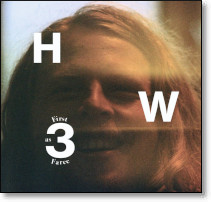
Hein Westgaard Trio: First as Farce (2022 [2023],
Nice Things): Guitarist, from Norway, based in Copenhagen, recorded
this "debut" in Sweden -- he appears to have a couple duo albums
they're not counting. With Petter Asbjørnsen (bass) and Simon
Forchhammer (drums). I'm impressed by the complementary thrash
that often erupts from the occasional background noodling.
A- [cd]
Ben Wolfe: Unjust (2021 [2023], Resident Arts):
American bassist, debut 1996, support at various times includes
Nicholas Payton (trumpet), Immanuel Wilkins/Nicole Glover (sax),
Joel Ross (vibes), Addison Frei/Orrin Evans (piano), and Aaron
Kimmel (drums). Some nice combinations.
B+(***) [sp]
Lizz Wright: Holding Space: Live in Berlin (2018
[2022], Blues & Greens): Jazz singer, from Georgia, grew up in
church, where her father was minister and musical director. Seventh
album since 2003, with Chris Bruce (guitar), Bobby Sparks (keybs),
Ben Zwerin (bass), and Ivan Edwards (drums).
B+(**) [sp]
Bobby Zankel/Wonderful Sound 8: A Change of Destiny
(2022 [2023], Mahakala Music): Alto saxophonist, long based in
Philadelphia, has a side credit from 1977 but debut as leader
was 1992, and he's remained relegated to small avant labels,
scattered from Krakow to Little Rock. He did a Wonderful Sound
6 album in 2017, and builds on that here, with a second alto
sax (Jaleel Shaw), trombone (Robin Eubanks), violin (Diane
Monroe), piano (Sumi Tonooka), bass (Lee Smith), and drums
(Pheeroan Aklaff), plus singer Ruth Naomi Floyd. Of course,
I prefer the blazing sax runs.
B+(***) [09-22]
Recent reissues, compilations, and vault discoveries:
Brian Blade Fellowship: Live From the Archives: Bootleg
June 15, 2000 (2000 [2022], Stoner Hill): Drummer, group
named from his 1998 debut album, group with Myron Walden (alto
sax/bass clarinet), Melvin Butler (tenor/soprano sax), Jon Cowherd
(piano), Kurt Rosenwinkel (guitar), and Christopher Thomas (bass).
I don't particularly see the point of this.
B [r]
Charlie Parker: The Long Lost Bird Live Afro-Cubop
Recordings (1945-54 [2023], RockBeat): Nice packaging.
The music comes from six widely scattered sources, including
guest spots with Woody Herman, Stan Kenton, and Machito, and
an early quintet with Dizzy Gillespie. Sound is variable, as
is the "cubop" quotient, though the "Manteca" with Machito
overcomes all my reservations. [Previously released on CD in
2015, now on vinyl.]
B+(***) [r]
Old music:
Johnny Cash: American V: A Hundred Highways
(2003 [2006], American): When Rick Rubin stepped in to record
Cash in 1994, the idea was less to cement his legend than to
just keep him going, after Columbia dropped him in 1986, and
Mercury in 1991. He was only 62, but had less than a decade
left, and he spent it singing whatever songs took his fancy,
in the simplest of arrangements, his voice still unique but
losing its force. Four volumes appeared before he died in 2003,
and this -- the only one I missed -- and American VI were
released later. American IV was the pick -- the others
struck me as various shades of B+ -- but the more time passes,
the more fortunate these recordings feel.
B+(***) [r]
Richard Davis: One for Frederick (1989 [1990, Hep):
Bassist (1930-2023), not a lot of albums under his own name --
Discogs lists 33, but only 13 list him first -- has a huge list
of side-credits, starting with Don Shirley in 1955 and Sarah
Vaughan in 1957, with 1964 an early peak (Eric Dolphy's Out
to Lunch and Andrew Hill's Black Fire), and even a
few "beyond" albums, like Van Morrison's Astral Weeks
(of which Greil Marcus wrote: "Richard Davis provided the
greatest bass ever heard on a rock album"). This one was live
at Sweet Basil, co-credited to "and Friends," a sharp quintet
with Cecil Bridgewater (trumpet), Ricky Ford (tenor sax),
Roland Hanna (piano), and Freddie Waits (drums, the Frederick
of the title, who died November, 1989, after this was recorded
in July).
B+(***) [sp]
The Fugs: The Fugs' Second Album (1966 [1994],
Fantasy): Folk-rock group founded 1964 by poets Ed Sanders and
Tuli Kupferberg, with Ken Weaver on drums, with others joining
on occasion -- most famously Peter Stampfel and Steve Weber.
They released a 1965 album on Broadside/Folkways titled The
Village Fugs Sing Ballads of Contemporary Protest, Point of Views,
and General Dissatisfaction, which a year later was reissued
as The Fugs' First Album, along with a second album, just
The Fugs, but rechristened here. Both pick up spare tracks.
They held together until 1969, recording one more album for ESP-Disk,
an unreleased album for Atlantic, and three for Reprise (eventually
boxed as Electromagnetic Steamboat: The Reprise Recordings).
This album even cracked the charts at 95, so their indifference to
commercial success wasn't totally unreciprocated. Big pieces here
are the not-quite-ironic-enough "Kill for Peace" and a stab at new
age exotica called "Virgin Forest" (11:17). Bonus tracks include
some live cuts and end with a whimper on "Nameless Voices Crying
for Kindness."
[sp]
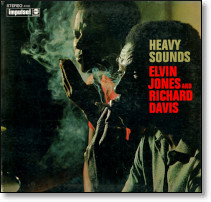
Elvin Jones and Richard Davis: Heavy Sounds
(1968, Impulse!): Heavy that drummer and bassist should share
billing credit, but they claim it with an 11:33 duet on
"Summertime." The other five cuts (30:23) add Billy Greene
on piano and Frank Foster, really tasty on tenor sax.
A- [sp]
Elvin Jones: Poly-Currents (1969 [1970], Blue
Note): Drummer (1927-2004), one of the Jones Brothers (with Thad
and Hank), played with Sonny Rollins (A Night at the Village
Vanguard) in the late 1950s, but is most famous for the
1960-66 John Coltrane Quartet, and echoes followed him ever
after. This is one of a bunch of 1968-73 records for Blue Note.
Five tracks, first three with Candido Camera (congas), Wilbur
Little (bass), and saxophonists George Coleman, Joe Farrell
(also English horn and flute), and Pepper Adams (baritone).
The last two cuts trim down a bit. Needless to say, the
drummer puts on a show.
B+(***) [sp]
Richard Thompson: (Guitar, Vocal): A Collection of
Unreleased and Rare Material 1967-1976 (1967-76 [1976],
Island): English folkie, guitarist first, singer-songwriter in
a duo with wife Linda 1974-82, solo for 40+ years after. This
picks up scattered bits starting with six songs with Fairport
Convention, then adds some outtakes with or without Linda,
including one new track. Seems like a hodgepodge, where the
artist only starts to reveal himself toward the end.
[NB: Issued in UK by Island 1976, as 2-LP; reissued in US by
Carthage in 1984, and by on CD Hannibal in 1989.]
B [sp]
Richard Thompson: Mirror Blue (1994, Capitol):
Eighth studio album, about par for the course.
B+(**) [sp]
Richard Thompson: Mock Tudor (1999, Capitol):
Another solid record.
B+(**) [sp]
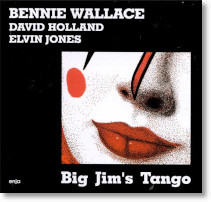
Bennie Wallace: Big Jim's Tango (1982 [1983], Enja):
Tenor saxophonist, from Tennessee, fifth album since 1978, a trio
with Dave Holland and Elvin Jones, playing four originals plus one
Cole Porter. Mainstream player, always loved his tone, especially
on mid-tempo pieces, but even there this rhythm section keeps him
on his toes.
[PS: Album cover from 1995 CD reissue.]
A- [sp]
Unpacking: Found in the mail last week:
- Sara Serpa & André Matos: Night Birds (Robalo Music) [09-29]
- Hein Westgaard Trio: First as Farce (Nice Things) [09-01]
Ask a question, or send a comment.
Sunday, September 10, 2023
Speaking of Which
I started to work on a books post this week, which caused some
confusion when I ran across reviews of books I had recently written
something about. I'm guessing I have about half of my usual batch,
so a post is possible later this week, but not guaranteed. I'm
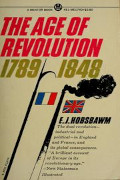
still reading Eric Hobsbawm's brilliant The Age of Revolution:
1789-1848, which is absolutely jam-packed with insights --
probably why I drone on at such length below on liberalism and its
discontents. I got deep enough into it to order three books:
- Franklin Foer: The Last Politician: Inside Joe Biden's
White House and the Struggle for America's Future (2023,
Penguin Press)
- Cory Doctorow: The Internet Con: How to Seize the Means
of Computation (2023, Verso)
- Astra Taylor: The Age of Insecurity: Coming Together as
Things Fall Apart (paperback, 2023, House of Anansi Press)
I didn't bother with any reviews of Foer this week (there are
several), although I mentioned the book
last
week. I figured I'd wait until I at least get a chance to
poke around a bit. I have a lot of questions about how Biden's
White House actually works. I'm not big on these insider books,
but usually the outside view suffices -- especially on someone
as transparent as Trump. Two I read on Obama that were useful
were:
- Ron Suskind: Confidence Men: Wall Street, Washington,
and the Education of a President (2011, Harper).
- Reed Hundt: A Crisis Wasted: Barack Obama's Defining
Decisions (2019, Rosetta Books).
Suskind was a reporter who had written an important book on
the GW Bush administration (The One Percent Doctrine: Deep
Inside America's Pursuit of Its Enemies Since 9/11). Hundt
was a participant, but not an important nor a particularly
successful one, so he took his time before weighing in.
Top story threads:
Trump:
Holly Bailey: [09-08]
Georgia special grand jury recommended charging Lindsey Graham
in Trump case. We now know that the Grand Jury actually
recommended prosecution of 38 people, but the prosecutor
streamlined the case to just 19 defendants. It's easy to
imagine the case against Graham, who was especially aggressive
in trying to bully Georgia officials into throwing the election
to Trump. But it's also easy to see how prosecuting Graham, and
for that matter Georgia Senators (at the time) Loeffler and
Perdue, could distract from focusing on the ringleader. Amy Gardner: [09-08]
Judge denies Mark Meadows's effort to move Georgia case to federal
court: This was the first, and probably the most credible, such
appeal, so it doesn't look good for the other defendants. Alex Guillén: [09-07]
Trump's border wall caused 'significant' cultural, environmental
damage, watchdog finds. Rep. Raúl Grijalva put it more bluntly:
"This racist political stunt has been an ineffective waste of
billions of American taxpayers' dollars." Nicole Narea: [09-06]
January 6 rioters are facing hundreds of years in prison combined.
What does it mean for Trump? Proud Boys leader Enrique Tarrio
was sentenced to 22 years for seditious conspiracy, the longest
individual sentence yet. Jeffrey St Clair notes (link below) that
Tarrio was initially offered a plea deal of 9-11 years, in "a
textbook case of how prosecutors use plea deals to coerce guilty
pleas and punish those who insist on their constitutional right
to a trial." He lists four more Proud Boys who received sentences
approximately double of what they were offered to plea out. Tori Otten: [09-07]
Guilty! Trumpiest Peter Navarro convicted of contempt of Congress.
Charles P Pierce: [09-08]
Get a load of the letter Fulton County DA Fani Willis sent Jim
Jordan: "I didn't think there were this many ways to tell
somebody to fck off." Jack Shafer: [09-08]
Donald Trump destroyed horse race journalism: "At least for
now." I guess it's hard to enjoy a good horse race when something
more than your own bet depends on it. Like whether there'll ever
be another race. Especially when you have to spend so much time
scanning the grounds for snipers and ambulances, which are the
only things about this race you haven't seen before. Li Zhou: [09-07]
Trump faces another big legal loss in the E. Jean Carroll case. No More Mister Nice Blog: [09-08]
So why wasn't Trump impeached for emoluments?:
It's a shame, because much of America struggled to understand the
point of the first impeachment, whereas an emoluments impeachment
would have been extremely easy for ordinary citizens to grasp: If
you use your status as president to cash in, that's illegal.
Simple. Relatable. It's like stealing from the cash register. And
he was allowed to get away with it.
The question is probably rhetorical, but the obvious answer is
that there was a faction of Democrats who thought that national
security was the only unassailable moral high ground that exists,
therefore everyone would get behind it. In the end, it persuaded
no one who wasn't going to vote to impeach Trump for any of dozens
of things anyway. Ironically, the key witnesses against Trump at
the time have become the Washington's biggest Ukraine hawks, with
the same "security Democrats" cheering them the loudest. And still
Republicans are trying to get Hunter Biden prosecuted, so you
didn't even win the battle, much less the war.
DeSantis, and other Republicans:
Fabiola Cineas: [09-08]
Republicans in Alabama still want to dilute the Black vote:
"Here's why the state's congressional maps were just struck down --
again." Interview with Michael Li. Prachi Gupta: [09-05]
Vivek Ramaswamy and the lie of the "model minority": "The
Asian American candidate is peddling a dangerous message." Ben Jacobs: [09-07]
RFK Jr.'s Republican-friendly Democratic presidential campaign,
explained. One revealing stat here is that his approval rate
is 28% among Democrats, 55% among Republicans. Sarah Jones: [09-08]
'Pro-Life' or 'Pro-Baby,' Republicans can't outrun abortion.
Robert Kuttner: [09-06]
US Steel and the Fake Populism of JD Vance: I don't doubt that
Kuttner is right, but when I read Vance's op-ed,
America cannot afford to auction off its industrial base, I
was surprised how persuasive he was. Not that I buy the "national
defense" crap, but there is something to be said for local rather
than foreign owners. Of course, my preferred local owners would
be the employees themselves, whose stake would indeed be local. Nicole Narea: [09-05]
The impeachment trial of Texas Attorney General Ken Paxton,
explained: Or how evil do you have to be to get your fellow
Republicans to turn against you? Will Norris: [09-06]
DeSantis loves stepping on Florida municipalities, thwarting the
popular will. Michael Tomasky: [09-08]
Jim Jordan and Wisconsin Republicans know the law -- they just don't
care: "Conservatism is no longer defined by resistance to liberal
progress -- it's all about destroying the pillars of our democracy." Maegan Vazquez/Amy B Wang: [09-10]
GOP presidential hopefuls take renewed aim at efforts to combat
covid. It's probably unfair to say that they want you to die,
but it's not inaccurate to say they don't care. And they really
hate the idea that government might respond to a pandemic by
trying to keep you well.
Biden and/or the Democrats:
Peter Baker/Katie Rogers: [09-10]
Biden forges deeper ties with Vietnam as China's ambition mounts:
Further proof that the only thing that can get American foreign policy
past a grudge is to spite another supposed foe. Jonathan Chait: [09-09]
Biden or Bust: Why isn't a mainstream Democrat challenging the
president? The simple answer is that no one wants to risk
losing, not so much to Biden as to a Republican who should be
unelectable but still scares pretty much everyone shitless.
The greater left of the party isn't that unhappy with Biden,
at least as long as they don't have to think much about foreign
policy (which, frankly, is pretty awful, but so were Obama and
Clinton). The neolibs aren't that unhappy either, and they're
the ones most likely to sandbag anyone to Biden's left. Second
answer is money. Nobody's got any (unless Bloomberg wants to
run again, and that would really be stupid). But if Biden did
drop out, ten names would pop up within a month. Lisa Friedman: [09-06]
Biden administration to bar drilling on millions of acres in
Alaska: This reverses leases granted in the late days of
the Trump administration, but only after [04-23]
Many young voters bitter over Biden's support of Willow oil
drilling, also on Alaska's north slope. Molly Jong-Fast: [09-05]
Can Joe Biden ride "boring" to reelection? "His administration is
getting a lot done for the American people, yet its accomplishments
don't get the same media attention as Trumpian chaos." Andrew Prokop: [09-08]
Should we trust the polls showing Trump and Biden nearly tied?
You have much more serious things to worry about than polls, but
what I take from this is that Democrats haven't really figured out
how to talk about their political differences, and the mainstream
media isn't very adept at talking about politics at all. There are
obvious, and in some ways intractable, reasons for this. The idea
of merely reporting the news gives equal credence to both sides
regardless of truth, value, or intent. Republicans are masters at
blaming everything bad on Democrats, while crediting them nothing.
Democrats are reluctant to reciprocate, especially as we've been
conditioned to dismiss their infrequent counterattacks as shrill
and snotty. The double standards are maddening, but somehow we
have to figure out ways to get past that. The differences between
Trump and Biden, or between any generic Republican and Democrat
you might fancy, are huge and important. At some level you have
to believe that it's possible to explain that clearly. But until
then, you get stupid poll results.
Legal matters and other crimes:
Climate and environment:
Kate Aronoff: [09-08]
World's wealthiest countries gather to admit continued failure to
address climate change: The G20. Umair Irfan: [09-09]
The Southern Hemisphere, where it's winter, has been really hot
too. Rebecca Leber: [09-08]
The oil industry's cynical gamble on Arctic drilling: "Companies
like ConocoPhillips are banking on a future filled with oil." Rebecca Leber/Umair Irfan: [09-09]
The world's brutal climate change report card, explained: In
subheds: Coil, oil, and natural gas need to go; Everyone is doing
something, but everyone needs to do more. Ian Livingston/Jason Samenow: [09-08]
A first: Category 5 storm have formed in every ocean basin this
year. One of them,
Hurricane Lee, is still well out in the Atlantic, and expected
to turn north before it gets to Florida and the Carolinas, but
could affect New England or (more likely) the Canadian Maritimes
(Nova Scotia and the Gulf of St. Lawrence). Aja Romano: [09-06]
The Burning Man flameout, explained: "Climate change -- and
schadenfreude -- finally caught up to the survivalist cosplayers."
Ukraine War:
Connor Echols: [09-08]
Diplomacy Watch: Inquiry finds 'no evidence' South Africa armed
Russia. No meaningful diplomacy to report. The website has
a new design, which I don't like, mostly because it makes it
much harder to find new pieces on the front page. Ben Armbruster: [09-05]
Why blind optimism leads us astray on Ukraine: "The
pre-counteroffensive debate in the US was dominated by claims of
'victory' and 'success' despite available evidence predicting it
wouldn't meet key goals." This is similar to the Confidence Fairy,
where Obama and his people seemed to think that the key to recovery
from the 2008 meltdown was projecting confidence that the economy
was really just fine. The effect of such thinking on war strategy
is even worse: any doubt that war aims will succeed is scorned as
giving comfort to the enemy, so everyone parrots the official line.
The final withdrawal from Afghanistan was hampered by just this
kind of thinking. The article includes a wide sampling of such yes
men cheering each other on into thinking it would all work out.
I've tried to take a different position, which is that it doesn't
matter whether the counteroffensive gains ground or not. In either
case, the war only ends when Russia and the US -- with Ukraine's
agreement, to be sure, but let's not kid ourselves about who
Putin's real opponent is -- decide to negotiate something that
allows both sides to back down. And the key to that isn't who
controls how many acres, but when negotiators find common ground.
Until then, the only point to the war is to disillusion hawks on
both sides. Ben Freeman: [06-01]
Defense contractor funded think tanks dominate Ukraine debate:
A lengthy report, finding that "media outlets have cited think
tanks with financial backing from the defense industry 85 percent
of the time." Jen Kirby: [09-07]
Are the US and Ukraine at odds over the counteroffensive? Daniel Larison: [09-07]
Hawks want Biden to take the fight with Russia global:
"Walter Russell Mead thinks the West can wear down Russia by
attacking it everywhere." The first question I have is: isn't
it global already, or is he really arguing for escalating with
military action? (Syria and Mali are mentioned.) The bigger
question is why do you want to fight Russia in the first
place? I can see defending Ukraine, but the hawks seem to
be starting from the assumption the US should wage war
against Russia, and Ukraine is just an excuse and tool for
that purpose. Anatol Lieven: [09-06]
Afghanistan delusions blind US on Russia-Ukraine: "If
Washington forgets the war's lessons, its mistakes are likely
to be repeated." Robert Wright: [09-08]
Logic behind Ukraine peace talks grows: This is a pretty good
summary of an argument that I think has been obvious if not from
day one, at least since Russia retreated from its initial thrust
at Kyiv: that neither side can win, nor can either side afford to
lose. Common Dreams: [09-02]
US to begin sending controversial depleted uranium shells to
Ukraine: The shells are effective at piercing tank armor,
but they ultimately disintegrate, leaving toxic and radioactive
uranium in the air, water, and soil. They were used extensively
in Iraq, and the results have been tragic; e.g., Sydney Young:
[2021-09-22]
Depleted Uranium, Devastated Health: Military Operations and
Environmental Injustice in the Middle East; and Dahr
Jamail: [2013-03-15]
Iraq: War's legacy of cancer.
Israel:
Around the world:
Daniel Handel: [09-05]
We're finally figuring out if foreign aid is any better than handing
out cash: "The rise of cash benchmarking at USAID, explained." Ellen Ioanes:
[09-10]
What we know about Morocco's deadly earthquake: "A massive quake
near Marrakesh on Friday night has killed more than 2,000." [09-10]
What's behind Africa's recent coups: Gabon, Niger, Burkina
Faso, Mali. And not just recent: worldwide, "from 1950 through
January 2022, there had been 486 coup attempts, 242 of which
were successful." For Africa, the numbers were 214 and 106,
ahead of 146 and 70 for Latin America. Nicole Narea: [09-07]
Latin American abortion rights activists just notched another win
in Mexico: "The Mexican Supreme Court decriminalized abortion
nationwide. It's a big deal for the whole region." Haris Zargar: [09-04]
India: Why Modi is fueling anti-Muslim riots ahead of 2024
elections.
Other stories:
Dan Balz: [09-09]
What divides political parties? More than ever, it's race and
ethnicity. That's what a report from the American Political
Science Association (APSA) says. My first reaction was: that's
a shame. My second was the suspicion that they got that result
because that's all they could think of to measure. It's always
possible to think of other questions that could scatter the
results in various directions. And my third is that this is
mostly an indictment of the news media, which seems completely
incapable of explaining issues in ways that people can relate
to.
Zack Beauchamp:
[09-06]
Elon Musk's strange new feud with a Jewish anti-hate group,
explained: So Musk is suing the Anti-Defamation League (ADL) . . .
for defamation? He blames them for a 60% loss of advertising revenue,
which couldn't possibly have been caused by anything he did? [09-10]
Chris Rufo's dangerous fictions: "The right's leading culture
warrior has invented a leftist takeover of America to justify his
very real power grabs." Rufo's book is America's Cultural
Revolution: How the Radical Left Conquered Everything. Rufo
is the guy whose rant on Critical Race Theory launched recent
efforts by DeSantis and others to ban its teaching, even though
it never had been taught, and thereby censoring the very real
history of racial discrimination in America, lest white people
be made to feel bad about what their ancestors did. CRT was
developed by legal scholars to show that some laws which were
framed to appear race-neutral had racist intent. This refers
to the Critical Theory developed by mid-20th century Marxists
like Theodor Adorno and Herbert Marcuse, which was very useful
in detecting how capitalism and authoritarianism permeated and
refracted in popular culture.
I spent a lot of time studying Critical Theory when I was young.
(I recently cracked open my copy of Dialectic of Enlightenment
and was surprised to find about 80% of it was underlined.) It really
opens your eyes to, and goes a long way toward explaining, a lot of
the features of the modern world. But having learned much, I lost
interest, at least in repeating the same analyses ad nauseum. (To
take a classic example, I was blown away when I read How to Read
Donald Duck, but then it occurred to me that one could write
the same brilliant essay about Huckleberry Hound, Woody Woodpecker,
and literally every other cartoon or fictional character you ran
into.) But while Critical Theory appealed to people who wanted to
change the world, it was never a plan of action, much less the plot
to take over the world that Rufo claims to have uncovered.
Beauchamp does a nice job of showing up Rufo's paranoia:
Rufo cites, as evidence of the influence of "critical theory"
across America, diversity trainings at Lockheed Martin and Raytheon
that used the term "white privilege" and similar concepts in their
documents. This, he argues, is proof that "even federal defense
contractors have submitted to the new ideology."
But the notion that American arms manufacturers have been taken
over by radicals is ridiculous. Lockheed Martin builds weapons to
maintain the American war machine. It is not owned or controlled in
any way by sincere believers in the Third Worldist anti-imperialism
of the 1960s radicals; it is using the now-popular terms those
radicals once embraced to burnish its own image.
Rufo is getting the direction of influence backward. Radicals
are not taking over Lockheed Martin; Lockheed Martin is co-opting
radicalism.
So Rufo is not wrong that some radical ideas are penetrating
into the institutions of power, including corporations. Where he
is bonkers is in thinking that the ideas are power, plotted by
some malign adversary bent on total control, trying to force us
to think (gasp!) nice thoughts. What's scary is the mentality
that views any hint of civility or accommodation as a mortal
threat. Beauchamp continues, in terms that will probably drive
Rufo even crazier:
Historically, liberalism has proven quite capable of assimilating
leftist critiques into its own politics. In the 19th and 20th
centuries, liberal governments faced significant challenges from
socialists who argued that capitalism and private property led to
inequality and mass suffering. In response, liberals embraced the
welfare state and social democracy: progressive income taxation,
redistribution, antitrust regulations, and social services.
Reformist liberals worked to address the concerns raised by
socialists within the system. Their goal was to offer the
immiserated proletariat alternative hope for a better life
within the confines of the liberal democratic capitalist order --
simultaneously improving their lives and staving off revolution.
Meanwhile, conservatives like Rufo resisted every such reform,
often histrionically, even ones they eventually came to accept
as necessary.
Jonathan Chait: [09-07]
Samuel Moyn can't stop blaming Trumpism on liberals. I only
mention this because I recently spent a lot of time writing up a
book blurb on Moyn's Liberalism Against Itself: Cold War
Intellectuals and the Making of Our Times. I'll save the
details, but note that Chait is upset because his heroes and
his muddle-of-the-road philosophy were critiqued -- he says,
incoherently. What happened was that after 1945, the New Deal
coalition was deliberately split as most traditional liberals
(like Chait, but he came much later) turned against the left,
both abroad and at home, as part of a bipartisan Cold War
consensus. They were pretty successful for a while, and with
Lyndon Johnson even did some worthwhile things (civil rights
and Medicare were big ones), but they neglected the working
class base of the party, while throwing America into nasty
(and in the case of Vietnam, hopeless) wars. So instead of
building on the significant progress of the New Deal, the
Democratic Party fell apart, losing not just to Republicans
but to its own neoliberal aspirants. How that brought us to
Trump is a longer and messier story, but it certainly got us
Reagan, and the rot that followed.
PS: I wrote this paragraph before the one above on Beauchamp,
so there's a bit of disconnect. Beauchamp talks about "reformist
liberals," which diverge somewhat from Moyn's "cold war liberals."
Chait thinks of himself as one of the former, but shares the
latter's aversion to the left. Classical liberalism contained
the seeds for both: first by individualizing society, breaking
down the traditional hierarchy, then by declaring that every
individual should have the right to "life, liberty, and pursuit
of happiness." It turns out that in order for any substantial
number of people to enjoy liberty, they need to have support
of government. Some liberals understood, and others (including
Hayek and Friedman) simply didn't care. Cold War liberals
wound up on both sides, but even those who still supported
reforms undercut them by fighting the left as much or more
than the right.
Rachel M Cohen: [09-05]
Is public school as we know it ending? Interview with Cara
Fitzpatrick, who thinks so, as in her book title: The Death
of Public School: How Conservatives Won the War Over Education
in America.
Richard Drake: [09-08]
Gabriel Kolko on the foreign policy consequences of conservatism's
triumph: I occasionally still crack open Kolko's brilliant
books on US foreign policy (both subtitled The World and United
States Foreign Policy, The Politics of War: 1943-1945,
and The Limits of Power: 1945-1954), but it's been some time
since I thought of his earlier The Triumph of Conservatism: A
Reinterpretation of American History, 1900-1916 (1963). The
point there is that while the progressive movement sought to limit
the manifest evils of capitalism, the actual reforms left big
business and finance in pretty good shape -- as was evident in
the post-WWI period, all the way to the crash in 1929.
Drake goes into the later books, but this piece doesn't do
much to clarify how the "triumph of conservatism" in 1916 led
to the "politics of war" in 1943. In this, I must admit I'm a
little rusty on my William Appleman Williams, but "democracy"
in Wilson's "making the world safe" slogan could just as easily
been replaced with "capitalism." That was exactly what happened
in the later 1943-54 period, when Roosevelt did so much to
revive Wilson's reputation, while forever banishing opponents,
including remnants of the anti-imperialist movement from 1898,
to obscurity as "isolationists."
Kolko's formulation also does a neat job of solving the
debate about whether Wilson was a progressive or a conservative:
he was the former to the ends of the latter. Nowadays we dwell
more on Wilson's racism, which we associate with the right, but
in his day the two weren't strangers, even if what we still
admire about the progressive idea suggests they should have
known better.
Zeke Faux: [09-06]
That's what I call ponzinomics: "With Sam Brinkman-Fried, Gisele,
and a credulous Michael Lewis at the zenith of crypto hype." On first
glance, I thought this might be a review of Lewis's forthcoming book
on Bankman-Fried (coming Oct. 3: Going Infinite: The Rise and Fall
of a New Tycoon), but it's actually an excerpt from Faux's new
book, Number Go Up: Inside Crypto's Wild Rise and Staggering
Fall, about a conference in 2022 where Lewis was talking about
Bankman-Fried "as if he were presenting a prize to his star pupil."
Constance Grady: [09-08]
The sincerity and rage of Olivia Rodrigo: One class of story
I invariably skip past is "most anticipated," especially with
albums, because interesting albums rarely get the advanced hype
to make such lists. (TV and movies fare a bit better, because
there are many fewer of them, at least that you'll ever hear
about.) But I gave this one a spin as soon as the banner popped
up on Spotify, and then I gave it a second. If you don't know,
she's a 20-year-old singer-songwriter from Los Angeles, whose
2021 debut Sour won me and practically everyone else over
immediately (RIAA has certified it 4x Platinum). Her new one,
Guts is her second, and I'll review it (sort of) next
Music Week.
For now I just want to note that she's getting newsworthy
press:
Adam Hochschild: [09-05]
The Senator who took on the CIA: Frank Church. Review of James
Risen/Thomas Risen: The Last Honest Man: The CIA, the FBI, the
Mafia, and the Kennedys -- and One Senator's Fight to Save
Democracy.
Whizy Kim: [09-08]
The era of easy flying is over: "Lessons from a summer of
hellish flights." As far as I'm concerned, it's been over for
at least 20 years, about the time when it became obvious that
deregulation and predatory profit seeking were going to devour
the last shreds of decency in customer service.
Karen Landman: [09-07]
Covid is on the rise again, but it's different now: "Covid
transmission continues to ebb and flow -- but at least the latest
Pirola variant isn't too menacing."
Prabir Purkayastha: [09-08]
Is intellectual property turning into a knowledge monopoly?
The question almost answers itself, given that the current laws
defining intellectual property include grants of monopoly (with
minor exceptions, like mechanical royalties for broadcast use
of songs). The question of "knowledge" is a bit fuzzier, but
there is real desire to claim things like "know how" as property
(read the fine print on employee contracts). A patent can keep
others making the same discovery independently from their own
work, and the tendency to chain patents can keep competition
away almost indefinitely. Copyrights, as the word makes clear,
are more limited, but once you start talking derivative works,
the line gets harder to draw. Moreover, the smaller granularity
of fair use gets, the more likely accidental reuse becomes. How
serious this is depends a lot on how litigious "owners" are,
but in America, where so much seems to depend on wealth, we
are very litigious indeed. This piece is excerpted from the
author's book: Knowledge as Commons: Towards Inclusive
Science and Technology (LeftWord, 2023).
Ingríd Robeyns: [08-28]
Limitarianism: academic essays: Author has edited a book,
Having Too Much: Philosophical Essays on Limitarianism,
with various academic papers on the problem of having too much
stuff. Fortunately, they read their own book and decided to
make it available through
Open Book Publishers, so it doesn't add to your surplus of
stuff.
Dylan Scott: [08-07]
The NFL season opener is also the kickoff for the biggest gambling
season ever: "How America became a nation of gamblers -- and
what might happen next." Few things make me more pessimistic for
the future of the nation.
Norman Solomon: [09-07]
Venture militarism on autopilot, or "How 9/11 bred a 'War on
Terror' from Hell: America's response to 9/11 in the lens of
history." Seems like every week brings enough new stories about
America's bloated, wasteful, stupid, ineffective, but still
really dangerous war culture, even beyond the ones that fit
securely under "Ukraine" and "World." This gets to the big
picture, being adapted from the introduction to Solomon's new
book, War Made Invisible: How America Hides the Human Toll
of Its Military Machine. The focus here is less on what
war is and does than on how it is talked about, to make it
seem more valorous and/or less cruel than it is, or just as
often, how it's not talked about at all, allowing most of us
to go about our daily lives with no sense of what the US
government is actually doing, let alone why.
Melissa Garriga/Tim Biondo: [09-08]
The Pentagon is the elephant in the climate activist room:
"The US military is the world's largest institutional oil consumer.
It causes more greenhouse gas emissions than 140 nations combined
and accounts for about one-third of America's total fossil fuel
consumption." Maha Hilal: [09-05]
22 years of drone warfare and no end in sight: "Biden's rules
on drone warfare mask continued violent islamophobia." Author
wrote the book Innocent Until Proven Muslim: Islamophobia, the
War on Terror, and the Muslim Experience Since 9/11, so that's
her focus, but one could write much more about the seductiveness
of drone warfare for the gamers who increasingly run the military,
with their huge budgets to waste while risking none of their own
lives.
Jeffrey St Clair: [09-08]
Roaming Charges: The pitch of frenzy. Lots here, as usual,
including some links I've cited elsewhere. One I'll mention here
is a tweet by anti-woke pundit Richard Hanania: "Jimmy Buffett
taught Americans to hate their jobs and live for nights and
weekends so they could stuff themselves with food and alcohol."
Actually, he picked that trope up from country music, where he
sold most of his records before being reclassified as Adult
Contemporary. The classic formula was to transpose Saturday
night and Sunday morning, but many singers never got to the
latter (or only did so in niche albums).
PS: I mentioned Biden's stop in Vietnam above, but hadn't
seen this article: Katie Rogers: [09-11]
'It is evening, isn't it?' An 80-year-old president's whirlwind
trip. Which focuses more on his age and foibles than on the
diplomatic mission, showing once again that the mainstream press
would rather focus on appearance than substance. Why does "the
rigors of globe-trotting statesmanship" even matter? I'd rather
prefer to have fewer photo-ops and more actual communication.
But the reason I bring this piece up isn't to rag on the sorely
atrophied art of journalism yet again. I found
this tweet by Heather Cox Richardson, which pointed me to the
article, even more disturbing:
Here's what I don't get: this administration's reworking of global
relationships is the biggest story in at least a generation in
foreign affairs -- probably more. Why on earth would you downplay
that major story to focus on Biden's well-earned weariness after
an epic all-nighter?
No doubt Biden has been very busy on that front, but it's hard
to tell what it all means, which makes it hard to agree that it's
big, harder still that it's good. GW Bush did at least as much
"reworking," but his assertion of imperial prerogatives wound up
undermining any possibility of international cooperation, and
more often than not backfired. Obama tried to unwind some of
Bush's overreach, and negotiated openings with Iran and Cuba,
but left the basic unilateral posture in place. Trump did more
in less time, but was too erratic, greedy, and confused to set
a clear direction.
Biden, on the other hand, is mostly intent
on patching up the mess Trump made, without addressing any of
the underlying problems. And because he's left the imperial
hubris unchecked, he's actually worsened relations with many
countries, of which Russia and China are the most dangerous.
On the other hand, even though Ukraine has brought us near a
precipice, he hasn't actually plunged into disaster yet, as
Bush did. It's still possible that, having reëngaged, he
could move toward a more cooperative relationship with an
increasingly multipolar world. But you can't call this a
"story" without some sense of how it ends, and that's far
from clear at the moment.
Ask a question, or send a comment.
Monday, September 4, 2023
Music Week
September archive
(in progress).
Music: Current count 40811 [40767] rated (+44), 34 [27] unrated (+7).
Huge
Speaking of Which last night: 135 links, 8610 words. Started
Thursday, and let some things like the baseball memoir, the note
on Golda Meir, and the Hobsbawm introduction just flow. Also added
the Jimmy Buffett obituary late, after I found the note on his
politics. By then I had gone back for a few of his records, below.
Looking back over it, I see a dozen spots where I should (or at
least could) write much more. I've made some minor edits, but it
certainly needs much more.
The only thing that kept the rated count from cratering was
working off a checklist, in this case the unheard records from
Brad Luen's
2003 poll results (in the
notebook), hence a
lot of 2003 releases under Old Music. I've hit everything that
got ranked, but very few of the single-vote records.
The records rarely got
more than one play, so they piled up pretty fast. Aside from
the Pet Shop Boys, which a second play would most likely lift
to full A, Marcelo D2 made the grade the fastest.
I got another
food plate, if you're into that. The diet is going fitfully,
but I believe I'm entitled to clean up leftovers and dated pantry
items. It was orders of magnitude better than the microwave fish
from the night before, or whatever I had last night and have
already blotted from memory.
After taking it apart and reassembling it, the upstairs CD
player finally decided to start working, but only after I ordered
a replacement -- something I found pretty embarrassing. But
it is the last such model still available (an Onkyo), and the last
unit Amazon had in stock, so I figure I'll keep it as a collector's
item. Next day, the downstairs CD player reverted to its bad habit
of instantly withdrawing the tray before I could put a new disc in,
so if I shoot it, I'll already have a replacement.
After much nagging, I filled out a ballot for the DownBeat
Readers Poll. My notes are
here. Note that I'm only picking from the ballot choices they
offer, which miss a lot of worthy albums (at least 80% of my A-lists:
2022 and
2023) and a great many notable
musicians (especially from Europe, but also more avant or more retro
than their MOR niche).
The demo queue continues to grow, and I'm probably farther behind
than I've been a decade (give or take). One reason I've let it slide
is that only 5 (of 35) are out yet, and most won't be released until
October. The
pending list is sorted by
release date, but my basket isn't, so sometimes I slip up and jump
the gun (as with Birnbaum, below; future dates noted at the end of
the review).
Still no indexing on last month's
Streamnotes.
Expecting more 100°F weather this week. It's often hot here until
the last week of September.
New records reviewed this week:
Adam Birnbaum: Preludes (2023, Chelsea Music Festival):
Pianist, several albums since 2006, in a trio with Matt Clohesy
(bass) and Keita Ogawa (percussion), playing Bach preludes.
B+(**) [cd] [10-10]
Jaimie Branch: Fly or Die Fly or Die Fly or Die ((World
War)) (2022 [2023], International Anthem): Trumpet player,
sings some, adds some keyboard and percussion, died at 39 shortly
after recording this somewhat unfocused album. Mostly quartet
with Lester St. Louis (cello), Jason Ajemian (bass), and Chad
Taylor (drums) plus extra credits for all, and various guest
spots -- Rob Frye plays bass clarinet on three tracks, Nick
Broste trombone on two of those.
B+(***) [sp]
Scott Clark: Dawn & Dusk (2021-22 [2023],
Out of Your Head): Drummer, has at least one previous album,
composed these pieces with lyric help from vocalist Laura Ann
Singh. Strong instrumental stretches, with JC Kuhl (bass
clarinet/tenor sax), Bob Miller (trumpet/flugelhorn), Adam
Hopkins (bass), and the always excellent Michael McNeill
(piano).
B+(**) [cd]
Kris Davis Diatom Ribbons: Live at the Village Vanguard
(2022 [2023], Pyroclastic, 2CD): Canadian pianist, based in New
York since 2001, impressed me early, especially with 2008's Rye
Eclipse, eventually rising in DownBeat's polls, and
winning the Jazz Critics Poll in 2019 for Diatom Ribbons.
The latter album, with its fusion elements (various guitars, Val
Jeanty's turntables, vocals and spoken word), threw me at the
time (or maybe, without a CD, I just didn't give it enough time,
but I did recheck it during the poll). But this new one isn't a
live take on the original. It's new material -- incorporating
pieces by Wayne Shorter, Geri Allen, Ronald Shannon Jackson,
Conlon Nancarrow/Eric Dolphy -- played by a slimmed down but
fully functional band, with Jeanty, Julian Lage (guitar), Trevor
Dunn (bass), and Terri Lyne Carrington (drums), with several
vocal samples (Messiaen, Stockhausen, Sun Ra, Paul Bley). It
opens up and stretches out (53:42 + 51:09), which among other
luxuries gives the pianist more time to claim the spotlight.
Which she does.
[PS: Back in early JCG days, I noticed that nearly all of my
featured Duds had just appeared on the cover of DownBeat.
Davis finally made the September 2023 cover, a rare exception
to a rule that has proven remarkably robust.]
A- [sp]
Homeboy Sandman: Rich (2023, Dirty Looks):
New York rapper Angel Del Villar III, lots of records since 2007,
this another short one (11 tracks, 26:29). Always loose, some of
this feels too flip, like when all he can come up with is "I rap
real well." Choice cut is "Then We Broke Up," where he even finds
some horns.
B+(**) [sp]
Superposition: Glaciers (2019-22 [2023],
Kettle Hole): Duo of piano/keyboard players Todd A. Carter and
Michael Hartman, who also work in some percussion and toys.
Second album (or "debut") under this name, but they have worked
together for 30 years, including in an ambient/drone band called
Liminal. Nice textures, ambient plus something.
B+(**) [cd]
Recent reissues, compilations, and vault discoveries:
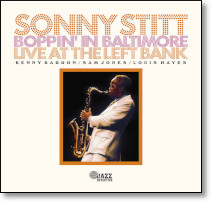
Sonny Stitt: Boppin' in Baltimore: Live at the Left Bank
(1973 [2023], Jazz Detective): Alto saxophonist, a bebopper from
his start in the late 1940s, took a lot of grief as a "Bird imitator,"
but invented as much as he stole, and really who cares? He was always
up to play, especially in his early-1960s duo albums with Gene Ammons,
but his best albums came in 1972 for Muse, when he slowed down a bit.
This previously unreleased tape comes from that period: a quartet
with Kenny Barron (piano), Sam Jones (bass), and Louis Hayes (drums).
A- [sp]
Old music:
Art Ensemble of Chicago: The Meeting (2003, Pi):
Down to four -- Malachi Favors (bass), Famoudou Don Moye (drums),
Roscoe Mitchell and Joseph Jarman (reeds), everyone percussion --
with the recent death of Lester Bowie. He is missed.
B+(*) [sp]
Art Ensemble of Chicago: Sirius Calling (2003 [2004],
Pi): Moving on, still a quartet, streaks of brilliance with a lot
of ambling along.
B+(*) [sp]
Art Ensemble of Chicago: Chi Congo (1972, Decca):
Now-legendary Chicago quintet, they recorded a massive amount in
1967-72, much of it in France, like this album, before they landed
on Atlantic for a couple 1972-73 albums, then ECM from 1978 to
2001 (aside for a 1986-90 burst in the Japanese label DIW).
B+(**) [sp]
Art Ensemble of Chicago: Live in Paris (1969 [2003],
Charly, 2CD): Two long pieces (49:34 and 42:02), each originally
split on LP, not sure when BYG originally released them but
Part 2 came out in Japan in 1975, they were collected on 2-LP
by Affinity in 1980, and later reissued on CD here and by Fuel
2000 in the US. Current digital editions have them split up
again, but each part refracts the whole and vice versa. As
usual, everyone doubles on percussion, with Roscoe Mitchell
and Joseph Jarman on all manner of flutes and reeds. Singer
Fontella Bass is also credited, a nice bit toward the end.
B+(**) [sp]
Art Ensemble of Chicago: Live Part 1 (1969
[1975], BYG): "Oh, Strange," credited to Jarman and Bowie.
B+(**) [sp]
Art Ensemble of Chicago: Live Part 2 (1969
[1975], BYG): "Bon Voyage," credited to Bowie.
B+(**) [sp]
Art Ensemble of Chicago: Live in Berlin (1979
[1998], West Wind, 2CD): One 80:10 stretch, sensibly split over
2-CD, the set pieces (if indeed that's what they are) flowing
into one long medley.
B+(*) [sp]
Baba Zula/Mad Professor: Ruhani Oyun Havalan (Psychebelly
Dance Music) (2003, Doublemoon): Turkish group, sing and
play traditional instruments augmented with electronics for "a
unique psychedelic sound," with Mad Professor mixing dub style,
and a couple dancers listed among group members.
B+(***) [sp]
Bobby Blue Bland: Blues at Midnight (2003,
Malaco): Blues/soul singer (1930-2013), his 1957-69 Duke
Recordings the peak of several essential compilations
ranging from 1952-59 (The "3B" Blues Boy) to 1973-84
(The ABC-Dunhill/MCA Recordings). After leaving MCA
in 1984, he got picked up by Malaco and cut nine more albums,
ending with this one -- touted as "a return to form." I've
never followed him album-by-album, but the first thing clear
here is that he never lost his voice (despite an occasional
disconcerting gargle). This one flows easy.
B+(**) [sp]
Brooks & Dunn: Red Dirt Road (2003, Arista
Nashville): Country duo, Kix Brooks and Ronnie Dunn, debut 1991,
ninth album (of eleven through 2007, plus Reboot in 2019),
most went top-ten country. Wikipedia says "neotraditional" but,
nah! I'm not sure who came first, but they were part of a wave
that amped country guitars and drums up to fill arenas. They
also groomed their songs to appeal to the mass conservative
audience, without quite becoming assholes about it. (GW Bush
and Barack Obama both used their "Only in America" as campaign
songs.) Most striking thing here is how their women are feisty
enough to dump them but never do. They count themselves lucky,
as well they should.
B [sp]
Jimmy Buffett: A White Sport Coat and a Pink Crustacean
(1973, ABC): Dead at 78, he recorded 29 (or 51) albums, sold
over 20 million, and probably made more money merchandising
his lifestyle (per Wikipedia, his net worth was $550 million).
Only thing of his I ever checked out was a 2003 best-of, but
I always loved this title -- a play on a Marty Robbins title
he didn't bother trying to turn into a song. Agreeably loose,
maybe even a bit sloppy.
B+(***) [sp]
Jimmy Buffett: Living and Dying in 3/4 Time
(1974, ABC): As folksy and sloppy as before, but somehow he
misplaced . . . songs, I think.
B [sp]
Jimmy Buffett: Havana Daydreamin' (1976, ABC):
Skipping a couple, another pleasant set from the Key West Chamber
of Commerce.
B+(*) [sp]
Jimmy Buffett: Changes in Latitudes, Changes in
Attitudes (1977, ABC): His country shtick seems to be
in decline, but he's been working on his songs, coming up with
a signature one in "Margaritaville" -- although note that the
chart it topped was called US Adult Contemporary (it hit 8 on
Billboard Hot 100, 7 on Cash Box). This was his first album to
rise as high as 12 on the pop charts (2 on country).
B+(**) [sp]
Jimmy Buffett: Son of a Son of a Sailor (1978,
ABC): Actually, a minor correction to the above: I did own a
copy of this, but it never got copied into my database. A
second platinum album, peaked at 10 (6 country), heights he
didn't return to until the 1990s. His hit single this time
was "Cheeseburger in Paradise," which like "Margaritaville"
he converted into a chain of restaurants.
B+(*) [sp]
John Cale: Hobo Sapiens (2003, EMI): Welsh
singer-songwriter, started in avant-classical in the 1960s,
played electric viola in Velvet Underground, had various high
points in the 1970s, which ultimately established the sound
he's still working with here, more engagingly than was his
norm (most remarkably "Letter From Abroad").
B+(***) [sp]
Constantines: Shine a Light (2003, Sub Pop):
Canadian indie rock band, five albums 2001-08, released a couple
reunion singles since. Second album.
B+(*) [sp]
Rodney Crowell: Fate's Right Hand (2003, DMZ/Epic):
Country singer-songwriter, moved from Houston to Nashville and made
a splash with his 1978 debut. This was his eleventh, during a stretch
of eight albums with eight different labels, most charting around 30.
Choice cut: "Preachin' to the Choir."
B+(***) [sp]
The Darkness: Permission to Land (2003, Atlantic):
English rock band, first album, leans toward metal but a bit soft
and malleable. Broke up after second album (2005), regrouped in 2012,
with five albums since. There was a day when I might have cut them
more slack (or maybe I did, given how annoying the singer's screech
is).
B [sp]
DonaZica: Composição (2003, Tratore): Brazilian
group, principally singers Anelis Assumpção, Iara Rennó, and
Andreia Dias (reportedly the lead), first of two albums (although
I've run across Rennó elsewhere). Looking them up, I got confused
by a samba dancer known as Dona Zica (actual name Euzébia Silva
de Oliveira, who died at 89 the same year this appeared). Catches
your ear, in a typically slippery mode.
A- [sp]
Kathleen Edwards: Failer (2003, Zoë): Canadian
folkie singer-songwriter, father was in the State Department, so
she grew up around the world. First album, of five through 2020.
B+(*) [sp]
Entropic Advance: Monkey With a Gun (2003,
Symbolic Insight): Wesley Davis (bios+a+ic) and Noise Poet
Nobody (James Miller?), released ten albums 1998-2014, of
dark ambiance, light noise, captured sounds, some vocal.
B+(**) [sp]
Barry Guy/Evan Parker: Studio/Live: Birds & Blades
(2001 [2003], Intakt, 2CD): Bass and tenor/soprano sax, one set
recorded at Radiostudio DRS Zürich, a second a day later at Sphères
Bar Buch & Bühne, also in Zürich. Long history, dating back to
the late 1960s when they, foremost among a few others (like Derek
Bailey and Paul Rutherford) introduced avant-jazz to Britain. This
is a generous sample of what what these remarkable musicians have
been doing for decades.
A- [sp]
Corey Harris: Mississippi to Mali (2003, Rounder):
Bluesman, appeared in the mode established by Taj Mahal in the
1970s, cultivating those old delta blues for hip moderns, which
garnered him a MacArthur in 2007. This came out about the time
Ali Farka Touré was being treated as John Lee Hooker's long-lost
cousin. That's the sort of connection Harris could revel in, but
the mix here barely connects.
B+(*) [sp]
King Geedorah: Take Me to Your Leader (2003, Big
Dada): Alias for rapper Daniel Dumile (1971-2020), formerly of
KMD, also recorded as Viktor Vaughn but is best remembered as
MF Doom. He was born in London, moved to Long Island while young,
built his career in US, then was denied re-entry after a tour of
Europe in 2010. I never quite got his cosmology, but the slinky
beats and sense of surprise were irresistible.
B+(***) [sp]
The Knife: Deep Cuts (2003, V2): Swedish
electronic duo, Olof and Karin Dreijer (brother and sister) --
she later broke off as Fever Ray, while he recorded, less
successfully, as Oni Ayhun. Second album.
B+(**) [sp]
Linkin Park: Hybrid Theory (2000, Warner Bros.):
Rap-metal group, first album, huge hit with 30 million copies
sold worldwide, albeit with very little love from critics I
follow. I cheated here by leaving the room while this played,
the distance dimming the volume and dulling the words (if not
dull enough already), but leaving basic impressions: palpable
anger, and enough melodic sense to provide hooks. Clearly not
my thing, but better than expected.
B+(*) [r]
Linkin Park: Meteora (2003, Warner Bros.):
Second album, worldwide sales dropped off to 27 million.
Listened to this one in the same room, which made it louder
and a bit clearer, and only marginally more tedious.
B+(*) [r]
Patty Loveless: On Your Way Home (2003, Epic):
Country singer-songwriter, original name Ramey but had just
divorced a husband named Terry Lovelace when she recorded her
debut in 1987. Has a pure country voice for a very traditional
sound, later moving even further into bluegrass, recording
steadily up to 2009, nothing since.
B+(**) [sp]
Marcelo D2: Looking for the Perfect Beat [A Procura Da
Batida Perfeita ] (2003, Mr. Bongo): Brazilian rapper
Marcelo Maldonado Peixoto, previously had a group called Planet
Hemp. Second album, title originally in Portuguese, translated
for reissue by Mr. Bongo (2003). I can't speak to the words, but
the beats really jump.
A- [sp]
Metric: Old World Underground, Where Are You Now?
(2003, Last Gang): Canadian electropop band, first album (of nine
through 2023), Emily Haines the singer-keyboardist, with James
Shaw on guitar.
B+(**) [sp]
My Morning Jacket: It Still Moves (2003, ATO):
Indie rock group from Louisville, Jim James the singer, nine
albums 1999-2021, this their third. Long album, sometimes
plaintive with faint echoes of Neil Young.
B [sp]
The New Pornographers: Electric Version (2003,
Matador): Canadian indie band, second album, three members also
have notable side projects (Neko Case, Carl Newman, Dan Bejar).
Came in 18 in Brad Luen's 2003 poll, highest of any album I
missed, the likely explanation being that I thought their debut
sucked, this one wasn't as well-regarded, and I've never cared
much for their later albums, or for those side projects. But
sure, it is very snappy, with hooks and, well, what else?
B [sp]
Pernice Brothers: Yours, Mine & Ours (2003,
Ashmont): Indie rock band led by Joe Pernice, formerly of Scud
Mountain Boys, and brother Bob among others. Third album. Sounds
pretty, but feels trivial.
B+(*) [sp]
Pet Shop Boys: Pop Art: The Hits (1985-2003
[2003], Parlophone, 2CD): A 35-song best-of, focusing on 7-inch
versions, so nothing very long (5:10 max). Most songs I instantly
recognize and totally love, including five songs from Very,
but the few I don't recognize are pretty amazing, too. Good
chance more plays would raise this grade.
A- [sp]
Steely Dan: Everything Must Go (2003, Warner
Bros.): Four outstanding albums 1972-75 when they were still a
band, fell off a bit in 1976 as Donald Fagen, Walter Becker,
and some studio support, found a new niche -- longer songs,
jazzier -- with Aja and Gaucho 1977-80. Not
much to show for solo careers, other than Fagen's brilliant
The Nightfly (1982), so they reunited in 2000 for a
pretty good record (Two Against Nature), then ended
with this (Becker died in 2017). Still, not much here beyond
trademark sound.
B+(*) [sp]
T.I.: Trap Muzik (2003, Atlantic/Grand Hustle):
Atlanta rapper Clifford Harris, second album (has eleven through
2020, has had a pretty checkered career beyond the music). Trap
has something to do with selling drugs, but you can just go with
the flow here, and occasionally catch the odd beats.
B+(**) [sp]
TV on the Radio: Young Liars (2003, Touch &
Go, EP): Indie/art rock band from Brooklyn, self-released a demo
album in 2002, this EP (5 songs, 25:13), then went on to release
five albums 2004-14, most critically acclaimed -- I'm even on
record as liking Dear Science and Nine Types of Light,
but don't remember any more than that. This hints at something
more, but hard to tell what.
B [sp]
Ying Yang Twins: Me & My Brother (2003, TVT):
Crunk duo from Atlanta, Kaine (Eric Jackson) and D-Roc (D'Angelo
Holmes), debut 2000, third album. Relentless, cartoonish bangers,
can be sampled on the Crunk Hits volumes. Christgau gets
the spirit: "Way more fun than most bitch-ass motherfuckers."
High point: "Naggin' Part II (The Answer)." Then the down of
"Armageddon."
B+(***) [sp]
Unpacking: Found in the mail last week:
- Afro Peruvian New Trends Orchestra: Cosmic Synchronicities (Blue Spiral) [10-01]
- Ron Blake: Mistaken Identity (7ten33 Productions) [10-13]
- John Blum: Nine Rivers (ESP-Disk) [09-01]
- Bowmanville: Bowmanville (StonEagleMusic) [10-01]
- Arina Fujiwara: Neon (self-released) [10-02]
- George Gee Swing Orchestra: Winter Wonderland (self-released) [11-01]
- Ivan Lins: My Heart Speaks (Resonance) [09-15]
- Todd Mosby: Land of Enchantment (MMG)
- Madre Vaca: Knights of the Round Table (Madre Vaca) [11-21]
- Colette Michaan: Earth Rebirth (Creatrix Music) [10-15]
- Mark Reboul/Roberta Piket/Billy Mintz: Seven Pieces/About an Hour/Saxophone, Piano, Drums (2004, ESP-Disk): [09-01]
Ask a question, or send a comment.
Sunday, September 3, 2023
Speaking of Which
I've been reading my old paperback copy of Eric Hobsbawm's
The Age of Revolution: 1789-1848 (1962, my paperback is
a New American Library pocket edition I've had for 50+ years --
retail $1.25, so it's bound as densely as it was written. I've
always been reluctant to read old books, but this one may get
me to change my mind, or at least continue to his sequels. The
first chapter, in particular, describes the European world so
compactly yet completely that you approach the French Revolution
thinking you know all the background you need. The next three
chapters -- one on the industrial revolution in Britain, the
next on France, and a third on the Napoleonic wars -- are every
bit as compact and comprehensive.
Much of the book is quotable, but I was especially struck by
the line at the bottom of this paragraph, from Part II, where
he goes back and surveys how ownership and use of land changed
during those revolutions (p. 191, several previous lines added
for context):
For the poor peasant it seemed a distinctly hard bargain. Church
property might have been inefficient, but this very fact recommended
it to the peasants, for on it their custom tended to become
prescriptive right. The division and enclosure of common field,
pasture, and forest merely withdrew from the poor peasant or cottager
resources and reserves to which he felt he (or he as a part of the
community) had a right. The free land market meant that he probably
had to sell his land; the creation of a rural class of entrepreneurs,
that the most hard-hearted and hard-headed exploited him, instead or,
of in addition to, the old lords. Altogether the introduction of
liberalism on the land was like some sort of silent bombardment which
shattered the social structures he had always inhabited and left
nothing in its place but the rich: a solitude called freedom.
The significance and relevance here has to do with the phenomenon
where former peasants leaned to the right politically, taking more
comfort in the memory of feudal bonds to lord and church. Liberalism
here means proto-capitalism, or what CB MacPherson more descriptively
called "possessive individualism." The later Luddite revolt grew from
a similar impulse, as does Trumpism today. In all these cases, the
satisfaction of joining the right is purely emotional, as the right
is every bit as controlled by people who saw in capitalism a path to
ever greater exploitation.
The difference between conservatism and
liberalism today is that one offers a better afterlife for their
deference, and the other offers a rarely achieved hope for better
in this life. The difference between liberals and the left is that
one idealizes individuals each responsible only to themselves, and
the other emphasizes solidarity, arguing that our fates are shared,
and therefore our responsibility is to each other. Liberals like
to call Trumpists, and their antecedents back to the Dark Ages,
populists, because they look down on common people as ignorant and
prejudiced (or as one put it memorably, "deplorable"). Leftists
hate that designation, because they feel kinship with all people,
not just because that's how solidarity works, but because they
see many of those people being critical of capitalism, even when
they aren't very articulate about why.
Top story threads:
Trump:
Jeff Amy: [08-31]
Efforts to punish Fani Willis over Trump prosecution are 'political
theater,' Georgia Gov. Kemp says. It seems unlikely that the
Republican threats to remove Willis will go anywhere without
Kemp's support, but this whole episode only underscores the point
that the party that wants to use the justice system as a political
weapon is the Republican. Such politicization is a two-edged sword.
Sure, it can involve prosecuting your opponents, but it also means
protecting your partisans from paying for their crimes.
Trump's pardons were often for political allies, like Michael
Flynn, Roger Stone, Paul Manafort, Joe Arpaio, Dinesh D'Souza, and
seven former Republican congressmen, including Duke Cunningham.
Nor was Trump the first Republican to excuse and shelter their
own criminals. Gerald Ford pardoned Nixon, but let the rest of the
Watergate criminals serve their sentences. GHW Bush pardoned the
Republican
Iran-Contra felons. GW Bush
commuted Scooter Libby's prison sentence (later
Trump pardoned Libby). But that's just one aspect of how politics
determines Republican attitudes to law enforcement. Republicans have
pushed for draconian enforcement of borders, drugs, and "fraud" in
voting and welfare, but are extremely lax when it comes to antitrust
cases, environmental disasters, and tax evasion. They've created a
culture of corruption where they've lost all sense of right and
wrong. Maggie Astor: [08-31]
Offering few details, Trump says he knows how Republicans should
approach abortion. Andrew Jeong: [09-02]
Trump lawyers evoke 1931 trial of 'Scottsboro boys' in election
case. The reference is described by one law professor as
"unbelievably juvenile." Nicole Narea: [08-31]
Trump could soon be in big legal trouble for inflating his net worth.
This is New York's civil case against his business, so no jail jeopardy,
but it cost him up to $250 million and result in him and his family
being banned from doing business in New York. Heather Digby Parton: [08-30]
Republicans demand a ransom: Defund the prosecution of Donald Trump
or else: Or else they'll force a government shutdown. Nia Prater: [08-31]
It turns out Trump probably didn't get $2.2 billion richer in 2014:
You mean, he lied? Ben Protess/Jonah E Bromwich/William K Rashbaum: [08-30]
Trump, under oath, says he averted 'nuclear holocaust': I'll
leave this to Dean Baker, who tweeted: "It's pretty funny that Donald
Trump apparently thinks he prevented a nuclear holocaust and we're
supposed to worry that Joe Biden is senile." Jennifer Rubin: [09-01]
What responsible media coverage in the Trump era would look like:
I.e., "if the media stopped normalizing the MAGA GOP." Myah Ward: [09-03]
Meet the white Trump official behind the launch of Black Americans for
Immigration Reform.
DeSantis, and other Republicans:
Dan Balz: [09-02]
Is America ready for another impeachment? McCarthy thinks maybe so.
Hard part is figuring out what for.
[PS: Also see Peter Baker: [09-02]
Biden team isn't waiting for impeachment to go on the offensive.] Michael Barajas: [09-01]
The "chief lawbreaking officer" of Texas finally faces trial:
"Ken Paxton evaded scandal -- criminal indictments, a staff revolt,
a whistleblower lawsuit -- for years. But his impeachment trial
starts in the Texas Senate on Tuesday." Which raises the question,
when was the last time an office holder was deemed too corrupt for
the Texas Lege? (As Molly Ivins liked to call it. She, of course,
would know.) Emma Brown/Peter Jamison: [08-29]
The Christian home-schooler who made 'parental rights' a GOP rallying
cry: "On a private call with Christian millionaires, home-schooling
pioneer Michael Farris pushed for a strategy aimed at siphoning billions
of tax dollars from public schools." I have mixed feelings about this,
in large part because I have bitter memories of my own public schooling,
but also I think most parents are incompetent at teaching children (mine
sure were, even if they had the time, which they didn't), and also because
I really hate the idea that children "are given by God to the parents,"
who can tyrannize them at will -- I'd say there's much more need for a
children's bill of rights than one for parents. I also have this view,
based on personal experience, that while adults should be free to adopt
any religion they fancy, imposing one on children is cruel. More generally,
I think all this indoctrination focus (either for or against, and those
who claim to be against public school indoctrination are usually the
strongest advocates of imposing it themselves) simply misses the point,
which is that people will react or rebel as they see fit. One of the
few pieces that seems to understand this is Sarah Jones: [04-08]
Children are not property. I'm so impressed by that piece, I've
kept it open ever since it appeared. Chauncey DeVega: [09-01]
From RICO charges to loyalty pledges: Trump's transformation of the
GOP into a crime mob is complete. The article quotes
Shawn Rosenberg saying something which is the core point of
chapter two of my political book (except that I drew the conclusion
from Richard Nixon):
Donald Trump and other Republican leaders have weaponized the idea
that the rule of law, democracy and democratic norms and institutions
do not matter, because all that matters is the end result. Winning at
any cost. You go for what you believe is right, and you get it in
whatever way you can.
DeVega also cites
a new poll from the Washington Post/FiveThirtyEight showing
"evidence of how a significant percentage of Republican voters
support candidates who break the law if it helps them to win
elections and get power." Ed Kilgore:
[08-29]
Francis Suarez drops out. Will the other 2024 duds follow?
I don't see why they're calling him a "dud": he got his name in the
press when he became the last to announce, and he got his name in
again when he became the first to quit. That's two more times than
Perry Johnson. [09-01]
If Mitch McConnell goes, the Senate could get very scary.
I don't see any reason to get sentimental over that old coot.
It's not like he hasn't done immense damage over his long term
as Senate party leader. Even if the leadership goes to someone
much worse (like Rick Scott), as opposed to just a little worse
(like John Thune/Cornyn/Barrasso), it's hard to run the Senate
as tightly as the House, especially when the margins are so
slim. Lisa Mascaro: [08-29]
Conservative groups draw up plan to dismantle the US government and
replace it with Trump's vision. Nicole Narea: [08-30]
A Florida hurricane and shooting are testing Ron DeSantis: I've
always thought that DeSantis's slogan
Make America Florida was a threat that would turn people away,
not something the rest of America would be attracted to. So this
week's brought more proof. On the other hand, faced with disaster,
even DeSantis recognizes he needs to tone it down a bit. One thing
you have to admit about Florida Republicans is that no matter how
much they complain about the federal government's spending, they
never take their hands back from a handout after a hurricane. Andrew Prokop: [08-29]
The "I would simply . . ." candidate: Vivek Ramaswamy, who has
an easy answer for everything, because he doesn't understand much
of anything -- just how to con gullible people. Greg Sargent: [08-30]
Nikki Haley's emotional plea about racist 'hate' takes a wrong
turn. "Why can't Haley just decry a horrifying white-supremacist
attack and leave it at that?" No, she also has to remind us not to
"fall into the narrative that this is a racist country." So when an
obvious racist kills someone, she feels the need to defend everyone
else -- really her fellow Republicans, who have so often exploited
racism for political gain, at least since 1964 -- from being tarred
as racists. Very few people actually believe that this has to be a
racist country, but most do get suspicious when you start denying
that it ever was: that's a lot of history to sweep under the rug,
all the way up to yesterday's newspaper. Emily Stewart: [08-31]
The conservative boycott playbook is kind of working: "From Bud
Light to Target, right-wing anger at 'woke capitalism' is scaring
corporate America." Kirk Swearingen: [08-20]
Guns, Republicans and "manliness": We all suffer from the right's
mental health crisis. Author also wrote: [09-03]
Can't we all get along? Actually, no -- not when the other side
behaves like that, rather belatedly in response to pretty dumb [08-02]
David Brooks column. Li Zhou: [08-28]
White supremacy is at the heart of the Jacksonville shooting.
Biden and/or the Democrats:
EJ Antoni: [08-31]
Bidenomics robs from the poor, gives to donor class: This piece
of hackwork showed up in my local paper, along with Ryan Young: [09-01]
Don't let politicians take credit for economic recovery. Together
they give you a sense of how flailing and incoherent right-wing attacks
on Bidenomics have become: on the one hand, don't credit Biden for any
recovery, because that's just good old capitalism at work (an article
that none of them wrote when Trump or Reagan were president, but became
a staple during the much stronger recoveries under Clinton and Obama);
on the other blame everything bad on Biden, and imply that corruption
is the root of everything Democrats do (talk about projection). Antoni
is particularly ripe for his concern over "the radical disconnect
between Washington's ruling elites and working-class folks." It may
be true that much of the extra spending Biden accomplished -- the first
recovery act, the barely-bipartisan infrastructure bill, and the big
Inflation Recovery Act -- has passed through the hands of companies
that donated to Democrats (and usually Republicans, who get even more
of their money from rich donors), but most of that money has trickled
down, creating jobs that wouldn't have existed otherwise, and raising
wages in the process.
Both parties do most of their public spending
through companies, but Biden has done a much better job than previous
Democrats at seeing that spending benefit workers -- and indeed in
improving the leverage of workers throughout the labor market. Maybe
you can criticize him for not doing enough, but he clearly would have
done more if he had more Democrats in Congress (and better ones than
Joe Manchin and Krysten Sinema). As for "robbing the poor," the only
evidence he has is inflation, which is simply the result of companies
actively taking advantage of supply shortages and growing demand --
lots of reasons for both, and I suppose you could blame Biden for
adding to the demand side, by giving jobs and raising wages. These
are, after all, complex issues, with many factors, but to the extent
you can isolate Biden's contribution, it clearly has helped large
segments of the economy.
[PS: Both links include author pics. I hate it when people make
assumptions about character based on looks, but I must admit I was
taken aback by this pair -- perhaps by how young they appear, and
how smiley when their messages are so disingenuous.] Jessica Corbett: [08-30]
Biden admin proposes 'much-needed' overtime protections for 3.6
million workers. Lee Harris: [08-07]
Biden Admin to restore labor rule gutted in 1980s. Ben Jacobs: [09-01]
Sidelined and self-sabotaged: What The Last Politician says
about Kamala Harris. Franklin Foer's book, subtitled Inside Joe Biden's
White House and the Struggle for America's Future, is coming out
this week (Sept. 5). I've never been much of a Harris fan, but I've
also thought they should be using her more, and trying to build her
up, to make the 2024 campaign more of a team effort, reassuring voters
of continuity, should Biden's age get the better of him. Republicans
are going after her anyway, so why not lean into it and feature her
more?. For a bit more on the book, see this
Playbook column. There is also an excerpt on Afghanistan in
The Atlantic. Harold Meyerson: [08-07]
Buybacks are down, production is up: "Bidenomics has begun to
de-financialize the economy." Toluse Olorunnipa: [09-02]
Biden surveys Hurricane Idalia's damage in Florida, without DeSantis:
There is a photo of DeSantis (looking annoyed) with Biden after Hurricane
Ian a couple years ago. Such photo ops are normal, but Republicans often
take flak for mingling with the enemy, much as Trump did for posing with
Kim Jong Un. I wonder how much of this is because the White House Press
has nothing useful to do, but maybe if they were given fewer useless ops
they might think of something?
[PS: I see a
tweet with a New York Times: "Biden Won't Meet DeSantis in Florida
During Tour of Hurricane Damage"; but wasn't it DeSantis refusing to
meet Biden, not the other way? On the other hand, Rick Scott wasn't
afraid of having
his picture taken with Biden. DeSantis is such a wuss!]Dylan Scott: [08-30]
Medicare's first-ever drug price negotiations, briefly explained:
Seems like a very modest first step, but looking at the list prices,
you can see how "serious money" adds up. (For you youngsters, back in
the 1970s, Sen. Everett Dirksen quipped: "a billion here, a billion
there, before long you're talking serious money"). After this ten,
another batch of fifteen are to follow. There is much more that should
be done. Such high prices are purely the result of government-granted
patent monopolies. The law could change the terms of patent use from
monopolies to some form of arbitration. Or (my preference) we could
end patents all together. And yes, I filed this under Biden/Democrats
because there is zero change of getting even this much relief when
Republicans are in power. Also see:
Legal matters: Ok, sometimes I mean illegal matters.
Obviously, Trump's crimes are filed elsewhere.
Adam Gabbatt: [08-30]
Kyle Rittenhouse sued by estate of man he killed at Kenosha anti-racism
protest: Also being sued, law enforcement departments: "They did
not disarm him. They did not limit his movement in any way. They did
not question him. They did not stop him from shooting individuals
after he started. They did not arrest him, detain him, or question
him even after he had killed two people." He is also facing two
other suits, by other people he shot (or their estates). Caroline Kitchener: [09-01]
Highways are the next antiabortion target. One Texas town is resisting.
This sounds ridiculous, but it allows anyone to sue anyone they suspect
of "abortion trafficking," and is just a localization of a more general
trend of criminalizing assistance from friends and concerned citizens.
Conservatives think that such laws will only be used by their people
to harass others, but it's hard to imagine limits to such a potential
expanse of litigation. Judd Legum: [08-31]
Top North Carolina judge faces potential sanctions for talking about
racial discrimination. Anita Earls, "the only Black woman on the
court, is under investigation by the state's Judicial Standards
Commission, a body largely comprised of conservative judges appointed
by North Carolina Chief Justice Paul Newby." Amber Ferguson: [09-01]
Ohio police release video of officer fatally shooting pregnant
woman. Alan Feuer/Zach Montague: [08-31]
Proud Boys lieutenant sentenced to 17 years in Jan. 6 sedition case:
Joseph Biggs. Prosecutors had asked for 33 years. Another Proud Boy
leader, Zachary Rehl, was sentenced to 15 years. Biggs' sentence was
the second-longest handed down, following the 18 years given to Oath
Keepers leader Stewart Rhodes. Tom Jackman: [09-01]
Proud Boys leader gets 18 years, matching longest Jan. 6 punishment
to date: Ethan Nordean. Dominic Pezzola also received a 10-year
term.. Ian Millhiser: [08-29]
America's Trumpiest court just put itself in charge of nuclear
safety:
Judge James Ho strikes again. "Much of the Fifth Circuit appears
to be intentionally trying to sow chaos throughout the federal
government, without any regard to consequences."
Climate and Environment: Hard to find anything about it
in the US press, but they're having a rip-roaring typhoon season
in East Asia this year; e.g.:
Typhoon Saola makes landfall in China's coast after slamming Hong
Kong; and
As Typhoon Haikui barrels into Taiwan, thousands are evacuated.
These are big storms hitting heavily populated areas. Back in early
August, there was this: [08-02]
Heaviest rainfall in 140 years drenches Beijing while Typhoon
Khanun hits Japan's Okinawa. You may recall that in 2022 they
held the Winter Olympics in Beijing, so it's not exactly a place
you expect to be ravaged by tropical storms.
Jacob Bogage: [09-03]
Home insurers cut natural disasters from policies as climate risks
grow. So what happens when you can't buy (or can't afford)
insurance against actual risks? At some point, I predict that the
insurance industry will be taken over by the federal government,
because no one else can afford to underwrite it. Matthew Cappucci: [09-01]
Idalia is gone, but peak hurricane season is looming. What's next?
There are four named storms in the middle of the Atlantic (Franklin,
Gert, Idalia, and José), where the only thing they're likely to hit
is Bermuda. Another one, Katia, is likely to appear this week, but
not much is expected of it. Beyond that, each tropical wave coming
off Africa could develop into something big. Umair Irfan/Benji Jones: [08-30]
Why Hurricane Idalia is so dangerous, explained in 7 maps.
On the other hand: Dan Stillman: [08-31]
Hurricane Idalia wasn't as bad as feared. Here are 5 reasons.
Hit at low tide; weakened just before landfall; hit an area with
lower population; moved relatively fast; the forecast was extremely
accurate. The day difference is explains the tone shift. It's normal
to try to scare people before the fact, then to soothe them after.
Still, with sources like these, it's hard to calibrate the right
level of hysteria. Taylor Lane: [09-03]
Monsoon rain leaves Las Vegas roads flooded. Rebecca Leber: [08-31]
There's been a shift in how we think about climate change:
Interview with "environmental psychologist" Lorraine Whitmarsh.
My quotes, because it seems to me like less a subspecialty than
a subject of investigation, but in a world with a shortfall of
answers there's always a market for "experts" (again, my quotes). Ian Livingston:
Sophia Tesfaye: [09-03]
Thousands trapped at Burning Man after historic flooding. Li Zhou: [08-30]
How Louisiana -- one of the nation's wettest states -- caught on
fire.
Ukraine War: The New York Times insists
Ukraine's offensive makes progress. Elsewhere, we are warned:
Ukraine tells counteroffensive critics to 'shut up'. Meanwhile,
Sen. Richard Blumenthal says
US is getting its 'money's worth' in Ukraine because Americans aren't
dying, which suggests ulterior motives and double standards.
More stories follow, but plus ça change, etc. Even if the
counteroffensive breaks the Russian line,
doing things in the next month or two (before winter) they haven't
even hinted at in the last three months, Ukraine will remain far
short of their goal of expelling Russia from their pre-2014 borders,
and will have no real leverage to force Russia to capitulate to
their terms. And even if they could expel Russia, they'd still be
locked in a state of war until a truce was negotiated.
The only way out is to find a combination of tradeoffs
that is agreeable both to Russia and to Ukraine, and (not that they
have any business dictating terms to Ukraine) to Biden, who is
engaged in his own shadow war with Putin, and has possibly decisive
chips to play (sanctions, trade, security assurances).
Blaise Malley:
[09-01]
Diplomacy Watch: The search for an endgame in Ukraine. [08-29]
Can sanctions help win peace? According to this report, not likely:
"Not only does economic warfare not work because it ends up hurting the
people it claims to help, but it can stand in the way of diplomacy."
I don't think that is quite right. Sanctions can, and should, be
considered a chit for negotiation, but that only works if one is
willing to relinquish them as part of an agreement. The problem is
when sanctions are seen as permanent, foreclosing negotiation. For
instance, sanctions against Saddam Hussein's Iraq demanded regime
change, not something Hussein could reasonably negotiate. Under
such conditions, sanctions are acts of kabuki warfare, symbolic
yet reflecting hostility and a desire to harm -- a meaning that
targets cannot fail to detect, but which, due to the arbitrariness
and overreaching hubris of American foreign policy, especially the
belief that enemies can only respond to a show of force, makes it
nearly impossible to defuse. US sanctions against Russia started
way before Putin's invasion of Ukraine, and have only escalated
with each offense, paving the way to the present war, and possibly
to much worse.
The report is from International Crisis Group: [08-28]
Sanctions, Peacemaking and Reform: Recommendations for US Policymakers.
One key quote there is: "Sanctions can only help bring parties to the
table for peace talks, and provide leverage when they get there, if
negotiators can credibly promise meaningful and enduring sanctions
relief." Moreover:
The U.S. does not always make clear what parties can do that will
lead to sanctions relief. In some cases, Washington has not laid out
any such steps or it has outlined steps that are unrealistic. In
others, the U.S. was never willing to lift sanctions in the first
place. Elsewhere, Washington's communication on sanctions has been
vague, leaving targets in the dark about what might lead to reversal.
Targets can be unsure why they were sanctioned, as members of
Venezuela's electoral authority reported in 2020, or have learned
about the designations second- or thirdhand (a former Congolese
official found out about his listing from the newspaper and some
FARC members learned from listening to the radio). Some never see
the full evidence underpinning the designations -- even if they
lobby the Treasury Department. Without clarity on why they were
sanctioned and what they can do to be delisted, targets have
little incentive to make concessions in exchange for relief.
A big part of the problem is that the neocon view that talking
is a sign of weakness, and liberal-interventionist conviction that
America's unique moral legitimacy makes it a fair and necessary
judge of everyone else, has driven diplomacy from Washington,
leaving American foreign policy as little more than "irritable
mental gestures." David Bromwich: [08-29]
Living on a war planet (and managing not to notice): Raises
the question (at least to me): if the war in Ukraine hadn't come
along, would America have invented it? ,Leaving aside the second
question (did it?), the withdrawal from Afghanistan left some
kind of void in the minds of that class of people whose sole
concern is America's military position in the world? Wars give
them meaning in life, and after twenty years of frustration in
Afghanistan and Iraq, Ukraine is some kind of dream: industry
is stoked delivering arms and explosives, while it's someone
else doing the fighting and bleeding, someone else having their
lives upended. The plotters in America haven't had so much fun
since Afghanistan in the 1980s -- another time when every dead
Russian was counted as a blow for freedom. But mostly it just
helped perpetuate the conflict, with no domestic political cost.
So of course they refuse to negotiate. Why spoil such a good thing?
After citing Roger Cohen's recent propaganda piece
(Putin's
Forever War), he notes that "Mikhail Gorbachev finally emerges
as the hero of this story," then adds:
Nowhere quoted, however, is the Gorbachev who, between 2004 and 2018,
contributed
eight op-eds to the New York Times, the sixth of which
focused on climate change and the eighth on the perilous renewal
of a nuclear arms race. Gorbachev was deeply troubled by George W.
Bush's decision to withdraw from the 1972 Antiballistic Missile
Treaty (which Putin
called a "mistake") and Donald Trump's similar decision to pull
out of the Intermediate-range Nuclear Forces Treaty. Does anyone
doubt that Gorbachev would have been equally disturbed by the Biden
administration's
virtual severance of diplomatic relations with Russia?
Daniel Brumberg: [08-30]
The Russia-Ukraine Jeddah meeting reflects a changing global
order. Stephen F Eisenman: [09-01]
Some people will hate me for writing this: End the war!
Sounds like some people already do. Every war starts with efforts
to suppress doubters and dissenters in one's own ranks, which no
one doubts happened in Russia this time, but has been relentless
here as well (albeit stopping short of arrests, unlike the World
Wars and, in some cases, Vietnam). Lately we've been warned that
casting doubt on the counteroffensive's prospects is catering to
Russia, and that even suggesting talks should begin before Ukraine
is ready implies we're eager to sell them out. My counter is that
the war will never end until negotiators on all sides decide to
end it, and that you'll never know whether that is even possible
until you've set up a forum for negotiation. Ellen Francis: [09-02]
Nobel Prize foundation scraps plan to invite Russia, Belarus after
criticism: Ukraine may be having trouble with their counteroffensive,
but they're winning regularly at shaming international bodies into
petty slighting of Russia. Keith Gessen: [08-29]
The case for negotiating with Russia: Draws on RAND analyst
Samuel Charap, co-author of the 2016 book, Everyone Loses: The
Ukraine Crisis and the Ruinous Contest for Post-Soviet Russia.
Since then, everyone has continued to lose, the pace accelerating
with the February, 2023 invasion. I'd argue that all wars are, as
he puts it, "negative-sum games," but the case here is especially
easy.
But among "defense intellectuals," that's a minority view --
in my formulation, it would probably disqualify you permanently
from employment. Gessen quotes Eliot A. Cohen as saying:
Ukraine must not only achieve battlefield success in its upcoming
counteroffensives; it must secure more than orderly Russian
withdrawals following cease-fire negotiations. To be brutal
about it, we need to see masses of Russians fleeing, deserting,
shooting their officers, taken captive, or dead. The Russian
defeat must be an unmistakably big, bloody shambles.
The implicit assumption is that it's possible to inflict such
a defeat on Russia without further escalation or recourse: that
Putin (or some other Russian who might ascend to power) will take
such a catastrophic defeat gracefully, as opposed to, say, blowing
the world up. Note that if Putin is really as irreconcilable as
people like Cohen make him out to be, that's exactly what he would
do in that circumstance. Joe Lauria: [08-29]
US victim of own propaganda in Ukraine War. Anatol Lieven:
[08-30]
Few Russians wanted the war in Ukraine -- but they won't accept a Russian
defeat either. As bad as Putin has been -- for America, for Europe,
even (especially?) for Russia -- replacing him could get a lot worse.
The kind of embarrassing, punishing defeat that Cohen (above) demands
has been tried before, especially at Versailles after WWI, and tends
to backfire spectacularly. [08-31]
Sarkozy vilified for speaking uncomfortable truths about Ukraine:
The quorted sections from Sarkozy's book seem pretty reasonable to me.
I've said all along that we should allow for internationally-supervised
referenda in the disputed territories. If Crimea, say, wants to be part
of Russia, it should be. Granted, it's harder to do now than it was
before the invasion, but it should be possible. I think that a similar
procedure should also be used to resolve disputes in Georgia, Serbia,
and elsewhere. If Scotland wishes to avail itself of a referendum, we
should allow it. It's easy enough to propose solutions on other issues
as well. But at some point Russia has to see NATO as a purely defensive
pact -- which NATO could help make more plausible with less war-gaming,
something that should be but doesn't have to be reciprocal -- and the
EU as simply an economic club, which Russia could conceivably join.
On the other hand, the US and allies need to see a path to dropping
the sanctions against Russia, and reintegrating Russia into the world
economy. Granted, there are problems with the way Russia runs itself,
but that's really their own business. One thing that would help would
be an international treaty providing a right to exile, so real or
potential political prisoners in any country could appeal to go to
some other country. It's hard to get a country like Russia to agree
to peaceful coexistence, but a necessary first step would be to tone
down the criticism, the meddling, the menace, and the isolation. In
the long run, none of us can afford this level of hostility. Alice Speri: []
Prigozhin's legacy is the global rise of private armies for hire.
Israel:
Al Jazeera: [09-03]
Israel's Netanyahu calls for deportation of Etitrean refugee
'rioters'. Jonathan Coulter: [09-03]
A seditious project: "Asa Winstanley's book shows how the Israel
lobby facilitated the influence of a foreign government's interests
in dictating who gets to lead the Labour Party, causing the downfall
of Jeremy Corbyn." The book is Weaponizing Anti-Semitism: How
the Israel Lobby Brought Down Jeremy Corbyn. Of course, the
Lobby is also active trying to purge any whiff of criticism from
the Democratic Party, but Corbyn was their biggest victim, all the
more critical as the Labour Party replaced him with the second
coming of Tony Blair ("Bush's poodle"). Nada Elia: [08-30]
Golda: A failed attempt to boost Israel's propaganda: There is
a new movie about the Israeli Prime Minister (1969-74), with Helen
Mirren in the title role. Looking at the film's plot on
Wikipedia, I see that it focuses on the 1973 war, when initial
setbacks led Meir to prepare to use nuclear weapons, and the immediate
aftermath, which led to recriminations over allowing those setbacks.
But it also notes: "Anwar Sadat, who like Golda Meir publicly speaks
English, agrees to establish diplomatic relations to Israel in
exchange for the return of the Sinai Peninsula." Sadat offered
that shortly after the war, but Meir didn't agree to any such deal.
That was Menachim Begin in 1979, under heavy pressure from Jimmy
Carter. By the way, one of the few stories I like about Meir is
how she casually referred to Begin, when he joined the war cabinet
in 1967, as "the fascist." (Begin doesn't appear in the film's cast,
although there are a bunch of generals, and Liev Schreiber playing
Henry Kissinger.)
Although the 1973 war occurred at the pinnacle of Meir's political
career, I doubt her leadership was any more decisive than Levi Eshkol's
was in 1967. In both wars, the key character was Moshe Dayan, and the
difference was that he was the aggressor in 1967, but in 1973 he had
to play defense, which wasn't as much fun, especially as it punctured
the air of invincibility he had built up through 1967. The key lesson
of 1973 is that if you refuse to negotiate with your enemies, as Meir
had done, they may eventually decide that their only option is war,
and at that point all sorts of bad things can happen. But to make
sense out of 1973, you need a lot more context than they're likely
to provide, especially given the usual propaganda mission.
I imagine that a more interesting film could be made about Meir
when she was younger, about how she became the only woman in the
Histadrut and Mapai inner circles, where she probably overcome the
default sexism by becoming the toughest character in the room --
not unlike Mirren's character in Prime Suspect. That would
have been a tougher movie to sell, especially without Mirren, and
it would be hard to present those times accurately, and easy to
wallow in post-facto mythmaking.
Having gone on at this length about Meir, I should close with a
quote of hers, which in my mind is possibly the most obnoxiously
self-flattering thing any political figure ever said:
When peace comes we will perhaps in time be able to forgive the
Arabs for killing our sons, but it will be harder for us to forgive
them for having forced us to kill their sons. Peace will come when
the Arabs will love their children more than they hate us.
But peace hasn't happened, and this attitude goes a long way to
explaining why. More on Golda:
Sonja Anderson: []
The real history behind the 'Golda' movie: A fairly detailed
biographic sketch of Meir's life, but very little to explain the
conflict leading to the 1973 war. David Klion: [09-01]
The strange feminism of Golda. Regarding director Nattiv's
motives: "The answer seems to be that he is more interested in
rescuing the dignity of Israel's founding generation in the context
of its current political crisis." Still, that generation was at the
root and heart of Israel's later militarism and apartheid. To hold
them up as models barely rebukes Netanyahu and Ben Gvir for bad
manners. Joseph Massad: [08-31]
Ben Gvir's racist comments are no different from those if Israel's
founders. Quotes from Theodor Herzl, Chaim Weizmann, Vladimir
Jabotinsky, David Ben-Gurion, Golda Meir, even the usually circumspect
Abba Eban. Peter Shambrook: [08-25]
Policy of Deceit: Britain and Palestine, 1914-1939: An extract
from a new book of that title. One of the first books I read on the
subject was Tom Segev: One Palestine, Complete: Jews and Arabs
Under the British Mandate, which I recommend, although there
is certainly more detail that can be added. Richard Silverstein: [08-29]
Why the US must not add Israel to its visa waiver programme.
Around the world:
Sarah Dadouch: [08-23]
Saudi forces killed hundreds of Ethiopians at Yemen border, report
says.
Brian Finucane: [07-17]
Dangerous words: The risky rhetoric of US war on Mexican cartels:
"War talk will only serve to strain US-Mexico ties." This has mostly
come from Republicans, including Trump, DeSantis, and Lindsey Graham,
who want to outdo each other in declaring the cartels to be "foreign
terrorist organisations" and bombing them as indiscriminately like
the US bombs Somalia. More:
Ellen Ioanes: [08-27]
Zimbabwe's elections herald more of the same. Jen Kirby: [08-29]
China's economy is slowing down. What gives? Interview with Stephen
Morgan. I'm not making much sense out of it. China's GDP growth forecast
for 2023 is 5 percent. That's less than the ten-percent growth of recent
years, but it's still double the worldwide growth rate. It's like he's
trying to measure China with rules they've never been held to. Paul Krugman: [08-21]
How scary is China's crisis?; and [08-31]
Why is China in so much trouble? I've come to be pretty skeptical
of the China doomsayers, because, well, they've always been wrong. So
I take these pieces with the usual measure of salt, but at least there's
a plausible kernel of substance here: it seems that a big slice of the
wealth China has accumulated has been channeled into a huge real
estate bubble, which is a surefire recipe for panic and recession.
That happened here in 2008, and Washington went into a tizzy, trying
at least to save the banking class, while leaving the rest of us to
adjust on our own. So if China does reach its own "Minsky moment,"
as Krugman notes: "the next few years may be quite ugly." But does
it have to be? China managed its way through 2008 better than most,
and same for 2020, especially compared to the armchair quarterbacks
in the US financial press.
Krugman, by the way, also wrote: [08-28]
The paranoid style in American plutocrats, about the not-so-curious
vortex of "the three C's: climate denial, Covid vaccine denial, and
cryptocurrency cultism," especially common among tech moguls. Branko Marcetic: [08-31]
The BRICS expansion isn't the end of the world order -- or the end of
the world.
Other stories:
Rachel DuRose: [08-30]
The US has new Covid-19 variants on the rise. Meet Eris and Fornax.
Bill Friskics-Warren: [09-02]
Jimmy Buffett, roguish bard of island escapism, is dead at 76:
I wasn't going to mention this here, but No More Mister Nice Blog
picked out a selection of rabid hate comments from Breitbart on
how awful his politics were (see
Jimmy Buffett, Stalinist Nazi). Warms my heart more than his
music ever did (and let's face it, I'd never turn down a "Cheeseburger
in Paradise," although I must admit I've never gone to one of his
restaurants for one). Few things drive right-wingers crazier than
finding out a rich guy identifies with Democrats. By the way, this
blog is almost always worth reading, but his piece
Public Options is especially striking, as one that gets personal --
unusual for an author whose last name is M.
Sean Illing: [08-30]
Is the populist right's future . . . democratic socialism?
Interview with Sohrab Ahmari, explaining "why precarity is breaking
our politics." You see some of this happening in multiparty systems
in Europe, where it's possible to combine safety net support with
conservative social concerns, resulting in a party that could ally
with either right or left, but at least this two-party system has
little choice to offer: you can get a better break on economics
with the Democrats, but you have to accept living in a diverse
and predominantly urban country; on the other hand, if you insist
on the old "family values," you can get some lip-service from
Republicans, but in the end their embrace of oligarchy will hurt
you. I think such people should be more approachable by Democrats,
but I'm even more certain that as long as they back Republicans,
they will be screwed.
Eric Levitz: [08-31]
Was American slavery uniquely evil? Not sure why this came up,
other than that some right-wingers are irate about the tendency to
view all (or at least many) things American as evil. As Levitz
points out, all slave systems shared many of the same evils. One
could argue that America was more exploitative because American
slaveholders were more deeply enmeshed in capitalism, but it's
hard to say that the French in Haiti and the British elsewhere
in the Caribbean were less greedy. You can argue that America was
more benign, because after the import of slaves ended, the numbers
increased substantially, while elsewhere, like in Brazil, imports
barely kept up with deaths. Plus there were many more slave revolts
in Brazil and the Caribbean than in the US -- but still enough in
the US to keep the masters nervous. As for reparations, which comes up
tangentially here, I don't see how you can fix the past. But it
would be possible to end poverty in the near future, and to make
sure everyone has the rights they need going forward. History
neither precludes nor promises that. It just gives you lots of
examples of what not to do again.
By the way, Levitz cites a piece he wrote in 2021 about Israel
and Palestinian rights:
Why is this geopolitical fight different from all other fights?
He offers three reasons, and admits one more ("Israel's role in the
Christian right's eschatology is also surely a factor"). He omits
one or two that have become even more salient since then: Israel
is an intensely militarist nation, which makes it a role model for
Americans (and some Europeans) who want an even larger and more
aggressive military front. Israel is also the most racially and
religiously stratified nation, with discriminatory laws, intense
domestic surveillance, and strong public support for establishment
religion, and some Americans would like to see some or all of that
here, as well. I only quibble on the count because the prejudices
seem to go hand-in-hand. On the other hand, many of the moderate
and left people who have begun to doubt the blind support given
Israel by nearly all politicians started with alarm at what
Israel's biggest right-wing boosters want to also do to America.
Amanda Moore: [08-22]
Undercover with the new alt-right: "For 11 months, I pretended to
be a far-right extremist. I discovered a radical youth movement trying
to infiltrate the Republican Party." But they're pretty obvious about
that.
Jason Resnikoff: [08-31]
How Bill Clinton became a neoliberal: Review of a book by Nelson
Lichtenstein and the late Judith Stein (who started work on the book
that Lichtenstein picked up): A Fabulous Failure: The Clinton
Presidency and the Transformation of American Capitalism. First
I have to question whether the notion that Clinton wasn't any kind
of neoliberal before he became president. The premise of the New
Democrat movement was the promise to be better for business than
the Republicans were, and Clinton's long tenure as governor of
Arkansas, as WalMart and Tyson grew from regional to national
businesses, suggests that he was good at it. Clinton certainly
wasted no time throwing labor under the bus to pass NAFTA.
Sam Roberts: [09-02]
Bill Richardson, champion of Americans held overseas, dies at 75:
Former governor of New Mexico, served 14 years in Congress, was
Secretary of Energy, held various diplomatic posts, including US
Ambassador to the United Nations, ran for president in 2008, and
engaged in more freelance diplomacy than anyone but Jimmy Carter.
Curiously, there is only one line here about North Korea ("he
went to North Korea to recover the remains of American soldiers
killed in the Korean War," as if he had nothing more to talk to
them about).
Nathan J Robinson:
[08-31]
"Conservatism" conserves nothing: "Whatever 'conservatism' is,
it does not involve the conservation of a stable climate, or the
polar ice caps, or the coral reefs, or the global food supply."
The rejoinder is that the nation and the world are too far gone
to be satisfied with just preserving the status quo, which is
why others are more likely to call them reactionaries: they see
change they don't like, and react fitfully, contemptuously, often
violently. But not all change bothers them: what they hate above
all is any challenge to the privileges of wealth, or any limit to
their ability to accumulate more. Given that one of the easiest
ways to get rich is to suck wealth from the earth, conservation
is not only not in their portfolio, it's something they dread --
etymology be damned. [08-29]
As cruel as it's possible to be: This week's example is Fox
host Jesse Waters, who wants to make homeless people feel more
ashamed for their misfortune, and argues that "the deaths of
homeless people are a form of cosmic justice."
Kenny Torrella: [08-31]
The myths we tell ourselves about American farming. One I
should write more about, one of these days.
Bryan Walsh: [09-01]
What America can learn from baseball (yes, baseball): "Baseball
fixed itself by changing its rules. The country should pay attention."
I used to know a lot about baseball. I could recall back to the 1957
all-star game lineups. (You know, the one where the Reds stuffed the
ballot box so Gus Bell and Wally Post got more votes than Hank Aaron
and Willie Mays.) And I looked up the rest. I was part of a club a
friend started called Baseball Maniacs, out of which Don Malcolm
started publishing his Big Bad Baseball annuals. (Malcolm
was my co-founder on
Terminal Zone, and he published
my Hall of Fame study, I think in the
1998 Annual.) Then with the
1994 lockout, I lost all interest, and never returned, although
I'm slightly more aware this year than I have been since 1994.
The difference is getting the "electronic edition" of the local paper,
which is padded out with a ridiculously large sports section. While
I speed click through everything else, that got me to following
basketball more closely, so I wondered if I might pick up a bit of
baseball while waiting for the season to change. A little bit is
about right: I land on the standings page, so I know who's leading
and who's beat, and sometimes look at the stats, but that's about
all. I do know a bit about the rules changes, because I've read a
couple pieces on them.
Walsh's point is that when people get too
good at cornering the rules, it helps to change them up a bit. In
baseball, that mostly means shorter games (not that they've gotten
much shorter: Walsh says they've been dialed back to the 1980s,
but I remember games that barely exceeded two hours). Walsh has
plenty of other examples of "operating under a rule book that is
out of date," many involving the gridlock in Congress. But baseball
at least has incentive to change (although it took an insanely long
time for the NL to accept the DH, even though watching pitchers try
to hit was embarrassing even back in the 1950s).
Li Zhou: [08-31]
Marijuana could be classified as a lower-risk drug. Here's what that
means. Well, for starters it would reduce the quantity of complete
nonsense the government swears on, which might make them more credible
about drugs that pose real dangers beyond mere bad habits.
There's a
meme titled "When the actual dictionary completely nails it." The
text offers a dictionary definition:
trumpery, n.; pl. trumperies, [Fr.
tromperie, from tromper, to deceive, cheat.]
- deceit, fraud. [Obs.]
- anything calculated to deceive by false show; anything externally
splendid but intrinsically of little value; worthless finery.
- things worn out and of no value; useless matter; trifles; rubbish;
nonsense.
This idolatrous trumpery and superstition.
Trump's German family name used to be Drumpf. After a brief search,
I'm unclear as to exactly when, where, and why the name change occurred,
but it does seem like a deliberate choice, if not necessarily a fully
knowing one.
Ask a question, or send a comment.
Monday, August 28, 2023
Music Week
August archive
(final).
Music: Current count 40767 [40728] rated (+39), 27 [19] unrated (+8).
Another big
Speaking of Which yesterday. Too bad I've never been able to
find a shrink who can explain why I've sat on my political book
idea for two (or twenty) years with nothing to show for it, then
knock out a pretty coherent outline in less than five hours. In
my experience, shrinks can help you out of extreme panic attacks,
but beyond that are useless. Beyond that, you need friends.
One thing I should have mentioned is the
Student Debt Release Tool, from the Debt Collective. If
you have outstanding loans, check it out.
Went to doctors last week, and lab results are grim. No idea
how I'm going to deal with this. (Well, maybe half an idea.)
Also grim is my CD player. I replaced the belts, and put it
back together again, and now I'm getting the same "error" flashed
on the front panel, as it's locked up and refuses to eject the
tray. Best guess is the sensor isn't detecting the presence or
absence of discs. Plan is to take it apart again and see if the
tray is misaligned or the skimpy cable isn't set right. Beyond
that, it probably goes into the trash. A few years back, I wanted
to set up an electronics bench so I could repair equipment like
this. Now that seems beyond my grasp.
Short list of new records reviewed this week. I have more in the
promo queue now than I've had at any point this year, but almost all
of them are September/October releases -- including the James Brandon
Lewis and Todd Sickafoose albums I jumped the gun on. I made up for
that shortfall by following a couple of checklists. The first was one
I had compiled some time ago based on
Will Friedwald: The Great Jazz and Pop Vocals Albums. Phil
Overeem mentioned this list in relation to a course he's teaching,
and discussion turned to a Barb Jungr record I hadn't found at
the time. I found it this time, and wound up playing most of her
oeuvre.
I didn't find anything in Soto's list that added to the 17 albums
already on my A-list, although they did lead me to a second Electronic
album that I liked a bit better -- the listed album came in at B+(***).
Still, it was an interesting exercise.
The second checklist was
one I compiled based on Afred Soto's post:
My 50 favorite albums. Turned out there were quite a few albums
on his list that I hadn't heard (or at least rated), so I wound up
spending most of the week filling in the blanks. Thus far, only one
record has eluded me: DJ Sprinkles: Midtown 120 Blues. (I did
find some Spotify playlists, but they were defunct, with links broken.)
I also jotted down the years of the records. I've long suspected that
most of the records one feels strongest attachment to are ones that
came out in one's teens and twenties. That's true of me, and I suspect
that explains most of our divergence. Soto's records fall into these
age bands: 1970-79 (6), 1980-84 (7), 1985-89 (8), 1990-94 (11),
1995-1999 (2), 2000-04 (4), 2005-09 (6), 2010-present (4). I don't
have a comparable list, but in my unsorted
1000 Records list, more
than half of my rock/r&b records came from the 1960s and 1970s
(255/407, or 62.6%; if you throw in rap and techno, and count all
of them as post-1979, it becomes 255/459, or 55.5%).
I had the idea of throwing together a comparison list, taking as
rules: one album for each year there were albums on Soto's list (so
the same age spread); no more than three compilations (Soto had Bryan
Ferry/Roxy Music, Wire, Dolly Parton), counted by source end date;
no more than one jazz album (Soto had Miles Davis). I'm not sure
that other genre matches would help much: Soto has 2 Brazil, 0
other world/latin, 3 rap, 3 country, 8 r&b, 2 (or maybe more)
electronica, the rest pop/rock (of which Sugar is most metal).
My biggest shift would be less r&b, which I thought went into
decline after 1980 and became increasingly muddled, not that I
wasn't able to find exceptions.
I also want to cite Brad Luen's
2003 poll results. He has been doing annual polls in the
Expert Witness Facebook group, decided to do 2003, and rounded
up 39 ballots (which don't seem to be available). I didn't vote,
but I do have a
2003 list published (untouched
since Jan. 1, 2005). Back in the day, I also compiled a
2003 poll
(10 voters, 7 for Buck 65's Talkin' Honky Blues, which
came in 7th in Luen's poll). I doubt I need to checklist the
results, as I've heard nearly all of them, but the exceptions
start at 24 with DonaZica's
Composição,
which got a boost recently with a Rod Taylor guest post on Luen's
Substack:
Sixteen 21st century Brazilian albums. Taylor's list deserves
a checklist, but my grasp of Brazilian music is so lame I doubt it
will do me much good. (Looking down at the poll results, there are
more, like Yin Yang Twins at 27, Linkin Park at 37, King Geedorah
at 40, Kathleen Edwards at 41, Constantines at 42, Brooks &
Dunn at 50, etc.
[PS: In scanning the list, I missed The New Pornographers:
Electric Version at 18. I just assumed I had heard it, like
the rest of the group's instantly forgettable albums.]
I don't often link to music, but Dan Ex Machina
posted a single to mark Trump's latest arrest.
August Streamnotes
done but not indexed yet. Monthly rated list dropped way down to
131.
New records reviewed this week:
Barb Jungr and Her Trio: My Marquee (2023,
Marquee): British singer, writes some songs but mostly interprets
other singer-songwriters, especially Bob Dylan. Twenty-seven
albums since 1985. Backed by piano-bass-drums trio, she does
six songs plus two medleys, taking vintage rock pieces and
treating them as proto-standards. Most successful is a medley
interleaving three Yardbirds hits ("Heart Full of Soul/Shapes
of Things/For Your Love").
B+(**) [sp]
James Brandon Lewis Red Lily Quintet: For Mahalia, With
Love [Expanded Edition] (2023, Tao Forms, 2CD): Tenor
saxophonist, formed this group for his poll-winning 2021 album
Jesup Wagon, reconvenes with Kirk Knuffke (trumpet), Chris
Hoffman (cello), William Parker (bass), and Chad Taylor (drums),
to play his arrangements of a set of trad. gospel pieces tied to
Mahalia Jackson, but with no vocals, as nothing else can be as
sanctified as his instrument. The digital album ends there (9
tracks, 71:32), and as long as it stays on track, it's as inspired
as any gospel program since David Murray's Spirituals. The
2-CD package adds a second album, These Are Soulful Days, a
suite (8 tracks, 47:24) that starts out as an interesting strings
piece, played by Lutoslawski Quartet, with Lewis joining in and
eventually dominating -- about as good as sax-with-strings gets.
[There's also a 2-LP package of the album proper, with a download
code for the bonus.]
A- [cd] [09-08]
Evan Parker/Matthew Wright Trance Map+ Peter Evans/Mark
Nauseef: Etching the Ether (2022 [2023], Intakt):
Soprano sax and electronics duo, their names above the group
name, as with their previous Crepuscle in Nickelsdorff,
with extra guests below the group name (new ones this time:
trumpet and percussion. (There's also a duo album on FRM, but
I haven't heard it.)
B+(**) [sp]
Rachael & Vilray: I Love a Love Song (2022 [2023],
Nonesuch): Vocal duo, Rachael Price and Vilray Bolles, who also plays
guitar and claims most of the writing credits, but doesn't publicize
his surname. Front cover lists much of the band.
B+(*) [sp]
Sebastian Rochford/Kit Downes: A Short Diary (2022
[2023], ECM): Drums and piano duo, the former -- drummer in Sons of
Kemet and various other groups -- also the composer. Very quiet,
the drummer almost inaudible.
B [sp]
Todd Sickafoose: Bear Proof (2023, Secret Hatch):
Bassist, looks like only his third album (since 2000) solely under
his own name -- Discogs mostly lists live Ani DiFranco albums from
2004-09, when she was jazzing up her sound (Mike Dillon and, later,
Allison Miller were also credited). Eight musicians, including
Jenny Scheinman (violin), Ben Goldberg (clarinet), Kirk Knuffke
(cornet), and Miller (drums).
B+(**) [cd] [09-29]
Kate Soper Feat. Sam Pluta: The Understanding of All
Things (2022, New Focus): Composer, mostly filed under
classical, plays piano, singer for Wet Ink Ensemble, was a
Pulitzer finalist for her chamber opera Ipsa Dixit.
Pluta works in electronics, which Soper speaks and sings over,
sometimes alarmingly.
B- [sp]
Aki Takase: Carmen Rhapsody (2023, BMC): Bizet
opera done up by jazz trio with piano (Takase), cello (Vincent
Courtois), and sax (Daniel Erdmann), with mezzo soprano Mayumi
Nakamura popping in and out. Needless to say, I could do without
the latter, but after the initial bad taste, I found it fitting
in with the flow.
B+(**) [sp]
Aki Takase/Alexander von Schlippenbach: Four Hands Piano
Pieces (2021 [2023], Trost): Piano duo, married but both
have huge solo careers, as well as several joint duo or larger
group albums. But this one feels awkward at first, banging chords,
but it does get a bit more interesting toward the end.
B [sp]
Recent reissues, compilations, and vault discoveries:
Julee Cruise: Floating Into the Night (1989 [2023],
Sacred Bones): Singer (1956-2022), originally from Iowa, moved to
New York, started working with David Lynch and Angelo Badalamenti
as a vocal coach for Isabella Rossellini in Blue Velvet.
First album, with Lynch writing lyrics and Badalmenti doing the
music and orchestration, tied into Lynch's Twin Peaks.
Billed as dream pop, but not without a few kinks.
B [sp]
Sonic Youth: Live in Brooklyn 2011 (2011 [2023],
Silver Current): Seminal New York guitar band, started with an
EP in 1982, ended in late 2011 with the separation of Kim Gordon
and Thurston Moore after 27 years of marriage. Last concert was in
São Paulo in November 14, following this August 11 performance
outdoors, in Williamsburg facing the East River. In recent years
they've released a couple dozen live tapes, but I've had little
interested in sifting through them. But they've singled this one
out, remastered it, and offer it as 2-LP or 2-CD (82:40). More
noise than I'd like, especially on the encore, but in controlled
doses it made them stand out.
B+(***) [sp]
Old music:
808 State: Ex:el (1991, ZTT/Tommy Boy): English
electronica group, from Manchester, first album 1988, this their
fourth (of seven through 2002) and most popular (4 in UK).
B+(**) [sp]
Aaliyah: Age Ain't Nothing but a Number (1994,
Blackground): Last name Haughton, released three gold records,
this first one when she was 15 -- also the age, in what seems
even more bizarre today, she married R. Kelly, although that
story is messier than I care to get into -- before dying at 22
in a plane crash. Kelly produced, his "new jack swing" a mix
of funk and hip-hop, tempered by the young singer. It sold
three million copies in the US, three more million elsewhere.
B+(*) [sp]
Aaliyah: One in a Million (1996, Blackground):
Second album, age 17, another big seller, runs 17 songs, 73:10,
seems to be coming her own but this is very much a producers'
showcase, with most of the songs written by Missy Elliott and
Timbaland. It does capture the sound of the times, which as
someone who grew up decades earlier has always struck me as a
bit muddled, but she comes through clearer than most.
B+(**) [sp]
Aaliyah: Aaliyah (2001, Blackground): One more
big hit record, most of the lyrics this time by Stephen Garrett,
the music by various committees, and four producers, not that
I can discern much variation, just relentless craft.
B+(**) [sp]
Change: The Glow of Love (1980, RFC/Warner Bros.):
Post-disco group, inspired by Chic, formed in Bologna, Italy, with
David Romani, Paolo Gianollo, and Mauro Malavasi doing most of the
songwriting and producing, Jacques Fred Petrus running the business,
and lots of movable parts, including Luther Vandross and Jocelyn
Brown singing two songs each.
B+(**) [sp]
Duran Duran: Rio (1982, Capitol): English new wave
band, MTV stars of the early 1980s as their first three albums
(1981-83) went multi-platinum. After that they coasted, but never
more than four years between albums (until 2021's Future Past
took six; a new one is scheduled for October 2023). Title song was
as catchy as they ever got. Nothing else here comes close, and in
the end I wonder whether there was anything to them in the first
place.
B- [r]
Electronic: Electronic (1991, Factory): Duo of
Bernard Sumner (Joy Division/New Order) and Johnny Marr (Smiths),
Sumner the vocal lead, both play guitars and keyboards, Marr also
bass. First of three albums (1991-99), sounds much like New Order,
nothing to sniff at, but lacks the same magic -- even when the
Pet Shop Boys join on two tracks.
B+(***) [sp]
Electronic: Raise the Pressure (1996, Parlophone):
Second album, Sumner and Marr are joined here by Karl Bartos, from
Kraftwerk, who co-wrote six songs. Soundwise, it doesn't make a lot
of difference, other than some extra squiggles in the background,
and more background vocals. In other words, less overtly New Order,
still built on the same strengths, but a bit more nuanced and nicer.
A- [sp]
Everything but the Girl: Walking Wounded (1996,
Atlantic): English duo, singer Tracey Thorn and multi-instrumentalist
Ben Watt, ten albums 1984-99 plus a new one in 2023, each with solo
albums before 1984 and after 2000, and also memoirs. This is their
ninth album, possibly their bestseller. Nice, steady beat, would
take more study, especially for a group I've heard next to nothing
by.
B+(***) [sp]
Amy Grant: Heart in Motion (1991, A&M):
Singer-songwriter, started on the gospel label Myrrh in 1977,
sixth album (1985) got picked up for distribution by A&M
and went platinum, with this more pop-oriented album ("mingled
with Christian values") an even bigger hit. I've had zero
interest in CCM (Contemporary Christian Music) since it emerged
as a marketing niche, but my rare encounters suggested it was
basically arena rock with sanctified (or at least sanitized)
lyrics, so as mind-numbing as metal without even the pretense
of subversion. This has some of that ("You're Not Alone" is so
over the top it's almost good), then winds down with some more
gracious ballads (best is "Hope Set High," despite Jesus).
B [sp]
The Human League: Dare (1981, A&M): English
new wave (synthpop) band, third album after their 1979 debut, a
breakthrough hit in the US as well as UK. Formally this has some
interest, but I still find it hard to like.
B- [sp]
Ice Cube: AmeriKKKa's Most Wanted (1990, Priority):
West coast gangsta godfather, O'Shea Jackson, first solo album while
still a member of N.W.A. -- group disbanded after their second album
in 1991, but he returned for their 1999-2002 reunion, and a couple
times since then. Big album at the time, hard beats, sharp jolts.
I'm certainly not hanging on every word.
B+(**) [sp]
Barb Jungr: Every Grain of Sand: Barb Jungr Sings Bob
Dylan (2002, Linn): English singer, father Czech, mother
German, writes some but has many songbook albums, including more
on Dylan. Tempting up to the home stretch, where the song
selection hits a couple pet peeves.
B+(***) [sp]
Barb Jungr: Waterloo Sunset (2003, Linn): Three
originals, nine covers, mostly rock singer-songwriters from the
Everly Brothers ("Cathy's Clown") to Richard Thompson, including
two Dylans and the remarkable title song from Ray Davies.
B+(**) [sp]
Barb Jungr: Love Me Tender (2004 [2005], Linn):
Moving on to Elvis Presley, including two more Dylan songs that
Presley covered, and one new song by Jungr and producer Aidan
York. Everything is done at such a crawl you may already be
dead for "Peace in the Valley."
B+(*) [sp]
Barb Jungr: Just Like a Woman (Hymn to Nina)
(2008, Linn): "All songs previously recorded by Nina Simone,"
but none written by her, and Jungr doesn't have the voice, the
phrasing, or the piano to make the connection. She does,
however, find three more Dylan songs.
B+(*) [sp]
Barb Jungr: Man in the Long Black Coat: Barb Jungr Sings
Bob Dylan (2003-11 [2011], Linn): Another Dylan tribute,
this one rolling up the covers on her albums since 2002's Every
Grain of Sand -- no duplicates, while adding four new ones (or
outtakes?). Almost a best-of, except when it isn't.
B+(***) [sp]
Barb Jungr: Hard Rain: The Songs of Bob Dylan & Leonard
Cohen (2014, Kristalyn): Six more Dylan songs, along with
five from Cohen (two co-credits with Sharon Robinson). The latter
tend to be played down, but she throws some back into the former,
especially "It's Alright Ma."
B+(**) [sp]
Barb Jungr: Shelter From the Storm: Songs of Hope for
Troubled Times (2016, Linn): Philipp Ther, in How the
West Lost the Peace, repeatedly refers to 2016 as annus
horribilis, the combined effect of Brexit and Trump, so
Jungr has some company in recognizing "troubled times." She
co-wrote three songs with pianist Laurence Hobgood ("featuring"
on the cover), but went to Dylan for a title (also for "All
Along the Watchtower"), Cohen for "Sisters of Mercy," Joni
Mitchell for "Woodstock," and wound up with Peter Gabriel and
David Bowie ("Life on Mars?/Space Oddity" -- nice idea for
another album).
B+(*) [sp]
Barb Jungr/John McDaniel: Come Together: Barb Jungr &
John McDaniel Perform the Beatles (2016, Kristalyn):
McDaniel is an American pianist, sings some, is best known as
music director for The Rosie O'Donnell Show, which netted
him a couple Grammys. Beatles songs have an almost singularly
shabby track record as jazz vehicles, but jazz isn't really the
point here. The mostly late-period songs are cannily selected for
diva performance, ranging from "Eleanor Rigby" to the medley of
"Somewhere" and "The Long and Winding Road," closing with "In My
Life."
B+(**) [sp]
Barb Jungr: Bob, Brel, and Me (2019, Kristalyn):
Bob is Dylan, of course, good for five more songs here, along
with five by Jacques Brel (translated into English by Robb
Johnson), and five originals. Even the Dylan songs are running
low.
B [sp]
The London Suede: Dog Man Star (1994, Nude/Columbia):
Britpop group, Suede in the UK, the qualification used only in the
US. Debut 1993, second album here, released five albums through 2002,
took a decade off and returned with four more 2013-22.
B [sp]
Kylie Minogue: Fever (2002, Capitol): Australian
dance-pop star, debut 1988, has sold over 80 million units worldwide,
but didn't chart above 53 (her debut) in the US until this eighth
album when platinum, peaking at 3. The beat, especially on the
opener ("More More More") is enticing, but winds up feeling a bit
empty.
B+(**) [sp]
Róisín Murphy: Overpowered (2007, EMI): Irish
singer-songwriter, grew up in Manchester, debut 2005 with three
EPs leading to the album Ruby Blue, followed by this album,
which sold well in the UK. Electropop, although it sometimes falls
below functional dance-pop levels.
B+(*) [sp]
Sinéad O'Connor: I Do Not Want What I Haven't Got
(1990, Ensign): Irish singer-songwriter (1966-2023), second album,
a huge hit. I didn't care for her debut album or for her best-of,
but this feels varied and masterful, if a bit beyond my ken.
B+(***) [sp]
Alexander O'Neal: Hearsay (1987, Tabu): R&B
singer, debut 1985, this his second (and bestselling, although
1991's All True Man came close) album, with occasional
later albums, up to 2010 (or 2017?).
B+(**) [sp]
René & Angela: Street Called Desire (1985,
Mercury): R&B duo, René Moore and Angela Winbush, recorded four
albums 1980-85, the first three for Capitol, this their first gold
record, but went separate ways afterwards: Angela recorded three
more albums, both having success in songwriting and production
(René contributing to Michael Jackson; together they had written
songs early on for Janet Jackson). Starts disco, but emphasis is
on the funk, extending to a Kurtis Blow rap.
[Spotify adds extra cuts, which I didn't manage to separate out.]
B+(***) [sp]
René & Angela: René & Angela (1980,
Capitol): First album, seven originals are decent enough, but
I wouldn't say they have great chemistry. The cover is wildly
unfortunate ("Hotel California").
B [r]
Unpacking: Found in the mail last week:
- Benjamin Boone: Caught in the Rhythm (09-15]
- Mike Clark: Kosen Rufu (Wide Hive) [09-08]
- Scott Clark: Dawn & Dusk (Out of Your Head) [08-25]
- David Ian: Vintage Christmas Trio Melody (Prescott) [09-22]
- Steve Lehman/Orchestre National de Jazz: Ex Machina (Pi) [09-15]
- Astghik Martirosyan: Distance (Astghik Music) [10-06]
- Billy Mohler: Ultraviolet (Contagious Music) [10-13]
- Jessica Pavone: Clamor (Out of Your Head) [10-06]
- Simon Willson: Good Company (Fresh Sound New Talent) [10-13]
- Superposition: Glaciers (Kettle Hole) [08-14]
Ask a question, or send a comment.
Sunday, August 27, 2023
Speaking of Which
 The Republican Party has been skidding into dysfunction and madness
for decades now -- take your pick when you want to start the plot --
but last week hit a new all-time low. Trump and eighteen others --
some conspiracists and others mere suckers -- had to trek to the
Fulton County Jail to be booked on racketeering charges, something
they turned into the mother of all photo-ops. Meanwhile, eight more
Republicans presidential candidates showed up in Milwaukee for a
Fox-sponsored debate forum, where they were torn between the need
to prove themselves as alpha leaders and the terror of saying
anything that could be construed as out of line with the dogma
propagated by the oracles of the right, ranging from QAnon to
Fox to Trump himself, whose 40+ poll leads exempted him from
having to associate with such meager strivers.
The Republican Party has been skidding into dysfunction and madness
for decades now -- take your pick when you want to start the plot --
but last week hit a new all-time low. Trump and eighteen others --
some conspiracists and others mere suckers -- had to trek to the
Fulton County Jail to be booked on racketeering charges, something
they turned into the mother of all photo-ops. Meanwhile, eight more
Republicans presidential candidates showed up in Milwaukee for a
Fox-sponsored debate forum, where they were torn between the need
to prove themselves as alpha leaders and the terror of saying
anything that could be construed as out of line with the dogma
propagated by the oracles of the right, ranging from QAnon to
Fox to Trump himself, whose 40+ poll leads exempted him from
having to associate with such meager strivers.
Weeks like this make me think I should dust off my political
book outline and finally get cranking -- although there seems to
be little chance of that happening. Basically, the idea is:
Introduction: The stakes of the 2024 election go way beyond
the usual patronage interests of political parties. This is not
just because Republicans and Democrats are rivals for popularity
and power. The Republicans have become so obsessed with seizing
and exploiting power, and so locked into a rich donor class and
a dwindling, emotionally fraught base, that in their desperation
they've turned against democracy, civil rights, reason, justice,
and civility, leaving them with a political agenda incapable of
addressing growing problems (like climate and war). The signs
are obvious. For example, when Trump lost in 2020, dozens of
Republican-controlled state legislatures passed new laws to
restrict or interfere with voting rights. They've gotten away
with this because they've been organized and ruthless, but also
because Democrats have been ineffective at countering them. The
first parts of the book will explore in more depth how and why
Republicans have gone so wrong. The latter parts will suggest
some ways Democrats can respond more effectively, and when they
do win, govern better. - History and structure: Here I want to look at the evolution
of the two-party system -- with an aside on why third parties
don't work -- and how it has evolved into a right-left divide.
Part of this is the period scheme I've sketched out before:
Jefferson-to-Buchanan, Lincoln-to-Hoover, Roosevelt-to-Carter,
Reagan-to-Trump. (The first could be divided at Adams/Jackson.
The second might have split with the Populist revolt of Bryan,
but that break was suppressed. Teddy Roosevelt represented a
brief progressive revival within the Lincoln-to-Hoover period,
as Johnson did in Roosevelt-to-Carter. Washington-to-Adams has
a similar pattern, but wasn't long enough for an era.) While
the first three eras each marked a distinct shift to the left,
Reagan is exceptional in moving to the right, so we need to
explore that anomaly: particularly how Reagan's success moved
Democratic leaders to the right, while driving the Democratic
base to the left.
- The Modern Republicans: The core concept that Republicans
are the only true Americans was forged in the Civil War, even
as the Party was split from the start between progressive and
conservative factions. However, with Goldwater conservatives
became ascendant, but it was Nixon to taught them not just how
to win but that winning was the only thing that matters. Nixon's
dirty tricks eventually did him in, but his legacy was to take
every advantage, to undermine opponents at every opportunity.
Reagan and the Bushes did this, while seeming to be nice guys.
Gingrich and Cheney weren't nice at all, and the base liked
them even more -- especially as the Fox cheerleaders kicked in.
After Obama won, Fox got ever nastier, and the Republican sweep
in 2010 went to their heads. Trump was nothing but menace. When
he managed to win without even getting the votes, Republicans
knew they had found their messiah. Even after losing Congress
in 2018, he held firm. And when he lost in 2020, he simply cried
foul, and most Republicans were so invested in him, they played
along. Karl Rove had contrasted self-actualizing Republicans to
"the reality-based community." Trump went him one better, making
his followers believe that reality was just a conspiracy against
them.
- Republicans Against Reality: The problem with Republicans
isn't just that they have no ethics, that they are inextricably
wedded to graft, that the fear and hatred they exploit for votes
rebounds against them, and the contempt they show for everyone
else motivates opposition. They also have really bad ideas, based
on a really poor understanding of how the world works. The theme
for this section is to examine 4-6 problem areas and show how
Republican solutions only make them worse. Some possibilities,
in no particular order:
- Government and the public interest: Reagan's joke and
Norquist's bathtub. Attacks on civil service, including public
sector unions, and expanding political control. Revolving door
and regulatory capture. Privatization. Erosion of the very idea
of public interest.
- Macroeconomic policy, business cycle, wage suppression,
inflation, bailouts for certain businesses.
- Tax policy, increasing inequality, and consequences.
- Mass incarceration, the erosion of civil rights, and the
imposition of repressive thought control (e.g., in education).
- Health care (opposition to anything that might help improve
services and/or contain costs).
- Climate change and disaster management.
- Defense policy, opposition to international treaties/cooperation
(except trade with the requisite graft), the wasteful deployment of
armed forces in the War on Terror, and the reckless provocation of
Russia and China.
Obviously, each of these could be a chapter or even a book on its
own, but they cover a broad swath of major issues, and are typical
of Republican approaches.
- What Democrats Can Do: To counter the Republicans, Democrats
need to do two things: they need to win elections, and they need to
implement policies that deal constructively with problems. Republicans
only do the former, and they do it mostly by convincing people that
they should fear and loathe Democrats. It shouldn't be hard to turn
the tables, given the critique of the previous chapters. Fear and
loathing of Republicans isn't enough to clinch Democratic wins, but
it is pretty widespread by now, at least among people with any idea
of the Republican track record. But the other thing Democrats need
to do is to build trust, and prove themselves trustworthy. Democrats
are most vulnerable when Republicans can turn the tables and paint
them as corrupt and/or out of touch (cf. the check-kiting scandal
of 1994, Obama's aloof and tone-deaf confidence cult in 2010, and
Hillary Clinton's courting of special interests in 2016).
This could be divided into two sections, with one showing how
the Democrats have compromised themselves, especially during the
Reagan-to-Obama era. (It took Trump to finally repulse Democrats
enough to stop tacking toward the center, although Bloomberg and
others rose to do just that in 2020, anything to deny Sanders the
nomination.) It's possible that many of these points may have been
made in earlier sections. The second part would be a recommended
behavior guide for Democratic candidates. I don't see much value
in providing a catalog of possible problem solutions -- a subject
for another book (or several). Rather, the goal is to show ways
Democrats can respond to Republicans in ways that elicit trust
from voters. Democrats need to listen and engage. They need to
keep an open mind, and be flexible enough to change tack when
better (or easier) solutions emerge. They need to balance off
multiple interest groups, and they need to minimize losses when
tradeoffs are necessary. They need to be decent and empathetic.
They need to offer orderly transitions where change is required.
They need to be very reluctant to force changes. They need to
develop the skills to reason down people on all sides who get
hung up on details. They need to respect differences of belief,
and to avoid blanket condemnation. They need to recognize that
there are limits to power, and shy away from overstepping. And
they need to recognize that some things can't be fixed before
they break, so that much of the work ahead will be recovery,
and won't be helped by recriminations.
Afterword: Is there anything left that needs to be said?
At some point, I should explain that the target audience for this
book consists of Democrats who are active in electoral politics, and
are trying to navigate the two requirements noted above: win elections,
and govern to make conditions better. It is also for leftists who are
willing to work within the Democratic Party to advance their ideas,
which often involves coalition-building with people who don't share
many of those ideas. Hopefully, it will help both understand each
other, and join forces, at least for practical purposes. I also
think that Democrats should accept that there are leftists who
don't want to work with them, and not get all bent out of shape
over that. Some Democrats seem to get way more agitated that some
folks voted for a Jill Stein or Ralph Nader than that many more
voted for Trump or Bush (or against Clinton or Gore). I won't go
so far as to say that there are "no enemies on the left," but I
have found that principled refuseniks are more likely to show up
at a demonstration when you really need them than are your local
Democratic Party workers.
The main way the book helps is in providing a historical
framework to how politics has been practiced in America, and a
general sense of how hopelessly divided we are on a number of
important issues. I think this framework will make it easier
to approach issues as they come up in campaigns. The etiquette
guide may also help, but most people inclined to run for office
already know most of it. There I'm more concerned with leftist
readers, who may need to moderate their tactics, if not their
views.
The book is not intended to convince Republicans (even Never
Trumpers) or Mugwumps. That's different task, and may very well
require a different writer. I do think that most people who vote
Republican are very poorly served by their elected representatives.
Maybe a few of them will open the book and discover why, but I'm
not counting on that, and don't regard it as a priority. That does
not mean I see no value in approaching such people politically.
I think literally everyone will ultimately benefit from honest,
flexible, responsible politics -- even billionaires who could take
a big financial hit. But people are different, and need to be
approached differently.
Such a book would ideally be published by early summer 2024,
in order to have any impact on those critical elections. Of course,
it's still likely to be generally useful after the election, and
well into the foreseeable future. My fantasy is that someone will
read it and decide to run. It can't have that impact in 2024, but
there will be many more critical elections to come.
Still, nine months seems like a long time compared to the five
hours I invested knocking the above out off the top of my head.
Too bad I don't have the confidence to commit to that.
Top story threads:
Trump: His week was dominated by the order that he surrender
to the Fulton County Jail, which produced a rather peculiar mug shot,
and the usual senseless blather on Trump's part, and reams of reports
and commentary elsewhere. Pieces on this (and other Trumpiana) are
alphabetized below, with Zhou as an intro, his Wednesday-night debate
diversion at the end.
Li Zhou: [08-24]
Why Trump's surrender is such a big deal: "Everything you need to
know about Trump's arrest, mugshot, and coming arraignment." Li Zhou/Nicole Narea: [08-25]
A visual guide to the 19 defendants in the Trump Georgia case:
"The mugshots and the charges they face, briefly explained." I have
to wonder about the mugshot process. For one thing, the Sheriff
medallions are different sizes, with Trump's especially small, all
but illegible. Also, Trump's picture is uniquely flattering, his
face sharply etched in shadows while the glare present in most of
the shots is limited to his shiny hair (which, as Warren Zevon once
put it, "is perfect"). Aaron Blake: [08-26]
Trump's Georgia case could get real -- quickly: With 19 defendants,
each relatively free to pursue their own options, including the early
trial date that Trump dreads. It's not unusual for defendants to plead
out during RICO trials, which usually means testifying against their
co-defendants -- of which one stands out as "more equal" than the
rest. Philip Bump: [08-25]
Parsing Trump's post-surrender comments in Georgia. Will Bunch: [08-27]
Journalism fails miserably at explaining what is really happening to
America: "Momentous week of GOP debate, Trump's arrest gets 'horse
race' coverage when the story's not about an election but authoritarianism."
Margaret Hartmann: [08-22]
Does Trump want me to think he's a flight risk? Well, he
does like to be seen as unpredictable, even though he rarely is. He
does tease a flight to Russia, but surely there must be preferable
retreats for an itinerant billionaire on the lam? Vinson Cunningham: [08-25]
Trump's mug shot is his true presidential portrait: "He might be
angry in the mug shot; he might even be scared. But he damn sure doesn't
look surprised. Nobody is." Ankush Khardori: [08-25]
Lock him up? A new poll has some bad news for Trump: Most
Americans believe Trump should stand trial before the 2024
election: 61% to 19% (independents 63% to 14%, Republicans 33%
to 45%). About half of the country believes Trump is guilty in
the pending prosecutions: 51% to 26% (independents 53% to 20%,
Republicans 14% to 64%). Half of the country believes Trump
should go to prison nif convicted in DOJ's Jan. 6 case: 50%
for imprisonment, 16% for probation, 12% financial penalty only,
18% no penalty (independents 51% prison to 14% for no penalty;
Republicans 11% to 43%). They also argue that "a conviction in
DOJ's 2020 election case would hurt Trump in the general
election," and "there is considerable room for the numbers
to get worse for Trump." Akela Lacy: [08-24]
Georgia GOP gears up to remove Atlanta prosecutor who indicted Donald
Trump: "Lawmakers invoked a new law that's supposed to target
reform DAs. The real targets are Black Democrats." This is evidently
similar to the law that DeSantis has been using to purge Florida of
Democratic District Attorneys. But the grounds stated in the law are
using discretionary powers to not prosecute state laws, so it will
be a stretch to remove Willis for actually prosecuting a case. Not
that Republicans think they need an excuse to trash local democracy. Amanda Marcotte: [08-21]
Let's pour one out for Mike Lindell: MyPillow Guy wasn't important
enough to get his own indictment. Speaking of unindicted
co-conspirators, Marcotte also wrote about: [08-23]
Roger Stone's hubris exposes Trump's plan: New video shows lawyers
faked distance from Capitol riots. Patrick Marley: [07-18]
Michigan charges 16 Trump electors who falsely claimed he won the
state: This story is more than a month old, so "the charges are
the first against Trump electors" is still true, but now they're
not also the last. There is also a story by Kathryn Watson: [08-17]
Arizona AG investigating 2020 alleged fake electors tied to Trump.
Looks like there are also investigations in
other states. Kelly McClure: [08-27]
Trump gripes on Truth Social that indictments are keeping him from PGA
championships in Scotland. Nicole Narea: [08-25]
Why Trump seems to grow more popular the worse his legal troubles
become: "Trump isn't Hitler. But when it comes to the courts,
he's successfully borrowing the Nazi's playbook." But, like, is
any of that actually true? Sure, Trump has a hard core following,
but is it really growing with each indictment? He's good not just
at playing the victim, but in acting defiant, but that's easy given
how much deference his prosecutors have shown him. And is running
40 points above DeSantis, Ramaswamy, Pence, Scott, Haley, Christie,
et al. such an accomplishment? All it suggests that Republicans are
more into circuses than bread
As for Hitler, the best analogy is the one Marx coined comparing
the two Napoleons: the latter was as full of delusion and himself
as the former, but had none of the skills, and few of the grievances,
that made the original such an ill-fated menace. But Trump was never
a failed painter, nor a battered soldier. He wasn't hardened by jail,
and never tried to articulate a vision, even one as perverse as
Mein Kampf. His agenda to "make America great again" was
miraculously achieved on inauguration day, as him being president
was all greatness required. Conversely, as soon as he lost the
presidency, America fell back into the toilet. Hitler, on the
other hand, just started when he ascended to power,
and used it even more ruthlessly than Napoleon, until it consumed
him, destroyed his nation, and wrecked much of the world.
Given that there is little daylight between Trump and Hitler
regarding emotions and morals, we are lucky that Trump is pure
farce: he is stupid, he is lazy, and he understands politics
purely as entertainment (which is the only thing he has any
real aptitude at, although lots of us have trouble seeing even
that). But not being Hitler doesn't make him harmless. He's
created -- not from whole cloth but by building on decades of
resentment and vindictiveness, from Reagan to Gingrich and
especially through the talking heads at Fox and points farther
right -- what may be summed up as the Era of Bad Feelings: a
revival of right-wing shibboleths and fever-dreams that had
mostly been in remission. And then there are the opportunity
costs: things we will pay for in the future because we were
too cheap, or dumb, or distracted to deal with when they were
still manageable (climate, obviously, but also infrastructure,
health care, and perhaps most importantly, peace).
Nonetheless, Narrea has opted to go down this rabbit hole, by
interviewing Thomas Weber, who's written about the comparison in
a forthcoming book,
Fascism in America: Past and Present (along with others
writing on various right-wing movements). I've done considerable
reading into the history of fascism, and as a person on the left,
I've developed a sensitivity to both its politics and aesthetics,
so these questions engage me in ways that most other people will
find pedantic and probably boring. I won't go into all that here,
but will note that even I find this particular discussion rather
useless. David Remnick: [08-22]
The mobster cosplay of Donald Trump. Jeff Stein: [08-22]
Trump vows massive new tariffs if elected, risking global economic
war: "Former president floats 10 percent on all foreign imports
and calls for 'ring around the collar' of U.S. economy." Unlikely
he's thought this through, but a reason for doing something like
this would be to help balance a trade deficit the US has run since
1970 and never done anything serious about, because the dollar drain
is either held as capital abroad or returned for financial services
and assets in America -- both of which are massive transfers to the
rich both here and elsewhere. But it's unlikely to happen, because
it will upset a lot of apple carts, and those aggrieved interests
will have no problem reframing it as a massive tax on American
consumers, which it would be. For more, see:
Dean Baker: [08-23]
Donald Trump's $3.6 Trillion Dollar Tax Hike: This might look bad
for Republicans to be raising taxes, but the only taxes Republicans
care about are ones that take money from the rich and distribute it
downwards -- those they hate, and do anything in their power to kill.
Tariffs, on the other hand, are taxes on consumption -- the only one
of those Republicans get upset over is the gasoline tax (or worse,
any form of carbon tax). Moreover, tariffs allow domestic businesses
to raise prices and pocket the profits, so they're cool with that,
too. Paul Krugman: [08-24]
Trump, lord of the ring (around the collar): Krugman hates the
idea for the usual reasons, plus some extras. At least he admits
that the economic inefficiencies are pretty minor. Given that any
taxes raised will be quickly respent, his complaint about the
regressive nature of the tax isn't such a big deal, either. His
bigger point has to do with international relations, although he
could explain it better. Trade makes nations more interdependent,
and less hostile. Unbalanced trade, like the US has been running,
also returns some good will. East Asia (China included) largely
grew their economies on trade surpluses with the US, and that
helps keep most of them aligned militarily aligned with the US
(not China, but it certainly makes China less hostile than it
would be otherwise). Trade wars, on the other hand, undermine
relationships, promote autarky and isolation, or drive other
countries into alliances that bypass the US (e.g., BRICS). The
few countries the US refuses to trade with fester economically
and become more desperately hostile (North Korea, Cuba, Iran,
Venezuela, and now Russia). They are usually so small that it
doesn't cost the US much, but Russia is stressing that, and a
trade war with China would stress everyone. Caitlin Yilek/Jacob Rosen: [08-27]
Trump campaign says it's raised $7 million since mug shot release.
I had already snagged the Darko cartoon up top before linking to this.
After all, he always does this. Matt Stieb: [08-23]
The craziest moments from Trump's Tucker Carlson interview.
For more crazy:
Jeanne Whalen: [08-22]
Trump promised this Wisconsin town a manufacturing boom. It never
arrived. Also on this:
DeSantis, and other Republicans: Starts with the Fox dog
and pony show in Milwaukee.
Eric Levitz: [08-24]
Who won (and lost) the first Republican debate: Scorecard format
counts DeSantis and Pence as winners; Ramaswamy, Scott, Haley, and
"your grandchildren" as losers. The knock on Scott was that he tried
to be sensible and was revealed as boring, while Haley tried to be
serious and turned preachy (she "came across as the most informed,
capable, and honest candidate on the stage. In other words, she's
cooked." Levitz didn't mention this, but she was also psychotic on
foreign policy, but sure, in Washington that counts as a synonym
for serious). Ramaswamy, on the other hand, tried to be "the biggest
sociopath at the prep-school debate" only to find out that he "just
isn't [MAGA Americans] kind of conman." That left the candidates
self-respecting Republicans can see themselves in, which is to say
ridiculous ones. As for the rest of us, we don't count to this
crowd. Levitz was much too kind in summing up their agenda for us
as a loss to "your grandchildren." The threat of these politicians
is much more urgent than that.
For more on the debate (let's try to contain this, although it
leaks out, especially in the attention suddenly being paid to Vivek
Ramaswamy):
Intelligencer Staff: [08-23]
34 things you missed at the Republican debate: The live blog, so
LIFO. Levitz skipped over Christie, but he wound up with the third
largest talking share (after Pence and DeSantis). Chait noted how
Christie got booed, and: "Christie picked the most moderate possible
ground to object to Trump's attempt to secure an unelected second
term. That stance was beyond the pale." As for DeSantis as winner:
Hartmann noted "Ron DeSantis almost appears human," while Rupar
conceded that "DeSantis is getting better at making normal human
facial expressions." With Republicans, it seems that journalists
have to take what they can get. Dan Balz: [08-26]
'Democracy' was on the wall at the GOP debate. It was never in the
conversation. Clearly, they view democracy as the enemy, but
they can't exactly say that in so many words. Emily Guskin, et al: [08-24]
Our Republican debate poll finds Ron DeSantis and Vivek Ramaswamy
won: Poll limited to "likely Republican voters," with 29% to 26%.
Nikki Haley came in third with 15%, Pence had 7%, Scott and Christie
4%, Burgum and Hutchinson 1%, 13% had no idea. Comparing pre- and
post-debate polls, Haley got the largest bump (29-to-46%), followed
by Burgum (5-to-12%). Ed Kilgore: [08-24]
The debate did nothing to diminish Trump's control of the GOP. Rebecca Leber: [08-24]
The first GOP debate reveals a disturbing level of climate change
denial. The more impossible it becomes to ignore or waive away
the evidence, the more dogmatic they become in rejecting the very
notion, and the more they retreat from any possible compromise. Nor
is this the only example. On virtually every issue, Republicans have
hardened their positions into rigid principles that they will defend
even if it involves wrecking the government. This is in stark contrast
to the Democrats, who have long been willing to compromise anything.
The result makes Republicans look strong (albeit crazy) and Democrats
weak (while getting little sympathy for being sane). Chris Lehmann: [08-24]
The Donald Trump look-alike contest. Amanda Marcotte: [08-24]
Why do Republicans even bother with this whole farce? "trump wasn't
there, but we saw why he's leading: GOP voters don't care about substance,
just unjustified grievances." Still, a large swath of mainstram media
took this "debate" as serious news, lending support to the idea that
we should care about what various Republicans think, and that it makes
any difference who they ultimately nominate. Osita Nwanevu: [08-24]
The first Republican debate was one long stare into a Trump-shaped
void. Christian Paz: [08-24]
2 winners and 3 losers from the first Republican debate: Winner:
Donald Trump; Loser: Any alternative to Trump; Loser: Ron DeSantis;
Winner: A pre-Trump Republican Party; Loser: Bret Baier and Martha
MacCallum. I don't understand the point of the second "winner," but
the audience reliably booed any least criticism of Trump, of which
there were very few. Nia Prater: [08-25]
Oliver Anthony didn't love his song being played at the GOP debate:
This should be a teachable moment. As I noted last week, the song's
first two lines could have kicked off a leftist diatribe. That he
then veered into stupid right-wing talking points was unfortunate,
but anyone who believes that working men are getting screwed should
have the presence of mind to see that the billionaires and stooges
on the Milwaukee stage were the problem, not the solution. Also see:
Dylan Scott: [08-25]
What the GOP debate revealed about Republican health care hypocrisy:
"The GOP loves Big Government in health care -- if it's blocking
abortion or trans care." Kelley Beaucar Vlahos: [08-24]
GOP debate bloodbath over Ukraine leaves room for agreement -- on
China: "All agreed Beijing is the greatest threat to the US,
particularly at the American border." Huh? Evidently, they believe
that China is behind the fentanyl being smuggled in from Mexico,
and that the best defense would be a strong offense . . . against
Mexico. Tony Karon: [10-24]
[Twitter]: "Whether it's Republicans or Democrats, US presidential
elections are conducted as TV game shows. America has entertained
itself to death, as Neil Postman warned it would . . ."
Philip Bump: [08-23]
One in 8 Republicans think winning is more important than election
rules: "Another 3 in 8 apparently think Donald Trump adheres
to those rules." I would have guessed it was more like 7 in 8, at
least if you limit the question to party activists (politicians,
donors, people who work campaigns, think tanks, and their media
flaks), and phrased it in terms that didn't inhibit from expressing
their beliefs. Their core belief is that anything that helps them
win is good, as is anything that can be used to hurt the Democrats.
I could, at this point, list a dozen, a score, maybe even a hundred
examples. This isn't just competitiveness -- Democrats can exhibit
that, too, although they're rarely as ruthless, in part because they
believe in representative democracy, where everyone has a say, and
that say is proportional to popular support. On the other hand,
Republicans believe that power is to be seized, and once you have
it, you should flout it as maximally as you can get away with. At
root, that's because most Republicans (at least most activists)
don't believe in democracy: they don't believe that lots of people
deserve any power or respect at all. Thomas B Edsall: [08-23]
Trump voters can see right through DeSantis. Interesting. So why
can't they see through Trump? James Fallows: [08-23]
"What's the matter with Florida?" "The GOP's doomed war against higher
ed." Van Jackson: [08-23]
Vivek Ramaswamy's edgelord foreign policy: What do you get when
you flail senselessly at the "secular gods" of "Wokeism, transgenderism,
climatism, Covidism, globalism"? I had to look "edgelord" up, but here
it is: "a person who affects a provocative or extreme persona," e.g.,
"edgelords act like contrarians in the hope that everyone will admire
them as rebels." But wasn't Nixon's "madman theory" simply meant to
confuse and intimidate others, not to woo voters? Glenn Kessler: [08-25]
Vivek Ramaswamy says 'hoax' agenda kills more people than climate
change. The Washington Post's Fact Checker says: "Four
Pinocchios." Ed Kilgore: [08-25]
Palin's civil war threat is a sign of very bad things to come.
Mostly that Republicans think they'll prevail, if not at the ballot
box (that one's pretty much sailed) then because they own more guns
than Democrats. This assumes that the institutions of justice and
violence, which they've been courting so assiduously all these years,
will bend to the ir demands. That didn't happen on Jan. 6, and it
still seems pretty unlikely, although it happens all the time in the
"shithole countries" Republicans are trying to turn this one into. Martin Pengelly: [08-25]
Ramaswamy's deep ties to rightwing kingpins revealed: Leonard
Leo and Peter Thiel, for starters. Charles P Pierce: [08-23]
Gregg Abbott has outdone himself again: "Exactly what are the
upper limits of inhumanity he has to reach before the federal
government does something about this mad stage play?" This time
he sent a busload of refugees from Texas into a hurricane in Los
Angeles, instead of doing the decent thing, which was to lock them
up and wait for a hurriance to hit Texas. Andrew Prokop: [08-23]
Vivek Ramaswamy's rise to semi-prominence, explained. The first
interesting question is how he got so rich. He started as a hedge
fund analyst investing in biotech, then bought a piece of a company,
which bought rights to an Alzheimer's drug that had repeatedly failed
trials. He hyped the drug into a lucrative IPO, before the drug again
flopped. Meanwhile, he sold off several other "promising" drugs, and
cleaned out, going back into the hedge fund racket, and his intro to
politics via books like Woke, Inc. Ryu Spaeth: [08-25]
What if Vivek Ramaswamy is the future of politics? Could be, as
long as the media is more concerned with the performance of politics
than with its substance. The most persuasive paragraph here is the
one that shows how Ramaswamy draws on Obama: nothing substantive, of
course, but much performative. So it's fair to say he's not just
aimed at out-Trumping Trump.
[PS: See Tatyana Tandanpolie: [08-24]
Vivek Ramaswamy accused of plagiarizing Obama line at GOP debate.
I wouldn't call that plagiarism. It sounds more like an homage.] Brynn Tannehill: []
Republicans' border policy proposals are sadistic and would lead to
chaos. Prem Thakker: []
Republicans pushed almost 400 "education intimidation" bills in past
two years. Li Zhou: [08-23]
A shooting over a Pride flag underscores the threat of Republican
anti-LGBTQ rhetoric.
From my Twitter feed, Peter Baker: "In 1994, 21% of Republicans and
17% of Democrats viewed the other party very unfavorably. Today, 62%
of Republicans and 54% of Democrats do." Mark Jacob
responded: "Call it 'tribalism' ifyou want. But another explanation
is that one political party turned full-on fascist, and the rest of us
found that unacceptable." Baker cites a WSJ piece by Aaron Zitner,
"Why tribalism took over our politics," which offered "an uncomfortable
explanation: Our brains were made for conflict." I haven't read the
piece (paywall), nor do I particularly want to, as it seems highly
unlikely that our brains manifested themselves on such a level only
in the last thirty years.
Legal matters:
Matt Ford: [08-25]
The one thing the Supreme Court got right: Blowing up college sports:
"The NCAA's hold on its lucrative status quo looks more vulnerable than
ever, two years after the high court ruled against it." On the other
hand, it would have been better still to blow up the entire business
of college sports, which are a massive drain (financial as well as
mental) on higher education. Stephanie Kirchgaessner/Dominic Rushe: [08-25]
Billionaire-linked US thinktank behind Supreme Court wealth tax case
lobbying. Christiano Lima: ]08-24]
Judge tosses RNC lawsuit accusing Google's spam filters of bias. Ian Millhiser: [08-26]
The edgelord of the federal judiciary: "Imagine a Breitbart
comments forum come to life and given immense power over innocent
people. That's Judge James Ho." Second time I've run across the
word "edgelord" this week: I think it was more accurately applied
to Vivek Ramaswamy (see Van Jackson, above), but the author was
evidently hard-pressed to find words to express his disgust with
Judge Ho. At one point he seems to give up: "There are so many
errors in Ho's legal reasoning that it would be tedious to list
all of them here." But then he comes up with five more paragraphs,
before warning us that "Ho could be the future of the federal
judiciary."
Climate and Environment:
Ukraine War:
Connor Echols: [08-25]
Diplomacy Watch: Washington's 'wishful thinking' on Ukraine:
Sub is "Russia hawks have no shortage of unrealistic assumptions
underlying their views of the conflict," but one can say the same
thing about American hawks, indeed about all hawks. Dave DeCamp: [08-20]
US 'fears' Ukraine is too 'casualty averse': This was the
first of a number of recent articles where America's armchair
generals are unhappy, blaming Ukraine's slow counteroffensive on
reluctance to sacrifice their troops. This shows that those who
suggested that America is willing to fight Russia "to the last
dead Ukrainian" were onto something. On the other hand, it also
suggests that Ukraine should reconsider its war goals in terms
of what is actually possible. Some examples include:
Thomas Graham: [08-22]
Was the collapse of US-Russia relations inevitable?. Branko Marcetic: [08-23]
Are US officials signaling a new 'forever war' in Ukraine? "Now
that Kyiv's counteroffensive is floundering, goal posts in the timing
for talks and a ceasefire are quietly being moved." Fred Kaplan: [08-21]
No, Biden hasn't messed up an opportunity to end the war in Ukraine:
But he hasn't presented one, either. Rather, as long as Ukraine is willing
to continue fighting, he's happy to keep supplying Ukraine with weapons,
and to duck the question of whether the US has ulterior motives in backing
Ukraine. Anatol Lieven/George Beebe: [08-25]
What Putin would get out of eliminating Prigozhin. The Wagner
Group CEO was presumably among the passengers in a plane that crashed
Thursday. Most commentators jumped to the conclusion that Putin was
behind the crash, because, well, it just seems like something he would
do. This piece doesn't offer any evidence. (Early speculation that the
plane was shot down seems to have fallen out, with a bomb now viewed
as the most likely. Another theory is that Prigozhin faked his death,
with or without Putin's collaboration, but I haven't seen any evidence
of that.) Lieven is usually pretty smart about reading Russian tea
leaves, but he doesn't have much to go on here.
More Prigozhin/Putin:
Robyn Dixon/Mary Ilushina: [08-27]
Russia confirms Wagner chief Prigozhin's death after DNA tests. Fred Kaplan: [08-23]
Why it's easy to see Yevgeny Prigozhin's plane crash as Putin's
murderous revenge. Joshua Yaffa: [08-24]
Putin's deadly revenge on Prigozhin. Paul Sonne/Valeriya Safronova/Cassandra Vinograd: [08-25]
Putin denies killing Prigozhin, calling the idea anti-Putin propaganda:
There's no way short of a confession, of which there is none, to know
if Putin ordered the killing, but he is right that the insinunation is
"anti-Putin propaganda" -- one more instance in a long list of charges
going back to the
1999 Russian apartment bombings, which Putin used as cassus belli
to launch the Second Chechen War, followed by virtually every mishap
that befell any of his political opponents ever since. The idea is to
present him as a ruthless monster who cannot be trusted and negotiated
with, who can only be checked by force, and who must ultimately be
beaten into submission. For all I know, he may indeed be guilty of
many of the charges, but he is still the leader of a large nation
we need to find some way to respect and coexist with, to engage and
work with on problems of global import. The purpose of anti-Putin
propaganda is to prevent that from happening. The results include
the present war in Ukraine, which, as Crocodile Chuck never tires
of reminding me, is what happens when you start believing you own
propaganda.
Around the world:
Jonathan Guyer: [08-23]
BRICS, the economic group of America's rivals and friends alike,
explained: Starting off as an economic forum for five prominent
countries outside the G7 (and more generally, outside US-dominated
networks; all five BRICS founders also meet with G7 members in the
G20), they could expand into a new edition of the Non-Aligned
Movement of 1955, where "as many as
40 countries want to join BRICS." More on BRICS:
Sarang Shidore: [08-24]
BRICS just announced an expansion. This is a big deal. Six new
states will join BRICS: Argentina, Egypt, Ethiopia, Iran, Saudi Arabia,
and UAE. In addition to its confabs, BRICS has its New Development Bank,
which is a potential rival to, or end run around, the US-controlled
World Bank. Of these, Iran is the most explicit challenge to the US, as
Trita Parsi explains. Celina Della Croce: [08-25]
How US sanctions are a tool of war: The case of Venezuela. Nick Turse: [08-23]
15 US-backed officers had hand in 12 West African coups. Turse also
wrote:
At least five members of Niger junta were trained in US;
Niger junta appoints US-trained military officers to key jobs; and
When is a coup not a coup? When the US says so.
More on the US in Africa:
Richard Silverstein: [08-25]
Ben Gvir: Give every Jew a gun.
Back to school:
Other stories:
Adam Bernstein/Robin Webb: [08-26]
Bob Barker, unflappable 'Price is Right' emcee, dies at 99: The
show debuted in 1956. I watched it pretty regularly into the early
1960s, and learned one indelible lesson: how list prices were inflated
to create the sense that sales offer bargains. Before we bought a set
of World Book in 1961, the book I most diligently studied was
the Sears & Roebuck catalog, so my knowledge of real prices was
close to encyclopedic, and the list prices on the show often came as
a shock. Barker didn't join the show until 1972, so I probably never
watched him except in passing. But the persistence of the show is a
tribute to the mass consumer society my generation -- the first to
watch TV from infancy -- was programmed to worship.
Rachel DuRose: [08-25]
AI-discovered drugs will be for sale sooner than you think:
"It takes forever to get drugs on the market. AI could help speed
up the process."
Ronan Farrow: [08-21]
Elon Musk's shadow rule: "How the US government came to rely on
the tech billionaire -- and is now struggling to rein him in." A
long and not unsympathetic profile, which starts from the fact that
Ukraine depended on Musk's Starlink satellite communications network,
which allowed him to shake the US down for profits. But what may have
started as a human interest story is rapidly becoming a morbid one,
the critical flaw not the person necessarily but the power he has
accumulated.
Adam Gopnik: [08-21]
How the authors of the Bible spun triumph from defeat. Reflects
on Jacob L Wright's new book, Why the Bible Began: An Alternative
History of Scriptures and Its Origins (out Oct. 19), which argues
that the secret of the Bible's long-term success was that it provided
a story of underdogs surviving against all odds:
The Jews were the great sufferers of the ancient world -- persecuted,
exiled, catastrophically defeated -- and yet the tale of their special
selection, and of the demiurge who, from an unbeliever's point of view,
reneged on every promise and failed them at every turn, is the most
admired, influential, and permanent of all written texts.
I've read several of Karen Armstrong's books, where she argues
that the major religions invented in the first millennium BCE were
attempts to limit the increasing horror of war -- one things of
the waves of Babylonians, Persians, and Greeks across the Middle
East, but India and China were similarly affected. It's hard to
say they worked: even Christianity, which was untainted by military
power until Constantine, proved to be amenable to state power.
I still find it puzzling that more than two-thousand years later,
the arts of war having advanced to an apocalyptic level, that no
comparable progress has been made in religion, leaving us stuck
grappling with these failed myths. As Gopnik notes, "Wright, like
so many scholars these days, cannot resist projecting pluralist,
post-Enlightenment values onto societies that made no pretense
of possessing them." But what else can he do, other than disposing
of the emotions that cling to belief in religion?
Sarah Jones: [08-25]
What is a university without liberal arts? More on West Virginia
Univeristy -- I noted Lisa M Corrigan:
The evisceration of a public university last week.
Andrea Mazzarino: [08-22]
The violent American century: "The ways our twenty-first century
wars have polarized Americans." I give you an example at the bottom
of this post. It's hard to imagine so many Americans stocking up on
guns as a solution to their concerns for safety and order without
the example of America's near-constant war -- at least since 1941,
but especially since 2001, when the "enemy" became as nebulous and
intimate as an idea.
Jonathan O'Connell/Paul Farhi/Sofia Andrade: [08-26]
How a small-town feud in Kansas sent a shock through American
journalism: The Marion County Record.
Emily Olson: [08-26]
Thousands march to mark the 60th anniversary of MLK's 'I Have a Dream'
speech. Also:
Nathan J Robinson:
[08-24]
This is only going to get worse until we make it stop: "Republicans
want to maximize the catastrophic heating of the globe. Democrats want
to pretend to be doing something without taking on the fossil fuel
industry." He starts by declaring that "I turned 34 yesterday." That
means he should have 38 more years left than I have. That calls for
a different perspective -- one I can't quite imagine, leaving me more
in tune with the cad he calls Martha's Vineyard Man. [08-22]
There should not be "religious exemptions to laws: Or, if there
should be a religious exemption, most likely the law is wrong -- he
gives examples like forced cutting of Rastafarian dreadlocks, or the
allowance for certain Indians to take peyote. [08-21]
How Rupert Murdoch destroyed the news.
Jeffrey St Clair: [08-25]
Roaming Charges: Through a sky darkly: Usual grabbag opens with
smoke close to his Oregon home, but goes far enough to note that
Europe has had over 1,100 fires this summer (up from a 2006-22
average of 724), offers a
map of Greece, notes the
Devastating floods in Slovenia, and the parade of hurricanes
currently crossing the Atlantic. Much more, of course.
Steve M (No More Mr Nice Blog) wrote a piece [08-23]
Vivek Ramaswamy wants to deport two members of congress (and doesn't
know one was born in America). I'm breaking this out because I
want to quote a big chunk, after he quotes Ramaswamy bitching: "We
need to weed out ingrates like Ilhan Omar and Rashida Tlaib who come
to this country and complain about it."
Hey, smart guy -- you know that Rashida Tlaib was born in Detroit,
right?
Omar, of course, is a naturalized citizen (though as Essence
once noted, Omar has been a citizen longer than Melania Trump). It's
true that Omar has said some critical things about America. But do you
know who else "complains about" the U.S.? Every Republican.
Republicans hate the president. They hate most of the laws passed
during liberal administrations, and most of the laws passed in liberal
cities and states. Republicans hate millions of their fellow
citizens. They hate most of the nation's cities. And they have an
inalienable right as Americans to feel all this hate and complain that
America isn't exactly the way they want it to be. But Ramaswamy
doesn't want extend this right -- a right Republicans exercise every
single day -- to Omar and Tlaib.
I'm old enough to remember when "love it or leave it" was on the
lips of every Cold Warrior, but what they really meant by "love it"
was support America's imperialist war in Vietnam. A few years later,
few Americans doubted that Vietnam was one of the worst mistakes the
nation had ever made, but few conceded that antiwar protesters had
been right all along, let alone that they cared more for the country
than the people who led them into such an evil war.
Back then, as well as today, there was/is a certain type of
American who feels the country is theirs exclusively, and that no
one who disagrees with them counts, or should even be allowed to
stay in the country they grew up in. And, as someone with only one
set of immigrant ancestors in the last 200 years (my father's mother's
parents, in the 1870s from Sweden), it especially galls me to be
slandered by relatively arriviste "super-patriots" named Ramaswamy
and Drumpf. (I'm not saying that newcomers can't be real Americans,
but I have noticed a tendency to overcompensate -- as, indeed, my
grandmother did, in totally discarding her Swedish heritage.)
Ask a question, or send a comment.
Monday, August 21, 2023
Music Week
August archive
(in progress).
Tweet: Music Week: 32 albums, 1 A-list,
Music: Current count 40728 [40696] rated (+32), 19 [22] unrated (-3).
Another big
Speaking of Which yesterday (8215 words, 134 links, words
slightly below
last week's record, but links are up). Since posting, I
added a link to
a piece on Stephen Miller's America First Legal suit against
Target for losing money in a right-wing anti-woke boycott. I saw
this story early in the week, and meant to link to it, but missed
it in the round up rush.
I figured there was no chance I'd hit 30 albums this week,
both due to distractions and a (probably seasonal) shortfall of
tips, but I found some priority jazz albums in my
tracking file, and they
led me to some more, with the Lucas Niggli oldies pushing me
over the top. I've long wanted to hit 100% of Intakt's back
catalog.
I wound up the week with zero A- records, but thought Noname
and Margaret Glaspy merited another spin (or as it turns out,
three each). Noname was the easier promotion, but the best Glaspy
songs are quite solid, and my main reservation is that sometimes
my mind wanders. Similar exposure might have promoted Neil Young,
or either or both Ivo Perelmans, but I chose not to go there. I
think those grades are solid enough.
I finally did the indexing for
July Streamnotes.
I barely average 30 records per week in July, so I guess this
has been going on longer than I thought. Sometimes it feels
like a pointless grind, but like Speaking of Which, it's one
of the few things I can do these days without too much strain.
Lots of useful information in Philipp Ther's How the West
Lost the Peace, but it doesn't really live up to the promise
of the title. It certainly is true that the West's single-minded
pursuit of neoliberal capitalism caused harm every step of the
way, but equally important was the blind spot that grew unaware
as "defense." That Russia, having been excluded from integration
with Europe both militarily and economically, and coming up on
the short end of both sticks, would revive imperial longings now
seems inevitable, even if completely foolish. Ther understands
this on some level, but in the end comes down so emphatically on
the side of Ukraine that he offers no exit path.
I was thinking I would read Christopher Clark's Revolutionary
Spring: Europe Aflame and the Fight for a New World, 1848-1849
next, but had to go to the doctor today, and wanted to carry a
smaller book. Scrounging through my old shelves, I found a 1962
paperback of EJ Hobsbawm's The Age of Revolution: 1789-1848,
which leads up to that period. I bought it ages ago (the paperback
price is $1.25), but don't recall ever actually reading it, but
now I have to admit that the first chapter is one of the most
brilliant pieces of historical writing I've ever encountered.
I doubt I'll be able to put it down (even though I just read a
pretty good short overview of the French Revolution in David A
Bell's Men on Horseback: The Power of Charisma in the Age
of Revolution).
Correction: The Doug MacDonald album I reviewed
last month as Big
Band Extravaganza was actually titled Edwin Alley, and
credited to Doug MacDonald Trio. Big Band Extravaganza was
reviewed in
January. Both reviews
are so cryptic I doubt anyone noticed, but I've seen several hints
that I screwed up, and balancing the books finally proved it.
New records reviewed this week:
Anitta: Funk Generation: A Favela Love Story
(2023, Republic, EP): Brazilian singer-songwriter, Larissa de
Macedo Machado, has several albums since 2013, this turns out
to be a very short one (billed as a single, but 3 songs, 7:33),
dance rhythms clicking.
B+(**) [sp]
Itamar Borochov: Arba (2022 [2023], Greenleaf
Music): Trumpet player, born in Israel, based in Brooklyn,
fourth album since 2011 (Arba is Hebrew for four).
Really nice trumpet, backed by piano (Rob Clearfield), bass
(Rick Rosato), and drums (Jay Sawyer), with a bit of oud and
some vocal effects.
B+(***) [cd] [09-09]
Grian Chatten: Chaos for the Fly (2023, Partisan):
Frontman for Irish post-punk rockers Fontaines D.C. tries a solo
album, very different in style and pace.
B+(**) [sp]
Claire Daly With George Garzone: VuVu for Frances
(2021 [2023], Daly Bread): Baritone saxophonist, side credits back
to 1990, only a handful of albums as leader. Garzone lends his tenor
sax to broaden out the leads, a nice set of standards which rarely
gets rowdy, backed by piano (Jon Davis), bass (Dave Hofstra), and
drums (David F. Gibson).
B+(**) [sp]
Dazegxd & Quinn: DSX.FM (2023, DeadAir, EP):
Young beat producer, with young rapper Quinn Dupree. Scattered at
first, but finds a crude groove. Seven tracks, 13:43.
B+(*) [sp]
Kent Engelhardt & Stephen Enos: Madd for Tadd: "Central
Avenue Swing" & "Our Delight" (2020 [2023], Tighten Up,
2CD): Alto sax and trumpet, the former a mainstay of the Cleveland
Jazz Orchestra, running a full blown big band playing Tadd Dameron
songs and a few originals, situating them in the transition from
swing to bop. Several vocals by Erin Keckan are treats.
B+(***) [cd]
Tianna Esperanza: Terror (2023, BMG): First album,
22, hard to piece together a coherent biography: British grandmother
Paloma McLardy was in the Slits and the Raincoats, but she's mixed
race, grew up on Cape Cod, through a litany of terrors she recounts
in the presumably autobiographical title song (or if not, she has
a pretty grim imagination). Comparisons to Nina Simone are apt,
starting with the voice, but she's picked up more history than her
publicity lets on. Could be an album that sticks with you, or misses.
B+(***) [sp]
Miya Folick: Roach (2023, Nettwerk): Singer-songwriter
from Los Angeles, studied acting at NYU before returning to USC.
Second album. One review describes this as her "quarter life crisis."
Most impressive when her anger rises, as in "Get Out of My House."
B+(**) [sp]
Frog Squad: Special Noise (2023, Mahakala Music):
Jazz group from Memphis, principally David Collins (guitar, vibes,
keys, percussion) and Khari Wynn (bass), with a couple label ringers
like Chad Fowler and Aaron Phillips joining in. Group has at least
two previous albums, including Frog Squad Plays Satie. They
lay it on pretty thick here.
B+(*) [sp]
Margaret Glaspy: Echo the Diamond (2023, ATO):
Singer-songwriter, from California, based in New York, third
album since 2016 (Emotions and Math, a Christgau A-).
She is at her best defending her "Female Brain," which in that
case came up with something a bit funkier than usual.
A- [sp]
Gloss Up: Shades of Gloss (2023, Quality Control):
Memphis rapper Jerrica Russel, second album this year.
B+(**) [sp]
K-Lone: Swells (2023, Wisdom Teeth): British
electronica producer Josiah Gladwell, second album.
B+(*) [sp]
Kimbra: A Reckoning (2023, self-released: Pop
singer-songwriter from New Zealand, full name Kimbra Lee Johnson,
fourth album.
B+(**) [sp]
Låpsley: Cautionary Tales of Youth (2023, Believe):
English pop singer-songwriter Holly Lapsley Fletcher, dressed up
her middle name to look Scandinavian, third album. This slips up
on you.
B+(**) [sp]
Pat Metheny: Dream Box (2021-22 [2023], Modern):
Guitarist, active since 1976, mostly in fusion bands I don't much
care for, although he has other interests that sometimes bear fruit.
This one is solo, quietly elegant.
B+(*) [sp]
Lucas Niggli Sound of Serendipity Tentet: Play!
(2023, Intakt): Swiss drummer, couple dozen albums since 1993,
surprised there is no Wikipedia page for him, as his albums with
Ali Keïta and Jan Galega Brönnimann are personal favorites.
Large group here, but not many horns (tenor sax, tuba, flute),
with organ, accordion, violin, celesta, melodica, bass, double
drums, and voice/electronics (Joana Maria Aderl).
B+(**) [r]
Noname: Sundial (2023, self-released): Rapper
Fatima Warner, second album after a breakout mixtape, subtle beats
under a torrent of words, some from guests who threaten politics.
Before I got to this I heard cries of "antisemitism" just because
Jay Electronica dropped a verse that namechecked Farrakhan --
far from the only preacher who wishes God's wrath on others, but
the one whose name automatically elicits instant opprobrium --
and delved into the murky prophecies of Armageddon. (Perhaps
even more politically incorrect these days, he says "a joke
like Zelenskyy.") More explicitly political is the later verse
by Billy Woods, recalling his childhood with revolution in
Africa, or for that matter the closer with the more liberal
Common. All reflect back on racism, which I figure is fair game,
especially done this seductively, in a brief 31:54.
A- [sp]
Arturo O'Farrill: Legacies (2023, Blue Note):
Pianist, son of Cuban bandleader Chico O'Farrill, based in New
York, typically records with the Afro Latin Jazz Orchestra,
but drops down to a trio here, with Liany Mateo (bass) and
Zack O'Farrill (drums). One original, one track by his father,
the rest jazz standards, including Monk and Powell, Rollins
and Hancock.
B+(*) [sp]
Okonski: Magnolia (2020-21 [2023], Colemine): Trio,
with Steve Okonski (piano), Michael Isvara "Ish" Montgomery (bass),
and Aaron Frazer (drums). First album, all pieces jointly credited.
B+(*) [sp]
Genesis Owusu: Struggler (2023, Ourness/AWAL):
Rapper/singer, born in Ghana, grew up in Australia, second album.
B+(**) [sp]
Ivo Perelman/Aruan Ortiz/Lester St. Louis: Prophecy
(2023, Mahakala Music): Tenor sax, piano, and cello, two long
improv pieces (55:10) recorded in Brooklyn. Their Brazilian and
Cuban sources, with their African and Iberian roots, may enter
a bit more than usual, as they feel each other out.
B+(***) [bc]
Ivo Perelman/James Emery: The Whisperers (2023,
Mahakala Music): Duo, tenor sax and guitar, thirteen improv pieces
recorded in Brooklyn. Emery goes back to the 1980s, played in
String Trio of New York, a duo with Leroy Jenkins, and various
others.
B+(***) [bc]
Bobby Rozario: Spellbound (2019-21 [2023], Origin):
Guitarist, mother a semi-classican Indian vocalist, father a Brazilian
drummer, grandfather a band master in the Brazilian Army, bio jumps
around a lot without explaining where he landed. Strong Latin beat
in much of this, several vocals, but something more. John McLauglin
is almost certainly an influence, but that's just a starting point.
B+(***) [cd] [08-26]
Tamara Stewart: Woman (2023, self-released):
Country singer, born in Australia, based in Nashville, Discogs
lists two 2001-05 albums, website offers three more recent
efforts (2012, 2018, 2023), a lyric places her at 44.
B+(**) [sp]
David Virelles: Carta (2022 [2023], Intakt):
Cuban pianist, moved to Canada after 2001, studying and playing
with Jane Bunnett, and on to New York in 2009. Eighth album,
a trio with Ben Street (bass) and Eric McPherson (drums), both
prominently credited on the cover.
B+(**) [r]
Recent reissues, compilations, and vault discoveries:
Anthony Branker & Ascent: Spirit Songs (2004
[2023], Origin): Composer, born in New Jersey, parents from Trinidad
and Barbados, has a 1980 debut album but discography really starts
up with Spirit Songs in 2005. This appears to be a prequel,
dusted off as a tribute to the late drummer, Ralph Peterson Jr.
Sextet with Ralph Bowen (tenor/soprano sax), Antonio Hart
(alto/soprano sax), Clifford Adams Jr. (trombone), Jonny King
(piano), John Benitez (bass), and Peterson.
B+(***) [cd] [08-26]
George Cartwright: The Ghostly Bee (2005 [2023],
Mahakala Music): Saxophonist, best known for his 1984-2003 group
Curlew, plus scattered releases under his own name since 1979.
This one appeared on Innova, a quintet with guitar (Davey Williams),
keyboards (Chris Parker), bass, and drums, organized as two long
"suites" (77:37 total, all improvised).
B+(*) [bc]
George Cartwright: A Tenacious Slew (2007 [2023],
Mahakala Music): Another reissue, originally on Innova. Includes
a bit of poetry by Anne Elias.
B+(*) [bc]
Neil Young: Chrome Dreams (1974-77 [2023], Reprise):
Demo album, considered for release in 1977, leaked in the 1990s as
a bootleg, so now is official, 16 years after the release of another
album, Chrome Dreams II. Most songs solo, but some are fleshed
out with a band, notably "Like a Hurricane." Most of the songs appeared
on his next four albums, up to 1980, with a couple stragglers. Those
four albums run { A-, A, A+, A- } in my book, so this should too, but
adds little, and feels a bit tentative.
B+(***) [r]
Old music:
Lucas Niggli Zoom: Spawn of Speed (2000 [2001],
Intakt): Swiss drummer, albums since 1993, this the first of four
with this trio of Nils Wogram (trombone) and Philipp Schaufelberger
(guitar). One of those odd three-legged stools that looks wobbly
but somehow holds up.
B+(**) [sp]
Lucas Niggli Zoom: Rough Ride (2002, Intakt):
Second album by this trombone-guitar-drums trio.
B+(*) [sp]
Lucas Niggli Drum Quartet: Beat Bag Bohemia (2007
[2008], Intakt): Three drummers plus Rolando Lamussene on djembe,
mbira, voice, percussion.
B+(**) [sp]
Unpacking: Found in the mail last week:
Ask a question, or send a comment.
Sunday, August 20, 2023
Speaking of Which
Didn't really start until Friday, but by now this pretty much
writes itself. I do notice that I'm dropping more bits of memoir
into the mix. Also that I needn't comment on everything. But do
read the Astra Taylor piece. Not sure when the new book is coming
out, but you probably have time to Democracy May Not Exist:
But We'll Miss It When It's Gone first.
I clicked on a bunch of articles, and ran into the paywall at
The New Republic. Evidently my wife's subscription had
expired. It's probably worth straightening out ($15/year is pretty
decent as these things go), but meanwhile the articles that looked
promising but I wasn't able to read:
Top story threads:
Trump: He got indicted again, and the resulting tsunami
of press earned him his own section, separate from the Republican
mill.
Alexander Bolton: [08-14]
GOP sees turnout disaster without Trump. This suggests that
a sizable bloc of Trump supporters will only turn out for him,
so that if Republicans run some other candidate with the same
effective program, a lot of voters are likely to pass. And since
Republicans have alienated most people, they can only continue
to win by thin margins (even trying to rig them, as they do).
It is certainly true that a lot of Trump supporters really hate
many other Republicans -- Mitch McConnell is a good example --
although they hate Democrats so much more that the GOP benefits
when they show up. It's also true that Trump's fans are
spectacularly misinformed about nearly everything, which is
a trait Republican strategists bank on. Jonathan Chait: [08-15]
Lindsey Graham: Don't indict Trump, or impeach Trump, or vote against
him: Two thoughts here: one is the extended portrait of Graham in
Mark Leibovich's Thank You for Your Servitude, which paints
Graham as an innate lap dog, who once took John McCain as his leader,
a role that, to the surprise of pretty much everyone, Trump has since
assumed (the insecurity to have made that transition is staggering);
the other is the old maxim, "all's fair in love and war." We won't
talk about Graham's love life, but no one in Congress in eons has
exhibited a more kneejerk affection for war. Graham has always seen
politics as war, so as long as Trump can be seen as an effective
warrior (and Graham can hardly see him otherwise), anything can be
excused (and most of it can be celebrated). Kyle Cheney: [08-15]
Special counsel obtained Trump DMs despite 'momentous' bid by Twitter
to delay, unsealed filings show. Isaac Chotiner: [08-16]
The benefits and drawbacks to charging Trump like a mobster:
"Racketeering statutes allow prosecutors to arrange many characters
and a broad set of allegations into a single narrative." Interview
with Caren Myers Morrison. Many people have observed that the Trump
indictments are designed to tell stories. Morrison contrasts Georgia
and Smith: "The other one's Raymond Carver, and this is Dickens." Matthew Cooper: [08-17]
Willis's indictment is "an overwhelming show of force . . . shock
and awe": Interview with Jennifer Taub. Norman Eisen/Amy Lee Copeland: [08-15]
This indictment of Trump does something ingenious. Adam Gopnik: [08-16]
There is nothing élitist about the indictments against Trump:
"The judicial system is doing its work, and the former President
has never been a man of the people." Danny Hakim/Richard Fausset: [08-14]
Two months in Georgia: How Trump tried to overturn the vote. Margaret Hartmann:
[08-18]
Trump cancels press conference, will lie in legal filings instead:
On Monday, he promised to unveil on Friday an "Irrefutable REPORT"
about "the 2020 presidential election fraud that took place in
Georgia." Then, big surprise, he bailed. - [08-18]
Melania really doesn't care about Trump's indictment, do u?
I had this theory back in 1988 that one of the reasons Bush won
(besides Willie Horton, you know) was that voters took pity and
decided to spare Kitty Dukakis the ordeal of being First Lady.
She was clearly unstable and easily freaked out during the
campaign, whereas, well, you might not like Barbara Bush, but
you knew she could take it. It's hard for me to gin up any
sympathy for Melania, but maybe someone should take pity on
her. Maybe not as much as I dread a second Trump term, but
putting her through a second term as First Lady seems like a
lot of unnecessary cruelty.
w/Chas Danner: [08-19]
Giuliani begged, but Trump refused to cover his crushing legal
bills. Richard L Hasen: [08-15]
The biggest difference between the Georgia indictment and the Jan. 6
indictment: Race, which enters from several angles, but especially
from Trump, who wasted no time in calling the prosecutor racist. Quinta Jurecic: [08-15]
Trump discovers that some things are actually illegal: "The cases
against the former president aren't criminalizing politics. They're
criminalizing, well, crimes." Ed Kilgore: [08-17]
A pardon won't save Trump if he's convicted in Georgia: They've
rigged the system to make pardons virtually impossible. Ian Millhiser: [08-15]
Will anyone trust these hyper-politicized courts to try Donald
Trump? "The federal judiciary is a cesspool of partisanship,
and now it's being asked to oversee some of the most politically
fraught criminal trials in American history." Lisa Needham: [08-15]
Trump's Fulton County indictment, unpacked. Andrew Prokop: [08-15]
The five conspiracies at the heart of the Georgia Trump indictment:
- Trump's effort to get Georgia officials and legislators to change
the outcome
- Trump's fake electors
- Jeff Clark's effort to have the US Justice Department case doubt
on Georgia results
- Trump allies' effort to influence poll worker Ruby Freeman's
testimony
- Trump allies' breach of voting data in Coffee County, Georgia
Matt Stieb: [08-18]
Threats from Trump supporters are piling up against the authorities:
This seems like one of those articles that's going to grow to book
length by the end of the year. The right-wing ecosystem is a cesspool
of hate and malice, so violence is inevitable, and not necessarily
preceded by easily traceable threats (such as the late
Craig Robertson). Jennifer Rubin: [08-20]
Why Trump's Georgia case likely can't be removed to federal
court. Charles P Pierce: [08-18]
I'm starting to think Donald Trump is untrustworthy: "He canceled
a Monday presser that was sure to be the mother of all conditions of
release violations." Tatyana Tandanpolie: [08-16]
Economic analyst stunned at sources of Jared Kushner's funds:
"Just 1% of investments in Kushner's fund came from sources in the
United States." No doubt Trump has done a lot of disreputable and
dishonest things to get money, but he's never come remotely close
to the heist his son-in-law pulled off, leveraging his multiple
White House portfolios. The 1% figure looks bad, but the really
outrageous number is $3 billion. Hunter Walker: [08-15]
The full story behind the bizarre episode that led to charges in
Trump's latest indictment: "How Kanye West's publicist, an "MMA
fighter," and a Lutehran pastor teamed up to pressure a Georgia
election worker." Amy B Wang/Josh Dawsey: [08-19]
Trump to release taped interview with Tucker Carlson, skipping GOP
debate. Odette Yousef: [08-18]
Threats, slurs and menace: Far-right websites target Fulton County
grand jurors. Follow-up: Holly Bailey/Hannah Allam: [08-18]
FBI joins investigation of threats to grand jurors in Trump Georgia
case. Li Zhou/Andrew Prokop: [08-16]
Trump's 4 indictments, ranked by the stakes: About what you'd
expect, but the Georgia election case could add up to more time
than the federal election case, and couldn't be pardoned by a
Republican president. (As I understand it, the Georgia governor
doesn't have pardon power like the US president has. To secure
a pardon in Georgia, you have to go before the state parole
board.) The New York charges would also be more difficult to
pardon, but aren't very likely to result in jail time. Ranked
third is the federal documents case. The charges there are
pretty air tight, and the maximum sentences are very long,
plus such cases are usually judged harshly. James D Zirin: [08-15]
Will the prosecution of Trump have terrible consequences?
"Maybe, but they're likely to be far less terrible than if he
wasn't prosecuted to the fullest extent of the law." I'm not
sure I understand either argument. If Trump had quietly faded
into oblivion, as Nixon did, I could see letting these charges
slip by -- although pleading them out would have been better.
But Trump couldn't let it go, so now he really should face a
reckoning with his crimes (at least those he's been charged
with -- no doubt there were many more). Will this have a
chilling effect on the behavior of future presidents? Let's
hope so.
This is an aside, but I hadn't realized that Gerald Ford
was given a
John F Kennedy Profile in Courage award for pardoning Nixon.
There was nothing conventionally recognizable as courage in that
pardon. It was pure cover-up, meant to short-circuit further
investigations, taking the story out of the press cycle, and
saving Republicans from the continued association. Still, in
one sense the award was completely predictable. In
his 1956 book, Kennedy devoted a chapter to Edmund G. Ross
for voting against impeachment of Andrew Johnson, who had become
president after the assassination of Abraham Lincoln, and who
used his office to sabotage Reconstruction, speeding the return
of white racist power in the South. Another of Kennedy's profiles
was Robert A Taft, who was praised for his criticism of the
Nurembert Trials of Nazi war criminals. Zack Beauchamp: [08-17]
The Trump indictments reveal a paradox at the heart of American
democracy: "The Trump cases help us understand how America's
democracy can be both strong and weak at the same time." Last
section sketches out what he calls "the ominous Israeli parallel,"
which is interesting in that few people are willing to take it
seriously, but is not quite the one I would make.
The simplest
way to make sense of politics among Israeli Jews is to divide it
on two axes: conservative vs. liberal/socialist, religious vs.
secular. The Palestinian "citizens of Israel" are off on the
side, with their own conservative (religious) vs. socialist
(liberal/secular) spread, but they are rigidly excluded from
consideration by Jewish Israelis. The secular/liberal sector
was dominant up to 1978, and still an important factor up to
2000, but have since been largely wiped out, as the right has
taken the lead in fighting the Palestinians, while neoliberal
economic policies have undermined traditional support for
Labor. The religious parties early on were content to seek
special favors from joining Labor coalitions, but with the
rise of the right, they gravitated that way, and recently have
become even more anti-Palestinian.
That same matrix model works reasonably well for the US, at
least if you buy the superficially ridiculous idea that Trump
is the manifestation of the religious right. The key thing is
that the more violence against others, the more people rally
to the cult of violence, which is most clearly represented by
the party of Armageddon.
The big question in Israel is whether the threat to democracy
from the religious right, which thus far Likud has indulged, will
push enough moderate voters into opposition to curb the threat
from the far right -- which threatens not just democracy but
genocide. One could imagine a similar dynamic in America, but
the far-right is mostly out of power here, unable to manufacture
crises (although Abbott and DeSantis are trying), and are faced
with a more deeply democratic/liberal political culture. Still,
that Trump can be seriously considered as a political force, and
that Republicans have had so much luck leveraging their power
bases, means that the threat here is real. To get a better idea
of how real that could be, look no farther than Israel.
DeSantis, and other Republicans:
Jonathan Chait: [08-18]
'Lock them up' is now the Republican Party's highest goal:
"It's no longer about policy or even culture war but prosecutorial
revenge." Nobody seems to remember this, but it was GW Bush who
started started the purge of politically unreliable US attorneys
back in 2006 (see
Dismissal of U.S. attorneys controversy). I don't recall
anything remotely like that under Obama, and Biden hasn't lifted
a finger to curtail the Trump-appointed US attorney prosecuting
Hunter Biden. You'd think that if Republicans genuinely objected
to the partisan nature of being prosecuted by Democrats, they'd
deny that if given the chance they'd do the same thing, but the
opposite appears to be true: they're chomping at the bit. One
pretty good bit here, about Trump:
Trump's legal jeopardy is easily explained: His private sector
record was a long history of shady associations with gangsters
and running scams. His presidency was a continuous procession of
his own advisers pleading with him not to do illegal things while
he complained that his attorneys weren't as unethical as Roy Cohn,
the mob lawyer he once employed.
I wouldn't have bothered with the last clause, as anyone familiar
with Cohn knows that representing the mob was nowhere near the most
unethical thing Cohn did. Also that Cohn was more of a mentor to
Trump than an employee.
PS: Steve M. comments on Chait's piece: [08-18]
Republicans think Democrats stole their act (and are doing it
better), starting with a tweet from Ben Shapiro (if you
don't know who he is, Nathan J Robinson has
written reams on him):
Whatever you think of the Trump indictments, one thing is for certain:
the glass has now been broken over and over again. Political opponents
can be targeted by legal enemies. Running for office now carries the
legal risk of going to jail -- on all sides.
In some sense, that risk has always been there. John Adams passed
laws to criminalize the speech of his political opponents, but he
never got around to prosecuting his vice president, Thomas Jefferson,
who did wind up prosecuting his, Aaron Burr. But for the most part,
politicians behaved themselves, or at least managed to keep above
the fray when their subordinates misbehaved (Grant, Harding, and
Reagan are classic examples; Nixon only escaped with a pardon). But
the idea of using criminal prosecutions for political leverage was
mostly developed against Clinton, a period when "no one is above
the law" was etched on every Republican's lips. Nothing comparable
happened on during the Bush and Obama presidencies, although several
people wrote books urging the impeachment of Bush (Elizabeth de la
Vega was one, in 2006, although the Democratic Congress elected
that year didn't touch it), and (as Chait noted) Shapiro himself
wrote The People Vs. Barack Obama: The Criminal Case Against
the Obama Administration, structuring his complaints as a RICO
case.
Trump, on the other hand, was hellbent on prosecuting his opponents
from early in the campaign, when "lock her up" became a rally chant.
He toned back a bit after taking office, probably realizing that he
didn't really have the power to order prosecutions (though Nixon
probably did just that with the Chicago 8 and Daniel Ellsberg), but
where he did have power he exercised it politically (e.g., to fire
James Comey, and to pardon a number of his allies). And in general,
he behaved as someone convinced he was above the law, as someone
who could never be held to account for trampling on the law, as
someone who had no sense of justice other than seizing advantage.
And he was above the law, until he wasn't. Prosecution for his
crimes may be precedent-setting, but the crimes are very carefully
defined, and the evidence overwhelming. As a precedent, it's also
a pretty high bar. If a Democrat did anything comparable, most of
us would have no problems with prosecution.
Ryan Cooper:
Beth Harpaz/Jacob Kornbluh: [08-14]
Former Trump adviser Michael Flynn blamed Jews for boarding trains
to Asuchwitz: And "more offensive comments he's made about Jews."
But not a single one involved Israel, so he must be OK. Ed Kilgore: [08-18]
DeSantis targeting Ramaswamy in a debate a sure sign he's losing:
It's hard to see how calling him an "inauthentic conservative" will
pay off, but bashing Ramaswamy as a Hindu should help DeSantis with
his bigotry bona fides. Eric Levitz: [08-19]
The rise of the young, liberal, nonwhite Republican Nia Prater: [08-17]
Trump supporter arrested for threatening to kill Trump's trial
judge. Matt Stieb: [08-18]
James O'Keefe is now under criminal investigation: Conservative
provocateur, recently ousted as CEO of Project Veritas, appears to
be one of those guys whose "favorite charity" is himself. Ben Terris: [08-17]
Awkward Americans see themselves in Ron DeSantis: I'm not sure
which one this reflects more embarrassingly on: the candidate or
the journalist (who at least asks one further question: "but do
they like what they see?"). Chris Walker: [08-16]
Arkansas rejects credit for AP Black History -- but Europe history
is fine. Benjamin Wallace-Wells: [08-17]
In Vivek Ramaswamy, the Republicans have something new: This
left me hoping we never have to take him seriously, but fearing
that he's proving much more effective at shoveling bullshit than
his milquetoast competitors.
Biden and/or the Democrats:
Legal matters:
Aaron Gregg/Jacob Bogage: [08-14]
After conservatives' Target boycott, Stephen Miller group sues over
losses. Miller's group is called America First Legal, "which
bills itself as the conservative movement's 'long-awaited answer
to the ACLU.'" It's unclear whether their mission is simply to
degrade and ultimately destroy Americans' civil liberties, or they
just mean to file lawsuits, like this one, to harass their imagined
enemies. Ian Millhiser:
[08-16]
The fight over whether courts can ban mifepristone is headed back
to the Supreme Court: "The far-right court just tried to ban
an abortion drug. Here's why you can ignore that." [08-20]
The case for optimism about the Supreme Court: "There are some
terrible things that even this Supreme Court isn't willing to do."
With power comes some measure of responsibility, I guess -- something
Thomas and Alito never learned, possibly because when they joined
the Court, right-wing agitators were still a minority. Or they may
simply bear in mind the threat that Congress can still restructure
the Court, a chance that goes up the more they embarrass themselves
as political hacks. Roosevelt's "pack the court" scheme wasn't very
popular, but ultimately failed because a majority of the Court read
the tea leaves and decided that Congress could legislate on issues
like child labor after all ("the switch in time that saved nine"). Andrew Perez/Julia Rock: [08-18]
The antiabortion judge with a financial ethics problem: James
Ho, who cast the decisive vote in the mifepristone case Millhiser
wrote about above. His wife, Allyson Ho, has "participated in events
with the Alliance Defending Freedom and accepted honoraria, or speaking
fees, every year between 2018 and 2021."
Climate and Environment: Record-setting high temperatures
here in Wichita, yesterday and today and probably tomorrow. Next week
we'll probably have news about Atlantic hurricanes, as no less than
five suspects have been identified late this week. And while the
rubble of Maui and the evacuation of Yellowknife are the big fire
stories below, there are also big ones in
Washington and
British Columbia.
Sue Halpern: [07-13]
Vermont's catastrophic floods and the spread of unnatural disasters.
Ellen Ioanes: [08-20]
Why Hurricane Hilary is so strange -- and how it could impact
California. Here's the
tracking and forecast.
[PS: There was also
a 5.1-magnitude earthquake, presumably unrelated, although in my
part of the country, water injected into faults does cause earthquakes.]
Benji Jones: [08-18]
9 things everyone should know about Maui's wildfire disaster.
Starts with: 1) This is the nation's deadliest wildfire in more than
a century; 2) More than 2,200 structures in the town of Lahaina were
damaged or destroyed; . . . Mike Lee/Adam Aton: [08-17]
Electric cars face 'punitive' fees, new restrictions in many states:
"A growing number of conservative states are imposing new taxes on
drivers using electric vehicle charging stations and trying to limit
EV sales." Texas is prominent here, but unbeknownst to me, Kansas has
one too. Part of the rationale has to do with lost gas tax revenues,
but you're also losing a lot of pollution and other rarely recovered
costs. Ian Livingston:
[08-16]
Canada's raging fires have burned the equivalent of Alabama:
"Wildfires continue to rage in Canada, burning twice as much land
as any previous season.
Yellowknife is being evacuated, as there are more than 200
wildfires in the Northwest Territories. [08-17]
Brutal heat wave developing over central US, with excessive heat watches
in Midwest: It hit 110°F here in Wichita on Saturday, with Sunday
forecast for the same, and another five days of 100°F or higher.
/Diana Leonard/Ian Livingston: [08-19]
Hurricane Hilary barrelling toward California, 'life-threatening'
flooding possible Sunday: Winds are expected to weaken to
tropical storm levels, which would still make it the first such
storm to his southern California since 1939. [PS: Ioanes, above,
cites
Hurricane Nora in 1997 as the most recent similar storm. Its
path was somewhat to the east, so Arizona and Utah were most
affected.] Kelsey Piper: [08-17]
We're bad at predicting the future and there's no way around it:
"Technology improves over time, but it's hard to know what that means
when it comes to calculating the social cost of carbon."
Ukraine War:
Blaise Malley: [08-18]
Diplomacy Watch: Will Russia follow through on Black Sea threats?
"Tensions are gripping the region as Ukraine begins to allow free
passage from its ports past the grain blockade." The end of the
Black Sea Grain initiative, and the subsequent Russian bombing of
Ukrainian ports, not only hurts world food supplies, it also means
suggests that Russia has decided that agreeing to such limits on
its warmaking won't lead to further negotiation. This is at least
partly the result of Ukraine crossing various red lines (mostly
through drone attacks, ranging from Black Sea ships to the Kerch
Strait Bridge to spots in Moscow), and partly due to ever-tightening
sanctions hurting Russia's efforts to export its own agricultural
products. Ukraine, meanwhile, is daring Russia to attack ships in
its newly-christened "humanitarian corridor." Nothing else in this
report suggests any diplomatic progress. Paul Dixon: [08-15]
Five lessons from Northern Ireland for ending the Ukraine war.
These points are fairly reasonable -- especially the second that
"everyone must win" -- but it seems to me that a partition plan,
decided by popular vote that hands Russia a slice of Ukraine
somewhere between the pre-2022 secession borders and the current
battle lines, would be cleaner and simpler than trying to come
up with a power-sharing agreement under a neutral Ukraine. That
would allow Ukraine to join the EU and (effectively if not quite
completely) NATO, while allowing ethnic Russians the option of
moving east), so the pre-2014 divisions would effectively vanish.
(One wrinkle I would like to see is the option of a revote in 5
years. That would provide both powers with incentives to rebuild
and to rule responsibly.) Benjamin Hart: [08-14]
How Ukraine's counteroffensive might end: Interview with John
Nagl, now a "professor of warfighting studies at U.S. Army War
College," once regarded as one of the Army's counterinsurgency
gurus. He's pretty gung ho on Ukraine, but he also admits that
Ukraine can't fight the war the way Americans would, and that's
the way he most believes in. He cites a piece by Steve Biddle: [08-10]
Back in the Trenches ("why new technology hasn't revolutionized
warfare in Ukraine") that gets technical about weapons systems and
trench warfare, while ignoring the only fact that matters: that this
war cannot be resolved on the battle field. John Hudson/Alex Horton: [08-17]
US intelligence says Ukraine will fail to meet offensive's key
goal: "Thwarted by minefields, Ukrainian forces won't reach
the southeastern city of Melitopol, a vital Russian transit hub,
according to a US intelligence assessment." Michael Karadjis: [08-17]
The Global South's views on Ukraine are more complex than you may
think: "The claim that developing countries are neutral about
the war or even pro-Russian oversimplifies and distorts a more
nuanced reality." Paul Krugman: [08-15]
Science, technology and war beyond the bomb: Tries to make a
case that superior technology and "under the surface" tactical
adjustments may still give Ukraine a counteroffensive breakthrough,
analogous to the WWII Battle of the Atlantic. In support of this,
he cites a piece by Phillips P O'Brien: [07-23]
Weekend Update #38, arguing "Please give this time." Branko Marcetic: [08-14]
Can Washington pivot from its maximalist aims in Ukraine?
Actually, many American presidents have talked themselves into
a blind alley. Truman couldn't accept a Korean armistice that
Eisenhower signed right after he took office. Johnson never got
a chance to negotiate a deal in Vietnam. Perhaps most egregiously,
GWH Bush's insistence that Saddam Hussein was Hitler redux made
it impossible to explain why he stopped the rout at the border
of Kuwait, leading to the grudge match in 2013. Anyone portraying
Ukraine as a life-or-death struggle for democracy is either full
of shit or incapable of thinking two or three moves ahead. Hard
to tell about Biden, but some of his people definitely are both.
Peter Rutland: [08-14]
Why the Black Sea is becoming ground zero in the Ukraine War:
"Kyiv's counteroffensive efforts have focused on cutting Russia
off from Crimea, while the grain export deal continues to falter." Ted Snider: [08-16]
Why peace talks, but no peace? When I saw this piece, I guessed
it was about the recent conclave in Saudi Arabia which Russia wasn't
invited to -- really more of Ukraine rehearsing its talking points
(see
Kyiv says Jeddah participants back Ukraine territorial integrity in
any peace deal) -- but this goes back to actual talks, both
before and after invasion, which the US and UK helped subvert. Kelley Beaucar Vlahos: [08-17]
Bill Kristol leads charge to make Republicans think 'right' on
Ukraine: The neocon founder is juicing over another war,
and has some lobbying money to work with, though probably not
enough to stand up to Trump. Marcus Walker: [08-20]
Why Russia's war in Ukraine could run for years: "The reason isn't
just that the front-line combat is a slow-moving slog, but also that
none of the main actors have political goals that are both clear and
attainable." Lauren Wolfe: [08-14]
In occupied regions, Ukrainians are being forced to accept Russian
passports: While the annexation is not sanction by international
law, the idea that this amounts to genocide mocks the concept. Joshua Yaffa: [07-31]
Inside the Wagner Group's armed uprising.
Around the world:
Sina Azodi: [08-16]
It's been 70 yrs since the CIA-assisted coup in Iran:
In many ways, the original sin of American Cold War foreign policy --
not the first move, as those as early as 1946 were directed against
actual communist influence and insurgencies, but in the case of Iran,
it was simply a favor to British imperialism and the "Seven Sisters"
of the oil world, which wound up compensating Anglo-Iranian Oil Co.
for its suffering. By 1979, the event was little remembered in the
US, but etched unforgettably in Iran, leading directly to the hostage
crisis and all the subsequent bad blood. Stephen Kinzer's All the
Shah's Men: An American Coup and the Roots of Middle East Terror
(2003) is a nice, short book on the subject. Adriana Beltrán: [08-18]
The high stakes of Guatemala's presidential elections: "The world
is watching as a reformer takes on and tries to reverse the country's
slide into political corruption." Connor Echols: [08-17]
What will happen to US troops stationed in Niger if the region
explodes? Genevieve Glatsky/José María León Cabrera: [08-20]
Security is the main worry as Ecuador votes on Sunday. Here's what
to know. It looks like leftist candidate Luisa Gonzalez leads
the voting, with "business scion" Daniel Noboa in second-place,
advancing to the run-off on Oct. 15. Uki Goni: [08-14]
Far-right outsider takes shock lead in Argentina primary election:
"Former tantric sex coach and Donald Trump admirer Javier Milei
has said he thinks the climate crisis is 'a socialist lie'." If
elected, it sounds like he could become the worst president
anywhere (although his party did poorly in Congressional races).
For another report:
Jack Nicas/Natalie Alcoha/Lucia Cholakian Herrera: [08-14]
Far-right libertarian wins Argentina's presidential primary:
With 30% of the vote, which puts him in the October 22 runoff.
The system is
pretty confusing, as the first round included primaries within
party coalitions, but it looks like the runoff will be between Milei,
Sergio Massa (21%, "center-left"), Patricia Bullrich (17%, "right-wing"),
and two others who cleared the 1.5% minimum: Juan Schiaretti (a
"non-Kirchnerist Peronist"), and Myriam Bregman ("a lawyer, human
rights and women's rights activist"). Eliminated are coalition
primary runners up Horacio Rodriguez Lareta (11%) lost to Bullrich
(which suggests the PRO vote is 28%), and Juan Grabois (6%) lost
to Massa (which would give FR 27%), so the top three coalitions
are pretty close, and a second runoff on November 19 seems likely. Sarah Dadouch: [08-14]
Who is Javier Milei, Argentina's right-wing presidential front-runner?
Neve Gordon: [08-18]
The true face of Israel's protest movement. Cites a
"glowing profile" of Israeli particle physicist Shikma Bressler,
then adds some nuances the New York Times missed. Ellen Ioanes: [08-20]
What's at stake in Guatemala's elections: "Anti-corruption
presidential candidate Bernardo Arévalo is heavily favored in
polls." Meanwhile. the conservative establishment is trying to
get him removed form the ballot. James Park/Mike Mochizuki: [08-18]
Camp David summit: A trilateral march toward instability?
The war council between the US, Japan, and South Korea met,
and decided to stroke each other to the exclusion of any more
serious issues of war and peace.
[PS: Fred Kaplan [08-18] has a different view:
Why Biden's summit with Japan and South Korea is a big deal.
He also gives Biden more credit on China than is clear to me: [08-11]
Biden's delicate dance with China.] Roni Caryn Rabin: [08-15]
Growing segregation by sex in Israel raises fears for women's
rights: As this makes clear, Israel is moving way beyond
apartheid.
Other stories:
Dean Baker: [08-15]
Getting beyond copyright: There are better ways to support creative
work.
Paul Cantor: [08-18]
The other 9/11: Next month will mark the 50th anniversary of
the US-supported coup in Chile, where democratically elected
president Salvador Allende was killed, as were many more (the
final figure cited here is 3000), and replaced by Augusto Pinochet's
dictartorship. Henry Kissinger was chief among the conspirators,
and this figures prominent in his long list of crimes against
humanity. Pinochet remained in power until 1990, and turned
Chile into a laboratory for Milton Friedman's neoliberal economic
theories, which needless to say were disastrous.
Robert Sherrill: [1988-06-11]
William F Buckley lived off evil as mold lives off garbage:
An old piece, basically a review of John B Judis: William F
Buckley, Jr: Patron Saint of the Conservatives, which includes
a section on Buckley's junkets to Chile to help Pinochet. Sherrill
was 89 when he died in 2014. I remember reading his eye-opening
1968 book, Gothic Politics in the Deep South, which helped
clarify some memories I had of visiting Arkansas when Orval Faubus
was still governor. I also read, and occasionally drop the title
of, Military Justice Is to Justice as Military Music Is to
Music (1970).
Lisa M Corrigan: [08-16]
The evisceration of a public university: "West Virginia University
is being gutted, and it's a preview for what's in store for higher
education."
Carter Dougherty: [05-22]
A new vision for a just financial system: A laundry list of
mostly good ideas, but the one that always strikes me as key is
"provide public banking," which leads me to ask, what do we need
all these other crooks and predators for? I don't anticipate
outlawing them, and I can see likely value for innovation around
the margins, but most banking transactions can be done simply
and cheaply by a common non-profit, and that can easily extend
into large classes of routine loans (credit cards, mortgages,
small business loans, etc.).
Rachel DuRose: [08-12]
What's going on with your lightbulbs? Perhaps they're right
that "incandescent lightbulbs aren't banned," but they're getting
harder to find, not that I've looked in 10-20 years, at least
since LED manufacturers stopped trying to charge you for the
5-10 incandescent bulbs you might have bought during the expected
lifetime of the LED bulb. I've moved to LEDs wherever possible:
the main exception are places where only halogens seem to work;
my happiest switch was finding I could replace fluourescent
tubes with LEDs without having to rewire around the ballast,
and they are many times better.
Jordan Gale: [08-18]
An intimate look at Portland's housing crisis: "The ongoing
housing crisis in Portland, Ore., has desensitized us to the real
people who have been affected." A photo essay.
Peter E Gordon: [08-08]
President of the Moon Committee: "Walter Benjamin's radio years."
German literary critic, associated with Frankfurt School but legendary
in his own right, 1892-1940 (committed suicide when jailed while trying
to flee the Nazis). This collects what survives of radio transcripts
from 1927-33, a wide-ranging commentary meant to be more readily
accessible than his usual writings.
Constance Grady: [08-17]
How does Elon Musk get away with it all? "The billionaire's
heroic image is built on media praise, breathless fans, and . . .
romance novel tropes." But hasn't he also become the object of
intense ridicule, based on not just that he's a rich asshole but
that he flaunts that image endlessly. Or am I missing something?
And what's unusual about rich assholes getting away with things?
Sure, Donald Trump is turning into an exception, but think of
all the things he got away with before his luck turned. And as
a rich asshole, he still has such enormous advantages, he may
still get away with it.
Lauren Michele Jackson: [08-17]
The "-ification" of everything: "it's an interesting combination
of trying to do something original that is, in fact, already quite
derivative. That's how culture works."
Chalmers Johnson: [08-13]
Coming to terms with China: This is a piece written back in
2005 by the former CIA analyst (1931-2010), who wrote a series
of books I recommend highly: Blowback: The Costs and Consequences
of American Empire (2000; rev. 2004); The Sorrows of Empire:
Militarism, Secrecy, and the End of the Republic (2006);
Nemesis: The Last Days of the American Republic (2007);
and Dismantling the Empire: America's Last Best Hope
(2010). In one of those books, he published a thought experiment
as to how China could disable America's entire satellite network
(all it would take would be to "launch a dumptruck full of gravel"
into earth orbit), and how crippling that would be. This is a
sober analysis of trends already clear in 2005 as China was
emerging as a fully independent world power. He ends with the
question: "Why should China's emergence as a rich, successful
country be to the disadvantage of either Japan or the United
States?" In particular, he warns that: "History teaches us that
the least intelligent response to this development would be to
try to stop it through military force." Yet we clearly do have
strategists in Washington whose intelligence is that low.
Mike Joy: [08-15]
Critics of 'degrowth' economics say it's unworkable -- but from an
ecologist's perspective, it's inevitable. Looks like it was
David Attenborough who said, "someone who believes in infinite
growth is either a madman or an economist." Even some economists
realized that infinite growth can't possibly happen (although I
failed to find the quote; I vaguely remember Kenneth Arrow). One
of the big differences between eco-activists and Democrats is that
the latter see growth as the solution to all problems, whereas we
(putting on that hat, which isn't my only one) see it as one of
the most intractable of political problems. But at some point, I
think it does have to come into play, as I don't see any viable
alternative.
Stephen Kearse: [08-17]
The return of Nonane: "In her new album, Sundial, the
rapper melds her activism and artistry seamlessly." Before I heard
this album, I ran into complaints of anti-semitism, a kneejerk
reaction to guest Jay Electronica namedropping "Farrakhan sent
me." So this review is first of all interesting to me because
the reviewer didn't even notice the offense, casually grouping
Jay Electronica with Billy Woods among "the fellow rap mavericks,"
with an oblique reference to a different line. Expect my review
in the next Music Week. I wish I was as sure of her political
acumen as Kearse is, but I also doubt that it really matters.
Chris Lehman:
[08-16]
The patronizing moralism of David Brooks: "In a series of recent
essays, the New York Times columnist has pronounced all social
ills the result of deficient moral fiber among individuals." Reminds
me of a Bertolt Brecht line, but the English translations leave much
to be desired. ("Grub first, then ethics"? More like "morality is a
self-satisfying luxury for those who have eaten." Not that Brecht
couldn't be pithy, as in: "What keeps mankind alive? Bestial acts.")
Still, isn't it possible to accept Brooks' analysis and simply ask
"so what"? If problems are caused by "deficient moral fiber," why
should that prevent us from solving the problems? Does it sound like
too much work? Or is it possibly the sense of righteousness that
accrues to people who can afford to look down their noses at others?
It's even possible that people who "lack morals" now might develop
some once their baser needs are met. On the other hand, I rather
doubt that the conservative approach, which is to let people rot in
their squalor, or just lock them away or worse, gives "morals" a
very good reputation, or sets a positive example.
Interesting note toward the end here about Christopher Lasch.
I read much of his early work, but never got to The Culture of
Narcissism, which as Lehman notes is widely cited by social
scourges like Brooks. Lehman defends Lasch as much misunderstood,
which certainly sounds credible to me. After all, the amount of
stuff Brooks misunderstands seems boundless. [08-18]
The new bard of the right: More than you need to know about a
country song by Oliver Anthony, "Rich Men North of Richmond,"
which earns its conservative bona fides by bitching about how
taxes are spent on poor people (without, of course, noting the
vastly larger sums spent making rich people richer).
PS: Listened to the
song and double-checked the
lyrics. First verse could just as easily have turned left
("I've been sellin' my soul, workin' all day/ Overtime hours for
bullshit pay"), but then he makes a couple fairly major blunders.
You know about the punching down on welfare, which has been a
right-wing trope for more than fifty years, but the other one
still surprises me: "These rich men north of Richmond/ Lord
knows they all just wanna have total control." This notion that
"liberal elites" (which is what his phrase means, after stripping
away the gratuitous Confederate angst) want "total control" is
ridiculous on many levels, yet it is the common thread of
right-wing paranoia (e.g., Bill Gates' nanobots disseminated
through Covid vaccines). Such control, despite the diligent
efforts of regimes like China and Israel, is impossible, and
even if it were possible, no liberals would want it: central
tenets of liberalism include that all people should think for
themselves, and respect for (or at least tolerance of) different
thinking by others.
Conservatives, on the other hand, are opposed to those tenets,
which makes their aversion that liberals want "total control" look
like some kind of projection. On a practical level, this leads them
to prevent students from being exposed to facts and ideas that may
undermine their preferred beliefs, and where possible to ban those
ideas from the public, while using the power of the state for harsh
repression of any sign of dissidence.
A couple more comments on this song:
Gregory P Magarian: [08-20]
The revealing case of a Kansas judge and a search warrant:
The Marion, KS police raided the offices of a small-town newspaper
that had upset a local business owner.
Orlando Mayorquin: [08-20]
Store owner is fatally shot by man who confronted her about Pride
Flag. Her murderer was later tracked down and killed by police,
further proof that while guns are good for committing crimes, they're
not much good for self-defense.
Christian Paz: [08-14]
How two pop culture Twitter accounts turned into the internet's
wire service: "Are Pop Crave and Pop Base the future of
political journalism?" Noted out of curiosity, which so far
isn't sufficient to render an answer. I am, however, skeptical,
and not just about these particular portals but about "political
journalism" in general.
Andrew Prokop: [08-17]
The mystery of Hunter Biden's failed plea deal: "Incompetence,
malfeasance, or politics?" My best guess is mixed motives, undone
by politics. The plea deal was a way for the prosecution to score
a win, while Biden gets to put the case behind him without too much
pain. But neither motive was strong enough to overcome the politics,
where Republicans have been harping on "the Biden crime family" way
before Biden ran in 2020. Without this drumbeat of harassment, I
doubt the case would ever have been prosecuted, regardless of the
defendant's name. In any case, credit Republicans with extraordinary
chutzpah for juggling their political campaign against Biden while
while still decrying political motives in re Trump.
Sigal Samuel: [08-18]
What normal Americans -- not AI companies -- want for AI:
"Public opinion about AI can be summed up in two words: Slow.
Down." One significant polling result is: "82 percent of American
voters don't trust AI companies to self-regulate." One proposal
is that: "At each phase of the AI system lifecycle, the burder
should be on companies to prove their systems are not
harmful." Even this seems like a two-edged sword, as "harmful"
can mean different things to different people. I'm inclined to
limit ways companies can profit from AI, such as requiring the
software to be open source, so we can get lots of eyes evaluating
it and flagging possible problems. That would slow things down,
but also help assure us that what does get released will be used
constructively. If AI seems like a sudden emergence in the last
couple years, it's because companies have hit the point where
they have products to sell to exploit various angles. Given that
most new business development is predatory, that's something one
should be wary of.
Jeffrey St Clair: [08-18]
The night the cops tried to break Thelonious Monk. No "Roaming
Charges" this week, but this is worth perusing. It recounts the
story of how Monk took a rap for the more fragile Bud Powell in
1951, and how Monk got blackballed by NYC, so he couldn't perform
live during the period when he cut some of the most groundbreaking
albums in jazz history. I first encountered these stories in Geoff
Dyer's fictionalized But Beautiful, which I've always loved
(although I know at least one prominent Monk fan who flat out hates
the book).
Astra Taylor: [08-18]
Why does everyone feel so insecure all the time? One of the
smartest political writers working today, offers an introduction
to her forthcoming book, The Age of Insecurity: Coming Together
as Things Fall Apart, where among much more she picks up on
Barbara Ehrenreich's "fear of falling" theme (title of her "1989
study of the psychology of the middle class"). The more recent
term is precarity. Much of this is quotable, as I'm reminded by
tweets quoting her:
The relatively privileged have "rigged a game that can't be won,
one that keeps them stressed and scrambling, and breathing the
same smoke-tinged air as the rest of us."
"Insecurity affects people on every rung of the economic ladder,
even if its harshest edge is predictably reserved for those at
the bottom."
Benjamin Wallace-Wells: [05-29]
The long afterlife of libertarianism: "As a movement, it has
imploded. As a credo, it's here to stay." Review of The
Individualists: Radicals, Reactionaries, and the Struggle for the
Soul of Libertarianism, by Matt Zwolinski and John Tomasi,
while roping in several other books. This reminds me that one of
my jobs, back in the mid-1970s, was typesetting reprints of several
Murray Rothbard books -- for the Kochs, as it turned out -- so I
got deep into the weeds of his arguments for privatized police and
fire departments, among everything else. Thus I was able to make
sense out of Michael Lind's quip: that libertarianism had been
tried and had failed; it was just called feudalism at the time.
(Can't find the exact quote.) It's easy to imagine the Kochs as
feudal lords, because that's how they run their company (and
would like to run the country), which not coincidentally leaves
precious little liberty but anyone but the lords. Still, when
governments do become overbearing, which is sadly much of the
time, it's tempting to fall back on the libertarians for sharp
critiques. It's just impossible to build anything that works
from negative platitudes. As I think back, the new left was
much smarter to focus not on government, which was a tool and
rarely monolithic, but on power itself. I don't recall when I
first ran across the maxim "power corrupts, and absolute power
corrupts absolutely," but it was well before I turned left,
yet it remains as one of the great truths of our times.
Ask a question, or send a comment.
Monday, August 14, 2023
Music Week
August archive
(in progress).
Music: Current count 40696 [40662] rated (+34), 22 [12] unrated (+10).
I published another substantial
Speaking of Which last night (8500 words, 115 links), probably
the longest this year (or for that matter, since I started the
title on
June 18, 2021. I used the old "I can't figure out how to write
about this, but here's sort of what I was thinking" trick for the
long intro on why the longer you stretch out the Russo-Ukraine War,
the worse it is for everyone.
I got off to a very slow start this week, partly because I made
a fairly fancy
Chinese dinner on Tuesday. I had gone to Thai Binh for some pantry
items (hoisin sauce, ground bean sauce, dark soy sauce) and wound up
picking up some eggplant, baby bok choy, and two packages of pork: a
fresh ham, and a chunk of pork side. I made red-cooked ham with the
former, twice-cooked pork with the latter: two of my favorite dishes,
and they both turned out splendid. I sliced and broiled the eggplant,
and topped it with spicy peanut sauce. The bok choy were parboiled
and stir-fried. I substituted velveted shrimp for ham in my usual
fried rice. And made pineapple upside down cake for dessert. Pretty
painful, but very delicious.
I did some tests, then sent my Fujitsu ScanSnap ix1300 scanner
back to Amazon. Some nice features -- I especially like feeding
photo prints in from the front, which is very fast -- but the scans
were of mixed quality, and most importantly I never got it working
with my Linux computer (despite it being on the SANE compatibility
list), so the workflow sucked. Probably the best scan I got out of
it was
my parents' wedding picture. I have a HP OfficeJet which can do
flat-bed scans, but doesn't work well either. I wish I had sent it
back in time, as it's probably the worst purchase I've ever made.
Still on my list of things to do is to call HP and try to get some
answers, why like the printer is recognized but refuses to print
anything. Also why I can do test scans using Xsane, but not final
scans. Also haven't fully resolved my email problem, but I did
get one
question. Could use some more.
Right now, the top technical task is to get my wife's Linux
computer running again, after a boot error. Could be that the
hard drive is toast. I ordered some parts for any eventuality,
and will get to that tomorrow. One pleasant surprise was being
able to pick up a 1TB SSD for $60. Last one I bought was a
quarter that size for a bit more. Also ordered a KVM switch,
as all my old ones are PS2/VGA medusae.
I did finally get the belts for my CD changer (from Greece, it
turns out), so now if only I can remember how to reassemble it.
That'll clear up some major clutter, as I had to take literally
everything out of the box to get to the bottom belt.
One technical win is that dug into the C++ program that converts
my music database input files to produce the web pages in my
index. I wanted to make it
possible to pass HTML entities through, so I could embed them
in my source files. (I'm still stuck using the Latin-1 codeset,
where the program converts all of the non-ASCII characters to
HTML entities, as well as "&" to "&" -- which was
my problem.)
I had a bit less trouble finding music to listen to this week.
Robert Christgau's
August Consumer Guide came out. The new records (see reviews
below) mostly landed at B+(**), as did many of the ones I had
already gotten to (my grades in brackets):
- Amaarae: The Angel You Don't Know (Golden Child '20) [A-]
- Amaarae: Fountain Baby (Interscope) [A-]
- Miles Davis: Bitches Brew Live (Columbia '11) [B+(***)]
- Fokn Bois: Coz of Moni 2 (Fokn Revenge) (Pidgen Music '14) [B+(**)]
- Lori McKenna: 1988 (CN/Thirty Tigers) [A-]
- Nia Archives: Sunrise Bang Ur Head Against the Wall (Hijinx/Island) [B+(*)]
- Palehound: Eye on the Bat (Polyvinyl) [B+(**)]
- SZA: SOS (Top Dawg Entertainment) [B+(**)]
That leaves a new Wreckless Eric album I haven't found yet.
I'll also note that Greg Morton offered a stinging rebuke to the
Lori McKenna album on Facebook (link hard to find, but somewhere in
here).
As someone with no children of my own, I took "Happy Children" to
be a nice sentiment, but as an unhappy child myself, Greg's review
hit a personal chord.
Beyond that I mostly checked out albums from Pitchfork's
The Best Music of 2023 So Far, and their recent
Out This Week columns. Neither were great sources for A-list
albums -- Bambii is my favorite of the high B+ albums. I'll also
note that Anohni topped Phil Overeem's
latest list, explaining "Even if I wasn't a Missourian,
where cruelty is our state adjective, it would have knocked me out."
I gave it two plays to make sure I wasn't knocked out, but it's not
unusual for me to register the melodrama but not the context. I'll
also note that back when I lived in St. Louis, I started pronouncing
the state name "mis'-ery" (sometimes preceded by "state of"). That
was no more far-fetched than the locals' butchering of the city's
many old French placenames (e.g., Grav-oise, Carondo-lette,
De-boliver, the River Despair).
I got a lot of incoming mail this week, most of which doesn't
actually drop until September (or sometimes October). I tracked
down a Henry Hey download after noticing him on the Pete McCann
album, but couldn't find anything on the album -- turns out it's
not released until October -- so I held off on it. Pretty good
piano trio. I have a lot of download links saved away. I should
go through them and check out a few, but it often seems like more
hassle than it's worth.
New records reviewed this week:
Rauw Alejandro: Playa Saturno (2023, Duars
Entertainment/Sony Music Latin): Puerto Rican reggaeton star,
fourth album, following 2022's Saturno.
B+(**) [sp]
Anohni and the Johnsons: My Back Was a Bridge for You
to Cross (2023, Secretly Canadian): English singer-songwriter,
originally Antony Hegarty, debut 2000 as Antony and the Johnsons,
trans from an early age but didn't change name to Anohni until
a 2016 solo album. A very emotional singer, this
waxes and wanes, impressively at times.
B+(**) [sp]
Bambii: Infinity Club (2023, Innovative Leisure,
EP): Toronto-based DJ, Kirsten Azan, first EP, eight tracks
(counting a short intro), 19:08, beats and vocals, some rapped.
B+(***) [sp]
The Baseball Project: Grand Salami Time (2023,
Omnivore): Alt-rock side project formed in 2008 with two guys who
had fronted minor bands (Scott McCaughey and Steve Wynn), another
who could have but was in a major band instead (Peter Buck), Wynn's
wife Linda Pitmon (drums), and more recently Mike Mills (bass).
Fourth album, nine years after 3rd, seems less focused on
trivia and, with Mitch Easter producing, more on song flow, but
I'm not sure that's a plus.
B+(**) [sp]
Blue Lake: Sun Arcs (2023, Tonal Union): Texas-born,
Denmark-based Jason Dungan, plays "self-built zithers, drones,
clarinets, slide guitars and drum machines." Third album, all
instrumental, not billed as jazz, not electronic, may draw on
folk but not obvious from where, so I wound up filing it in my
little-used new age file, where it settled in nicely.
B+(**) [sp]
Christian Dillingham: Cascades (2021 [2023],
Greenleaf Music): Bassist, first album, but has a Grammy (played
on a Kirk Franklin gospel album), wrote ten original pieces here,
with Lenard Simpson (alto/soprano sax), Dave Miller (guitar),
and Greg Artry (drums).
B+(***) [cd] [09-01]
Dream Wife: Social Lubrication (2023, Lucky Number):
London-based pop/punk band, Rakel Mjöll the singer (from Iceland via
California), third album.
B+(***) [sp]
Jad Fair and Samuel Lock Ward: Happy Hearts (2023,
Kill Rock Stars): Half of Half Japanese plus a singer-songwriter I
never heard of, but Ward has several dozen DIY albums, including
at least nine volumes of The Lame Years, as well as close
to a dozen group efforts like the Eggnogs, Kickass Tarantulas, and
Admiral Cadaver & the New Pricks. This is as offhanded and
minor as ever, needing more concentration that I care to muster,
but I hear it's worth the trouble.
B+(**) [sp]
Girl Ray: Prestige (2023, Moshi Moshi): British
indie rock trio, third album, fond of disco riffs.
B [sp]
Home Is Where: The Whaler (2023, Wax Bodega): Emo
band from Palm Coast, Florida; second album, each preceded by an EP.
Reminds Pitchfork of Modest Mouse, which is close but rougher
and more volatile here.
B+(**) [sp]
John La Barbera Big Band: Grooveyard (2023,
Origin): Conductor and arranger, b. 1945, originally played trumpet,
worked with Buddy Rich and others, brother of Pat (tenor/soprano
sax) and Joe (drums), both present here. Conventional big band
with a few extras.
B+(*) [cd] [08-26]
Lil Tjay: 222 (2023, Columbia): New York rapper
Tione Jayden Merritt, third album, first two peaked at 5.
B+(**) [sp]
Lindstrøm: Everyone Else Is a Stranger (2023,
Smalltown Supersound): Norwegian electronica producer, first
name Hans-Peter, first couple albums were duos with Prins Thomas
(2007-09). Four tracks (36:59).
B+(**) [sp]
Damon Locks/Rob Mazurek: New Future City Radio
(2023, International Anthem): From Chicago, Locks is a visual
and sound artist with a couple Black Monument Ensemble albums,
offering a verbal pastiche here that Mazurek fleshes out with
trumpet and electronics.
B+(*) [sp]
Pete McCann: Without Question (2022 [2023],
McCannic Music): Guitarist, debut 1998, nice mainstream sound
but I note that he also played in the Mahavishnu Project. Varied
quintet, with Steve Wilson especially strong (alto/soprano sax),
a standout solo by pianist Henry Hey, plus Matt Pavolka (bass)
and Mark Ferber (drums).
B+(***) [cd]
Haviah Mighty: Crying Crystals (2023, Mighty Gang):
Canadian rapper, debut mixtape 2010 (at 18), second studio album.
B+(**) [sp]
Blake Mills: Jelly Road (2023, New Deal/Verve
Forecast): Singer-songwriter based in California, plays guitar,
has a long list of side and production credits.
B [sp]
Matt Otto: Umbra (2022-23 [2023], Origin):
Tenor saxophonist, has a couple albums, one as far back as 1998.
Nice, steady mainstream tone, default trio, adds guitar and
Rhodes on five (of nine) tracks, plus trumpet (Hermon Mehari)
on three of those.
B+(**) [cd] [08-26]
Ted Piltzecker: Vibes on a Breath (2022 [2023],
OA2): Vibraphonist, from Denver, fifth album since 1985, leads
a septet with two brass and two saxes, so his own instrument
tends to get buried.
B+(*) [cd] [08-26]
Yunè Pinku: Babylon IX (2023, Platoon, EP):
Electropop singer-songwriter, Malaysian-Irish, based in London,
second EP (six songs, 23:25).
B+(**) [sp]
Knoel Scott/Marshall Allen: Celestial (2022
[2023], Night Dreamer): Two alto saxophonists, the former also
sings and plays flute, joined Sun Ra in 1979, only has a couple
albums on his own. Allen boarded the Arkestra 25 years earlier,
and at 98 is still at the helm of the ghost band. The pair are
backed by piano (Charlie Stacey), bass (Mikele Montolli), and
drums (Chris Henderson), on five cosmic tracks (36:59).
B+(***) [sp]
Travis Scott: Utopia (2023, Cactus Jack/Epic):
Houston rapper Jacques Webster II, fourth album, all bestsellers.
Impeccable flow, rarely rising to the level where it demands my
attention. No idea whether it would rise or sink if I did manage
to focus on it.
B+(**) [sp]
Snooper: Super Snõõper (2023, Third Man):
Punk trio from Nashville, three previous EPs, started as a duo
of guitarist Connor Cummins and visual artist/singer Blair Tramel,
beefed up for this first album.
B+(***) [sp]
Techno Cats: The Music of Gregg Hill (2023,
Cold Plunge): One of many recent tributes to the Michigan composer,
this a postbop quintet: Chris Glassman (bass trombone), Nathan
Borton (guitar), Xavier Davis (piano), Javier Enrique (bass),
and Michael J. Reed (drums).
B+(*) [cd]
Kris Tiner/Tatsuya Nakatini: The Magic Room
(2023, Epigraph): Trumpet player, based in Bakersfield, in a
duo with percussion.
B+(**) [cd]
TisaKorean: Let Me Update My Status (2023, Jazzzy):
Houston rapper Domonic Patten, Wikipedia credits him with a bunch
of singles and four mixtapes since 2017, but Discogs barely noticed
him. The jerky rhythms and muffled words (rhymes?) are tough going,
and not clearly worth the trouble.
B [sp]
Tujiko Noriko: Crépuscule I & II (2023, Editions
Mego, 2CD): Japanese ambient electronica producer, sings, Tujiko her
surname. Long and uneventful.
B [sp]
Veeze: Ganger (2023, Navy Wavy): Detroit rapper,
second album/mixtape. Sludgy, surreal, long (21 tracks).
B+(*) [sp]
Recent reissues, compilations, and vault discoveries:
Nastyfacts: Drive My Car + 2 (1981 [2022],
Left for Dead, EP): Per Robert Christgau: "three white male
NYC teens with their 18-year-old senior partner, black female
composer-vocalist-bassist Kali Boyce. All three kick ass and
then some." That shortchanges some details, like the skids
and crashes on the title romp, or the male interjections on
the closer. I might cavil about the length (7:38), but this
is pretty tightly packed, with each song building on the
previous.
A- [bc]
Taylor Swift: Speak Now (Taylor's Version)
(2023, Republic): I'm pretty indifferent to this series, which may
be why I'm filing this under "reissues" even though I take them at
their word that they're all new recordings. Both sides of the
dispute are rich, and Taylor's only getting richer. I've heard
the originals, but don't remember them enough to nitpick, and
I'm not interested enough to go back. As a first approximation,
I'd say they're pretty even, with a bit more excess baggage on
the new ones, but they've tracked my original grades. This, her
third album, was the first I graded A-, and I'm hearing it all
again. Except this time I have a better picture of how big she
promised to become in "Mean."
A- [sp]
Old music:
Džambo Aguševi Orchestra: Brasses for the
Masses (2020, Asphalt Tango): Macedonian brass band, the
leader plays trumpet.
B+(**) [sp]
Mighty Sam McClain: Give It Up to Love (1993,
Audioquest): Soul-blues singer from Louisiana (1943-2015), sang
in church, recorded some singles in the 1960s but no albums until
1986, and this seems to have been his breakthrough. A slow grind
with organ and guitar.
B+(***) [sp]
Kris Tiner: In the Ground and Overhead: 14 Miniatures for
Muted Trumpet (2020, Epigraph, EP): Trumpet player, recorded
these short solo pieces (14:29) "while in residence at Montalvo Arts
Center in the forested foothills of the Santa Cruz Mountains."
B+(*) [sp]
Unpacking: Found in the mail last week:
- Farida Amadou/Jonas Cambien/Dave Rempis: On the Blink (Aerophonic) [10-10]
- Anthony Branker & Ascent: Spirit Songs (Origin) [08-26]
- Michael Echaniz: Seven Shades of Violet (Rebiralost) (Ridgeway) [09-08]
- Kent Engelhardt & Stephen Enos: Madd for Tadd: "Central Avenue Swing" & "Our Delight" (Tighten Up) [08-25]
- Bobby Kapp: Synergy: Bobby Kapp Plays the Music of Richard Sussman (Tweed Boulevard) [09-01]
- John La Barbera Big Band: Grooveyard (Origin) [08-26]
- Pete McCann: Without Question (McCannic Music) [08-04]
- Matt Otto: Umbra (Origin) [08-26]
- Ted Piltzecker: Vibes on a Breath (OA2) [08-26]
- Darden Purcell: Love's Got Me in a Lazy Mood (Origin) [09-15]
- Bobby Rozario: Spellbound (Origin) [08-26]
- Brandon Sanders: Compton's Finest (Savant) [08-25]
- Techno Cats: The Music of Gregg Hill (Cold Plunge) [08-14]
- Kris Tiner/Tatsuya Nakatini: The Magic Room (Epigraph) [08-04]
- Vin Venezia: The Venetian (Innervision) [10-20]
- Maddie Vogler: While We Have Time (Origin) [09-15]
- Bobby Zankel/Wonderful Sound 8: A Change of Destiny (Mahakala Music) [09-22]
Ask a question, or send a comment.
Sunday, August 13, 2023
Speaking of Which
Midweek I thought I had an idea for a real essay on an important
issue. I then flailed for a couple days, ultimately writing nothing.
That's not unusual these days, making me despair of ever writing
anything worth being taken seriously. Then on Friday I pulled up
my template for this weekly compendium, and started scanning the
usual sources, and words came pouring out. I'm at 6600 mid-Sunday
afternoon, and still writing.
The piece I had in mind was a reaction to Roger Cohen: [08-06]
Putin's Forever War. I cited this piece last week, and wrote:
An extended portrait of a Russia isolated
by sanctions and agitated and militated by a war footing that seems
likely to extend without ends, if not plausibly forever. I suspect
there is a fair amount of projection here. The US actually has been
engaged in forever wars, boundless affairs first against communism
then against terrorism (or whatever you call it). Russia has struggled
with internal order, but had little interest in "a civilizational
conflict" until the Americans pushed NATO up to its borders. On the
other hand, once you define such a conflict, it's hard to resolve it.
The US has failed twice, and seems to be even more clueless in its
high stakes grappling with Russia and China.
I don't doubt that there is substance in this piece, but note also
that it fits in with a propaganda narrative that posits Putin as an
irreconcilable enemy of democracy, someone who will seize every
opportunity to undermine the West and to expand Russia.
I'd have to research prior uses, but "forever war" seems to have
appeared as a critical response to America's War on Terror, given
its vague rationale and arguably unattainable goals, but the terms
"endless war" and
"perpetual
war" go back farther, and have been applied to the US for cases
like Vietnam and Central America (which goes back to the "gunboat
diplomacy" of Theodore Roosevelt, Taft, and Wilson, which returned
in different guise with Reagan, Bush, and Clinton). But the Cold
War as a whole fits the term, as it was directed more against
working class and anti-colonial revolts everywhere, and not just
the Soviet Union that was imagined directing them. The Cold War
lost a bit of steam when the Soviet Union disbanded in 1991, but
continues to this day, most conspicuously against North Korea and
Cuba, but also more obliquely (I'm tempted to say aspirationally)
China and Russia.
Despite these examples, "forever war" isn't a popular idea in
America. At least through my generation, we grew up expecting quick,
decisive wars: big wars like WWII took less than four years, WWI
about half that, even the Civil War a few months more; Korea was
largely decided in the first year, but stretched out to three as
Truman refused to sign off; smaller wars were usually over quickly,
as were Bush's in Panama and Kuwait. Vietnam was viewed as "endless"
mostly by the Vietnamese, as they had struggled for independence
against China, France, and Japan before the Americans -- Gen. Tran
Van Don wrote a 1978 book to that effect. In America the preferred
word was "quagmire," reflecting a decision to get into something
that war couldn't fix, rather than evoking a struggle that would
go on for generations.
Throughout history, most protracted wars occurred on the margins
of empires. If you recognize America as an empire -- a word that
Jefferson was fond of, although lately it's fallen out of favor,
even as the evidence of 800+ bases around the world, and fingers
in the affairs of virtually every country, prove the point --
"forever wars" are all but inevitable. Especially since the US
built its permanent war machine, linked to an industrial complex
whose profits depend on projecting potential enemies, which will
supposedly be deterred by the terror the US could unleash upon
its enemies.
But deterrence is a frail, fragile concept, one that works only
as long as the country being deterred doesn't feel threatened. The
Soviet Union jealously guarded what Stalin regarded as his sphere
of influence, but had no real ambitions beyond that. Revolutions
would have to come on their own, as happened in China, Vietnam,
and Cuba. Most countries don't admit to feeling threatened, as it's
easy enough to humor the Americans, and possibly advantageous to
local elites. On the other hand, when Al Qaeda took a couple pot
shots at American power, the doctrine of deterrence, built on the
concept of America as the world's sole hyperpower, dictated war,
even if the US had to invent proxy countries to invade. This show
of absolute power only revealed its vulnerability.
But Islamic jihadists turned out to be only minor nuisances,
leading to endless skirmishes in places like Somalia and Niger,
while the arms merchants looked back longingly on the good old
days of the Cold War, when weapons systems were expensive and
didn't really have to work (e.g., the F-35), so they've fomented
a propaganda offensive against Russia and China -- the latter still
passes as communist, and the former is still Russian, so it's been
easy to revive old tropes. Finally, they hit pay dirt in Ukraine,
where they've been remarkably successful at avoiding any thought
of compromise, leaving endless war as the only thinkable option.
Of course, they're not selling it as an endless war. They hold
out a promise of Ukraine recapturing all of the Russian-occupied
territory, even regions that had rejected Kyiv's pivot to the West
in 2014. All winter we were regaled with stories about how Ukraine's
"spring offensive" would drive back Russia (provided we delivered
sufficient weapons). The optimism hasn't abated since the delayed
"counteroffensive" started in June, but they've made virtually no
net progress. In the long run, Russia has three big advantages:
a much larger economy, much more depth in soldiers, and they are
fighting exclusively on Ukrainian territory (although the native
population of Crimea and Donbas have always favored Russia, so
even if Ukraine regains ground, they may lose the defensive edge
way before they meet their goals).
The other hope is that Russia's will to fight might flag, given
how extensive sanctions have isolated the Russian economy. Again,
there is scant evidence of this, and sanctions may just as well
have hardened Russian resolve. There is also no reason to believe
that Putin's hold on Russia's political structure is slipping or
fragmenting. Sensible people would recognize this as a stalemate,
and attempt to find some negotiated compromise, but hawks on both
sides are working hard to keep that from happening.
Cohen's article is important for showing how Putin is organizing
support for extending the war indefinitely by portraying it as a
defense of Russian civilization against the West. In such a war,
the stakes are so high that the only option is to fight until the
threat gives up. We should find this prospect very disconcerting,
and should take pains to assure Russia that we're still looking
forward to a peace where we can coexist, work together, and prosper.
But America has its own coterie of civilizational warriors, who
have been stoking this war most of their lives. They insist that
Putin has been plotting revenge against the West since 1991, with
the immediate goal of restoring the Soviet Union borders, moving
on to restore the Russian Empire, and beyond that who knows? Most
of these people are Russophobes dating back to the Cold War, and
they may well have good reason for their prejudices, but turning
them into ideological principles makes them useless in a world
where war is so destructive that almost any kind of peace is
preferable.
There must be people in the Biden administration to understand
that such demonization of Russia (and China) risks developing into
a war of unimaginable dimensions. There must be people who realize
that cooperation is essential to keep economies functioning, to
transition away from fossil fuels, to save human life as we know
it. Yet they are cornered by arms merchants and strategists and
ideologues who are willing to risk all that just for some patch
of ground that ultimately means nothing.
I've insisted all along that there are ways to negotiate not just
an end to this war but a lasting peace based on mutual respect and
interests. The unwillingness on all sides in doing this is rooted
in misinformation and disrespect. Cohen's article shows one set of
myths taking root in Russia. Perhaps by examining those, we can also
start examining our own.
I suppose that's one way to end a piece. Obviously, much more can
be said. I refer you back to my original
23 Theses piece, and to the weekly sections on Ukraine
in every
Speaking of Which
since Putin's invasion in late February, especially the Feb. 26, 2022
Speaking of Ukraine, where I heaped plenty of blame on Putin,
but also wrote:
The real question is whether the US can come out of this with a
generous, constructive approach to world order -- something far
removed from the arrogance that developed after the Cold War, that
drove us into the manifest failures of the Global War on Terror.
Looking around Washington it's hard to identify anyone with the
good sense to change direction.
A
week
earlier, I was already writing about the war drums beating, starting
with "possibly the most dishonest and provocative [tweet] I've ever
seen," and including links to titles like: Army of Ukraine lobbyists
behind unprecedented Washington blitz; America's real adversaries
are its European and other allies; Why every president is terrible
at foreign policy now; and (just to show you I wasn't only thinking
about Ukraine/Russia) Some Trump records taken to Mar-a-Lago clearly
marked as classified, including documents at 'top secret' level.
I also ended with an 11-paragraph PS that worked up to this:
I don't know of anyone with a soft spot for Putin. I do know people
who consider him less of a threat to world peace than the leaders of
the country that spends more than 50% of the world's total military
expenditures, the country that has troops and 800+ bases scattered
around the world, the country that has (or works for people who have)
business interests everywhere, a country that does a piss poor job of
taking care of its own people and has no conception of the welfare of
others, a leadership that so stuck in its own head that it can't tell
real threats from imaginary ones, that projects its own most rabid
fears onto others and insists on its sole right to dictate terms to
the world.
I also wrote a fairly long piece on Ukraine and Russia back on
January 27, 2022:
NATO pushes its logic (and luck?). Not much more before that,
at least relative to everything else, but it's interesting to
scroll back, finding lots of stories that still reverberate,
and comments that are mostly still appropriate.
Top story threads:
Trump: The indicted one continues to draw enough comment
to merit his own section, mostly on his legal predicaments, as he
as nothing else substantive to offer -- other than an exceptionally
robust selection of "irritable mental gestures" (Lionel Trilling's
description of "conservative thought," which has only grown more
apt over seventy-plus years).
Holly Bailey: [08-12]
Georgia prosecutor to begin presenting 2020 election case next week
to grand jury: Promises, promises. Zack Beauchamp: [08-11]
The constitutional case that Donald Trump is already banned from being
president: "Two conservative lawyers make a strong 14th Amendment
argument. But the politics of their theory are very, very dicey." I
don't really buy the "strong" arguments that Trump should be banned,
let alone the idea that doing so would help preserve democracy. Jonathan Chait: [08-09]
Prosecuting Trump will only make Republicans crazier, warns law prof:
Bush henchman Jack Goldsmith
wrote the op-ed Chait's reacting to: [08-08]
The prosecution of Trump may have terrible consequences. I can
think of reasons why the prosecution may come to naught, but Trump's
acts were so egregious that I can't blame the the system for trying
to defend its conception of law and order. Goldsmith offers impeachment
as a preferable remedy but, you know, been there, done that, found it
didn't really work. Chait asks the obvious rhetorical question: "How
much crazier can they get, though?" It's beginning to seem limitless.
Matthew Cooper: [08-04]
"The jury is not going to believe" Trump's defense in the January 6
trial: Interview with Jennifer Taub: "The problem here is Merrick
Garland. In March 2021, when Garland was sworn in, he should have
appointed a special counsel. There's almost nothing in this indictment
that they would not have had earlier if they had had the special
counsel. We could have had an indictment a year ago. This would
have been resolved." Ankush Khardori: [08-10]
Is it possible Trump will strike a plea deal to avoid prison?
That's what a sensible person would do, especially one with the
intrinsic advantages of Trump. But it would be political suicide.
His strength is that he always fights back, even when faced with
overwhelming odds. Take that away, and what does he have left? Chris Lehman: [08-11]
A federal judge warned Trump not to make "inflammatory statements":
Or more precisely, "statements that might amount to witness intimidation
or jury tampering," which reads much more narrowly, given that Trump
makes nothing but inflammatory statements. Now the question is whether
the judge's warning will be enforced (e.g., by finding Trump in contempt
of court and/or revoking his bail). I seriously doubt the judge will do
either, although judge Chutkan has issued a novel threat: see Kyle
Cheney: [08-11]
Judge warns Trump: 'Inflammatory' statements about election case could
speed trial. Timothy Noah: [08-08]
The commentariat lets Donald Trump off the hook: The thing is
that while there's no reason for sensible people to take anything
that Trump says seriously, there really are seriously deranged
individuals looking to him for inspiration and direction as to
who to hit in his name. So while Trump himself isn't competent
enough to organize a mugging or a hit, it's not inconceivable
that one of his fans might get the hint and try to please him.
A responsible person would recognize that anyone who has that
sort of influence needs to speak cautiously. Trump simply isn't
that kind of person. Jose Pagliery: [08-11]
Inside one 'egregious' mistake from Trump's Florida Judge Aileen
Cannon. Nia Prater: [08-10]
Trump is going after Fani Willis before he even gets indicted:
Have you noticed how Trump attacks every Black person who crosses him as
"RACIST"? Can't he conceive of any other reason someone might not
like him? Christopher Robertson/Russell M Gold: [08-10]
Legal scholars reject Trump complaints: Prosecutors treating him
"a lot better" than most defendants: "We wish that our clients
received the advantages that prosecutors are giving Trump." It
would be more accurate to admit that most defendants are treated
harshly and imperiously, because prosecutors have the power to
do that. Trump is the exception, not just because he's white and
rich and massively lawyered up, but because he brings intense
public scrutiny to the case, forcing everyone to be on their best
behavior -- something almost unheard of in the American system of
justice. Areeba Shah: [08-10]
Trump's Twitter account may be key "part of the puzzle" for Jack
Smith to "prove intent": This explains the rationale for the
subpoena. You can speculate over Elon Musk's obstruction, for
which see Tatyana Tandanipolie: [08-09]
Twitter fined $350K for not complying with Jack Smith subpoena
because they wanted to tip off Trump. Alex Shephard: [08-10]
Trump as a big weakness, but his rivals don't want to exploit it:
"The former president has been an electoral liability three cycles
in a row. Why not mention it?" But they do at least allude to it,
and it surely gets an airing behind closed doors, especially in
the establishment campaign committees, but there's not much they
can do about it as long as Trump holds sway over a majority of
the base. And it's not as if mainstream Republicans are all that
popular. They depend a lot on gerrymanders, and they're masters
of nasty campaigning, but they're lucky if they break even, and
when they do win, their support quickly collapses. Besides, while
Trump lost some possible votes, he won a lot of crossover votes
in 2016, and even in 2020. And he wins on attitude and conviction,
which is what juices the base. Take that away and what do you
still have left? "Good government" conservatism? Ha! Jonathan Swan/Ruth Igielnik/Shane Goldmacher/Maggie
Haberman: [08-13]
How Trump benefits from an indictment effect: "In polling,
fund-raising and conservative media, the former president has
turned criminal charges into political assets." Betsy Woodruff Swan/Kyle Cheney: [08-08]
Special counsel still scrutinizing finances of Trump's PAC. Joan Walsh: [08-11]
Please, please stop blaming "progressives" for Donald Trump's
fascism: My first reaction was: yeah, that's Walsh's job (cf.
her rants about Jill Stein, Cornel West, even
Bernie Sanders). Then I read the article, and found out that
this time she's dumping on Michael Schaeffer: [08-11]
Please, please stop with the progressive hero worship of Jack Smith
and Tanya Chutkan. (Not in the title, but in the illustration,
note Robert Mueller, making the point succinctly enough that the
rest of the article is redundant.) I'm not even sure who the
"progressives" are here, but they're obviously not much to the
left of Walsh. It's worth recalling that all of these people were
selected because they would be viewed as impartial by people in
the middle of the political spectrum, and that they will bend over
backwards to prove their impartiality before they're done. Sure,
it's reassuring that they're willing to level the most inarguable
charges against someone as flagrantly evil as Trump, but they're
not heroes; they're just doing their job, within the limits of
their power and understanding thereof.
DeSantis, and other Republicans:
Fabiola Cineas: [08-10]
DeSantis is still standing by Florida's revisionist Black history.
Nate Cohn: [08-10]
It's not Reagan's party anymore: "Our latest poll leaves little
doubt that Donald J. Trump has put an end to that era." This piece
could be an exhibit in How to Lie With Statistics. The very
concept of "Reagan's party" is pretty nebulous. He represented one
faction in a more diverse party, but was at least tolerant of the
other factions. Since the Hastert Rule, Republicans have become so
homogenized that they only move in lockstep. Hence the transition
from Paul Ryan to Trump has been like a school of fish all turning
in unison. Especially spurious is the definition of "Reagan's
three-legged stool": all three are vaguely but perversely defined,
with Reagan himself clearly opposed to the leg defined as "prefer
reducing debt to protecting entitlements" (debt exploded under
Reagan's tax cuts and defense build up, while he raised taxes to
shore up Social Security); "think America should be active abroad"
is way too vague (what about "think Iran-Contra was a good idea"?);
and "oppose same-sex marriage" wasn't even an issue for Reagan,
whose contempt for gays was summed up in his hopes for the AIDS
plague (thankfully, the government didn't actually follow his
lead on that one). No doubt the GOP as evolved since Reagan, but
it's usually been to universalize his most perverse impulses.
In that, we should be wary of excusing him just because later
generations of Republicans became even nastier and more brutish.
Reagan, like Nixon before him, set the tone, which hasn't changed
all that much with Trump. It's just become more shameless. Ed Kilgore: [08-09]
Ohio blows up the Republican plan to block abortion rights:
Going back to the progressive era, Ohio allows citizens to petition
for a vote on a possible state constitutional amendment, which can
pass with a simple majority of votes. One is scheduled for November
to consider an amendment that will ensure abortion rights as a matter
of state constitutional right. After Kansas voted down 59-41% a state
amendment to remove a constitutional right to abortion, Republicans
in Ohio panicked, and pushed an amendment vote up to Tuesday, to
change the state constitution to require a supermajority of 60% to
pass future amendments. That's what got voted down this week, 57-43%,
allowing the November amendment to be decided by a majority vote.
Further evidence that no gimmick is so obscure or undemocratic for
Republicans to try if they see some advantage. Also that people are
wising up to their tricks. Dan Lamothe/Hannah Dormido: [08-12]
See where Sen. Tommy Tuberville is blocking 301 military promotions:
I couldn't care less about the promotions, which are mostly general
officers, but it is notable how Senate rules allow one moron to cause
so much obstruction. Rebecca Leber: [08-11]
An insidious form of climate denial is festering in the Republican
Party. They've basically reverted to shouting their denials
louder, as if that makes them more convincing. Not that Republicans
are unwilling to do something about "climate" if their incentives
are aligned: they're pushing a "Trillion Trees Act," which is
basically Bush's "Healthy Forests Initiative" warmed over (i.e.,
clearcut forests and replace them with tree farms). They also
want to, quoting Kevin McCarthy, "replace Russian natural gas with
American natural gas, and let's not only have a cleaner world, but
a safer world." That's wrong in every possible direction. Jose Pagliery/Josh Fiallo: [08-09]
'Weak dictator' Ron DeSantis ousts another prosecutor he dislikes:
Orlando-area prosecutor Monique Worrell, a Democrat who won her district
with 67% of the votes. DeSantis previously suspended Tampa prosecutor
Andrew Warren. For more, see Eileen Grench: [03-04]
Florida prosecutor reveals real reasons she landed in DeSantis'
crosshairs. Nikki McCann Ramirez: [08-10]
DeSantis says drone strikes against Mexican cartels are on the table:
I'd like to see this table, the one people are constantly piling stupid
ideas on, just to show they're so tough and brainless. Michael Tomasky: [08-09]
Please, House Republicans, be crazy enough to impeach Joe Biden:
"If Kevin McCarthy does what his unhinged caucus wants him to do, he
may as well hand over his speakership to the Democrats." It's generally
believed that impeaching Clinton hurt the Republicans (Democrats in
1998 picked up 5 seats in the House, and held even in the Senate,
defying the usual shift to the party out of the White House). They
had a better case then, and a slight hope they might panic Clinton
into resigning. Conversely, it's hard to say that the first Trump
impeachment helped the Democrats (who lost seats in 2020, but took
the White House; after the second, they lost the House in 2022).
A Biden impeachment would be even more obviously a flagrant partisan
ploy, and is even more certain of failure. All it would do is expose
how unhinged Republican rhetoric has become. So I'm not worried that
they might bring it on. Scott Waldman: [08-07]
DeSantis's Florida approves climate-denial videos in schools. Noah Weiland: [08-13]
After end of pandemic coverage guarantee, Texas is epicenter of Medicaid
losses: "Texas has dropped over half a million people from the
program, more than any other state." In the early days of the pandemic,
Trump and the Republicans panicked -- most likely because the stock
market crashed -- and begged Democrats to pass a relief bill. What
Schumer and Pelosi came up with was remarkable, and saved the day,
while Republicans became increasingly upset that they had done
anything at all. The emergency reforms all had sunset dates, but
should have been the basis for extended reforms. Voters failed to
reward Democrats for what they did -- the tendency is to assume
that a disaster averted would never have happened -- and now the
American people (especially in "red states") are paying the price.
Biden and/or the Democrats:
Lee Harris: [08-07]
Biden admin to restore labor rule gutted in 1980s. Robert Kuttner: [08-08]
Biden's New Hampshire blunder. Biden, or the DNC that he controls,
decided to promote South Carolina (which Biden won in 2020) ahead of
Iowa and New Hampshire (which Biden lost, both, badly, although as
the incumbent he'd be very unlikely to lose them in 2024). Folks in
New Hampshire put a lot of stock in being first in the nation. Aside
from ego, it draws a lot of tourist dollars in the middle of winter.
I've always thought this was a really terrible idea, and could write
reams on why, but right now it's simply a boat that doesn't need
rocking, fueled by rationales that don't need airing (e.g., NH is
too white; on the other hand, SC is too Republican; NH gets a lot
of press, but up third, SC has actually had more impact lately). Jason Linkins: [08-12]
This week's Republican faceplant has a 2024 lesson for Democrats:
No matter how great Bidenomics is, the really persuasive reason to
vote for Democrats is to save us from Republicans. There are many
examples one can point to, but the stripping of abortion rights is
one of the clearest and most impactful. Chris Megerian/Terry Tang: [08-08]
Biden creates new national monument near Grand Canyon, citing tribal
heritage, climate concerns. Jeff Stein: [08-12]
5 key pillars of President Biden's economic revolution: run the
economy hot; make unions stronger; revive domestic manufacturing
through green energy; rein in corporate power; expand the safety
net.
Legal matters:
Climate and Environment:
Umair Irfan: [08-10]
This strange hurricane season may take a turn for the worse:
"Oceans are at record high temperatures, but El Niño is keeping a
lid on tropical storms in the Atlantic." According to
Wikipedia, there were three named storms in June (before the
season officially started), but only one in July, and none so far
in August. You might also check out the trackers for
Pacific hurricanes (Dora, which crossed open seas, impacted Hawaii's
fires with strong winds);
Pacific typhoons (Mawar, which passed by Japan, was severe;
Doksuri, which hit Fujian and dumped record rainfall as far inland
as Beijing, and Khanun, which landed in Korea, were "very strong,"
as is Lan, currently approaching Japan); and
Indian Ocean cyclones (Mocha, which hit Bangladesh, and Biparjoy,
which hit Gujarat, were especially severe). Benji Jones: [08-11]
How Maui's wildfires became so apocalyptic: "A large hurricane,
drought, and perhaps even invasive grasses have fueled the devastating
fires in Hawaii."
Kate Aronoff: [08-11]
WHO head on Hawaii: This is the "new normal." Actually, "normal" no
longer exists. Kellen Browning/Mitch Smith: [08-13]
'We need some help here': West Maui residents say government aid is
scant: Haven't they heard Reagan's quip about "the seven scariest
words in the English language"? Seriously, it was a joke, and when
disaster hits, it isn't even that. David Gelles, et al: [08-13]
The clean energy future is arriving faster than you think: Sure,
not fast enough, but after decades of talk with little to show for
it, this is starting to look real. Part of a series, including:
Matt Stieb: [08-11]
There will be more Mauis: "The dangers of high winds and dry
grassland make for a dangerous wildfire formula, and not just in
Hawaii." Interview with Nick Bond. Dan Stillman: [08-11]
Unrelenting Hurricane Dora makes history by becoming a typhoon:
The difference between a hurricane and a typhoon is the international
date line: in the east Pacific, they're hurricanes; in the west, they're
typhoons. Dora started up as a tropical wave that crossed over Central
America into the Pacific, intensifying to Category 4 south of Cabo San
Lucas, Mexico, on August 2-3, and has headed pretty much due west ever
since, passing south of Hawaii but close enough to whip up the winds
that fanned fires in Maui, and it's still headed west, varying between
Categories 2 and 4. It seems to finally be degrading now, and the
forecast shows it curving north. Molly Taft: [08-11]
Should climate protesters be less annoying? Sure. And I don't
see how some of these examples help. But it's so hard to get heard
that acts of desperation are all but inevitable, and are increasingly
likely as more and more cautiously reasoned projections turn into
hard facts (like the Maui fires this week). And if, for instance,
Kim Stanley Robinson's Ministry for the Future is prophetic,
there's going to be a lot more of what we like to call "eco-terrorism"
in the near future, before serious people finally get serious about
solving the problem. Even when the protesters turn offensive, turning
away from the real problem to condemn them is a waste. They'll go
away when you fix the problem, and until then should only be a
reminder that you haven't.
Ukraine War:
Connor Echols: [08-11]
Diplomacy Watch: China looms large at Ukraine 'peace summit' --
which wasn't in any practical sense about peace, but was intended
to rally support for Ukraine's non-negotiable points. Echols also
wrote: [08-07]
America's top 5 weapons contractors made $196B in 2022. George Beebe: [08-10]
The myth of a strong postwar Ukraine. It's easy to spin glib
prognoses about a postwar Ukraine, but there are many more questions
than answers. For starters, recall that Ukraine from 1991-2014 fared
even worse under capitalism than Russia. For all its vaunted democracy,
politics in Ukraine were dominated by oligarchs, whose dealings may
have oriented them East or West, without benefit to the masses. While
the West has been happy to provide arms that have devastated much of
the country, they have poor track records when it comes to rebuilding.
Postwar Ukraine is certain to be much poorer than prewar Ukraine. Nor
is the task of resettling millions of refugees likely to go easy. And
a significant slice of a generation is likely to be marred by war,
both physically and psychically. Compared to the existential crises
of war, the question of whether various patches of land wind up on
one side of the border or not is almost trivial -- no matter what
the war architects think at the moment. Everyone loses at war, and
everyone begrudges their losses. Beebe would like to reassure us
that "ending the conflict sooner" still offers "better prospects,"
but there's no calculating how much has been lost, and how much more
there still is to lose.
PS: In reading Philipp Ther: How the West Lost the Peace,
I'm reminded of the mass migrations after the fall of the communist
states in East Europe, especially from East to West Germany. Basically,
the most skilled and mobile workers left, leaving their old countries
impoverished. Something similar happened to Russia and Ukraine with the
departure of many Jews to Israel (and some to the US). Millions of
Ukrainians have already left to escape the war. I wouldn't be surprised
if most of those who can hack it in the West stay there, rather than
return to their bleak and broken homeland. A second point is that the
aid promised to the former communist states rarely amounted to much,
and usually came saddled with debt and neoliberal nostrums that made
a corrupt few rich but left most people much poorer. Maybe postwar
aid will be more enlightened this time, but there is much reason to
remain skeptical. EU membership will bring some redistribution, but
with strings, and will make it easier for Ukrainians to stay in the
West (or if they haven't already, to move there). And America has an
especially poor track record of rebuilding the nations it has ravaged.
Sure, the Marshall Plan helped, but that was 70 years ago, and really
just an indirect subsidy of American business, with strings. Ted Snider: [08-09]
The Poland-Belarus border is becoming a tinderbox: Wagner Group
forces are training new the NATO border. And now
Poland plans to move around 10,000 troops to border with Belarus.
Neither side appears to be asking "what can go wrong"? The Poles
argue that the move will deter Belarus from misbehavior, but isn't
that what NATO is supposed to guarantee? And given the NATO umbrella,
doesn't Poland's move look like a threat? Kelley Beaucar Vlahos: [08-10]
Biden asks Congress for $25 billion in new Ukraine aid: The lion's
share of a $40 billion emergency spending request, bundled with disaster
aid requests Congress will be hard-pressed to reject. Vlahos previously
wrote: [08-04]
Most Americans don't want Congress to approve more aid for Ukraine
war, with Republicans more reticent than Democrats. Still, Biden
hasn't had any trouble getting Republican votes for Ukraine (or for
anything that goes "boom"). Also:
Israel, again:
Michael Arria: [08-10]
AIPAC eyes another round of Democratic races, brings Jeffries group to
Israel. Juan Cole: [10-10]
Israel's crisis is not about democracy but occupation. Middle East Eye:
[08-08]
Israeli finance minister freezes funds for Palestinian citizens of
Israel: "Far-right Finance Minister Bezalel Smotrich also holds
up educational grants for Palestinians." Looking at this site's
Occupation links, this one struck me as exceptional. Israel was
founded on a compromise whereby Palestinians who had stayed in
Israel throughout the 1948-51 war would be considered citizens of
Israel, but those who had left the country would not, and had their
property confiscated. Palestinian citizens of Israel could vote,
but even so were subject to military law up to 1967, and subject
to other discriminatory laws. This citizenship could have been a
step toward normalizing relations, but a few months after military
law was ended within the Green Line (Israel's pre-1967 borders),
Israel went to war to occupy parts of Egypt, Jordan, and Syria.
The people in those occupied territories were subjected to military
rule, without even basic rights of citizenship. As Israelis set up
settlements in the occupied territories, there emerged a two-tier
system of justice. Under recent right-wing governments, there has
been a movement not just to extend settlements in the West Bank
but to strip Israeli-Palestinian citizens of rights dating from
the 1952 compromise, so that this two-tier system is being imposed
in all of Israel. Smotrich's decisions seem deliberately intended
to fan protest within Israel, which can be used as pretext for ever
more violent repression. A glance at the other headlines shows where
this is heading:
Israeli forces kill Palestinian in raid on Tulkarm refugee camp;
Israeli forces kill Palestinian man in West Bank raid;
'Systemic abuse' by Israeli settlers displaces yet another Palestinian
community. [08-08]
'Watershed moment': Over 700 academics equate Israeli occupation with
apartheid. The letter is here, called
The elephant in the room (the signature list is now up to 1400).
One of the more famous names on the list is Benny Morris, a historian
who did important work in documenting the Nakba expulsions, before
swinging hard to the political right around 2000. His Righteous
Victims: A History of the Zionist-Arab Conflict, 1881-1999 was
a pivotal book for me. Richard Silverstein: [08-11]
Israel: Chronicle of a genocide foretold.
Around the world:
Ben Armbruster: [08-11]
How US media builds public support for confrontation with China:
"A recent NBC Nightly News threat hyping segment exemplifies the fourth
estate's complicity in a march to a new cold war with Beijing." Kate Aronoff: [08-10]
Britain's hot new import from America: The climate culture wars. Ryan Grim/Murtaza Hussain: []
Secret Pakistan documents US pressure to remove Imran Khan. This
was supposedly part of a shakedown when Khan balked at supporting US
on Ukraine. Yet it's hard to think of any other cases where the US
cracked the whip this effectively, so there must be more to this
story.
More on Pakistan:
Jonathan Guyer: [08-11]
Biden's risky Persian Gulf bet: Quotes Emma Ashford: "We're
talking about putting Marines in harm's way to try to deter Iran
from attacking ships, because we're not willing to look at any of
the other political options." The one thing we should have learned
from the Ukraine war is that sanctions and deterrence are more
likely to provoke war than to prevent it. Also:
Trita Parsi: [08-04]
With Marines on Persian Gulf vessels, is Biden risking war with
Iran? Parsi comments that "it is impressive how MBS has played
Biden," but with Saudi Arabia and Iran normalizing relations under
a Chinese-brokered agreement, a more likely explanation is that
this is just further proof that Israel is running American foreign
policy. Taiwo Hassan: [08-08]
Niger coup brings West Africa to brink of war: ECOWAS threatens
to intervene to restore the previous ("democratically elected")
government. Ellen Ioanes: [08-12]
What could still go wrong with the US-Iran prisoner swap. Middle East Eye: [08-11]
Iran nuclear deal opponents conspired to oust US special envoy Robert
Malley. The former not only include the usual suspects in Israel,
Saudi Arabia, and Washington, but "certain hardline and influential
elements within Tehran and out of government, without President Ebrahim
Raisi's consent and awareness." There have been rumors, which I never
bothered citing here, of an imminent revival of the anti-nuke deal
with Iran. Hamstringing Malley, who is one of the few Americans to
have actually worked out deals in the Middle East, is one way to keep
any deal from happening. Li Zhou: [08-10]
A shocking assassination highlights escalating violence in Ecuador.
Li Zhou/Jen Kirby: [08-09]
A deadly shipwreck illustrates the tragedy behind Europe's migration
policies.
Other stories:
William Astore: [08-08]
An exceptional military for the exceptional nation: "Recall that,
in his four years in office, Donald Trump increased military spending
by 20%. Biden is now poised to achieve a similar 20% increase in just
three years in office. And that increase doesn't even include the cost
of supporting Ukraine in its war with Russia -- so far, somewhere
between $120 billion and $200 billion and still rising." Also:
The greatest trick the U.S. military ever pulled was essentially
convincing us that its wars never existed. As Norman Solomon notes
in his revealing book, War Made Invisible, the
military-industrial-congressional complex has excelled at camouflaging
the atrocious realities of war, rendering them almost entirely invisible
to the American people. Call it the new American isolationism, only this
time we're isolated from the harrowing and horrific costs of war itself.
America is a nation perpetually at war, yet most of us live our lives
with little or no perception of this. There is no longer a military draft.
There are no war bond drives. You aren't asked to make direct and personal
sacrifices. You aren't even asked to pay attention, let alone pay (except
for those nearly trillion-dollar-a-year budgets and interest payments on
a ballooning national debt, of course). You certainly aren't asked for
your permission for this country to fight its wars, as the Constitution
demands. As President George W. Bush suggested after the 9/11 attacks,
go visit Disneyworld! Enjoy life! Let America's "best and brightest"
handle the brutality, the degradation, and the ugliness of war, bright
minds like former Vice President Dick ("So?") Cheney and former Secretary
of Defense Donald ("I don't do quagmires") Rumsfeld.
Astore cites the
Costs of War Project,
that "roughly 937,000 people have died since 9/11/2001" thanks to the
Global War on Terror, which has thus far run up a bill of $8 trillion.
Of course, GWOT gets little press these days: George Will has dismissed
it recently as the
"era of Great Distraction" -- insisting we return to focus on the
more lucrative Cold War rivalry with Russia and China.
Dean Baker: [08-07]
Taxing share buybacks: The cheapest tax EVER! Baker is right on
here. Share buybacks would be easy to tax, and hard to evade. They
would only take money that's already on the table, and if that tips
the decision as to whether to buy, that's not something anyone else
needs to worry about. Besides, share buybacks are basically a tax
avoidance scheme.
Ross Barkan: [08-03]
Has the socialist moment already come and gone? "Bernie and AOC
helped build a formidable movement. Since Biden took office, we've
seen its reach -- and its limits." Well, what do you want? Sanders
was uniquely able to expand his ideological base of support because
he's one of the few politicians in Washington whose integrity and
commitment are unimpeachable. But also because he's actually willing
to work hard for very modest improvements. He's inspired followers,
but thus far no significant leaders. But does that matter? The
possibility of a resurgent independent left is restrained, as it's
always been in America and Western Europe, by two overwhelming
forces: one is fear of fascism on the far right (Republicans); the
other is the possibility of ameliorative reform from the center
(Democrats). Why risk the former and sacrifice the latter just for
the sake of a word ("socialism," or whatever)? On the other hand,
as long as Democrats -- even such unpromising ones as Biden -- are
willing to entertain constructive proposals from the left, why not
join them?
Colin Bradley: []
Liberalism against capitalism: "The work of John Rawls shows that
liberal values of equality and freedom are fundamentally incompatible
with capitalism."
Robert Kuttner: [08-07]
Eminent domain for overpriced drugs: "Exhibit A is the case of
the EpiPen. It should cost a few dollars rather than the $600 or
more charged by monopolist Viatris."
Althea Legaspi: [08-12]
Record labels file $412 million copyright infringement lawsuit against
Internet Archive: First of all, the
Internet
Archive is one of the great treasures of modern civilization.
A lawsuit against them is nothing less than an assault on culture and
our rights to it. Second, there are mechanisms under current law
for dealing with copyright disputes short of lawsuits. They aren't
necessarily fair or just, but they exist. It's possible that the
labels have exhausted these, but that seems unlikely, given the
ridiculous claims they are making about lost revenue from free
dissemination of 50-to-100-year-old recordings that are already
in the public domain in much of the world (just not the US, due
mostly to Disney lobbyists). Rather, this appears to be malicious
and vindictive, which is about par for the rentier firms that are
pursuing it. Of course, it would be nice to write better laws
that would if not tear down the paywalls that throttle free speech
will at least allow them to expire in a timely fashion.
Eric Levitz:
Miles Marshall Lewis: [08-09]
In 50 years, rap transformed the English language bringing the Black
vernacular's vibrancy to the world: Part of a series of pieces on
the 50th anniversary of rap music, which I'm sure will provide ample
target practice for anyone who finds "the paper of record" more than
a bit pretentious and supercilious. This one focuses on five words
(dope, woke, cake, wildin', ghost), which represent less than 1% of
what one could talk about. Links toward the bottom to more articles,
including Wesley Morris: [08-10]
How hip-hop conquered the world. I'm going to try to not get too
bent out of shape.
Julian Mark: [08-12]
'Unluckiest generation' falters in boomer-dominated market for homes:
"The median age of a first-time homebuyer climbs to 36, as high interest
rates and asking prices further erode spending power." First I heard of
the term (see Andrew Van Dam:
The unluckiest generation in U.S. history), the more common one
being "millennials" (born 1981-96). Van Dam's chart lists ten
generations, each spanning stretches that average twenty years
(min. 17, max. 30, start dates in order from 1792, 1822, 1843,
1860, 1883, 1901, 1925, 1946, 1965, 1981, ending in 1996; no data
for 1997 and beyond). I've never put much stock in these labels,
but have given a bit of thought to which years were the luckiest,
and concluded that men born between 1935 and 1943 hit the sweet
spot: the depression was waning, they were too young for WWII
and (mostly) Korea, too old for Vietnam; they started work in
the boom years of the 1950s, and many were well positioned to
benefit from inflation in the 1970s; they moved off farms and
into cities; many were the first in their families to go to
college. They drove big, gas-guzzling cars, and quite a few
retired to putter around the country in RVs. I have a half-dozen
cousins who fit that profile to a tee. On the other hand, I never
liked the Boomer designation, as it seemed to actually have three
subsets: the leading edge got ahead of the expansion of education
in the 1960s, which by the time I got there was already cooling;
the middle got diverted to Vietnam; and the tail end had to fend
off Reagan. Still, it's hard to feel when you get into your
seventies, even if that's some kind of proof.
Of course, no generational experience is universal.
Women were better off born after 1950, as career options opened
up in the 1970s, and abortion became legal. What is pretty clear
is that prospects have dimmed for anyone born after 1980. It also
seems pretty likely that unless there are big changes, those born
after 1997 will be even more unlucky. But it's more possible than
ever for young people to understand what made some lucky and what
doesn't, and to act accordingly.
Still, this particular article is more about housing prices than
generations. The median US home sold in 2023 for $416,100, up 26%
from 2020, which is pushing the age of first-time buyers up and up,
to 36 from 29 in 1981. I'm beginning to think we made a big mistake
long ago in treating houses not just as necessities but as stores
of wealth and vehicles for investment.
Steven Lee Myers/Benjamin Mullin: [08-13]
Raids of small Kansas newspaper raises free press concerns: "The
search of the Marion County Record led to the seizure of computers,
servers and cellphones of reporters and editors."
James Robins: [08-08]
The 1848 revolutions did not fail: "The year that Europe went to
the barricades changed the world. But it has not left the same impression
on the public imagination as 1789 or 1917." Review of Christopher Clark:
Revolutionary Spring: Europe Aflame and the Fight for a New World,
1848-1849. This is a piece of history I've neglected, although I
have a theory -- partly informed by Arno Mayer's The Persistence of
the Old Regime, perhaps by Hobsbawm's The Age of Revolution,
and more generally by Marx -- that 1848 marked the end of bourgeois
revolutions, as the rising of workers convinced the bourgeoisie and
the aristocracy that they had more in common. Clark has an earlier
book, The Sleepwalkers: How Europe Went to War in 1914, so
perhaps he's looking backwards as well. China Miéville has another
book on 1848, from a different perspective: A Spectre, Haunting:
On the Communist Manifesto.
Nathan J Robinson: [08-11]
You either see everyone else as a human being or you don't:
"It's obviously morally abominable to booby-trap the borders with
razors. But some people think desperate migrants deserve whatever
cruelties we inflict on."
Aja Romano: [08-11]
The Montgomery boat brawl and what it really means to "try that in a
small town": The viral fight valorized Black resistance -- and
punctured Jason Aldean's racist 'small town' narrative."
Jeffrey St Clair: [08-11]
Roaming Charges: Mad at the world. Seems like every week brings
another story like this one:
An Arkansas woman called 911. When the cops arrived, an officer was
frightened by her Pomeranian, shot at the dog and missed, hitting the
woman in the leg. The cop then tries to tell her the bullet hole in
her leg is probably just a
scratch from the dog.
Ask a question, or send a comment.
prev -- next
|