LinksLocal Links Social Media My Other Websites Music Politics Others Networking Music DatabaseArtist Search: Website SearchGoogle: |
Music Week (7:2)A few select reviews from week 2 of month 7 (July).
The July 5 deadline for the Francis Davis Jazz Critics Mid-Year Poll has passed, and I'm done with counting ballots. I'm especially done with fretting over who got or forgot their invites, and who might come around with just a bit more nudging, as well as all the others I didn't manage to invite, but would have if I just had more time and energy. We wound up with 127 ballots, which is a drop-off from last year-end's 168, but a bump from last mid-year's 113. The dropoff is similar to what typically happens in America's "mid-term" elections — a term I hate because it implies that the presidency is more important than Congress, which was meant to more directly reflect and write the will of the voters into law. But for that to work, you need a president and a court system willing to follow the law, and right not we have neither, allowing a deranged and sociopathic moron to run roughshod over 250 years of popular, democratic aspirations. One can only hope that the dropoff in this year's mid-terms will follow the usual pattern, where lukewarm supporters of the president stay home, and those of us most furious with him and his Republican cronies turn out in droves. The dropoff in mid-year poll voters is similar at least in that those who actually voted are likely to be somewhat better organized, better informed, and/or more motivated. How much difference this has made is impossible to tell: if we knew what the others would have voted for, we would have counted it. My big job for the next week, one I normally dread, will be to write up a couple of essays introducing and, to some minimal degree, explaining the poll results. Those essays will be published by Arts Fuse, hopefully around the middle of next week. They will include a table of the top 50 (or so) new jazz albums, and another table of the top 25 (or so) rara avis (reissues/archival), as well as some notes on how we got there, and where we're going from there. At the same time, the full results will be published on the poll website, where you can already see every critic's ballot. The idea behind these Notes on Everyday Life posts is to pick out 6-8 reviews from the week's batch, and send them out before I post the whole thing (this week 30 rated, 5 A-list) on my blog. I will probably do that in a day or two. Another big jazz week, as I'm still a long ways from catching up with the albums recommended in the poll. Kirk Knuffke: Brother (2026, SteepleChase): Cornet player, "one of modern jazz's most skilled navigators of the divide between freedom and swing," presents a trio with Charlie Burnham (violin) and Thommy Andersson (bass), mostly keyed to Yusef Lateef. B+(***) Catherine Russell: Live at Jazz at Lincoln Center
(2024 [2026], Dot Time): Jazz singer, got a late start at 50 with
her 2006 debut, but her famous father was older still when she was
born (that's swing bandleader Luis Russell, 1902-63, who after 1930
ceded top billing to his star, Louis Armstrong), although her less
famous mother, Carline Ray (1925-2013, a singer who played guitar
and bass) must have had a more direct influence. She's impressed
every time out, but rarely moved this far into the old songs, with
a seven-piece swing band — including Jon-Erik Kellso (trumpet),
John Allred (trombone), Evan Arntzen (tenor sax/clarinet), and Matt
Munisteri (guitar), plus a tap dancer on four tracks.
B+(***) Cécile McLorin Salvant: With Every Breath I Take
(2025 [2026], Nonesuch): Jazz singer, born in Miami, father Haitian,
mother French, moved to France at 18, studied classical voice
(and Sarah Vaughan), eighth album since 2013, moving into the
top echelon of jazz artists — with the MacArthur "genius
grant" to prove it, as if winning the vocal section of our poll
every year she had an album out wasn't testimony enough. Still,
I've never been much of a fan. I admit that she has exceptional
technical command (as did Vaughan), but I've never much enjoyed
her albums (aside from the odd song or two). And this one, hyped
as her first with an orchestra (Metropole Orkest, with big band
master Darcy James Argue co-producing), seemed pretty unlikely
to appeal. Then I found myself tempted, by "Send in the Clowns"
(of all things), followed by "Barbara Song" (I'm always up for
Weill, and she has impressed me there before). But after that,
nothing really meshes — not even the French song, or her
masterful navigation of the notoriously tricky "Lush Life."
Why is hard to pin down, or maybe doing so just doesn't seem
worth the effort.
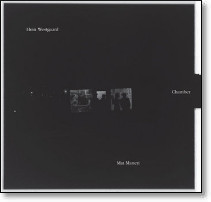
B+(*) Hein Westgaard & Matt Maneri: Chamber
(2024 [2025], Gotta Let It Out): Guitar and viola duo. Guitarist
has a few albums, including one from 2023 I liked. Maneri has
many records since 1994, picking up his father Joe Maneri's
microtonal practices. "Chamber jazz" is a loose term borrowed
from classical, where the defining feature is an intimate and
intricate group of soft instruments: mostly strings, almost
never drums, wind instruments only on their best behavior.
Maneri's viola fits the mold, but usually sounds too classical
for me. But the guitarist plays around the edges, keeping it
interesting, even adding a bit of rhythm.
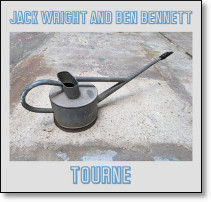
A− Jack Wright and Ben Bennett: Tourne (2026, self-released):
Sax and drums duo, the former from Pittsburgh, with dozens of albums
since 1983; the latter from Philadelphia, with several albums together
since 2011. Three tracks (35:12). That's a good length for this sort
of prickly free jazz, which I find instantly appealing as long as it
doesn't run too long, or too loud. Reminds me that I've long appreciated
Wright, even if I rarely remember his name.
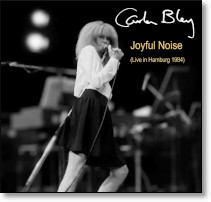
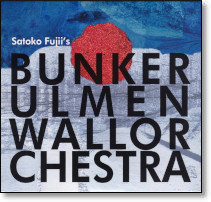
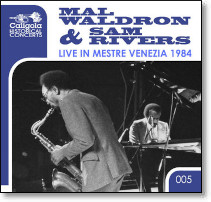
A− Carla Bley: Joyful Noise (Live in Hamburg 1984) (1984 [2026], Moosicus): Pianist (1938-2023), exceptionally famous as a composer and arranger, was a founder of the Jazz Composers Orchestra Association, whose initial project was her ambitious opera, Escalator Over the Hill. Large (10-piece) group, with four brass, two saxes, piano (Ted Saunders), organ (Bley), electric bass and drums. Title is taken from a song, but is also a philosophy of life. A− Satoko Fujii: Satoko Fujii's Bunker Ulmenwall Orchestra (2014 [2026], Libra, 2CD): Japanese avant-pianist, very prolific since 1996, went on a big band kick around 2007, organizing a series of orchestras wherever she traveled (first three were New York, Nagoya, and Tokyo). Many more since, with five new tapes of various vintages promised this year, starting with this one from Bielefeld, Germany (Bunker Ulmenwall was a WWII-vintage air raid shelter; to be followed later this year by the Orchestras Kobe, Nagoya, Berlin, and Tokyo). Detailed with many remarkable passages, demanding close scrutiny. A− Mal Waldron & Sam Rivers: Live in Mestre Venezia 1984
(1984 [2025], Caligola): Piano and tenor sax duets. Around this time,
Waldron was playing in duos with Steve Lacy and Marion Brown, so he
has a well-honed sense of how to engage here. It's hard to imagine
a more astute accompanist, and his solos never leave you wanting.
Probably helps that they stick to standards, including "Scrapple
From the Apple" and "Blue Monk."
A− Notes on Everyday Life, 2026-07-08 |