LinksLocal Links Social Media My Other Websites Music Politics Others Networking Music DatabaseArtist Search: Website SearchGoogle: |
After the FloodTrying to find the future after the elections.
After voting on Tuesday, we went out to lunch with friends, came home, and avoided TV/computer/phones until after midnight. We were cautiously optimistic. The polling place, in what is normally a Democratic precinct, was packed. A survey of signs, at least in parts of town I frequented, was solidly Democratic, especially for Adam Hamilton. I got a relentless barrage of voting texts, all from Democrats — a get-out-the-vote campaign I've never seen before in default-Republican Kansas. But Republicans have a nasty habit of pulling out close wins, like Pat Roberts did in his last Senate race, against a strong-polling, well-heeled independent. And hell, I still haven't forgotten (or forgiven) Bob Dole's nasty 1972 squeaker against Bill Roy. Those are far from the only times I've been disappointed by the American people (or the ones who vote, or the ones who get counted). With Trump's approval rating down around 32%, and nothing of significance to decouple other Republicans from his sinking ship, the election should have been an even bigger rout than it was. But the media and the pollsters worked overtime to cheer Republicans up, presenting races as "tossups" that all broke Democratic. I hoped but didn't expect to win those, and possibly a surprise or two. Angie Nixon in Florida was the one I most hoped for (she lost 51-48%). South Carolina is one that came in (Darline Graham lost 46-51%). Mississippi may be another. Few people talked about it, but Democrat Jamie Davis got 49% in Louisiana. The one Senate hopeful who fell flat was Independent Dan Osborn in Nebraska, 44-50% (maybe he should have run as a Democrat?). Maybe still-to-be-decided Alaska, where Democrat Mary Peltola leads narrowly after all the hysterically spun adverse publicity the New York Times could deliver. Aside from the Senate, I haven't looked at vote tallies as I've often done in the past. (Back in my teens, colored in county maps in based on old World Almanac voting tables, so I was pretty familiar with the research behind Kevin Phillips' The Emerging Republican Majority, although Nixon's Southern Strategy didn't occur to me.) Maybe I'll look at more numbers later, but for now the key takeaways are that Democrats will have solid majorities in both houses of Congress, a majority of governorships, and in some battleground states have gained control of state legislatures. Tom Wellborn wrote up a pretty reasonable explanation of what happens to Trump and the Republicans, in the order it happens Of course, they're not entirely predictable. The big problem is that Trump remains president. Immediately, there's the matter of the Republican-controlled lame duck Congress back in session until January. What's the worse that could happen? Well, much worse than Stephen Miller getting promoted over the Peter Principle. Netanyahu could talk Trump into nuking Iran. The initial target would be Pickaxe Mountain (the nukes are supposedly needed as "bunker busters" aimed at Iran's phantom "nuclear program"). Seems unlikely, but that would set a precedent, and could set off a chain reaction where Israel could use their own nukes against Iranian cities. Putin could then argue that if the US and Israel have lost their inhibitions, he might as well try to break the stalemate in Ukraine. After all his bluffing, he may feel like he's on the spot. Since the election, Trump has already said he may have to 'destroy the rest of the country' of Iran. He can't do that to a country that big and populous with only conventional explosives. He can blow up lots of stuff, and kill lots of people, but not enough of either to change their resolve to fight back. And when it comes to fighting back, Iran is hardly a spent force. My theory is that the Gulf States, which are most vulnerable to retaliation, and which hold the keys to so much Trump graft, are quietly restraining Trump, even more than Netanyahu is egging him along. As for Netanyahu, Israel's elections have put him in a tight spot. His Likud party lost 9 seats, dropping to 20% of the total vote. His ultra-fanatic religious allies have also lost seats, so his coalition has dropped to 53, 8 short of the majority they need to form a new government. The Zionist opposition bloc grew to 48 seats, even shorter of a majority, unless they work out some sort of deal with the Israeli-Palestinian parties, which increased their standing to 19 seats. Those parties represent the Palestinians within 1950-67 Israel who did not flee as refugees in the 1947-49 Nakba. They were granted citizenship at the same time the refugees were denied their UN-sanctioned right of return, in what must at the time have seemed like a clever ploy by Ben-Gurion. When Israel seized East Jerusalem, the West Bank, and Gaza in 1967, the Palestinians there were treated as non-citizen residents under military rule, a discrimination which persists to this day. The notion that Israel is a democracy overlooks the disenfranchised status of approximately 5 million Palestinians (3.3 in the West Bank and East Jerusalem; 2.1 million in Gaza before the genocide). To form a government, one coalition has to get 61 (of 120) Knesset seats. Netanyahu can do this by getting one or more of the Jewish opposition parties to join him, but those parties are largely self-defined by their loathing of Netanyahu. The leader of the anti-Netanyahu bloc, Gadi Eisenkot, can form a government if the Palestinian parties add their 19 votes to the bloc's 48, but the Zionist parties have vowed never to invite Palestinians into their government. (They're likely to get lynched, like Republicans in the Reconstruction South; if that seems far-fetched, consider Yitzhak Rabin, or Folke Bernadotte.) A possible deal would be a minority government that the Palestinian parties could protect but not join. That would dispose of Netanyahu and the main genocide cheerleaders, and would protect the court system that Netanyahu has been trying to curtail, while leaving the military and Israel's extremely discriminatory and punitive legal regime very much in control. Whether that would throttle the settlers terrorizing the West Bank is unclear, but the fog of war has given them cover, and Netanyahu has gone to extraordinary lengths to keep Israel embroiled in war. Two other possibilities are that Eisenkot and Netanyahu might come to some kind of power-sharing deal, or Netanyahu could continue to run a "caretaker" government until the next round of elections, in about six months. Given that Netanyahu would probably prefer the latter — he eventually won out in a similar series of 4 elections in 2019-21 — Eisenkot doesn't have much leverage. But he also knows better than most that Netanyahu cannot be trusted to honor a deal. He certainly doesn't suffer from Ehud Barak's hero worship for his opponent (Ariel Sharon). And he may well know that he's never going to get a better opportunity to make his mark. This matters to us primarily because Netanyahu has had an uncanny knack for roping American presidents, especially Trump, into his megalomaniac schemes. (Among other things, Miriam Adelson is a big donor to both.) Netanyahu's alignment with Trump and the Republican Party has made him very unpopular with Democrats, so the rising Democratic tide in America may give Israelis doubts about his effectiveness. Something similar happened in the early 1990s, when Yitzhak Shamir's refusal to deal with Bush led to his replacement by Yitzhak Rabin, which led to the Oslo Accords, the closest Israel ever came to conflict resolution. However, the right in Israel, led by Netanyahu and Sharon, and the neocons in America wrecked that, provoking the "terrorism" that gave Bush II his excuse for blowing up the whole Middle East. While Eisenkot has an unfortunate record of supporting all of Netanyahu's wars — indeed, he thinks he can execute them more smartly, not understanding that Netanyahu's mistakes are fundamental, or that Netanyahu's real aim is simply to keep the wars going, as they sustain the settlement program, and revel in Israeli dominance. Even Trump realizes that he desperately needs to extricate the US from war with Iran. Netanyahu has repeatedly derailed his efforts. Whatever else Eisenkot is, he isn't that devious, or as exclusively focused on his own political survival, so he may have an inkling of how much these ware are really costing Israel. ◆ ◆ ◆ This election reminds me of 2006 and 1994. Clinton and Obama focused on getting elected with a near-minimum of battleground states, as did (less successfully) every other Democrats since Dukakis got wiped out in 1988. But in 2006, Howard Dean took over the DNC, and pushed his "50-state" plan: contest everywhere, and ride all the pent-up resentment in whatever form it takes. Dean put his own political orientation aside (he had coined the term "democratic wing of the Democratic Party") and got a lot of "blue dog" Democrats elected in unlikely places. Bush was very unpopular following Katrina, and even more so in 2008, when the Republicans only recovered one House seat (in Kansas). Then Obama fired him, reoriented the DNC to his own reelection, and lost Congress in 2010, effectively until now. One big advantage of running a midterm election is that you get to pick candidates with local feel for each office, and they get to go their own way, focusing on what their voters are most interested in. Meanwhile, the sitting president's party is stuck to a single figurehead, who like Clinton in 1994, Bush in 2006, Obama in 2010, and Trump this year, can hem them in — and increasingly has, as mainstream media gave way to propaganda mills, and everyone became more polarized. But of those years, 1994 was the only one where the shift really stuck. That's because Republicans rebuilt the party that year from the ground up, with Newt Gingrich's "Contract with America" stunt playing a unifying (if mostly symbolic) role. The "class of 1994," working off a single coherent playbook, figured large over the following decade, especially with Fox News becoming its public oracle. The Democrats haven't quite done that, but they've made steps in that direction. They've come up with a lot of new candidates, some quite good. (There was no reason to think Roger Marshall was endangered in Kansas, until Adam Hamilton came along and blew him away.) They've also gotten much better at raising money without selling out their message. Trump helped, especially motivating small money donors, but I also suspect some savvy businessfolk saw this as an opportunity to return to the easy profits of divided government. The stock market sure celebrated the Democrats.
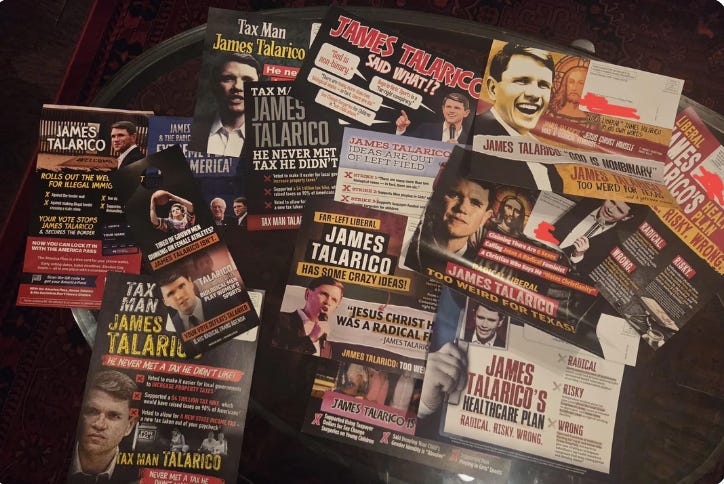
The challenge will be to build on this foundation. The focus on affordability, war, and corruption won't go away. Health care is big now, and soon to get bigger. Compared to these issues, the Republican focus on name calling and scare mongering isn't getting much traction. Republicans out-advertised Democrats in much of the country, but wasted nearly all of that on nonsense. (We were warned that Cindy Holscher wanted to make Kansas just like California. And endlessly that Adam Hamilton is "too woke for Kansas," as if the only proper Kansans are assholes. Pictured right is a sampling of the anti-Talarico mailings Elon Musk spent some $224 million flooding Texas with.) This stuff is as likely to backfire as not: before long, "socialist" will simply be a synonym for conscientious and caring. One hopeful sign is that left and "center" Democrats got very close to the same vote totals. Florida was a good example of that. Sure, in Kansas and Texas, the famously Christian Senate candidates led more progressive Governor candidates, but not by much, and some of that can be credited to other factors. And note that in the Haley Stevens blip, even long-time Israel groupie Chuck Schumer called her betrayal "despicable." Democrats have a bad reputation not just for fighting among themselves, but for throwing elections when the wrong candidate gets nominated (most notoriously, McGovern in 1972, and Bryan starting in 1896). More recently, Democrats have repeatedly undercut themselves by accepting Republican talking points, then trying to subtly finesse them. This makes the Republicans look strong and decisive, and the Democrats unprincipled and weaselly. But this is beginning to look like solidarity: a fundamental way of life on the left, but something new for the money-chasing "centrists," who back in Cold War days saw themselves as the first-line defense against creeping socialism. It's possible that I have a somewhat romantic notion of the left, seeing us all as people who start from a principled case for equality, combined with a praxis that respects individual freedom while promoting cooperative efforts, and eschewing abusive power and violence. As such, I prefer reforms that leave the system functioning to revolutions, which often break more than anyone intended. Indeed, I regard revolution as a sign of both moral and political failure on the part of the rulers, whose obstinacy and incompetence left no alternative. But that, while an interesting tangent, is not the point I want to make here. My point here is that there are people who identify with the left who will attempt to spoil this shift by demanding more of these politicians than can be delivered. To pick a relatively innocuous example, we have a friend who criticized Obama's big speech for El-Sayed for not including an endorsement of Rashida Tlaib, who won handily, as expected, without it. I have my own reservations — I find it very hard to think of, let alone listen to, Obama without recalling many ways I think he failed us. But the speech was a gift to the common front against Trump, and it was good to see him and El-Sayed joined in that effort. More serious are pundits trying to claim the election as a big win for Palestinian rights or DEI/Woke. It's always tempting for activists to claim an election for their pet cause, but the picture is much bigger, and more complicated. It's fair to say that the election shows a significant shift in favor of candidates willing to be critical of Israel, but that's not necessarily why those candidates won. If what voters want is a fairer shake from the economy, they're more likely to find support among people who still have a moral compass and critical faculties. They sure can't get that from Republicans. My sense is that virtually all leftists working within the Democratic Party are, like me, soft-hearted (but not soft-headed) reformers, and are willing to work with any coalition they can find that merely points in the right direction. Bernie Sanders, for instance, supported the ACA, which he knew would fail, even though he had a much better plan ready to go, because ACA was as far as Democrats were willing to go. The big advantage of electing any kind of Democrat over any kind of Republican is that you can talk to the former, and argue on the basis of principles they understand. (Sure, I'm old enough to realize this wasn't always the case, but it's been increasingly true for 20-30 years.) The left has three things to offer Democrats: better policy ideas; clearer principles; and integrity. But the actual policies will be implemented from the center, or maybe even the right. The value of electing leftists isn't to storm the barricades. It's to get people into the room, where they can have a different kind of influence than the one we've often demonstrated in the streets and courts. Democrats have two years in opposition to work on honing their critique of Trump, his billionaires, and their goons. Hopefully they'll do a better job of articulating values that one can build on, and be guided by. But also they need to aim higher than they can achieve, and criticize themselves for not doing better. They can't (like Trump and Biden) just pat themselves on the back. Whoever is elected president in 2028 is going to inherit one hell of a mess, and whoever loses is going to be brutal about their failures. So one needs to set expectations, but also be clear about what obstacles are in the way, and what it will take to clear them. It will, for instance, be tempting to focus on lowering gas prices, but any sober analysis will quickly show that we need to wean ourselves off gas (the market-oriented way to do this is to raise gas prices; there are ways to do this that hurt less and help more. Housing prices is another tough problem. (We think of houses as assets, but driving costs down reduces asset value, so expect pushback.) Health care and peace are simpler in principle, but lots of people still can't straighten their heads out on those issues. Clinton and Obama promised the moon, delivered next to nothing, and got creamed in their midterms — not that they cared, as both got second terms anyway, not out of hope, but because folks started remembering why they hated Republicans. They didn't bother trying to win Congress back, because their donors liked the idea of a do-nothing Congress tied to a President eager to cater to their whims. (Clinton's second term was a bonanza for bankers and tech moguls.) Biden did slightly better, but wasn't coherent enough to convince people, and expected his subs to praise his accomplishments, as if nothing more was necessary. Harris rolled all three into one, but didn't have the skills to win, even against Trump. In electing Trump twice, we've dug ourselves a hole we may never get out of. One shudders at the prospect of Democrats blowing it again, but they seem to do that a lot. While I remain convinced that the answers are on the left, and that we're within reach of very comfortable lives for pretty much everyone, we're a long ways from understanding how to do that. For instance, war needs to end, and with it wasteful military spending. Products need to be maintainable, free of enshttifying controls. Workers should own most businesses, and operate within a fair profit band. Technology needs to be open source, free of patents. The safety net needs to be expanded, and not just for the poor. Banking needs to serve the public, not defraud it. Power needs to be widely distributed, and limited. These are not just policy tweaks. They are changed world-views. None of these things are novel ideas, but they aren't things that are even discussed among the political class. That should change, but it's going to be slow, and probably crisis-driven. People do learn things, but usually the hard way. On the other hand, there are lots of modest reforms that can help us muddle through, especially if you can stop Trump and his Republicans from making things even worse. I am pleased to note that the new generation of Democratic politicians, and not just those on the left, are beginning to understand that much — and just as importantly, that they need to deliver more than just talk. Also that there is a wealth of policy think tanks that are working on a huge range of issues, and how to package and sell them. In recent years, Democrats have come off as negative, because there's been so much to be negative about. But they have to up their game. Not every apostle of evil is going to come off as hapless as Trump. For instance, Ron DeSantis kicked off his 2028 presidential campaign by calling the midterms an "extinction-level event for Republicans," while insisting that "Democrats are unpopular" and taunting them for not running on a "positive agenda." That's a clever line, even if DeSantis isn't a credible actor. Nor, for that matter, is the similar Ted Cruz, or bought men like Rubio and Vance, but the casting call won't end there. The chief lesson of the last two (or 20?) years has to really sink in: you can't believe any of them. Once that happens, which is one of the main takeaways from 2026, advertising ceases to work, no matter how much money you burn on it. Still, as long as no one can be believed, let alone trusted, we'll continue this cycle of desperately electing then rejecting saviors. At least it's unlikely that the next one will be as transparently phony as Trump. ◆ ◆ ◆ I originally meant to start this off with a personal note, on my struggles the past week, before I looked back at the elections. This started off by noting what I had written: After the break I took to fix my birthday dinner, it seems like I've been writing like crazy: two major blog posts, a Music Week (30 albums rated) to end October, and a 19,000 word pre-election compendium of news and links, Loose Tabs. Also two Substack posts leading up to the election: Elections Past and Present and Trump's Greatest Hits, plus a recap of Loose Tabs (10). Then this on the elections. I've finally cleared out the leftovers, and gained a depressing amount of weight for my efforts. It may be some time before I cook again. I've made no progress on two fairly serious essays: one is the outline to my "weird" book, which revisits the Trump-Harris 2024 campaign, and expands on many of the themes above, including a sketch of the dystopia I see Republicans building if they get the chance, and a bit of "The Way Things Ought to Be" on prospects if we can stop them; the other is my solution to Israel's (and in many ways the whole world's) wars. The way things are going, neither is likely to ever reach completion, but I feel like I understand a lot of the problems. What I am likely to do is run the 21st Annual Francis Davis Jazz Critics Poll. I'd like to send out invites by mid-month, which is what? a week away? I'm no where near prepared to do that. But if I stay within the parameters of last year's poll (and this one's mid-year poll), I should be able to get by. I do need to prepare the website, and send out some email this coming week. Music Week keeps getting pushed out as I work on this. It should appear tomorrow. I'll try to steer it back to a weekday after that. Notes on Everyday Life, 2026-11-06 |