Blog Entries [750 - 759]Sunday, June 3, 2018
Weekend Roundup
Impossible to put the usual amount of work into this weekly feature,
but filling out and posting something of a stub is at least a step back
toward normalcy, as well as something I can look back on for a timeline
to this miserable period in the nation's storied but increasingly sorry
history. The main problem is that I'm still waylaid by the crash of my
main working computer. I've restored local copies of my websites, but
the shift to a new computer, running newer software, has resulted in
massive breakage. I'm making slow but steady progress there, but this
website in particular is nowhere near stable enough for me to do my
usual update. So while I'm doing the usual work locally, the only files
I'm updating on the server are the blog posts.
A secondary problem is that my workspace has been disrupted, which
among other things leaves me facing a different (even more cluttered)
desk, using a different (and less comfortable) keyboard and mouse,
with less satisfactory lighting, and other minor nuisances. Among
other things, expect more typos: the keyboard touch is worse (although
this one is less prone to dropping 'c'), a subtle change in emacs
drops spaces where I expect to have to delete them (so I've caught
myself deleting first characters of words), and a spellcheck script
I wrote is gone and will have to be reinvented. Also note that where
I used to keep twenty-some news/opinion sites permanently open, I've
yet to re-establish the practice, nor have I looked up passwords to
the few sites I have such access to, so my survey this week will be
especially limited. I'm also running a browser without NoScript or
even an ad blocker, so we'll see how long I can stand that.
Got email from Facebook reminding me that today is Bill "Xcix"
Phillips' birthday. I usually don't bother with such notices, but
last year I did, only to find out that Bill had died a few months
earlier. So today's email reminds me that he's still dead, and
how dearly I miss him.
Some scattered links this week:
Matthew Yglesias: The 4 biggest political stories of the week, explained:
Puerto Rico got a credible estimate of Maria's death toll (approximately
4,600 excess deaths); Trump imposed tariffs on American allies; Roseanne
got canceled; Dinesh D'Souza got a pardon.
Other Yglesias posts:
Trump's legal memo to Robert Mueller is a recipe for tyranny.
Trump's wildly inappropriate (and possibly corrupt) jobs report tweet,
explained.
Walmart's too-good-to-be-true "$1 a day" college tuition plan, explained.
Raises the question of why not just raise wages? For a wonkier explanation,
see:
Paul Krugman: Monopsony, Rigidity, and the Wage Puzzle.
Republicans are sowing the seeds of the next financial crisis.
Virginia's state Senate just voted to expand Medicare.
The shocking truth about the Hurricane Maria death toll is our Trump
nightmare made real:
The carnage in Puerto Rico is the most severe manifestation of Trump's
basic unfitness for the job he currently occupies, but it's far from
the only one. And the focus on his various antics has an unfortunate
tendency to detract from the basic reality that he doesn't put in the
time or the work to solve problems, when really that's the core of the
issue. If you put a telegenic demagogue in office, you will get some
choice moments of televised demagoguery. You won't get an adequate
response to a hurricane, and that means you will get a sky-high death
toll. The rest of us can only hope our luck holds up.
Yeah, but really, what is this "luck" Yglesias keeps talking about?
Branch Rickey famously said "luck is the residue of design." The design
applicable here is the Constitution and 230 years of law and precedent,
which have given the US President great but not dictatorial power.
Without this design, Trump would have done much more damage than he
actually has, but even with it he and his cronies are taking a toll,
the severity of which is only gradually becoming manifest.
The raging controversy over whether to call Trump's lies "lies,"
xplained: "It's not the word you use that matters -- it's whether
you extend him the benefit of the doubt."
Yet the troubling thing about media coverage of Trump isn't that the
press has failed to label lies as lies once they are proven to be lies.
It's that these kinds of statements continue to be taken at face value
when they are made, as if they were offered by a normal, reasonably
honest person. But Trump is not a reasonably honest person. He is
someone who flings around unconfirmed accusations and demonstrable
falsehoods with abandon -- and who does so, by his own admission,
for calculated strategic purposes.
Maureen Dowd: Obama -- Just Too Good for Us: Not my line or
take. One problem is that we (by which I mostly mean the liberal
punditocracy) spent so much effort into preëmptively congratulating
ourselves on our foresight and good nature in electing Obama, we
never bothered to consider whether we shouldn't wait until he did
some things. (Case in point: the Nobel Peace Prize.) We did expect
him to do things (good things), didn't we? And when he didn't,
shouldn't we have been at least a little bit critical? Anyone can
be naïve, but if after eight years you let the Clinton campaign
shame you for doubting anything about Obama, you've moved on to
foolishness and irrelevance. Dowd, quoting Obama adviser and new
author Ben Rhodes (The World as It Is):
The hunger for revolutionary change, the fear that some people were
being left behind in America and that no one in Washington cared,
was an animating force at the boisterous rallies for Donald Trump
and Bernie Sanders.
Yet Obama, who had surfed a boisterous wave into the Oval, ignored
the restiveness -- here and around the world. He threw his weight
behind the most status quo, elitist candidate.
"I couldn't shake the feeling that I should have seen it coming,"
Rhodes writes about the "darkness" that enveloped him when he saw the
electoral map turn red. "Because when you distilled it, stripped out
the racism and misogyny, we'd run against Hillary eight years ago with
the same message Trump had used: She's part of a corrupt establishment
that can't be trusted to change."
Norman G Finkelstein: Strong as Death: "Truth is that the Israeli
army has no answer to non-violence resistance. . . . Therefore, the
army's reaction is to open fire, in order to induce the Palestinians
to start violent actions. With these the army knows how to deal."
Note that Finkelstein has two recent books:
Method and Madness: The Hidden Story of Israel's Assaults on Gaza, and
Knowing Too Much: Why the American Jewish Romance With Israel Is Coming
to an End.
Thomas Frank: Forget Trump -- populism is the cure, not the disease.
A response to two recent books attacking "populism" as a right-wing
assault on democracy: Yascha Mounk's The People vs. Democracy
and William A. Galston's Anti-Pluralism: The Populist Threat to
Liberal Democracy. As a fellow Kansan, I've long sided with our
populist heritage, so I agree with Frank that anti-populism is rooted
in elitism, even when dressed up as an embrace of liberal democracy.
After all, isn't the point of democracy to bend government to the
will of the people?
Ed Pilkington: Trump's 'cruel' measures pushing US inequality to dangerous
level, UN warns: Just to be clear, the complaint isn't about the rich
getting even richer, but how Trump and his party are shredding what's left
(after Reagan and Clinton and Bush) of the "safety net," making the poor
more miserable and desperate.
Andrew Prokop: Why Trump hasn't tried to pardon his way out of the Mueller
probe -- yet.
Ganesh Sitaraman: Impeaching Trump: could a liberal fantasy become a
nightmare? Provocative title for a favorable book review of
Laurence Tribe/Joshua Matz: To End a Presidency: The Power of
Impeachment. My view is that impeachment is a purely political
act, so unless/until you have the power to back it up there's no
point talking about it. On the other hand, if I had a vote, and
the question was put to a vote, sure, I'd vote guilty, even if the
actual charges didn't exactly align with my own position (cf. Bill
Clinton). By the way, I highly recommend Sitaraman's book, The
Crisis of the Middle-Class Constitution. I've since moved on
to start Gordon S. Wood's Empire of Liberty, and have been
pleased to find the two books in general agreement.
David Smith: How Donald Trump is weaponising the courts for political
ends. Also by Smith:
Trump goes it alone: running the White House not like a president, but
a CEO. This hook would make more sense if it was widely understood
how CEOs have evolved over the last 30-40 years. Where once CEOs were
viewed as competent general managers of vast and complex enterprises,
as their rewards have expanded tenfold relative to average employees,
they've become increasingly imperious, egotistical, and desperate given
how much "skin in the game" they have (mostly short-term bonuses and
stock options). Their obsessions with busting unions and stripping
regulations are of a piece with their insatiable power grab. On the
other hand, Trump is actually worse than a modern CEO. He's an owner,
so he's never been constrained by a board or stockholders (let alone
the SEC).
Harry Litman uses a different metaphor in
President Trump Thinks He Is a King . . . and not one of your
boring constitutional monarchs, either; more like the kind who
could say, "L'état, c'est moi."
Li Zhou: Sen. Gillibrand said Bill Clinton should've resigned over
Monica Lewinsky.
Clinton disagrees. Well, he certainly should have resigned for something,
but one thing about the Clintons is that they've always put their personal
fortunes above their party and especially above the people who support that
party.
Ask a question, or send a comment.
Thursday, May 31, 2018
Streamnotes (May 2018)
Back on Monday, when I posted
Music Week, I figured I had a couple more days to add to my
already substantial Streamnotes draft. But then disaster struck:
my main computer seized up, losing (at least for now) what little
additional work I had added. What happened was some kind of power
surge worked its way through the UPS that supposedly protected
the computer, into the computer's power supply and evidently on
to the motherboard. Whether it also damaged the hard drives is
yet to be determined, but replacing the power supply failed to
light the motherboard's always-on LED, so something is probably
seized up there. (On the other hand, there are no visible signs
of physical damage, like popped capacitors or unseemly burn or
smoke residue.)
Realizing that I couldn't repair/rebuild the computer anytime
soon, I switched plans: I have a secondary computer which I use
for listening to music and occasionally watching video. I rebuilt
it a year or two ago, and it's actually a pretty solid machine:
AMD 8-core CPU, ASUS motherboard, 32 GB RAM, 1 TB hard disk, a
medium-low end video card. Most important, it's up to date, with
Ubuntu 16.04 (vs. Ubuntu 12.04 on the dead machine). The outdated
software has been a fairly serious problem: among other things, I
wound up having to use the newer machine for Facebook and Twitter,
and a Chromebook for Amazon (partly why Book Roundups have been
rare lately).
The newer machine is running Firefox much faster than the dead
one ever did. On the other hand, up-to-date software is causing
me other problems, as websites which worked on the older versions
have cracked in numerous ways. Most of my work, including my book
drafts, has been hidden away on my website, so I figured I could
get going again by retrieving data from the server. This is also
true for a half-dozen other websites which I built and manage,
so getting them back and running again will at least allow me to
work going forward. I'm still out a fair amount of data, but the
most critical parts (especially to other people) are on those
websites.
I ran across a fairly daunting task last night, when I realized
that PHP dropped the old mysql database interface module in favor
of the "improved" mysqli module, necessitating a complete rewrite
of all of the Consumer Guide database at
Robert Christgau's website. I tried some band-aid solutions last
night, and managed to successfully connect to the database, but that
was it. I decided today I need to go back and RTFM ("read the fucking
manual") until I actually understand how to use the new "object model."
The code is scattered over about 30-40 files, and there is real risk
that the rewritten to run under PHP 7 here will break on a server
which is still running PHP 5.6.
So I decided to go after (hopefully) simpler problems today. In
particular, realizing that today is the last day of May, I thought
I should make an effort at posting May's Streamnotes column. The
first problem was that when I initially brought up the blog roll,
the only thing that appeared was the banner image. So I had to do
some research on how to turn error messages on, then march through
the wreckage. First problem was that the function split() had been
dropped from PHP 7, in favor of explode(), but one of the arguments
also had to be tweaked. I won't bore you with further details, but
after a couple hours I managed to get the blog roll and individual
posts looking right.
Then I figured I could prepare a new blog post, and copy that
one file to the server, with a reasonable expectation that it would
work. So I went through my usual motions of preparing a Streamnotes
post, including opening next month's draft file and indexing this
month's records. Of course, I couldn't see anything until I fixed a
couple more split() calls, plus a more serious character set matter.
But once I finish writing this introduction, all I'm going to upload
is the blog file -- lest I inadvertently break something else. I'm
not planning on doing a full update until I get a real handle on
things.
One thing I can't do now is take the time to write up general
comments on the records below. You can find some commentary in
my various Music Week posts over the past week -- especially the
one linked to above. I will note an exceptional number of A/A-
records this month, and a pretty diverse set at that.
Most of these are short notes/reviews based on streaming records
from Napster (formerly Rhapsody; other sources are noted in brackets).
They are snap judgments, usually based on one or two plays, accumulated
since my last post along these lines, back on April 28. Past reviews
and more information are available
here (11180 records).
Recent Releases
3hattrio: Lord of the Desert (2018, Okehdokee): Folk
group, from the southwest corner Utah near Zion National Park; banjo,
fiddle, stand-up bass, sounding pretty rustic, although the bassist
is a ringer from Florida who knows his way around the Caribbean.
B+(**)
Idris Ackamoor & the Pyramids: An Angel Fell (2018,
Strut): Tenor saxophonist, born Bruce Baker in Chicago, based in San
Francisco, dates his group back to 1972 at Antioch College, where Cecil
Taylor taught, but disbanded in 1977, not regrouping until 2012. Band
is funky, with guitar and violin for texture, congas as well as drums.
Sax is often terrific, but vocals disappoint.
B+(**)
Bill Anschell: Shifting Standards (2017 [2018], Origin):
Mainstream pianist, grew up in Seattle, spent a decade in Atlanta before
moving back. Trio with Jeff Johnson (bass) and D'Vonne Lewis (drums),
playing nine standards -- two from Gillespie, Mal Waldron's "Soul Eyes,"
Fats Waller's "Jitterbug Waltz," the rest from the Berlin-to-Bernstein
songbook, all smartly done.
B+(***) [cd]
Anteloper: Kudu (2017 [2018], International Anthem):
Duo, Jaimie Branch (trumpet, had a widely praised debut album in 2017)
and Jason Nazary (drums, played in groups Bear in Heaven and Little
Women). I don't know who is into electronics, but I figure that's the
source of the dark atmospherics, with the trumpet blending in more
often than standing out.
B+(**) [bc]
Tiffany Austin: Unbroken (2018, Con Alma): Jazz singer,
writes some lyrics, born in Los Angeles, based in San Francisco. Gospel
voice, scats a lot, good horns, and a stellar Cyrus Chestnut/Rodney
Whitaker/Carl Allen rhythm section.
B+(*) [cd]
Cardi B: Invasion of Privacy (2018, Atlantic):
Rapper Belcalis Almanzar, first album after two Gangsta Bitch
Music mixtapes and a chart-topping single, "Bodak Yellow,"
that won last year's Pazz & Jop song category. Big investment
here: scads of songwriters, producers, guests, yet consistent,
hooky, unpredictable.
A-
Alice Bag: Blueprint (2018, Don Giovanni): Alicia
Armendariz. lead singer in LA punk band the Bags (1977-80), later
chronicled the LA punk scene, wrote an autobiography (Violence
Girl: East LA Rage to Hollywood Stage: A Chicana Punk Story),
and finally launched a solo career with her eponymous 2016 album.
Opens with a foursquare rocker, even brings some punk rage, but
the album falls off a bit midway.
B+(*)
MC Paul Barman: (((Echo Chamber))) (2018, Mello Music
Group): Rapper, several albums since Paullelujah! in 2002, for
some reason feels the need to note that he's white in the second song
here -- not really necessary as LA Weekly included him in their
"Top 20 Whitest Musicians of All Time" list, but I can't fault him for
feeling the need to make anti-racialist points that should be common
sense by now. Fast, scratchy, high pitched, a lover of words, but not
quite as funny as his best past work.
B+(***)
Kenny Barron Quintet: Concentric Circles (2018,
Blue Note): Timed to coincide with the pianist's 75th birthday,
marking 50 years of recording -- actually longer, side credits
going back to 1961 with Perry Robinson's Funk Dumpling (1962)
an early triumph; his own records start in 1968, with Peruvian
Blue (1974) an early landmark; his Stan Getz duos People
Time (1991) and Swamp Sally (1995, with Mino Cinelu)
are my favorites. New quintet adds Dayna Stephens (tenor sax) and
Mike Rodriguez (trumpet) to his recent trio with Kiyoshi Kitagawa
(bass) and Johnathan Blake (drums). Young group, well schooled in
contemporary postbop -- all these years Barron has made the bulk
of his living teaching, and is justly legendary, but academic jazz
still has its limits.
B+(**)
Berry: Everything, Compromised (2018, Joyful Noise):
Rock band, principally guitarist/vocalist Joey Lemon and drummer Paul
Goodenough, formed on Martha's Vineyard in 2002, shortly moving to
Chicago. At some point they start sounding like late Beatles, minus
hooks and catchy melodies and clever lyrics. Kind of like Badfinger,
but badder.
B-
Black Foxxes: Reiði (2018, Spinefarm): British
alt-rock band, from Exeter, a tuneful guitar swarm. Some hear echoes
of Smashing Pumpkins, Jeff Buckley, and Radiohead, but even with
their incomprehensible title I don't find them anywhere near that
pretentious. Melodramatic? Maybe.
B
Terence Blanchard: Live (2018, Blue Note): Trumpet
player, has done a lot of soundtrack work, pulled this from concerts
in Minneapolis, Cleveland, and Dallas, in each case thinking of
recent shootings, either by or of police. (The way I'm reading the
hype sheet, they're providing dates of the shootings, not of the
concerts.) Quintet called E-Collective, with Charles Altura (guitar),
Fabian Almazan (piano/synths), David "DJ" Ginyard (bass), and Oscar
Seaton (drums). Dense, uplifting, doesn't show off his trumpet very
well.
B+(*)
Andrea Brachfeld: If Not Now, When? (2017 [2018],
Jazzheads): Flute player, eighth album since 2001, started studying
classical but followed her instrument into Latin jazz, where she
has a couple of "lifetime achievement awards." That's less evident
here, where she's backed by Bill O'Connell (piano), Harvie S (bass),
and Jason Tiemann (drums). Mostly original pieces, some co-written
by O'Connell (strong performance from him), ending with "Amazing
Grace."
B+(*) [cd]
Greg Burk: The Detroit Songbook (2017 [2018],
SteepleChase): Pianist, Michigan native, bunch of records since 2005,
trio here, with Matteo Bortone (bass) and John B. Arnold (drums),
all originals, smartly executed.
B+(**)
David Byrne: American Utopia (2018, Nonesuch): He has
a distinctive sound, especially rhythmic, but not as spry as it used
to be, which at worst steers him into self-caricature. First solo album
since 2004, one that aims at more optimism -- it's part of "a larger
multimedia project titled Reasons to Be Cheerful -- than seems
warranted, not least by the music. Exception: "Everybody's Coming to
My House."
B
Jonas Cambien Trio: We Must Mustn't We (2018, Clean
Feed): Portuguese pianist, trio adds André Roligheten (soprano/tenor
sax, bass clarinet, flute) and Andreas Wildhagen (drums, plus a bit
of trumpet), with guest trumpet on two tracks (Torstein Lavik Larsen).
Opens strong with lots of rhythmic friction, varying thereafter as
Roligheten works through his arsenal.
B+(***)
François Carrier/Michel Lambert/Rafal Mazur: Beyond
Dimensions (2016 [2018], FMR): Alto sax-drums duo from Quebec,
have produced a lot of albums since 1999, often trios with a guest
pianist or bassist or, here, their fourth album with Polish acoustic
bass guitarist Mazur. Some superb stretches, a shade less satisfying
than their Oneness (2017) or Unknowable (2015).
B+(***) [cd]
Playboi Carti: Die Lit (2018, AWGE/Interscope):
Atlanta rapper Jordan Terrell Carter, had an eponymous mixtape last
year that turned some heads, returns with first studio album. Same
herky jerk, rhythmic appeal that repeatly snags you then lets you go.
B+(*)
Dan Cavanaugh/Dave Hagedorn: 20 Years (2017 [2018],
UT Arlington): Piano/vibraphone duets, the musicians meeting as
undergrads 20 years prior. Several free improvs, also tunes from
Ornette Coleman, Trent Reznor, Herbie Nichols, and an original
arrangement of "Maple Leaf Rag."
B+(*) [cd]
Cavern of Anti-Matter: Hormone Lemonade (2018, Duophonic):
Berlin-based trio, third album, Holger Zapf's electronics plus two guys
from electropop group Stereolab, playing their own twist on Krautrock
grooves.
B+(**)
Ceramic Dog [Marc Ribot/Shahzad Ismaily/Ches Smith]: YRU
Still Here? (2018, Northern Spy): Guitarist Marc Ribot's
group, second by the trio after eponymous debut, the others play
bass and drums but also everyone dabbles in electronics and sings --
leads seem to be Ribot, with lyrics on half of the pieces, maybe
more, plus guest horns on a couple. Not sure I get all the politics,
or that it really matters. The anger is sure palpable, as is the
Arab-Jewish fusion.
A-
Chamber 3: Transatlantic (2016 [2018], OA2): I
don't know of any formal definition of "chamber jazz," but usually
look for a soft instrument (clarinet or violin/viola) and absence
of drums. Principals here are Christian Eckert (guitar), Steffen
Weber (tenor sax), and Matt Jorgensen (drums), but they're not
even a trio -- Phil Sparks plays bass, though his name didn't make
the front cover -- actually just a rather nice little postbop sax
quartet. Disc is packed, and "When You Wish Upon a Star" is radiant.
B+(*) [cd]
Chloe x Halle: The Kids Are Alright (2018, Parkwood/Columbia):
Sisters Chloe and Halle Bailey, less than two years apart, harmonize
everything, play sumptuous pop which probably wouldn't be recognized
as r&b without an assist from the eyes -- even with guest spots
for GoldLink and Joey Bada$$. Could grow on you.
B+(**)
The Nels Cline 4: Currents, Constellations (2017
[2018], Blue Note): Guitarist, in a two guitar quartet with Julian
Lage -- Cline and Lage did a duo album in 2014 -- backed by Scott
Colley (acoustic bass) and Tom Rainey (drums). All Cline pieces
except for one from Carla Bley. The rhythm section helps.
B+(*)
Freddy Cole: My Mood Is You (2018, High Note): Nat
King Cole's little brother, 86 now, his eerily reminiscent voice
finely aged, takes a set of slow ones, not so much because he's
wearing out as enjoying the sublime. With John di Martino (piano),
Randy Napoleon (guitar), Elias Bailey (bass), and Quintin Baxter
(drums), plus Joel Frahm on tenor sax -- hope Houston Person is OK,
but Frahm is well poised to pick up his session work.
B+(***)
J. Cole: KOD (2018, Roc Nation): Popular rapper,
fifth studio album, all chart toppers. Title repeatedly spelled out,
supposed to mean Kids on Drugs or King OverDosed or Kill Our Demons.
B+(**)
Confidence Man: Confident Music for Confident People
(2018, Heavenly): Dance pop quartet, fronted by a man and woman in white
with pseudonyms, backed by two people totally in black, faces hidden
behind hoods. Don't know where they're from -- one source says Missoula,
MT, another Melbourne down under, their label website only showing UK
dates. Reminds me of various things, especially from 1980s new wave
disco, which doesn't offer great promise for future efforts, but for
now those are all things I enjoy, and there's something to be said
for living in the moment.
A-
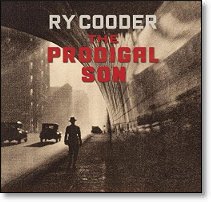
Ry Cooder: The Prodigal Son (2018, Fantasy): Three
clever originals, the rest obscure covers, mostly blues/gospel, four
by three gents known as Blind -- Willie Johnson, covering all the
bases, doubles up. Took several plays to sink in, and still feels a
little slick, but hardly glib.
A-
Frankie Cosmos: Vessel (2018, Sub Pop): Singer-songwriter
Greta Kline, famous actor parents (Kevin Kline/Phoebe Cates), acted some
as a child, third album, started DIY as Ingrid Superstar and doesn't get
fancy now that she's got label backing. Not exactly awkward, but not
untroubled either, or uninteresting.
B+(***)
Elysia Crampton: Elysia Crampton (2018, Break World,
EP): Electronica, artist has a couple previous albums. Cover here says
Ocelote but I've yet to see anyone used that as the title. Six
songs, 18:45, big beats, hard and quasi-industrial.
B+(*)
Czarface/MF Doom: Czarface Meets Metal Face (2018,
Silver Age): The former originally a 2013 album by 7L & Esoteric
(George Andrinopoulos and Seamus Ryan, 7 albums 1999-2010) and Wu-Tang
Clan member Inspectah Deck, now joined into a "supergroup," now with
four subsequent albums. Needless to say, their comic book/underground
rap fusion was right up Doom's alley -- indeed, MF stands for "Metal
Face." Of course, I'm not properly following the plot, but even at my
superficial level this is great fun.
A-
Dead Composers Club [Noah Preminger/Rob Garcia]: Chopin
Project (2017 [2018], Connection Works): Compositions by
Frederic Chopin, arrangements by Preminger (tenor sax) or Garcia
(drums), with Nate Radley (guitar) and Kim Cass (bass). Being a
classical music phobe, nothing I recognize here, nor anything that
triggers my traditional gag reflex. The drummer certainly helps.
B [cd]
Benoît Delbecq 4: Spots on Stripes (2017 [2018], Clean
Feed): French pianist, with Mark Turner (tenor sax), John Hébert (bass),
and Gerald Cleaver (drums), doing original material, prickly and rather
abstract.
B+(**)
Robert Diack: Lost Villages (2018, self-released):
Drummer, from Toronto, first album, quartet with guitar (Patrick
O'Reilly), piano (Jacob Thompson), and bass (Brandon Davis) --
giving the short-ish album a luxurious shimmer.
B+(*) [cd]
Ron Di Salvio/Bart Plateau: The Puglia Suite (2017
[2018], Blujazz): Piano and flutes, respectively, a duo as far as I've
noticed, Di Salvio the main composer. Sometimes I wonder if I'm being
too hard on flute players -- I do tend to prefer deeper instruments --
but then there's this, which among other things reminds one how hard
it is for flute to escape its role in classical music.
B- [cd]
DJ Koze: Knock Knock (2018, Pampa): German
DJ/electronica producer Stefan Kozalla, third album, a bit slow
finding the groove this time. Mixed bag after that.
B
Yelena Eckemoff Quartet: Desert (2015 [2018], L&H
Production): Russian pianist, trained under the Soviets in classical
music, moved to US in 1991 and took a shot at jazz in 2009. Back cover
shows the diminuitive redhead surrounded by three giants with white
(or no) hair: Paul McCandless (oboe, English horn, soprano sax, bass
clarinet), Arild Andersen (double bass), and Peter Erskine (drums).
Lovely pastorales, the piano and reeds alternately delightful.
B+(***) [cd]
Kat Edmonson: Old Fashioned Gal (2018, MRI):
Singer-songwriter from Houston, fourth album, harkens back to the
jazz and pop of the 1940s (more or less). Cute voice, some clever
lyrics, including a slam against pop-up ads.
B+(*)
Adrean Farrugia/Joel Frahm: Blues Dharma (2017
[2018], GB): Piano/tenor sax duets, the pianist from Canada, teaches
at York, two previous albums, not someone I've noticed before but
he's forceful here, driving the rhythm, building on it. Frahm is
a saxophonist I've often admired, but usually on other people's
albums. He's masterful here, a delight.
A- [cd]
Fickle Friends: You Are Someone Else (2018, Polydor):
British indie pop group, Natassja Shiner sings, plays some keyboards.
First album after two EPs and a dozen singles. Bright and bouncy.
B+(**)
Flatbush Zombies: Vacation in Hell (2018, Glorious Dead):
Hip hop group from Brooklyn, second album after a couple mixtapes. Long,
catchy, lot to sort out.
B+(***)
Dave Gisler Trio: Rabbits on the Run (2017 [2018],
Intakt): Swiss guitarist, backed by Raffaele Bossard (bass) and
Lionel Friedli (drums), both names prominent on cover. Starts with
an easy atmospheric piece, followed by hard groove with impressive
drumming, then works back and forth.
B+(***) [cd]
The Go! Team: Semicircle (2018, Memphis Industries):
Indie pop band modeled on a high school cheerleader squad, with
conceptmeister Ian Parton turning the vocals over to Ninja and
adding the Detroit Youth Choir for depth.
B+(**)
Benito Gonzalez/Gerry Gibbs/Essiet Okon Essiet: Passion
Reverence Transcendence: The Music of McCoy Tyner (2016
[2018], Whaling City Sound): Pianist, born in Venezuela, based in
New York, three previous albums. All three have ties to Tyner, who
wrote the first nine pieces and dropped in for some booklet photos.
Tenth piece is by Coltrane. Last three are tributes, one each.
B+(***) [cd]
Jean Grae & Quelle Chris: Everything's Fine
(2018, Mello Music Group): Rap duo, Tsidi Ibrahim (daughter of
Abdullah Ibrahim and Sathima Bea Benjamin) and Gavin Tennille --
reports are they are engaged or married. Underground beats,
often recycling to the title refrain. More his raps than hers,
but his sly offhand delivery has never been better framed.
A-
Danny Green Trio Plus Strings: One Day It Will
(2017 [2018], OA2): Pianist, "Danny Green (6)" at Discogs, they
don't show much discography but I've heard four previous records.
The strings are a conventional quartet. They're usually the kiss
of death, but are just about right here, adding depth and resonance
without getting in the way.
B+(**) [cd]
Bill Hart Band: Live at Red Clay Theatre (2017
[2018], Blujazz): Guitarist, from Onbatio, has taught in Atlanta
for 25 years, sixth album since 1999, leads a sextet with Alex
McGinnis on sax, Pat Strawser on keyboards, plus bass, drums, and
extra percussion.
B [cd]
Eddie Henderson: Be Cool (2018, Smoke Sessions):
Trumpet player, well into his 70s now with a discography starting
in 1973, substantial although he's rarely claimed the spotlight.
Starts here like hard bop still has some tricks to show -- group
is a quintet with Donald Harrison (alto sax), Kenny Barron (piano),
Essiet Essiet and Mike Clark -- but soon moves into ballad territory,
which (especially with Barron) also shines.
B+(***)
Fred Hersch Trio: Live in Europe (2017 [2018],
Palmetto): Piano trio, Hersch has a lot of these since 1985,
including eight on this label. This one was recorded in Belgium,
with John Hébert (bass) and Eric McPherson (drums). Seems about
par for the course, with two covers each from Monk and Shorter
on the ends, originals in the middle.
B+(**) [cd]
Hieroglyphic Being: The Red Notes (2018, Soul Jazz):
Jamal Moss, from Chicago's acid house movement, long instrumental
vamps with a touch of jazz in the air.
B+(***)
Tyler Higgins: Blue Mood (2016 [2018], Shhpuma):
Guitarist, long list of instruments here including lap steel and
celesta, backed by Paul Stevens on drums and piano, with Ellen
Higgins voice (not that I particularly noticed). Harsher than
ambient, but shades in that direction.
B+(*)
Amos Hoffman/Noam Lemish: Pardes (2017 [2018],
self-released): Guitar/oud and piano, respectively, based in New
York and Toronto but with Israeli roots, in a quartet backed by
bass and drums, plus a couple of guest spots (notably the cut
with Jacob Gorzhaltsan on clarinet).
B+(*) [cd]
Dave Holland: Uncharted Territories (2018, Dare2,
2CD): British bassist, first album (Conference of the Birds,
1972) was a landmark of the 1970s avant-garde, but he edged into
the postbop mainstream over the years, winning many polls for his
quintet and big band efforts. In some ways he returns full circle
here, in a quartet with Evan Parker (tenor sax), Craig Taborn (piano,
keyboards, organ, electronics), and Ches Smith (percussion). Still,
nothing hair-raising here, with Parker at his most measured. Second
disc dials it back further, in case you want to enjoy the bassist.
A- [cdr]
Hookworms: Microshift (2018, Domino): British group
from Leeds, third album, leans pop in a prog-ish sort of way, not as
hooky as their first (especially) or even their second.
B+(*)
Hop Along: Bark Your Head Off, Dog (2018, Saddle Creek):
Indie band from Philadelphia, third album, singer-songwriter Frances
Quinlan is key, having started as a solo act (as Hop Along, Queen
Ansleis), with brother Mark Quinlan drums and a couple others. A bit
fancy, as the lyrics stretch around slightly off-kilter melodies.
B+(*)
Jon Hopkins: Singularity (2018, Domino): English
electronica producer, keyboards, bright and shiny, mostly with a
good beat, or some gentle ambience, which works too.
B+(***)
Hot Snakes: Jericho Sirens (2018, Sub Pop): From
San Diego, post-hardcore group, three albums 2000-04, a live one
in 2006, then they broke up, with John Reis moving on to Rocket
From the Crypt. Reunited in 2011, but this is their first album
from their second life. Dense grind, not something I ever want to
hear again, but not bad for what it is.
B
Kira Kira: Bright Force (2017 [2018], Libra):
Part of Japanese pianist Satoko Fujii's record-a-month celebration
of turning sixty, resoundingly answering my complaint about last
month's entry by returning her piano to center stage -- at least
I assume it's her, as the quartet includes a second keyboardist,
Alister Spence, on "Fender electric piano, effects pedals and
preparations" (actually, pretty easy to keep them straight). With
Natsuki Tamura on trumpet (also inspired) and Ittetsu Takemura on
drums.
A- [cd]
Hayley Kiyoko: Expectations (2018, Empire/Atlantic):
Singer-songwriter, dropped her last name (Alcroft), started out in a
band called the Stunners before going solo, acts some, first album,
electropop but more dream than glitz.
B+(*)
Matt Lavelle/Lewis Porter/Hilliard Greene/Tom Cabrera: Matt
Lavelle Quartet (2016 [2017], Unseen Rain): Trumpet player,
also plays flugelhorn (natch) and alto and bass clarinets -- has a
unique style on the latter. Backed by piano/bass/drums, freebop with
the leader's Jekyll/Hyde horn shifts. Porter seems to want to split
the distance between Kenny Barron and Oscar Peterson, and succeeds
pretty niftily.
B+(***) [bc]
Matt Lavelle's 12 Houses: End Times (2014 [2017],
Unseen Rain): Larger group, I count 16 musicians including Lavelle
(credits: cornet, flugelhorn, alto clarinet, conduction) -- not a
big band formula, nor an orchestral arrangement, but a powerful
array of solo voices erupting out of the matrix -- Anders Nillson
(guitar) and Jack DeSalvo (banjo) make an early impression. "12
Houses," by the way, is an Ornette Coleman reference.
B+(**) [bc]
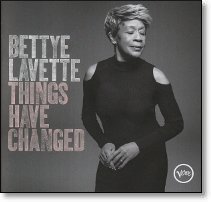
Bettye LaVette: Things Have Changed (2018, Verve):
Soul singer, cut an album for Motown in 1982, a second album in 1991,
a third in 2000 in Europe where she finally started to find some
traction. Did an album of Brit Rock songs in 2010 which seemed like
a waste, but turned to Dylan here, much more impressively. Probably
helps that she steers away from songs you recognize -- mostly from
the '80s, I gather. Gives them more charge and depth than Dylan ever
did.
A
Azar Lawrence: Elementals (2018, High Note): Tenor
saxophonist, from Los Angeles, I thought his 1974 debut Bridge
Into the New Age was brilliant, but he only released one album
between 1976 and 2008 before mounting a comeback that has bounced
from label to label. With Benito Gonzales (keyboards), Jeff Littleton
(bass), Marvin Smith (drums), Munyungo Jackson (percussion), and a
few guest shots.
B+(**)
Mike LeDonne and the Groover Quartet: From the Heart
(2018, Savant): Organ player, quartet probably dates back to his 2009
album The Groover: Eric Alexander (tenor sax), Peter Bernstein
(guitar), and Joe Farnsworth (drums), although Mike Clark drums on two
cuts. Those are all marquee names, with the guitarist adding especially
tasty licks, but to limited appeal.
B+(*)
Bongwool Lee: My Singing Fingers (2016 [2018], Origin):
Pianist, from Seoul, South Korea, based in New York, studied classical
music before discovering Oscar Peterson. Trio, first album, all originals
except for "Bye Bye Blackbird," nicely done.
B+(**) [cd]
Igor Lumpert & Innertextures: Eleven (2017 [2018],
Clean Feed): Tenor saxophonist from Yugoslavia (Slovenia), cut an album
called Innertextures in 2004 and clearly likes the term. Mostly
trio with Christopher Tordini (bass) and Kenny Grohowski (drums), plus
occasional guests like Greg Ward and Jonathan Finlayson.
B+(***)
Stephen Malkmus and the Jicks: Sparkle Hard (2018,
Matador): Former leader of Pavement (1992-99), seventh album since
2000, most citing his band. At his best, he made music so improbable
that it redeemed his obviously inept voice, but decades of recording
and touring have narrowed the gap.
B+(*)
Ben Markley Quartet: Basic Economy (2017 [2018], OA2):
Pianist, several albums including a tribute to Cedar Walton, Director
of Jazz Studies at University of Wyoming but seems to be most active
in/around Denver. Adds alto saxophonist Greg Osby to his trio. Haven't
heard much from him lately, but he's stellar here.
B+(**) [cd]
Walter Martin: Reminisce Bar & Grill (2018,
Family Jukebox): Singer-songwriter, fourth album, perhaps better
known as bassist for the Walkmen, a band I've never had any use
for. Don't have much use for him either, although he's not nearly
so annoying, and more songs like "Ride Down the Avenue" make me
wonder.
B
Deanne Matley: Because I Loved (2018, self-released):
Singer, from Calgary, wrote four (of twelve) songs here. Band touches
all the bases, including a string quartet, but stays nearly tucked
into the background. Ranee Lee drops in for "Necessary Evil."
B+(*) [cd]
Solon McDade: Murals (2017 [2018], self-released):
Bassist, from Edmonton, started out in the McDade Family Band (folk
music), later the McDades, moving on to study jazz at McGill in
Montreal. First album as leader, composed all the pieces, played
by a bright postbop quintet with two saxes, piano, and drums.
B+(**) [cd]
MJO Brothers Present: Hip Devotions (2017, Blujazz):
"Meditative jazz improvisations devoted to sacred and secular song
titles." Three Hanrahans: Curt (saxes), Warren (drums), and Timothy
(bass), plus guitar and vibes, with "chant recordings" by the Racine
Dominicans. First half tunes are by names I recognize: McLaughlin,
Shorter, Coltrane, Ellington. Second half not so much. Both have
stretches that are very pretty.
B [cd]
Lello Molinari: Lello's Italian Job Volume 2 (2018,
Fata Morgana Music): Bassist, both acoustic and electric, teaches at
Berklee, has a previous album from 1992, a Vol. 1 from 2015.
Lots of Italian names in the band -- Dino Govoni (reeds), Marcello
Pellitteri (drums), Sal DiFusco (guitar) -- but don't know anything
about them. Mixed up nicely, adding a Meena Murthy (violincello) on
a couple cuts.
B+(**) [cd]
Janelle Monáe: Dirty Computer (2018, Bad Boy):
Third album, continuing her evolution from dancing android to flesh
and blood pop star, conscious enough to opine that "everything is
sex, except sex is power." Her funk channels Prince rather than
George Clinton and James Brown, so it slides off the one, aiming
for something more slippery.
A-
Van Morrison and Joey DeFrancesco: You're Driving Me Crazy
(2018, Legacy): Morrison continues to release records faster than he
can write new songs. The last couple, delving into blues standards
(Roll With the Punches and Versatile), have been duds.
Here he goes with a jazz group: Joey DeFrancesco (organ), Dan Wilson
(guitar), Michael Ode (drums), and Troy Roberts (sax, which Morrison
also plays). Half originals, from the jazzy side he has long cultivated;
the better known standards (like "Miss Otis Regrets") bigger reaches.
Not terrific. Still, his timing and phrasing shames such highly touted
male jazz vocalists as Elling and Porter.
B+(***)
Mount Eerie: Now Only (2018, PW Elverum & Sun):
Phil Everum, has been making albums under this moniker since 2005,
with this the second since his wife, Geneviève Castrée, died in
2016. I'm not unsympathetic, and I don't doubt that 2017's A
Crow Looked at Me and now this album have something to say
about the grieving process -- indeed, I can't even excuse myself
by noting how poorly my ears pick up lyrics, as his music offers
scant camouflage. But the words are nearly as haphazard as the
bare guitar-and-voice music. So art, maybe, but nothing I look
for in music.
B+(*)
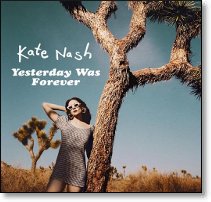
Kate Nash: Yesterday Was Forever (2018, Girl Gang):
English singer-songwriter, also acts, which kept her busy the last
five years, between albums three and four. This one seems more
scattered, but all four are terrific.
A-
Meshell Ndegeocello: Yesterday Was Forever (2018,
Naïve): Singer-songwriter, originally Michelle Lynn Johnson, plays
bass and other instruments, "sparked the neo soul movement," lately
has feigned toward jazz -- e.g., with her 2012 Nina Simone tribute.
Covers here: only one I got immediately was "Atomic Dog," but seems
like all have been stretched out to make them more sinuous (if not
necessarily sensual).
B+(*)
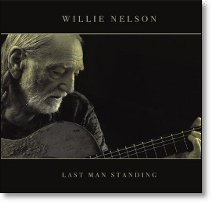
Willie Nelson: Last Man Standing (2018, Legacy):
New songs, working harder to prove he ain't dead yet than he has
in quite some time. Gives him a new perspective on life.
A-
Angelika Niescier Trio: The Berlin Concert (2017
[2018], Intakt): German saxophonist, alto mostly, discography
dates back to 2000. Trio, with Christopher Tordini on bass and
Tyshawn Sorey on drums.
B+(***) [cd]
Nuance Crusaders: Reflections (2017, Blujazz):
Compositions by Mark R. Baldridge, lyrics (not many) by Andrea
Litzenberger, played by other musicians I've never heard of,
split into two tiers -- a sax/piano/bass/drums quartet and extra
guitar, sax, violin (OK, Diane Delin), and the Swing City Express
Big Band. Group name some kind of oxymoron, not that I'm inspired
to figure it out.
B- [cd]
Orquesta Akokán: Orquesta Akokán (2018, Daptone):
Afro-Cuban big band, "Akokán" a Yoruba word meaning "from the heart,"
recorded in Havana.
B+(***)
Juan Andrés Ospina Big Band: Tramontana (2017 [2018],
self-released): Colombian pianist, also in Banda Magda, with a sprawling
international big band -- I count ten countries represented, 27 musicians.
Plenty of Latin tinge, but not much more.
B [cd]
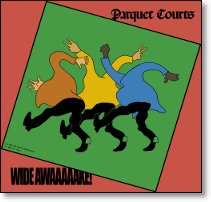
Parquet Courts: Wide Awake! (2018, Rough Trade):
Previously the most consistent Velvets-rooted alt/indie band in the
land, here they try to mix things up to sometimes odd effect, not
least by employing Dangermouse as producer. Still, half or more of
the songs come through as loud and clear as anything this year.
Not impossible that deeper exposure will tie up the rough edges.
A-
Jeremy Pelt: Noir En Rouge: Live in Paris (2018,
HighNote): Mainstream trumpet player, impressed early on with his
chops, but I've rarely been impressed by his records. (NB: I've
missed three well-received 2015-17 albums in the label drought.)
With Victor Gould (piano), Vincente Archer (bass), Jonathan Barber
(drums), and Jacquelene Acevedo (percussion).
B+(**)
Matt Piet & His Disorganization: Rummage Out
(2017 [2018], Clean Feed): Pianist, Chicago area, has a number of
records since 2015 -- the one I noticed was a trio with Dave Rempis
and Tim Daisy. This is a two-horn quartet with Josh Berman (cornet),
Nick Mazzarella (alto sax), and Daisy (drums), with piano rumble
filling in for the missing bass, as well as adding flourishes.
B+(***)
Matt Piet/Raoul van der Weide/Frank Rosaly: Out of Step:
Live in Amsterdam (2017, self-released): Avant piano trio,
pianist and drummer from Chicago, bassist local. Improvised live,
two pieces, intensely rhythmic.
B+(***) [bc]
Matt Piet/Paul Giallorenzo: Wood, Wire, and Steel
(2017, self-released): Two Chicago avant pianists, duets, both can
work up a sweat, or wax elegant.
B+(**) [bc]
Matt Piet & Tim Daisy: Strike One; Strike Two
(2017, self-released): Piano-drums duets, two pieces (35:38), strikes
hard.
B+(***) [bc]
Matt Piet: The Bitter Angles of Our Nurture (2017,
self-relesaed): Solo piano, one 40:32 piece. Strong performance,
especially rhythmically.
B+(**) [bc]
Prefuse 73: Sacrifices (2018, Lex): Electronica
producer Scott Herren, bunch of albums 2001-11, but this is only
second since. Gets catchier as it lumbers along.
B
Princess Nokia: A Girl Cried Red (2018, Rough Trade,
EP): New York rapper Destiny Nicole Frasqueri, first album turned some
heads, but this set of eight tracks (20:14) is something else, with
few raps and much singsong -- not so interesting, at least at first.
B+(*)
Charlie Puth: Voicenotes (2018, Atlantic): Pop star,
second album, strives to be soulful, claims to be danceable, sometimes
is.
B+(*)
Reggie Quinerly: Words to Love (2017 [2018],
Redefinition Music): Drummer, from Houston, third album, piano
trio (Orrin Evans) plus Jaleel Shaw on alto sax on 4/8 cuts,
plus lyrics and voice -- either Milton Suggs or Melanie Charles,
everyone reminding you they learned in church.
B [cd]
Rival Consoles: Persona (2018, Erased Tapes): British
electronica producer Ryan Lee West, fourth studio album plus bunches of
EPs. Attractive beats and colors, a couple notches above ambient.
B+(*)
Kristo Rodzevski: The Rabbit and the Fallen Sycamore
(2017 [2018], Much Prefer): Singer-songwriter from Macedonia, based
in New York, day job psychiatrist, also plays guitar, third album, gets
classified as avant-garde jazz but sounds more like the Go-Betweens.
The confusion is explained by the band: Mary Halvorson (guitar), Kris
Davis (piano), Ingrid Laubrock (tenor sax), Brian Drye (trombone),
Michael Blanco (bass), Tomas Fujiwara (drums and co-producer). OK,
they're slumming playing such straightforward rock, except that's not
all they do.
B+(***) [cd]
Rolo Tomassi: Time Will Die and Love Will Bury It
(2017 [2018], Holy Roar): British mathcore (progressive rock, hardcore
punk, art punk, post-hardcore) band, singer Eva Spence and synth player
James Spence the only constants since 2005. Not sure what the difference
between this and death metal, say, except this is consistently listenable,
not least because it regularly reverts to normal levels of volume and
rage. Still, more of both than I generally care for.
B+(***)
Saba: Bucket List Project (2016, Saba Pivot): Chicago
rapper Tahj Malik Chandler, underground, nice flow, several pieces
pivot back to bucket list concept.
B+(**)
Samo Salamon/Tony Malaby/Roberto Dani: Traveling Moving
Breathing (2017 [2018], Clean Feed): Slovenian guitarist,
composer, produced, his name along on the spine, the three names
in order on the cover. Not one of those albums where Malaby blows
the lid off, but nice shadings and a few strong runs.
B+(***) [cd]
Rob Schwimmer: Heart of Hearing (2018, Sunken Heights
Music): Pianist, also plays Theremin and Haken Continuum (a variable
pitch control surface, although software can split the space up into
scales). Mostly solo, although there is a credit for Jay Anderson
(bass) and Jeff Hirschfield (drums), and some voice. Some Chopin,
and several "Hallucinations on Popular Songs."
B- [cd]
Matthew Shipp: Zero (2018, ESP-Disk): Solo piano.
Recognizable with his bold march through dense block chords, but
doesn't do much to lively up the progression. Indeed, most song
titles return to zero.
B+(*)
Matthew Shipp Quartet: Sonic Fiction (2018, ESP-Disk):
His regular piano trio -- Michael Bisio (bass) and Whit Dickey (drums) --
plus Polish saxophonist Mat Walerian (lto sax/bass clarinet/clarinet),
whose led several recent albums with Shipp. Has some flair when they're
all working together, but dull spots in between.
B+(**)
Susana Santos Silva: All the Rivers: Live at Panteão Nacional
(2016 [2018], Clean Feed): Portuguese trumpet player, prolific since
2013, solo here, also credited with tin whistle and bells, one 42:04
track, aiming at picking up resonance from the "marble acoustics and
huge reverberation" of Santa Engrácia's Church in Lisbon.
B+(**)
Edward Simon: Sorrows & Triumphs (2017 [2018],
Sunnyside): Pianist from Venezuela, dozen or so albums since 1995.
Terrific sax solo on the opener (David Binney), nice piano throughout,
guests include Adam Rogers (guitar), Gretchen Parlato (vocals), and
the Imani winds (flute, oboe, bassoon, clarinet, French horn), in
declining order of interest.
B+(*) [cd]
Sly & Robbie Meet Nils Petter Molvaer Feat. Eivind Aarset
and Vladislav Delay: Nordub (2016 [2018], Okeh): Risks
too many cooks, although reggae's premier rhythm section usually
work within the borders of the Norwegian trumpeter's jazztronica --
the main difference being the extra resonance of acoustic drums.
Aarset is Molvaer's usual guitarist, so I'm not sure why he gets
billing while keyboardist/producer Jan Bang doesn't -- probably
because Delay's electronics seek to square the circle.
A-
Gary Smulyan: Alternative Contrafacts (2017 [2018],
SteepleChase): Baritone saxophonist, broke in with Woody Herman in 1978,
a dozen or so albums since 1991, often near the top of DownBeat's
polls but I haven't heard much. Describes contrafacts as "a music making
method that shares the chord progressions with other compositions" --
credits here include Mal Waldron, Jimmy Giuffre, Al Cohn, Ted Curson,
Coleman Hawkins, one original. Trio with David Wong (bass) and Rodney
Green (drums). Good showcase for his horn.
B+(***)
Soccer Mommy: Clean (2018, Fat Possum): Sophie
Allison, born in Switzerland but grew up in Nashville. First album
after some DIY dating back to 2015. Acoustic guitar strum, tuneful,
attractive, starts stronger than it ends.
B+(**)
Soccer Mommy: Collection (2017, Fat Possum): Eight
songs, 27:13, cheap keyboard and electric guitar on cover but her
main instrument is acoustic guitar. One song recycled from her debut
EP but time suggests it was recut and I'm not locating the others,
so the suggestion that this is her label-signing DIY retrospective
is unconfirmed.
B+(*)
Sonar With David Torn: Vortex (2017 [2018], RareNoise):
Swiss band (two guitars, electric bass, drums), handful of albums
including two on Cuneiform and two on Nik Bärtsch's Ronin Rhythm
Records (one with Markus Reuter). Classified math/art/prog rock,
which doesn't mean much to me. This is instrumental with strong
guitar riffing, probably the band's default but also guitarist
Torn's preferred metier.
B+(***) [cdr]
Speedy Ortiz: Twerp Verse (2018, Carpark): Band
led by Sadie Dupuis, named after a comic book character, third
album. Long on guitar, some attractive thrash, not much I can
make sense of.
B+(*)
Jon Rune Strøm Quintet: Fragments (2017 [2018],
Clean Feed): Norwegian bassist, both acoustic and electric, leads
a group with Thomas Johansson (trumpet), André Roligheten (tenor
sax), Christian Meaas Svendsen (more bass), and Andreas Wildhagen
(drums). Some strong ensemble work, plus bass duets.
B+(**)
Hans Teuber & Jeff Johnson: Deuce (2017 [2018],
Origin): Saxophone and bass duets, Teuber credited with tenor, alto,
and alto flute. Couple standards, mostly joint compositions. Easy
as these things go.
B+(*) [cd]
Henry Threadgill: Double Up, Plays Double Up Plus
(2017 [2018], Pi): Threadgill's Ensemble Double Up debuted in 2015,
recording Old Locks and Irregular Verbs, the Jazz Critics
Poll album of 2016. The idea was two alto saxes, two pianos, and
two . . . well, one each: tuba, cello, drums. "Plus" adds a third
piano -- unless the point is it takes two pianists (David Bryant
and Luis Perdomo) to replace Jason Moran. Threadgill doesn't play
(Curtis Macdonald and Roman Fíliu return on alto), but composed
the tricky, slippery score. Not quite the tour de force of the
previous album, but perhaps he was thinking ahead to his larger
ensemble.
A- [cd]
Henry Threadgill 14 or 15 Kestra: Agg: Dirt . . . and More
Dirt (2017 [2018], Pi): Recorded over three days starting
on the date of Double Up, the group expanded from 8 to 15,
with composer Threadgill (alto sax, flutes) and producer Liberty
Ellman (guitar) joining in, two trumpets, two trombones, bass, an
extra drummer, but only two pianists (Davids Bryant and Virelles).
Two pieces in multiple parts, alternately grand and fancy. Takes
a while to sink in.
A- [cd]
Tune-Yards: I Can Feel You Creep Into My Private Life
(2018, 4AD): Singer-songwriter Merrill Garbus, with Nate Bronner on
bass and co-credited on all tracks. Fourth album, the first three
huge critical favorites, especially among Christgau's followers --
second album, Whokill, won the Pazz & Jop poll -- but
this one doesn't seem to be anyone's fave (Metacritic score 79 on
31 reviews, so not ignored). Alfred Soto panned it as "for fans
only." I've never been one, embracing neither the glitchiness nor
the warble, but I can't say this is inferior to her other work.
Well, perhaps less personable.
B
Kali Uchis: Isolation (2018, Virgin EMI): Pop
singer, born in Colombia but raised in Virginia, real name Karly
Loaiza, her stage name seems to have been a childhood nickname.
First album after a mixtape. Doesn't really fit under any of the
assigned genres (hip hop, Latin, funk/soul; I've also seen bossa
nova, reggaeton, and trip hop mentioned). Joe Levy tried "vintage
and futuristic." Not especially glitzy, but it does grow on you,
not like anything you'd expect, but still cozy comfortable.
A-
Marike Van Dijk: The Stereography Project Feat. Jeff Taylor
and Katell Keinig (2018, Hert/Membran): Dutch alto saxophonist,
seems to be based in Brooklyn, released a previous record called The
Stereography Project in 2015 so I adjusted the title here. Two sets
of songs, the first five written and sung by Taylor, the remaining six
by Keinig, all arranged by Van Dijk, with two distinct groups. Plodding,
Rather arty.
B [cd]
Vin Venezia: Fifth and Adams (2015-16 [2018], Blujazz):
Guitarist, haven't found any bio or previous albums but a picture shows
gray hair. Recorded over three sessions with varied casts, including a
duo with guitarist Mike Stern, another with percussionist Manolo Badrena,
but most with David Budway (piano/organ), Harvie S (bass), and Richie
Morales (drums), plus Bob Magnuson (tenor sax) on the opener.
B [cd]
WoodWired: In the Loop (2017 [2018], UT Arlington):
Duo, Drs. Cheyenne Cruz (bass clarinet) and Hannah Leffler (flute),
based in Dallas, the former teaches at UT Arlington, the latter
graduated from and teaches at UNT. Don't see any other credits but
their website notes "their groundbreaking use of live electronics
in a chamber music setting" -- sounds like drums to me, plus the
occasional bird tweet. The two instruments sound good together,
and the extra rhythm helps.
B+(**) [cd]
Wussy: Getting Better (2018, Damnably, EP): Talk
about stopgap efforts: four songs, all covers, 13:35, the title
song from the Beatles, striking me first as a nobel gesture despite
overwhelming evidence to the contrary, then ultimately as bitter
irony. Don't know the other songs: "Runaway," "Nomenclature,"
"Retarded."
B+(*)
Wussy: What Heaven Is Like (2018, Shake It): The
Cincinnati group's shoegaze album: lots of jangly guitar drowning
out the two vocalists, who elsewhere usually have something to say.
Not that I have any complaints about the guitars.
B+(***)
The Xcerts: Hold on to Your Heart (2018, Raygun):
Scottish power pop trio, Murray Macleod the singer-guitarist, a bit
over the top for my taste but not exactly lacking in chops and/or
impression.
B
Darryl Yokley's Sound Reformation: Pictures at an African
Exhibition (2018, Truth Revolution): Tenor saxophonist,
also plays some alto, from Los Angeles but based in Philadelphia,
played in Captain Black Big Band. Second album, with Zaccai Curtis
(piano), Luques Curtis (bass), and Wayne Smith Jr. (drums), with
Nasheet Waits (drums) listed as "special guest." Draws inspiration
from painter David Emmanuel Noel, also from Mussorgsky. Sounds
like there are more horns than the credits show. I was losing track
and interest, but the sax storm in "Genocide March" shook me.
B [bc]
Young Fathers: Cocoa Sugar (2018, Ninja Tune):
Scottish trio, two black (one born in Liberia, the other second
generation from Nigeria). I initially filed them as hip-hop, but
they sing more than rap. I never warmed to their two previous
albums or two earlier mixtapes, but this is pretty solid all
around and not much like anything else.
A-
YoungBoy Never Broke Again: Until Death Call My Name
(2018, Never Broke Again/Atlantic): Rapper Kevin Gaulden, from Baton
Rouge, age 18, first album after a stack of mixtapes starting April
2015. Still, nothing here suggests teen rap.
B+(**)
Recent Reissues, Compilations, Vault Discoveries
Eliane Elias: Music From Man of La Mancha (1995 [2018],
Concord): Brazilian pianist, started singing mid-career but sticks
with piano here, backed by Marc Johnson (bass) and Satoshi Takeshi
(drums) or Eddie Gomez (bass) and Jack DeJohnette (drums), with
Manolo Badrena (percussion) on 8/9 tracks. The music is from the
1964 musical rendition of the Don Quixote story -- not all
that familiar, but she gives it a strong ride.
B+(*)
William Parker: Voices Fall From the Sky (1993-2018
[2018], AUM Fidelity, 3CD): Legendary bassist, has composed hundreds
of pieces since 1971 (the earliest date here), occasionally songs
with lyrics like his 1991-93 Song Cycle, which provides the
earliest songs here. Results have been decidedly mixed -- by far my
favorite is the Raining on the Moon group with Leena Conquest.
The old recordings on CD-2 suggest a compilation, but nearly everything
else has been recorded over 2017 sessions (lapping into January 2018),
so the set is much more new than not. Parker uses various musicians
and no less than 17 vocalists -- some I recognize from past efforts
or from their own notable jazz careers (like Fay Victor), but many I
don't. It would take me many hours to sort this all out, but the main
thing I'm struck by in two passes is how much of it I never want to
hear again: operatic sopranos, arch art-song, avant-warbling. Doesn't
all grate, but enough does to make me want to move on.
B [cd]
Liz Phair: The Girly Sound Tapes (1991 [2018], Matador,
3CD): Phair recorded as Girly-Sound three cassettes of solo demos --
just guitar and voice -- a couple years before her career took off in
1993 with the instant classic Exile in Guyville. There's a 25th
Anniversary box, Girly-Sound to Guyville available cheap ($22)
as 3-CD or expensive ($100) as 7-LP which combines the album with the
demos, but streaming sources have this alternative: just the demos --
eleven recut for Exile in Guyville, more that trickled out on
later albums. I played these in two long stretches, finding the first
stretch compelling, still fresh and striking after a quarter century,
the second a bit less so.
[Amazon prices above; Matador's own store has cheaper prices, except
that the demo-only The Girly Sound Tapes MP3 costs more than the
3-CD Girly Sound to Guyville. Caveat emptor.]
B+(***)
Liz Phair: Girly-Sound to Guyville: The 25th Anniversary
Boxset (1991-93 [2018], Matador, 3CD): Classic album on first
disc, demo cassettes crammed into two more, and actually cheaper on
CD than MP3.
A-
Otis Redding: Dock of the Bay Sessions (1967 [2018],
Rhino): Dead in a plane crash at age 26, four of his first five
albums (1964-66) went top-10 r&b, but peaked at 54 on the pop
charts, with his Carla Thomas duets (King & Queen) and
his Live in Europe (both 1967) doing only slightly better.
He cut many singles, but 21 and 25 were his highest places. Then,
after his death, "(Sittin' on) The Dock of the Bay" hit number one,
the album number four. More posthumous releases -- four through 1970,
and a half dozen live albums -- trickled out. The Dock of the Bay
album was thrown together to cash in on the single, mostly collecting
singles dating back to 1965. This recapitulates the hit in the context
of contemporary recordings -- I haven't seen any dates, so I don't know
how tight the window is, but there isn't any patter or false starts:
all twelve songs are in finished form, making this effectively a
sampler of Redding posthumous albums: The Immortal Otis Redding
(5 cuts), Love Man (3), and Remember Me (2).
B+(***)
Old Music
Tommy Flanagan: Giant Steps: In Memory of John Coltrane
(1982, Enja): Piano trio, with George Mraz (bass) and Al Foster (drums),
playing six Coltrane tunes, starting with the infections "Mr. P.C." Slows
down a bit for "Naima" but then ends on a rousing "Giant Steps."
A-
Bettye LaVette: Tell Me a Lie (1982, Motown): Born in
Michigan, raised in Detroit, cut a single in 1962 when she was 16, a
few more over the decade, an album for Atco in 1972 that got shelved,
and a decade later this one-shot. Huge voice, already sounds dated --
a plus on the soul ballads, if not the disco.
B+(**)
Bettye LaVette: Child of the Seventies (1962-73 [2006],
Rhino Handmade): "The Complete Atlantic/Atco Recordings": her previously
unreleased 1972 Muscle Shoals album, two 1972 singles plus an unreleased
one from December 1973, topped off with four tracks from 1962 singles,
back when she was 16. The lost album is no great shakes, but not really
because the singer came up short -- the Muscle Shoals crew is a little
loose. The early singles aren't unforgettable, but they deserve notice.
B+(*)
Bettye LaVette: I've Got My Own Hell to Raise (2005,
Anti-): Her breakthrough album was A Woman Like Me, released on
a small label in 2003. That got her a contract with a notable indie
rock label, one with scant experience in r&b but willing to let
her do her thing.
B+(**)
Bettye LaVette: Worthy (2015, Cherry Red): Everything
she sings sounds like a struggle, and most of the time she overcomes.
B+(**)
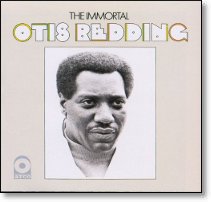
Otis Redding: The Immortal Otis Redding (1967 [1968],
Atco): Second posthumous album, short (30:01), eleven songs from three
weeks of sessions just weeks before his death -- but only five on the
new Dock of the Bay Sessions -- starting with the magnificent
"I've Got Dreams to Remember" and ending with "Amen." Not sure why
they sound so much better here.
A-
Otis Redding: Tell the Truth (1967 [1970], Atco):
Fourth posthumous album, following Love Man. "Demonstration"
shows they haven't hit the bottom of the barrel yet, but the fact
that they didn't bother with a fifth one until 1992 suggests they
were beginning to harbor doubts. Still, some terrific stuff here.
Who else has ever been able to credibly cover James Brown and
Little Richard?
B+(***)
Otis Redding: Remember Me: 22 Previously Unissued Tracks
(1962-67 [1992], Stax): No dates on these tracks, but Redding joined
Stax in 1962 and died in 1967 and several compilations I have dates for
reflect that. Redding's leftovers got combed through pretty thoroughly
after his death, so you might not expect much here. The last eight cuts
are alternate versions, including two takes of "The Dock of the Bay,"
but the first fourteen would make a remarkable album -- indeed, they've
been released separately as It's Not Just Sentimental.
B+(***)
Gary Smulyan Quartet: Homage (1991 [1993], Criss Cross):
Baritone saxophonist, probably his second album (after the Quintet
The Lure of Beauty), album notes "featuring Tommy Flanagan"
(piano), but also notable are Ray Drummond (bass) and Kenny Washington
(drums). The rhythm section is right at home playing eight songs written
by the homage subject, fellow baritonist Pepper Adams.
B+(***)
Gary Smulyan: The Real Deal (2002 [2003], Reservoir):
Mainstream quintet, two originals by the baritone saxophonist and a batch
of standards and jazz covers, with Joe Magnarelli (trumpet/flugelhorn),
Mike LeDonne (piano), Dennis Irwin (bass), and Kenny Washington (drums).
B+(*)
Notes
Everything streamed from Napster (ex Rhapsody), except as noted in
brackets following the grade:
- [cd] based on physical cd
- [cdr] based on an advance or promo cd or cdr
- [bc] available at bandcamp.com
Ask a question, or send a comment.
Monday, May 28, 2018
Music Week
Music: current count 29759 [29733] rated (+26), 344 [351] unrated (-7).
Rated count down a bit. I spent most of Monday and Tuesday cooking
a fairly large Indian dinner to mark my late sister's birthday, so I
took the time to enjoy old favorites. After that, I made a small dent
in my CD queue, which had partly been impoverished by my picking out
the most promising titles earlier this month. Still, I expected good
things from François Carrier's latest -- largely delivered, although
I detected a bit of unsteadiness compared to recent efforts -- and a
3-CD William Parker collection. The latter samples Parker's 1991-93
Song Cycle (with Ellen Christie and Lisa Sokolov), adds some
later vocal pieces, and throws in two discs of new recordings. I find
most of them hard to take -- an aversion to opera, art song, and avant
warble I've long held.
I also sought out some recent Clean Feed releases -- long my favorite
label but less so since they stopped servicing me. I also found a few
recent HighNote/Savant releases on Napster -- back catalog isn't there
yet, but one hopes -- and took a look at Chicago pianist Matt Piet's
Bandcamp pages (but didn't bite on the 3-hour Live in Chicago).
Also checked out Robert Christgau's
latest picks (Frankie Cosmos and Speed Ortiz; I had already played
his HMs), and Prefuse 73 (a friend was curious). Still, none of those
struck me as A- records: Carrier came closest, and Piet impressed me
as someone worth keeping an ear open for.
Expect a Streamnotes compilation by the end of the month. I currently
have 19 new A/A- releases (plus one new compilation), which is actually
well above average for a month. The
2018 A-list only totals 40 so far,
so nearly half of them have come in May. Ignoring January (usually just
previous year catch-up) that comes to 10/month, or 120/year. That's
actually a bit down from
2017, which totals 144 new A-list
records (including 5 added since the Jan. 31, 2018 freeze date).
I have 320 new records rated so far this year, so an average of
80/month, projected to 960 for the year. For 2017 the current total
is 1177 (42 added since freeze date), so I'm down a bit this year.
No real surprise given how the year has gone. The May Streamnotes
draft file currently has 128 new records (including compilations),
well above my average this (or practically any) year.
Not much unpacking this week, but after reports that Cuneiform
had closed down back in January, I was very pleasantly surprised
to see two new Thumbscrew (Mary Halvorson) records show up in my
mail box.
New records rated this week:
- Bill Anschell: Shifting Standards (2017 [2018], Origin): [cd]: B+(***)
- Tiffany Austin: Unbroken (2018, Con Alma): [cd]: B+(*)
- Andrea Brachfeld: If Not Now, When? (2017 [2018], Jazzheads): [cd]: B+(*)
- Jonas Cambin Trio: We Must Mustn't We (2018, Clean Feed): [r]: B+(***)
- François Carrier/Michel Lambert/Rafal Mazur: Beyond Dimensions (2016 [2018], FMR): [cd]: B+(***)
- Dan Cavanaugh/Dave Hagedorn: 20 Years (2017 [2018], UT Arlington): [cd]: B+(*)
- Freddy Cole: My Mood Is You (2018, HighNote): [r]: B+(***)
- Frankie Cosmos: Vessel (2018, Sub Pop): [r]: B+(***)
- Dead Composers Club [Noah Preminger/Rob Garcia]: Chopin Project (2017 [2018], Connection Works): [cd]: B
- Kat Edmonson: Old Fashioned Gal (2018, MRI): [r]: B+(*)
- Danny Green Trio Plus Strings: One Day It Will (2017 [2018], OA2): [cd]: B+(**)
- Tyler Higgins: Blue Mood (2016 [2018], Shhpuma): [r]: B+(*)
- Amos Hoffman/Noam Lemish: Pardes (2017 [2018], self-released): [cd]: B+(*)
- Azar Lawrence: Elementals (2018, HighNote): [r]: B+(**)
- Mike LeDonne and the Groover Quartet: From the Heart (2018, Savant): [r]: B+(*)
- Ben Markley Quartet: Basic Economy (2017 [2018], OA2): [cd]: B+(**)
- Deanne Matley: Because I Loved (2018, self-released): [cd]: B+(*)
- Jeremy Pelt: Noir En Rouge: Live in Paris (2018, HighNote): [r]: B+(**)
- Matt Piet: The Bitter Angles of Our Nurture (2017, self-released): [bc]: B(**)
- Matt Piet/Paul Giallorenzo: Wood, Wire, and Steel (self-released): [bc]: B+(**)
- Matt Piet & Tim Daisy: Stroke One; Strike Two (self-released): [bc]: B+(***)
- Matt Piet/Raoul van der Welde/Frank Rosaly: Out of Step: Live in Amsterdam (2017, self-released): [bc]: B+(***)
- Prefuse 73: Sacrifices (2018, Lex): [r]: B
- Speedy Ortiz: Twerp Verse (2018, Carpark): [r]: B+(*)
- WoodWired: In the Loop (2017 [2018], UT Arlington): [cd]: B+(**)
Recent reissues, compilations, and vault discoveries rated this week:
- William Parker: Voices Fall From the Sky (1993-2018, AUM Fidelity, 3CD): [cd]: B
Unpacking: Found in the mail last week:
- Gene Jackson Trio NuYorx: Power of Love (Whirlwind)
- Jure Pukl: Doubtless (Whirlwind)
- Ratatet: Heroes, Saints and Clowns (Ridgeway): June 22
- Thumbscrew: Ours (Cuneiform): June 8
- Thumbscrew: Theirs (Cuneiform): June 8
Ask a question, or send a comment.
Sunday, May 27, 2018
Weekend Roundup
I started assembling and writing some of this as early as Thursday
this week, shortly after Trump cancelled his much hyped Singapore
summit with Kim Jong-un, and I haven't been able to catch up with
such later news as
Kim Jong-un Meets With South Korean Leader in Surprise Visit and
US Officials Meet With North Koreans to Discuss Summit. It was a
pretty good initial guess that John Bolton was at the root of the
cancellation, first by poisoning the well with his insistence that
North Korea surrender its nuclear weapons like Libya did in 2004,
and finally by whispering into the gullible president's ear that if
he didn't cancel, Kim would beat him to the punch. As I note below,
if the two Koreas can proceed to their own deal, it really won't
matter much what Trump and Bolton think. And by the way, I think
it's safe to say that Trump's 3rd National Security Adviser won't
be his last. While Bolton hasn't flamed out as fast as Anthony
Scaramucci -- indeed, he may even outlast Michael Flynn (who
resigned after a little more than three weeks) -- he's embarrassed
Trump is a way that won't soon be forgotten.
Also on death watch is Rudy Giuliani, who's managed to make Trump
look even guiltier while trying to polarize political reaction to
the Mueller investigation, figuring that as long as he can keep his
base from believing their lying eyes he'll survive impeachment, and
as long as that happens he can pardon the rest.
Some scattered links this week:
Matthew Yglesias: No "4 most important stories this week,"
or maybe just no clue
how to explain them? My nominations for the top four stories:
President Trump cancelled his planned summit with Kim Jong-un;
Neither North Korea nor Iran are taking Trump's rejection and
threats as provocations to belligerence; Trump hatched "spygate"
to further politicize the Mueller investigation; Ireland voted
to legalize abortion.
Still, a busy week's worth of posts for Matthew Yglesias:
NFL owners are stifling speech, but it's not called "no-platforming"
when you're rich and own the platform: "Real power over the flow
of ideas rests with the wealthy." Argues that the rich -- and when
we're talking NFL franchise owners, we're talking very rich -- don't
always use their wealth to promote their political interests (clearly
he hasn't worked for the Kochs) they can and do when it makes sense
to their bottom line.
The good news for free speech is that rich people generally like money,
and this operates as a practical constraint on the extent to which they
use their control of platforms for political purposes. NFL owners are a
conservative-leaning bunch, for example, but they aren't going to subject
fans to pregame lectures about the merits of tax cuts because they don't
want to annoy the audience.
But one luxury of being rich is you can sacrifice some financial upside
for political purposes if you want to. A recent paper by Emory University
political scientists Gregory Martin and Josh McCrain found that when
Sinclair Broadcast Group, a legendarily right-wing network of local TV
stations, buys a station, its local news programs begin to cover more
national and less local politics, the coverage becomes more conservative,
and viewership actually falls -- suggesting that the rightward tilt isn't
enacted as a strategy to win more viewers but as part of a persuasion
effort.[*]
Martin and Ali Yurukoglu, meanwhile, found in a separate study that
without Fox News's slanted coverage, the Republican presidential candidate's
share of the two-party vote would have been 3.59 points lower in 2004 and
6.34 points lower in 2008. The Koch brothers have started using their
financial clout to buy influence on college campuses, making generous
contributions in exchange for a role in hiring faculty members. Google
spends millions of dollars a year sponsoring academic research that it
hopes will influence both mass and elite opinion in favor of Google-friendly
policy conclusions, and it's obviously not the only wealthy business that
does this.
Most cases are, of course, going to be less extreme but still
significant. An old quip by Anatole France notes that "the law, in its
majestic equality, forbids the rich as well as the poor to sleep under
bridges, to beg in the streets, and to steal bread." By the same token,
the rich and the poor alike have the right to buy a chain of local
television news stations or NFL franchises, but in practice, only the
rich actually can control the flow of information.
One should note [*] that Sinclair's substitution of national for
local news is also a cost-cutting (profit-enhancing) feature, as local
news is generally of interest only to its local market, whereas national
stories can be sourced anywhere and reused everywhere. The Kochs, by
the way, have been buying academic favors at least since the 1980s,
when they founded Cato Institute and bankrolled James McGill Buchanan
(see Nancy McLean's Democracy in Chains: The Deep History of the
Radical Right's Stealth Plan for America; by the way, I saw a line
just this week insisting that the Nobel Prize for Economics isn't given
out to marginal cranks, but Buchanan disproves that).
For more on the NFL, see:
Benjamin Sachs: The NFL's "take a knee" ban is flatly illegal.
Donald Trump's posthumous pardon of boxing champion Jack Johnson,
explained: "A case where breaking norms helps get the right thing
done." By all means, read if you don't know who Johnson was (or think
he's a white folksinger). I learned about the first black boxing champ
back in the 1960s -- not just his boxing career and taste for white
women but that he was also into fast cars -- especially through Howard
Sackler's 1967 play The Greate White Hope (a stage and screen
breakthrough for James Early Jones), soon followed by one of Miles
Davis' greatest albums (A Tribute to Jack Johnson). Johnson's
Mann Act conviction was unjust, but not unique (the same law was used
to jail Chuck Berry in the 1950s), and indeed the period was so full
of racial injustice that it would be mind-boggling even to try to
recognize it all. On the other hand, if Trump's pardon of Johnson
is anything more than a cheap publicity stunt, all it signals is
Trump's identity with famous people, and his sense that pardoning
a black man who died 70 years ago won't ruffle his base (especially
after his much more consequential pardon of racist sheriff Joe
Arpaio).
Why did anyone ever take Trump's North Korea diplomacy seriously?
Sure, there's never been any reason to take Trump's understanding of
either war or diplomacy with North Korea seriously. However, most US
military experts really want to avoid war with North Korea, and that
group clearly includes Secretary of Defense Mattis. On the other hand,
Trump has glibly promised "to take care of" the pseudo-problem of
North Korea's nuclear arsenal. I say "pseudo-problem" because it's
pretty clearly only meant as a deterrent and/or bargaining chip,
not as the offensive threat that Trump seems to think. As long as
the US and its allies don't attack North Korea, there's no reason
to think that North Korea will attack us -- it would, after all, be
a purely psychotic thing to do. So the simplest solution would be
to just ignore the supposed provocation, but Trump and the neocon
hawks won't tolerate anything that might make the US look weak, or
sensible. However, it has always seemed possible that North and
South Korea could work out their own deal, which Trump would be
hard-pressed not to go along with. One always hopes that sanity
will prevail over war, so it was tempting to humor Trump as long
as he raised that possibility. Unfortunately, a lot of so-called
experts in America have been taking pot-shots at the prospect,
some (like John Bolton and Mike Pence) because they want to keep
any agreement from happening), and some (like Yglesias) because
they regard Trump as a dangerous and/or delirious buffoon.
DOJ is giving a special partisan briefing on the Trump-Russia investigation
to GOP Congress members.
Most Americans don't realize Robert Mueller's investigation has uncovered
crimes: "17 indictments and five guilty pleas so far." Yet the chart
shows that 59% of Americans don't think the investigation has uncovered
any crimes. For more details, see
Andrew Prokop: All of Robert Mueller's indictments and plea deals in the
Russia investigation so far.
3 winners and 3 losers from primaries in Georgia, Texas, Kentucky, and
Arkansas: Winners: the DCCC (defeated Laura Moser in TX-7); Medicaid
expansion; black Democrats. Losers: the GOP mobilization strategy; Our
Revolution; Georgia Republicans.
Stacey Abrams just won a shot to be the first black woman governor in
America.
Bank profits hit a new all-time record as Congress is poised to roll back
post-crisis regulations
The media ignored the policy stakes in 2016 -- don't make the same mistake
again in the midterms: This starts out sounding like a critique of
the media problem, as even the less partisan media, through a combination
of sloth and greed, favors cheap clickbait over wonkish policy matters:
The policy stakes in the 2016 elections were high -- because the stakes
are high in all elections -- and yet television news coverage of the
election utterly failed to convey the stakes, with more attention paid
to the Clinton email issue than to all policy issues combined.
Trump as an actual president has received more critical scrutiny
than he did as a long-shot candidate, but even so, the coverage thus
far of the 2018 midterms has focused very heavily on Trump drama rather
than the concrete stakes. But if the GOP holds its majorities -- not
currently considered the most likely scenario, but one for which the
odds are decent -- there are a range of policies very likely to move
forward that will have enormous consequences for the everyday life
of millions of people.
Yglesias also notes that a Democratic Congress would present Trump
with a very different set of opportunities: instead of relying on Ryan
and McConnell to force straight party-line votes, he'd have to make
some reasonable concessions to gain at least a few Democratic votes,
which would make his administration less extremist and polarizing. The
problem here is that the so-called moderation or unorthodoxy of Trump's
campaign really seems to have been nothing but an act, and he may have
revealed his true colors in tossing it aside. (Or it may just be that
his understanding of real issues is so shallow that his instinct for
pomposity and cruelty is all he really has to fall back on.)
Trump backs away from China trade war, while a Trump development gets a
$500 million Chinese loan:
Many Republicans in Congress are clearly aware that something fishy is
happening with ZTE. And journalists are clearly noting that Trump is
contradicting some very clear campaign promises on Chinese trade in
general.
But while the GOP-led Congress has extensive oversight powers that
could be used to check Trump's conflicts of interest, they uniformly
decline to use any of them, leaving America to depend on nothing more
than Trump's say-so and goodwill for as long as the GOP retains the
majority.
And journalists who cover the Trump administration's infighting and
intrigue seem inordinately reluctant to so much as mention the conflict
of interest when covering these issues.
Noah Berlatsky: The Trump effect: New study connects white American
intolerance and support for authoritarianism
Chas Danner: Ireland Votes Overwhelmingly to Legalize Abortion; also
Barbara Wesel: A triumph for women and for Ireland.
Tara Golshan: John McCain's shocking concession on the Iraq War: it was
a "mistake": Not that he ever harbored doubts, let alone opposed,
the war at any time when his opposition could have made a difference.
But on his death bed, he explains his change of heart: "I sacrificed
everything, including my presidential ambitions, that it would succeed."
Makes you wonder whether he has any other second thoughts about the many
wars he championed. For instance, is he still upset that the US didn't
go to war against Russia to support Georgia's claim to South Osetia?
McCain's concession is reportedly in a new book he's had ghost-written
for him. There's also a hagiographic documentary film, For Whom the
Bell Tolls, which Matt Taibbi reviews in
John McCain's Revisionist History Is a Team Effort. Taibbi writes
a lot about McCain and Iraq, but doesn't seem to have gotten the memo
on what a mistake McCain thinks it was. He does, however, note other
mistakes McCain has admitted, like picking Sarah Palin as his running
mate, but only to show how the movie glosses them over.
Eric Levitz: America's Version of Capitalism Is Incompatible With
Democracy: This follows up on
Jedediah Purdy: Normcore, which I cited previously.
Josh Marshall: Stop Talking about 'Norms':
But we need to stop talking so much about norms. Because it doesn't
capture what is happening or the situation we're in. In every kind of
communication, clarity is the most important thing. By talking so much
about "norms" and the violation of "norms" we're confusing the situation
and even confusing ourselves. . . .
I've noted something similar about the language of "conflicts of
interest." I have heard many people claim that that $500 million
Chinese state loan to a Trump Organization partnership development
in Indonesia is a "conflict of interest." Whether or not you think
that is the best example there are many others to choose from: Jared
Kushner hitting up the Qataris for loans for his family business
empire while supporting a blockade of their country or pressuring
foreign governments and political groups to use the President's DC
hotel or a million other examples.
These are not "conflicts of interest." A "conflict of interest"
is a case in which the nature of a situation makes it impossible
for a person to separate their personal interests from their public
responsibilities (or to appear to do so). All recent Presidents put
their private wealth into blind trusts. We assume they weren't going
to try to make money off the presidency in any case. But they wanted
to remove any question of it and avoid situations where their own
financial interests would bump up against their public responsibilities.
What we're seeing now are not conflicts of interest. They're straight-up
corruption. It's like "norms." Defining "conflicts of interest" is meant
to keep relatively honest people on the straight and narrow or create
tripwires that allow others to see when people in power are crossing
the line. Nothing like that is happening here. We have an increasingly
open effort to make vast sums of money with the presidency.
Tom McCarthy: Rudy Giuliani admits 'Spygate' is Trump PR tactic against
Robert Mueller. The first I heard of "spygate" (not yet so-named)
was when Trump demanded that the DOJ investigate the FBI for infiltrating
his 2016 campaign "for political purposes." My first reaction was, well,
yeah, everyone who suspected the FBI of infiltrating their political
organizations should also demand an investigation. Like most of Trump's
charges against the FBI, this resonates because this is the sort of
thing the FBI is famous for doing (although usually not targeting the
likes of Donald Trump -- although there is little doubt but that J.
Edgar Hoover kept files on politicians, including three who routinely
renominated Hoover to head the FBI: Kennedy, Johnson, and Nixon). After
all, when Tim Weiner wrote his history of the FBI, his chosen title
was Enemies. Then I was reminded of the definition of a gaffe:
when a politician inadvertently admits a truth that he isn't supposed
to say. Since he joined Trump's lawyer team Giuliani has been an
extraordinary fount of gaffes -- this being just one more example.
Jonah Shepp: Trump's Credibility Problem Is Now America's: At
the end of WWII, the United States commanded fully half of the world's
wealth. In a moment of extreme arrogance, George Kennan said that
preserving that degree of dominance should be the goal of American
foreign policy. It was inevitable that the ratio would fall, but
Kennan's "containment policy" defined the Cold War and helped lead
to the strangulation and collapse of the Soviet Union and its allies.
By the time that happened, the US was scrambling to form NAFTA to
achieve economic parity with the European Union, but the cloistered
Cold War ideologues let their triumph go to their heads, proclaiming
the US the World's Sole Superpower -- some dubbed it the Hyperpower --
and went on advocate strangling any would-be rivals in the crib (not
that it wasn't already too late to head off China or Russia, or as we
now see, North Korea). But the fact is, American power has been in
decline ever since 1945 (or at least 1950, as the Korean War ground
to a stalemate). Sure, the US was able to keep up a semblance of an
alliance even to the present day, but that's mostly because the US
pays most of the "defense" costs and runs trade deficits which help
allied economies (and global corporations). Meanwhile, America's
credibility suffered, first with its pro- and post-colonial wars,
with its embrace of brutal and corrupt dictatorships, with trade
arrangements to collect monopoly rents, and with its control of
debt and imposition of austerity measures. Even America's vaunted
military has turned out to be somewhere between useless and down
right embarrassing. Remember when "shock and awe" was supposed to
cower Iraq into submission? Those who survived discovered they
could fight on, as they did, and in Afghanistan and elsewhere
continue to do. Had Trump merely followed his "America First"
campaign promises -- shaking "allies" down for more "defense"
spending while reversing their trading fortunes -- the long-term
decline already in place would have increased, but Trump's foreign
policy has been astonishingly erratic and incoherent. Indeed, the
only reason the world hasn't yet rejected and isolated the US as
the rogue state it's become is that most "allies" are unable to
grasp just what living in a post-American world might mean.
For decades, the free world has operated under the assumption that
the United States will act as its leader, using its might to advance
not only its own interests but also those of its kindred nations and
the international community writ large. Under Trump, the world is
finding that we can no longer be trusted to engage in consultation,
deliberation, or dialogue of any kind. Instead, we do whatever we
want (or whatever he wants) with no real concern for the impact our
decisions have on other countries, be they allies or adversaries.
When other countries behave this way, we have a word for it: We call
them rogue states. How long will our allies put up with this behavior
before they simply stop believing a word we say? And how long will
it take to repair that damage after the Trump era is over?
Actually, the "free world" has been a myth almost from the start,
and America's "leadership" has never been more than consensual ego
stroking. Neither of those things are recoverable, nor really are
they desirable. The problem with Trump isn't that he's shrinking
America's role in the world, but that he's trying to present his
retreat as arrogant self-indignation. It's sort of like the story
in Atlas Shrugged, where the entrepreneurs go on strike
expecting the world to collapse without them. But the rest of the
world hasn't needed America for some time now. As Bush's Iraq War
alliance crumbled, he coined the term "Coalition of the Willing"
to describe its remaining token members. All Trump has done has
been to remove America from the "Willing." Hopefully, the rest of
the world will step up -- as, in fact, we see happening after US
withdrawals from Paris, Iran, and Korea. Maybe, post-Trump, a
chastened US will join them.
Related to this, see
Mark Karlin: "Making America Great Again" Assumes That It Once Was,
an interview with David Swanson, author of Curing Exceptionalism:
What's Wrong With How We Think About the United States; also by
Karlin:
The United States Is a Force for Chaos Across the Planet, an interview
with Tom Engelhardt, author of A Nation Unmade by War. Engelhardt
edits
TomDispatch, where he's
published more relevant articles:
Alfred McCoy: The Hidden Meaning of American Decline: McCoy
recently published In the Shadows of the American Century: The
Rise and Decline of American Global Power:
As Trump has abrogated one international accord after another, observers
worldwide have struggled to find some rationale for decisions that seem
questionable on their merits and have frayed relations with long-standing
allies. Given his inordinate obsession with the "legacy" of Barack Obama,
epitomized in a report, whether true or not, of his ritual "defiling" of
his predecessor's Moscow hotel bed via the "golden showers" of Russian
prostitutes, there's a curious yet coherent logic to his foreign policy.
You might even think of it as Golden Shower diplomacy. Whatever Obama
did, Trump seems determined to undo with a visceral vehemence: the
Trans-Pacific trade pact (torn up), the Paris climate accord (withdrawn),
the Iran nuclear freeze (voided), close relations with NATO allies
(damaged), diplomatic relations with Cuba (frozen), Middle Eastern
military withdrawal (reversed), ending the Afghan war (cancelled),
the diplomatic pivot to Asia (forgotten), and so on into what already
seems like an eternity.
John Feffer: Korea's Two "Impossibles".
Karen Greenberg: Dismantling Democracy, One Word at a Time.
Richard Silverstein: Dead in the Water: Trump Middle East Peace Plan and
Pompeo's Iran Plan B: I can't say that I was ever aware that Trump's
minions even had plans for Israel-Palestine peace or post-JCPOA Iran.
Wishes, maybe, but since Bolton (in particular) clearly involves any
negotiations involving any degree of give-and-take as unacceptable signs
of weakness, the question is whether they can force the solutions they
prefer over the resistance of the forces they want to vanquish. In the
case of Israel-Palestine, that's a moot point, because Israel doesn't
want any kind of "peace process" -- in the past they've had to give lip
service to American aspirations, but they've got Trump so wrapped up
I doubt any pretense is necessary. As for Iran, all they have is vague
hopes for sanctions and prayers for some kind of popular revolt -- as
if they've forgotten that the last time that happened didn't bode well
for American hopes. More links on Israel-Palestine and/or Iran:
Emily Stewart: Congress finally found something it can agree on: helping
banks: A significant rollback of Dodd-Frank, considered "bipartisan"
because 33 Democrats in the House and 16 in the Senate (plus Angus King)
voted for it. Stewart also wrote:
Matthew Stewart: The 9.9 Percent Is the New American Aristocracy:
Long piece (plus some video), something I've barely skimmed and need
to look at in more depth, but argues that there is an aristocracy in
America ("toxic, and is fast becoming unbridgeable"), but that it's
bigger than the 1% made famous by Occupy Wall Street, let alone the
0.1% Paul Krugman likes to cite. The 9.9% slice simply comes from the
top decile not in the 0.1%. Also from The Atlantic, not yet
read but possibly interesting:
Ta-Nehisi Coates: I'm Not Black, I'm Kanye.
Alex Ward: The Trump-Kim summit is canceled: Includes Trump's
letter. Ward also wrote
South Korea is scrambling to figure out WTF just happened with the
Trump-Kim summit.
More links viz. Korea:
Zeeshan Aleem: The White House is hinting it could ramp up sanctions
against North Korea.
Perry Bacon Jr: Trump's handling of North Korea has been one of the few
things Americans liked about his presidency: At least until he
canceled the much-hyped summit. Note that he's currently -9 on Iran,
and -15 on immigration, but his lowest marks are on his cabinet: -25.
Zack Beauchamp: The real reason Trump's North Korea summit failed:
"Trump's goal -- getting rid of North Korea's nukes -- was always
impossible." More importantly, argues that "Trump's goal" is itself
unreasonable, and argues that instead we accept North Korea's nuclear
deterrent as credible and sufficient to deter any US aggression. The
question then is what would be a reasonable goal? The answer is to
take diplomatic steps to reduce the conflict: to limit the posture of
US troops in the region, and to unwind the sanctions which threaten
the regime and impose hardships on the Korean people.
Anna Fifield/Emily Rauhala: After summit pullout, South Korea and China
have little appetite for Trump's 'maximum pressure'.
Uri Friedman: How South Korea Pulled Trump and Kim Back From the
Brink.
Michael H Fuchs: Who knew diplomacy with North Korea was so hard?
Susan B Glasser: President Trump is a better dealbreaker than dealmaker:
On Tuesday, at a meeting with South Korean President Moon Jae-in in the
Oval Office, Trump seemed to signal where it was all headed. Speaking
to reporters, the President delivered a mini-lecture about the perils
of dealmaking. "Whether the deal gets made or not, who knows? It's a
deal. Who knows? You never know about deals. You go into deals that are
one hundred per cent certain, it doesn't happen. You go into deals that
have no chance, and it happens, and sometimes happens easily," Trump
told the reporters. "I made a lot of deals. I know deals, I think,
better than anybody knows deals. You never really know."
Sixteen months into the Trump Presidency, it is finally time to say:
we really do know. There are no deals with Trump, and there are increasingly
unlikely to be. Not on NAFTA. Not on Middle East peace. Or Obamacare or
infrastructure. On tax cuts, the one big deal that did get passed,
Republicans in Congress agreed to give their grandchildren's money to
American corporations and wealthy families and put it all on the nation's
credit card; Trump championed it but, by all accounts, played little role
in shaping the legislation, and did nothing to build consensus with
skeptical Democrats. On North Korea, Trump spontaneously (and over the
fears of his advisers) agreed to meet a dictator whose family, for three
generations, has made the acquisition of nuclear weapons the centerpiece
of its national security; Trump's negotiating strategy was to demand that
the Kim dynasty completely give them up. How surprised are we that it
didn't work out?
No, Trump is a much better dealbreaker than dealmaker. He's pulled
out of the Paris climate accords and the Trans-Pacific Partnership, and
just a couple weeks ago followed through on his threats to blow up the
Iran nuclear deal negotiated by his predecessor, which he long ago
labelled "the worst deal ever." So isn't it about time to stop buying
into Trump as the great dealmaker he ceaselessly proclaims himself to be?
One more point here: one thing that is different about Trump from
any and every other person who has become president is that he feels
no need whatsoever to maintain continuity with previous administrations
(and not just Obama's). I always felt that Obama went way too far in
refraining from criticizing the legacy that GW Bush left him, and of
course I hope that Trump's successor not only erases Trump's legacy
but makes it clear just what a travesty Trump wrought. But still,
Trump's cavalier contempt for continuity is unprecedented -- and
damn close to nihilist.
Fred Kaplan: Trump Just Handed Kim Jong-un a Major Win (May 24),
and before that:
Trump to Iran and North Korea: Submit or Be Destroyed (May 22), and
Trump's Last Foray Into Arms-Control Talks Doesn't Bode Well for His
Kim Meeting.
Jeffrey Lewis: Kim Jong Un is the real artist of the deal, not Donald
Trump.
Josh Marshall: What to Make of President Trump's Letter to Kim
Jong-un.
Ankit Panda: Kim Jong Un-Trump summit: How did it all fall apart?
Ask a question, or send a comment.
Monday, May 21, 2018
Music Week
Music: current count 29733 [29697] rated (+36), 351 [349] unrated (+2).
Got a rude shock from Twitter this afternoon when I went to
announce that I had finally posted my Sunday
Weekend Roundup column. After the initial shock wore off, I
figured out that they didn't like my browser so decided to force
me to use their "mobile" interface. It is, necessarily, more
compact, dispensing with stats like how many followers I have,
how many notifications I haven't looked at, and other features --
not least the form to enter a new tweet. When I found the icon,
it threw away the rest of the screen. I imagine a lot of you
interact with Twitter through your phones, so you're used to
this, but after an experiment I stripped their ap from my phone.
I'm no Luddite, but did find that the value added was far less
than the nuisance received.
Turns out that my secondary computer still gets the regular
user interface, so I can go there (as I've had to do for Facebook
for several years now). I have 298 followers. Been stuck there
for a few weeks, and thought of making a pitch here to push me
over the 300 number. (Would be nice to break 300 followers
before I break through 30,000 records rated, no?) Link is under
Networking to the left, or
here.
One other thing I noticed on Twitter today is that the proportion
of advertisements in the feed has exploded -- as it did in Facebook
maybe a year ago. It looks like they've taken a big step on the curve
from enticing people with a free service to turning it into a major
public nuisance. Of course, that's happening all over the Internet
these days -- as if everyday life wasn't troubling enough. I reckon
I'll have to stop being so offended if/when I start pulling shit
like that myself, but for now I entitled to complain.
I've been reading Michael Ruhlman's Grocery: The Buying and
Selling of Food in America, which follows a brief history of
how grocery stores developed with a much longer investigation into
the current business of one local chain Ruhlman is particularly
fond of: Heinen's, in and around Cleveland (and Chicago). I've
read a number of Ruhlman's books, going back to The Soul of a
Chef (2000), most recently The Elements of Cooking
(from 2007, but I read it, along with Judith Jones' The Tenth
Muse: My Life in Food, to take a break from something in
2016).
The thing that Ruhlman reminded me of is how much the technology
and business of good has changed during my lifetime, and that it's
mostly been for the better -- despite many other metrics that have
been in more or less constant decline since I was born in 1950.
Ruhlman attributes this to customer demand, and paints a picture
of a vibrantly functioning capitalism constantly adapting to meet
demands for broader and more exotic selection, fresher and less
contaminated produce and meats, and (most of all) more convenient
ways of obtaining tastier meals. Sure, his favored grocery chain
seems to be working harder than most to satisfy those desires, but
I can see faint echoes of that in the two chains that dominate my
home town (Kroger and WalMart, so probably yours too). And it is
true that when capital, competitive markets, innovation, and real
personal demand come together capitalism can be a wondrous thing.
I'm often haunted by the question of why, if business (especially
finance) is so rotten and government so corrupt, so many people
think their lives are better than ever. Good food helps explain
that.
But Ruhlman also notes that profit margins in groceries are
exceptionally thin -- something which has probably spared chains
like Heinen's from the devastation of private equity firms. But
I'd like to single out one more factor: taste. As Adam Smith knew,
markets only work when they are transparent, which is to say when
the buyer knows exactly what she is buying. As MBA students soon
learn, the trick to increasing profits is to make products opaque,
so people can never really understand just what they are buying.
(This is why medicine has been such a long-term profit engine.)
But everyone has a taste for good food, and that's what keeps the
industry at least relatively honest. (Not that big processed food
companies haven't exploited our weak spots for salt, sugar, and
fat, but even that is relatively easy to see around.) Moreover,
most of the workers and businessfolk throughout the food chain
take pride in their products and services, in marked distinction
to the widget-counters who dominate other industries.
Speaking of food, my late sister's birthday is tomorrow, so I'll be
cooking for her son and some friends tomorrow. Last year she requested
Indian for her birthday, so I figured I'd reprise that menu (with a
couple of minor changes) this year: lamb and fish curries, several
vegetable dishes (cabbage, greens, eggplant, green beans), cucumber
raita, a simple rice pilaf, some warmed-up frozen paratha (I've made
scratch, but hardly seems worth the trouble). Thought I'd go with
Mom's legendary coconut cake for dessert this time. (Last year was
a flourless chocolate cake with ice cream.) Need to wrap this up
and go shopping -- such dinners usually take 3-5 grocery store stops,
but this one should actually be relatively easy. And I'll miss a
couple days of searching out new music. However, this past week
offers a pretty broad selection, so enjoy.
[PS: Back from shopping, which proved not so easy. Took me four
hours, four stores: Sprouts (most of the vegetables), Dillons (lamb,
halibut, yogurt), Whole Foods (bulk rice, cabbage), and Asia Bazaar
(ghee, bread, urad dal, a coconut). I expected to get by with just
the first two, as I have almost all of the more esoteric Indian
ingredients already in stock (maybe not urad dal, but I could have
skipped it). However, Dillons disappointed me, among other things
getting rid of their bulk goods section, and I didn't feel like
buying a 5 lb. package of rice there. Also, no coconut, and when
I got to Whole Foods I remembered I forgot the cabbage. I had
enough ghee and bread, but by then I thought I might as well stop
at Asia Bazaar to make sure I don't run out. Also found some nice
okra there, which I hadn't planned on. Not sure how much cooking
I'll get done tonight, so I may wind up having to cut dishes
tomorrow.]
A couple of very brief notes on the music. I went into some Otis
Redding back catalogue after noticing the new compilations. All of
the B+(***) albums could have come in higher had I not recalled the
other records I've heard so well. I had a couple of Redding's early
LPs, but really fell for him again with the 3-CD The Otis Redding
Story, which came out in 1989 and still remains definitive.
Needless to say, it's pretty remarkable for a guy who only recorded
six years to have amassed that much great music. I also have three
of the four 1968-70 posthumous albums at A- (The Dock of the Bay
and Love Man are the ones omitted below).
LaVette, of course, is relatively minor, but the new record made
me want to dig deeper. Her best previous record remains A Woman
Like Me (2003). Christgau gave a full A to the new record
here, as well as reviewing two Wussy albums (one EP, one LP)
that he likes much more than I do. I previously gave the EP,
Getting Better, a B+(*) a while back. I like the album a
bit more, but I'm more suspicious I've overrated it than under.
New records rated this week:
- 3hattrio: Lord of the Desert (2018, Okehdokee): [r]: B+(**)
- Idris Ackamoor & the Pyramids: An Angel Fell (2018, Strut): [r]: B+(**)
- MC Paul Barman: (((Echo Chamber))) (2018, Mello Music Group): [r]: B+(***)
- Playboi Carti: Die Lit (2018, AWGE/Interscope): [r]: B+(*)
- Benoît Delbecq 4: Spots on Stripes (2017 [2018], Clean Feed): [r]: B+(**)
- Adrean Farrugia/Joel Frahm: Blues Dharma (2017 [2018], GB): [cd]: A-
- Flatbush Zombies: Vacation in Hell (2018, Glorious Dead): [r]: B+(***)
- Bill Hart Band: Live at Red Clay Theatre (2017 [2018], Blujazz): [cd]: B
- Hieroglyphic Being: The Red Notes (2018, Soul Jazz): [r]: B+(***)
- Bettye LaVette: Things Have Changed (2018, Verve): [r]: A
- Igor Lumpert & Innertextures: Eleven (2017 [2018], Clean Feed): [r]: B+(***)
- Stephen Malkmus and the Jicks: Sparkle Hard (2018, Matador): [r]: B+(*)
- Solon McDade: Murals (2017 [2018], self-released): [cd]: B+(**)
- MJO Brothers Present: Hip Devotions (2017, Blujazz): [cd]: B
- Mount Eerie: Now Only (2018, PW Elverum & Sun): [r]: B+(*)
- Meshell Ndegeocello: Ventriloquism (2018, Naïve): [r]: B+(*)
- Nuance Crusaders: Reflections (2017, Blujazz): [cd]: B-
- Parquet Courts: Wide Awake! (2018, Rough Trade): [r]: A-
- Matt Piet & His Disorganization: Rummage Out (2017 [2018], Clean Feed): [r]: B+(***)
- Charlie Puth: Voicenotes (2018, Atlantic): [r]: B+(*)
- Rival Consoles: Persona (2018, Erased Tapes): [r]: B+(*)
- Rolo Tomassi: Time Will Die and Love Will Bury It (2017 [2018], Holy Roar): [r]: B+(***)
- Matthew Shipp: Zero (2018, ESP-Disk): [r]: B+(*)
- Matthew Shipp Quartet: Sonic Fiction (2018, ESP-Disk): [r]: B+(**)
- Jon Rune Strøm Quintet: Fragments (2017 [2018], Clean Feed): [r]: B+(**)
- Vin Venezia: Fifth and Adams (2015-16 [2018], Blujazz): [cd]: B
- Wussy: What Heaven Is Like (2018, Shake It): [r]: B+(***)
- The Xcerts: Hold on to Your Heart (2018, Raygun): [r]: B
Recent reissues, compilations, and vault discoveries rated this week:
- Otis Redding: Dock of the Bay Sessions (1967 [2018], Rhino): [r]: B+(***)
Old music rated this week:
- Bettye LaVette: Child of the Seventies (1962-73 [2006], Rhino Handmade): [r]: B+(*)
- Bettye LaVette: Tell Me a Lie (1982, Motown): [r]: B+(**)
- Bettye LaVette: I've Got My Own Hell to Raise (2005, Anti-): [r]: B+(**)
- Bettye Lavette: Worthy (2015, Cherry Red): [r]: B+(**)
- Otis Redding: The Immortal Otis Redding (1967 [1968], Atco): [r]: A-
- Otis Redding: Tell the Truth (1967 [1970], Atco): [r]: B+(***)
- Otis Redding: Remember Me: 22 Previously Unissued Tracks (1962-67 [1992], Stax): [r]: B+(***)
Unpacking: Found in the mail last week:
- Bill Anschell: Shifting Standards (Origin)
- Phil Haynes & Free Country: 60/69: My Favorite Things (Corner Store Jazz, 2CD): June 1
- Ernie Krivda and Swing City: A Bright and Shining Moment (Capri): June 15
- Bongwool Lee: My Singing Fingers (Origin)
- Ben Markley Quartet: Basic Economy (OA2)
- No Fast Food: Settings for Three (Corner Store Jazz): June 1
- J. Peter Schwalm: How We Fall (RareNoise): advance, June 8
Ask a question, or send a comment.
Sunday, May 20, 2018
Weekend Roundup
Once again, a week with too damn much to report, and too little time
to collect it all. Nothing on elections in Iraq (last week) or Venezuela
(coming soon; US media already bitching like crazy over Maduro stealing
the election and driving the "once prosperous" country ever deeper into
ruin). Nothing on primaries in Pennsylvania and elsewhere, nor on prospects
for November. A little bit on Korea, written before the US backed down and
called off the war games that threatened to derail the talks. Fred Kaplan
notes:
One Month Before His Summit With Trump, Kim Jong-un Is the One Calling
the Shots. (Considering John Bolton and Donald Trump as alternatives,
that's really not such bad news.) Just a wee bit on the Mueller "witch
hunt." Didn't even get around to the book I'm reading.
Some scattered links this week:
Matthew Yglesias: 4 stories that you shouldn't miss this week, explained:
Gina Haspel is America's new director of the CIA (six Democrats supported
Haspel, who ran Bush-era torture programs, while two Republicans opposed,
with McCain absent); Net neutrality won a vote in the Senate (52-47 to
overrule the FCC, although the House is unlikely to concur); The North
Korea summit is suddenly in trouble (Yglesias doesn't mention continuing
US war games that North Korea objects to, but does note that John Bolton
keeps insisting on things that North Korea is unlikely to ever agree to);
There's an Ebola outbreak in the DRC (Democratic Republic of Congo):
But if things get bad, the United States, traditionally a world leader
in epidemic response, has greatly diminished capacity in this regard. . . .
Inconveniently, the head of the National Security Council's global health
security efforts abruptly left earlier this month as part of a
Bolton-inspired shake-up. His whole team has been dismantled, and
budget cuts have already forced US public health agencies to scale
back their international work.
Other Yglesias links:
It might take a black candidate to beat Trump's toxic racial politics:
"Cory Booker's path out of the identity vs. economic politics quagmire. . . .
Booker's solution is essentially the one Obama offered -- reassure voters of
color by putting one of their own in charge, and then let the politician
spend his time making his case to the white voters." I've long regarded
Booker as a crony of Wall Street, so even if he does make the case while
campaigning I have little hope that he won't revert to form in office. As
with Obama, that doesn't strike me as a long-term winning formula, which
is what the Democrats really need. For what it's worth, I think the class
vs. identity debate within the Democratic Party is muddled and confused.
4 winners and 3 losers from the primaries in Pennsylvania and Nebraska:
Winners: Pittsburgh-area socialism, Democratic women, Pennsylvania Gov. Tom
Wolf, tattoos. Losers: Rick Saccone, Oregon, DCCC (although I don't get the
slam against Oregon).
Trump helps sanctioned Chinese phone maker after China delivers a big loan
to a Trump project: I'm not a fan of US sanctions against Iran and
North Korea -- they're meant to buttress a harsh and vindictive foreign
policy, and they depend on imperious overreach by the US government into
foreign commerce. Still, it's viciously amusing to see Trump all wound up
about lost jobs in China, especially since the obvious explanation is old
fashioned graft.
Cruelty is the defining characteristic of Donald Trump's politics and
policy: "John Kelly says separating kids from their parents is fine
because of 'foster care or whatever'." But that's just one example.
From new Medicaid rules that hurt people with disabilities to rewriting
bank regulations to favor predatory lenders to siding with Dow Chemical's
lobbyists over pediatricians to keep allowing the manufacture of a pesticide
that poisons children's brains, the circle of people who are subject to harm
by a regime that practices the law of the jungle is ever widening.
Very few of us are as rich or powerful as Trump, his Cabinet, his circle
of friends and family, or his major campaign contributors. All of us will
lose out from an ethic that licenses the strong to oppress the weak.
Foreign-born children are uniquely disempowered in the political system,
so they bear the brunt for now. But almost all of us will need help or
protection at some point.
Also see
Masha Gessen: Taking Children From Their Parents Is a Form of State
Terror.
Why are we taking Donald Trump's Korea diplomacy seriously? "All
he does is lie and break promises. This will be no different." Sure,
but why be so pessimistic about it? Yglesias sounds like he buys the
whole argument that it's all North Korea's fault that we don't get
along swimmingly with them -- even going so far as to buy the argument
that acknowledging their existence by merely meeting is some kind of
huge concession. The fact is that whatever deal emerges will almost
completely be shaped by the two Koreas, and the planets seem better
aligned than usual for such an agreement. In this context, Trump may
have an advantage over past US presidents: ignorance, inattention to
detail, a weak understanding of America's imperial posture, and an
eagerness to claim credit for things he did nothing to make happen.
He also has some advisers who realize that the US has no good options
with North Korea -- not least because the US has painted itself into
a corner by insisting on denuclearizing North Korea without having
any way to force the issue. (Ever escalating cycles of sanctions are
a nuisance for North Korea, but they don't threaten the survival of
the regime; moreover, they underscore how hostile the US is, and how
important it is that North Korea have a nuclear deterrent against US
aggression.) Admittedly, Trump has some aides like John Bolton who
are prefer the use of military force, but the people who actually
run the DOD harbor no delusions that such an attack could be launched
at a tolerable cost. So if the Koreas present him with a fait accompli,
would he really screw it just to humor Bolton? I wouldn't put it past
him: hiring Bolton and withdrawing from the Iran deal certainly seem
to be a secret desire for failure. But even as the smart money bets on
Trump doing something stupid, I don't see any reason to cheer him on.
Zeeshan Aleem: Trump missed Congress's deadline for getting a NAFTA deal
done. Now what? Not much, unless Trump decides to blow the whole
existing deal up, which would, well, nobody knows what that would do.
One thing it wouldn't do is restore pre-NAFTA jobs and demographics.
This is partly because businesses that have been taking advantage of
the arrangement for 25 years now aren't likely to roll over (or lose
influence in all three countries), but also the pact's many losers
(in all three countries) have moved on (or been trampled under). Any
new deal will generate new winners and losers, so everyone advising
the process have their own angles. As for Ryan's "deadline," that
assumes Trump will come up with a Republican-favored deal, but the
GOP is likely to be as divided as Democrats on any such change.
Zack Beauchamp: Santa Fe High: Texas lieutenant governor blames shooting
on "too many entrances": "too many exits" too: "There aren't enough
people to put a guard at every entry and exit." It's not clear to me that
shootings have anything to do with entries/exits, but one real threat
that you'd like to have more exits for is fire. Maybe fires are rarer
these days than shootings, but they do happen, and they are things that
school administrators properly worry about.
There are a number of practical problems with this idea. If you have a
mass shooter in the building, you don't want to trap people in the
building. It's not obvious that security guards would be able to spot
someone concealing a weapon even if they were at every door; in fact,
there were two armed guards at Santa Fe on Friday. And closing most of
the entryways to a school would create a serious fire hazard.
More fundamentally, this all feels like an absurd kind of deflection.
Caleb Crain: Is Capitalism a Threat to Democracy? Basically, a
review of Robert Kuttner's new book, Can Democracy Survive Global
Capitalism? -- although he starts off with a long disquisition
on Karl Polanyi and his 1944 book The Great Transformation
("as the world was coming to terms with the destruction that fascism
had wrought"). For another review, see
Justin Fox: How Rampant Globalization Brought Us Trump. One thing
I've noticed is how reviewers tend to drop the key word "Global" from
the title. Kuttner doesn't have a problem with the well-regulated mixed
economies of Western Europe and America from the 1940s through the
1960s: they combined strong growth rates with broad distribution of
wealth. Rather, he blames the political rise of global finance since
the 1970s, by the 1990s capturing center-left parties (e.g., Bill
Clinton in the US and Tony Blair in the UK), ultimately discrediting
the left such that populist resentment often wound up falling for
the far right.
Sean Illing: How TV trivialized our culture and politics: Interview
with Lance Strate, author of Amazing Ourselves to Death: Neil Postman's
Brave New World, as a surrogate for late media critic Neil Postman,
most famous for his book Amusing Ourselves to Death: Public Discourse
in the Age of Show Business (1985). Seems like I bought but never
read that book -- or maybe I'm thinking of his 1992 book, Technopoly:
The Surrender of Culture to Technology, by which time Postman was
turning into something of a neo-luddite. The context for Amusing,
of course, was Ronald Reagan, an actor who played the role of president,
but unlike Trump today, Reagan at least tried to act presidential, since
that's what the role expected. Trump lacks Reagan's craft and discipline
as an actor, or even as a human being. Rather, taking Postman's title
to its absurd conclusion, Trump channels Reagan less through "reality
TV" than through the "zombie apocalypse" genre: with Trump we not only
get the death of democracy, we get to watch it mindlessly devouring
itself, as reality itself has become more horrific than the dystopias
Postman could imagine in his lifetime (he died in 2003). Strate does
note that "I think Postman held out great hope for education as a way of
addressing these problems." Postman wrote several books about education,
but the one I read and treasured as a high school dropout was Teaching
as a Subversive Activity, written with Charles Weingartner in 1969.
The authors there posited that the highest goal of teaching was to get
students to develop acute "bullshit detectors." Needless to say, that
was not on the curriculum of the high school I dropped out of, nor has
it gained much currency since then. Indeed, the recent focus on nothing
but test scores teaches "crap-detection" only by burying students in
it. It's not like critical thinking has disappeared, but those in power
have done their best to banish it to the isolated corners of society,
and are reaping the fruits of their astonishing incompetence. In some
sense it would be comforting to blame all this on the obliteration of
words by images. Still, I'm somewhat more suspicious of the triumph of
money over morals.
For another take on Trump/Reagan see:
Susan B Glasser: Is Trump the Second Coming of Reagan? "[Brett
Baier] knows that our current president is louder, cruder, and ruder
than Ronald Reagan, 'a counterpuncher' from New York far different
from the genial Republican predecessor."
Sarah Kliff: The new Trump plan to defund Planned Parenthood, explained:
"Women's health clinics that provide abortions or refer patients for the
procedure will be cut off from a key source of federal funding under new
Trump administration rules expected to be released Friday."
Matthew Lee: Pompeo: 'Swagger' of State Department Is 'America's Essential
Rightness': In his recent closed door pep talk, Pompeo reportedly
said: "Swagger is not arrogance; it is not boastfulness, it is not ego.
No, swagger is confidence, in one's self, in one's ideas. In our case,
it is America's essential rightness. And it is aggressiveness born of
the righteous knowledge that our cause is just, special, and built upon
America's core principles." Maybe the words he understands even less
than "swagger" are: "arrogance," "boastfulness," and "ego." He went on
to underscore his confusion by adding: "we should carry that diplomatic
swagger to the ends of the earth; humbly, nobly and with the skill and
courage I know you all possess." OK, add "humbly" to the list of words
he doesn't begin to understand.
Dara Lind: Trump on deported immigrants: "They're not people. They're
animals."
If Trump understands his own administration's policy, he's never
acknowledged it in public. He sticks to the same rhetorical move every
time: refer to some specific criminals, call them horrible people and
animals, say that their evil justifies his immigration policy, and
allow the conflation of all immigrants and all Latinos with criminals
and animals to remain subtext.
This is who Donald Trump has been for his entire political career.
The worst-case scenarios about his dehumanizing rhetoric -- that they
would foment large-scale mob violence or vigilantism against Latinos
in the United States -- have not been realized. But neither have any
hopes that Trump, as president, might ever weigh his words with any
care at all, especially when encouraging Americans to see human beings
as less than human.
Also see:
Juan Escalante: It's not just rhetoric: Trump's policies treat immigrants
like me as "animals".
Charles P Pierce: Can the Republic Recover from Donald Trump?:
Good question, but the
post is all question, no answer. I don't think this quite rises to the
level of an assumption, but the default sentiment is that before Trump
we had norms, and now clearly we don't. But wouldn't it be, uh, normal
to revert to norms once the disruption is removed? I don't think that's
how it works. To pick an obvious example, GW Bush did a lot of shit --
tax cuts, defense buildup, the War on Terror, "no child left behind,"
"tort reform," the pivot away from "Peace Process" to Sharon on Israel,
packing the courts with right-wingers -- that Barack Obama never came
close to reversing. In fact, he rarely tried, because even though there
was voluminous evidence that nearly everything Bush touch made the world
worse, he tacitly accepted that changed world order. To reverse what
Bush did, Obama would have had to work much harder than Bush did to
break it all. We can debate whether Trump is even worse than Bush, but
one thing that is clear is that Trump's world is even more fragile than
Bush's, because so much of what Bush (and Clinton and Bush and Reagan
and, sad to say, Carter, Ford, Nixon, and LBJ) broke was never fixed.
On the other hand, Trump's efforts to wipe out everything worthwhile
Obama did have already been almost complete, achieved with remarkable
ease. On the other hand, they haven't fixed anything. They've simply
made everything worse. It's like we're struggling against the second
law of thermodynamics, where it take enormous energy to order anything,
but no effort at all to let it turn to shit.
I don't normally read Pierce, but he seems to have been on quite a
roll lately, at least title-deep:
Frank Rich: Trump's Jerusalem Horror Show: Structured as an interview,
so it quickly wanders onto other topics, like Kelly Sadler's "joke" about
John McCain dying and the Trump legacy of never apologizing for anything
bigoted (or merely stupid), and praise for the late journalist Tom Wolfe.
For what little it's worth, I don't think I ever read anything by Wolfe,
but I was aware of him and always suspected that his "Radical Chic" was
the opening salvo in the long term assault on liberal sympathies for the
poor and downtrodden, dismissing them as elitist conceits, conveniently
dismissing the problems themselves.
For more on the Jerusalem embassy event, see:
Michelle Goldberg: A Grotesque Spectacle in Jerusalem:
The event was grotesque. It was a consummation of the cynical alliance
between hawkish Jews and Zionist evangelicals who believe that the
return of Jews to Israel will usher in the apocalypse and the return
of Christ, after which Jews who don't convert will burn forever. . . .
This spectacle, geared toward Donald Trump's Christian American base,
coincided with a massacre about 40 miles away. Since March 30, there
have been mass protests at the fence separating Gaza and Israel. Gazans,
facing an escalating humanitarian crisis due in large part to an Israeli
blockade, are demanding the right to return to homes in Israel that their
families were forced from at Israel's founding. . . . The Israeli military
has responded with live gunfire as well as rubber bullets and tear gas.
In clashes on Monday, at least 58 Palestinians were killed and thousands
wounded, according to the Gaza Health Ministry.
The juxtaposition of images of dead and wounded Palestinians and Ivanka
Trump smiling in Jerusalem like a Zionist Marie Antoinette tell us a lot
about America's relationship to Israel right now.
Somewhere in all of this people have forgotten why moving the US
embassy from Tel Aviv to Jerusalem matters in the first place. The
British held a League of Nations mandate for Palestine since 1920,
after the colony was carved out of the former Ottoman Empire. That
was renewed by the UN on its founding in 1945, but the British tired
of trying to rule Palestine, so threw the problem back to the UN to
sort out by 1948. The UN convened a commission to "study" the issue,
and they came up with a partition plan that would divide Palestine
into three sections: a mostly Jewish segment across the Jezreel
Valley, down the coast, and extended through the Negev to Eilat; an
almost exclusively Muslim-Christian territory broken into three
segments (Gaza, West Bank, West Galilee) plus the isolated city of
Jaffa; and, finally, an "international" area centered on Jerusalem.
Ben Gurion and the Zionists lobbied hard to secure UN approval of
the partition plan, then took that mandate and launched offensives
to capture Jerusalem, West Galilee, and Jaffa, and to reduce and
concentrate Gaza. Meanwhile, Transjordan grabbed up the West Bank
and East Jerusalem, dividing the city while leaving the Palestinians
nothing. Subsequent UN resolutions, following international law,
insisted that Palestinian refugees should be able to return in
peace to their homes, and that the expansion of Israel following
the 1967 war, especially the annexation of greater Jerusalem, was
"inadmissible." The US has always supported (in word, anyway) the
sanctity and applicability of international law, and in the 1980s
the PLO reoriented itself to embrace a solution based on law.
One might argue that the US has never been really serious about
international law, especially as Americans have claimed the right
to ignore any parts they find inconvenient (e.g., the refusal to
join the International Criminal Court, and the decision to ignore
POW status/rights in the Global War on Terror). But Eisenhower was
willing and able to pressure Israel to return land seized in 1956
(although Johnson made no similar effort in 1967), and Carter got
Israel to reverse its 1977 intervention in Lebanon (which Reagan
fatefully allowed to resume in 1982). At least, GWH Bush and Clinton
made something of an effort to get "two state" peace talks going,
but since 2001 (when GW Bush and Sharon came to power) the US has
steadily retreated, often just rubber-stamping Israeli decisions
on war and foreign policy. (Obama did negotiate the Iran nuke deal
over Israeli objections, but he did nothing effective to advance
peace and justice in the area Israel controls.) With Trump, what we
are seeing is a total surrender of American interests to Netanyahu's
political agenda. The embassy move is hardly the worst submission,
but given its long centrality has great symbolic portent. This is
well understood in Israel and among Palestinians, but given how
long and how thoroughly Americans have deceived themselves about
Israel, it is scarcely commented on here. The fact that Israel can
bomb Iranians in Syria and shoot marchers in Gaza with absolutely
no concern for how bad such acts look is testimony to how completely
Trump has surrendered to Israel (or maybe just to Sheldon Adelson, who
speaks fluent Trump,
sealing the deal with a $30 million check).
More links on Israel-Palestine:
Zachary Roth: Is the System Rigged Against Democrats? Sure it is,
right down to the New York Times substituting a Reagan campaign poster
for the book cover or any other relevant graphic in this review of
Davis Faris' slim book It's Time to Fight Dirty: How Democrats Can
Build a Lasting Majority in American Politics. Unfortunately,
Faris focuses on re-rigging the system:
To end gerrymandering, Faris says, they should scrap the winner-take-all
method we use to elect members of the House and replace it with a system
known as "ranked choice voting" that better reflects voter preferences.
To fix the problem of Democratic underrepresentation in the Senate,
Washington, D.C., and Puerto Rico should get statehood, and California
should be split into seven separate states. Democrats should add seats
to the Supreme Court and fill them with progressives. And they should
reform voting laws to ban onerous voter ID requirements, re-enfranchise
ex-felons and automatically register everyone to vote.
I'm not unaware of structural factors which make the system less
representative and less responsive to voter wishes, but the real
problem Democrats face is getting voters to trust and support them,
which is pretty much the same thing as getting Democrats to trust
and support a clear majority of the voting public -- enough to
overcome whatever structural deficits the party endures. Thanks
to the Republicans' ideology, platform, and track record, that
shouldn't be hard -- but, of course, given the pervasive influence
of money, media, and mythology, it is. I wouldn't call this dirty,
but one thing Democrats have to learn -- something that Republicans
have definitely figured out -- is that it matters whether they win
or not.
Dylan Scott: Who is the freeloader: the working poor on food stamps --
or corporations that don't pay them enough? Sen. Sherrod Brown
starts with the insight that food stamps, medicare, etc., effectively
subsize companies who underpay their workers by allowing people to
work for less than they really need to live on, then tries to turn
the tables on those companies. But he doesn't come up with a very
good way of doing so, and his rhetoric about "corporate freeloaders"
plays into the conceit that getting something for nothing is morally
wrong. If you want to reduce welfare benefits, a more straightforward
way to do that would be to legislate higher minimum wages. Even so,
that leaves some problem cases, like earners trying to support larger
families (more children or other dependents). In many cases, it would
be preferable to provide more welfare benefits, and pay for
them out of taxes on excessive profits and wages. Unfortunately, many
liberals buy into the notion that welfare is a bad thing, and think
they're scoring points with phrases like "corporate welfare." Doesn't
the Constitution talk about "promoting the general welfare" as being
one of the tasks of good government? Isn't the right's generic attack
on government effectively an effort to reduce the general welfare?
I think this confusion about welfare partly explains why the farm
bill has become such a political football. See
Tara Golshan: A House revolt over immigration just killed the farm
bill -- for now. I don't really understand what immigration has
to do with this, and indeed the reports are contradictory: evidently
some Republicans want to force action on DACA, and others want to
vote on a more restrictive anti-immigrant bill. For some time now,
there has been a right-wing faction which opposed government efforts
to stabilize agricultural markets -- rhetorically their complaints
about "corporate welfare" have some resonance with liberals -- but
this year they've managed to insert some poisonous "work requirements"
into the food stamp program, moving Democrats into opposition. By
taking advantage of mainstream Republicans' embrace of Trump cruelty,
a few dozen Koch-funded fanatics are threatening American agribusiness.
It's an interesting example of dysfunction within the GOP.
Emily Stewart: Donald Trump is raging over the Mueller investigation
on Twitter; also by Stewart:
Roger Stone acknowledges he might be indicted, and
Donald Trump Jr. and Trump aides were reportedly open to foreign help
in 2016 election beyond Russia (especially UAE and Saudi Arabia).
I am of the camp that regards Mueller's investigation as largely a
distraction, although it does tangentially touch on two more serious
stories: the profound corruption of the US electoral process, and
the deeply ingrained corruption of the Trump family and their cronies
and enablers. Still, one thing remains amusing: how guilty Trump
continues to look. As I recall, the thing that finally got to Nixon
about Watergate wasn't the specific crime, but all the other things
he was doing that could have been exposed in the investigation (of
course, many "dirty tricks" did in fact come to light).
There's been a big media push from Republican flacks complaining
about how the Mueller investigation has now dragged on for an entire
year, so that got me to wondering how long the Starr investigation
into Clinton lasted? There's a chart of all past Special Counsel
investigations in
Amelia Thomson DeVeaux: Mueller Is Moving Quickly Compared to Past
Special Counsel Investigations, and it shows that Starr's "Whitewater"
investigation lasted a little more than six years. The upshot there
was that Starr eventually caught Clinton in a lie that had nothing
whatsoever to do with the original subject, but which provided House
Republicans with an excuse to impeach Clinton (even knowing there was
no chance the Senate would convict him). The Clinton/Starr experience
convinced many of us that the Special Counsel law was an invitation
to political abuse, and it has rarely been used since then. (The only
time before Russia was the Valerie Plame leak, which was one of the
shortest ever.) When Trump wails about the "greatest witch hunt ever,"
he's being very forgetful (as well as whiny).
Matt Taibbi: The Battle of Woodstock: "First in a series of diaries
from the oddest House primary race in America" -- NY-19, where Taibbi
is following Jeff Beals. Enter the DCCC. Hard to tell whether their
ignorance or interest will turn out more self-defeating. Speaking of
the DCCC and the Democratic Party old guard, see:
Joe Biden Clarifies He's No Bernie Sanders: "I Don't Think 500
Billionaires Are Reason We're in Trouble, adding "The folks
at the top aren't bad guys." Maybe not all of them, but ones like
Sheldon Adelson, Charles Koch, Robert Mercer, Art Pope, and Betsy
DeVos kind of skew the sample. Oh, also Donald Trump -- he may or
may not be a billionaire, but he plays one on TV. Billionaires
who donate to Democrats aren't exempt, either. Bill Gates was in
the news last week making fun of Trump, but one shouldn't forget
his effort to corner the Internet back in the 1990s, resulting in
a conviction for antitrust violations.
Ask a question, or send a comment.
Monday, May 14, 2018
Music Week
Music: current count 29697 [29660] rated (+37), 349 [356] unrated (-7).
Once again, counted the list below and found my rated count short,
so checked everything, adding four grades. Also noticed one item missing
from the list. Still two short, but harder to check that direction, and
will soon be forgotten anyway. Presumably the
Year 2018 list is accurate. I've been
adding quite a few records to the
Music Tracking list, mostly based on
various AOTY lists -- up to 772 records at the moment (OK, vs. 3690 for
2017, but 1742 for
2016; by the way, rated counts are:
279, 1179, 1167; if you figure we're 25% into 2018 -- counting January
in the previous year as we're always playing catch up -- the track this
year is for 1116 albums, down a bit but not much).
Confidence Man and Kali Uchis are currently ranked 1st
and 5th on AOTY, and I might not have noticed them otherwise. (Not that
their picks are a lock, as shown by 3rd-ranked Black Foxxes and number
ten Hot Snakes -- I was also pointed toward the latter by
Phil Overeem, and I've followed most of his tips.) I also noticed
Kate Nash on AOTY's lists, but nowhere near the top. Top record I haven't
heard yet is Saba's Care for Me (2), followed by the Xcerts' Hold
on to Your Heart (6), and many more from 13th down.
The Ry Cooder record was reviewed by Robert Christgau
here -- also Mount Eerie's Now Only, 14th on AOTY's list, which
I'll get to in due course. As of this writing, Christgau's website is
still down. This has been reported to the hosting company, who are
reportedly working on it. We had another outage a few months ago, but
they've generally been rare.
One thing that I should note is the confusing product choices surrounding
the 25th anniversary of Liz Phair's Exile in Guyville. I gave the
preferred grade to the 3-CD box, but actually only listened to the MP3-only
The Girly-Sound Tapes -- effectively solo demos for the album and
the leading edge of Phair's career. The box combines a remaster of the
classic album with the Tapes, and as best I can tell, the 3CD set
(although not the 7LP box) is actually cheaper than the MP3 Tapes
alone. I can say that I was seriously considering an A- for Tapes,
but consumer guidance (and the desire just to picture one cover) steered
me the other way.
A couple of links to recommend:
I was particularly pleased to see the mention of Nick Mason's
Fictitious Sports ("a Carla Bley album in all but name").
I should also note that avant-guitarist Glenn Branca has died
(1948-2018), but can't really say much about him. Legendary, but
I never got around to listening to his records -- possibly because
too many had "Symphony" in the title.
New records rated this week:
- Anteloper: Kudu (2017 [2018], International Anthem): [bc]: B+(**)
- Black Foxxes: Reiði (2018, Spinefarm): [r]: B
- Greg Burk: The Detroit Songbook (2017 [2018], SteepleChase): [r]: B+(**)
- David Byrne: American Utopia (2018, Nonesuch): [r]: B
- J. Cole: KOD (2018, Roc Nation): [r]: B+(**)
- Confidence Man: Confident Music for Confident People (2018, Heavenly): [r]: A-
- Ry Cooder: The Prodigal Son (2018, Fantasy): [r]: A-
- Robert Diack: Lost Villages (2018, self-released): [cd]: B+(*)
- DJ Koze: Knock Knock (2018, Pampa): [r]: B
- Yelena Eckemoff: Desert (2015 [2018], L&H Production): [cd]: B+(***)
- Fickle Friends: You Are Someone Else (2018, Polydor): [r]: B+(**)
- Benito Gonzalez/Gerry Gibbs/Essiet Okon Essiet: Passion Reverence Transcendence: The Music of McCoy Tyner (2016 [2018], Whaling City Sound): [cd]: B+(***)
- Eddie Henderson: Be Cool (2018, Smoke Sessions): [r]: B+(***)
- Fred Hersch Trio: Live in Europe (2017 [2018], Palmetto): [cd]: B+(**)
- Hop Along: Bark Your Head Off, Dog (2018, Saddle Creek): [r]: B+(*)
- Jon Hopkins: Singularity (2018, Domino): [r]: B+(***)
- Hot Snakes: Jericho Sirens (2018, Sub Pop): [r]: B
- Hayley Kiyoko: Expectations (2018, Empire/Atlantic): [r]: B+(*)
- Matt Lavelle's 12 Houses: End Times (2014 [2017], Unseen Rain): [bc]: B+(**)
- Matt Lavelle/Lewis Porter/Hilliard Greene/Tom Cabrera: Matt Lavelle Quartet (2016 [2017], Unseen Rain): [bc]: B+(***)
- Kate Nash: Yesterday Was Forever (2018, Girl Gang): [r]: A-
- Juan Andrés Ospina Big Band: Tramontana (2017 [2018], self-released): [cd]: B
- Reggie Quinerly: Words to Love (2017 [2018], Redefinition Music): [cd]: B
- Kristo Rodzevski: The Rabbit and the Fallen Sycamore (2017 [2018], Much Prefer): [cd]: B+(***)
- Saba: Bucket List Project (2016, Saba Pivot): [r]: B+(**)
- Edward Simon: Sorrows & Triumphs (2017 [2018], Sunnyside): [cd]: B+(*)
- Gary Smulyan: Alternative Contrafacts (2017 [2018], SteepleChase): [r]: B+(***)
- Hans Teuber & Jeff Johnson: Deuce (2017 [2018], Origin): [cd]: B+(*)
- Kali Uchis: Isolation (2018, Virgin EMI): [r]: A-
- Marije Van Dijk: The Stereography Project Feat. Jeff Taylor and Katell Keinig (2018, Hert/Membran): [cd]: B
- Darryl Yokley's Sound Reformation: Pictures at an African Exhibition (2018, Truth Revolution): [bc]: B
Recent reissues, compilations, and vault discoveries rated this week:
- Liz Phair: The Girly-Sound Tapes (1991, Matador): [r]: B+(***)
- Liz Phair: Girly-Sound to Guyville (1991-93, Matador, 3CD): [r]: A-
Old music rated this week:
- Gary Smulyan Quartet: Homage (1991 [1993], Criss Cross): [r]: B+(***)
- Gary Smulyan: The Real Deal (2002 [2003], Reservoir): [r]: B+(*)
Unpacking: Found in the mail last week:
- Justin Brown: Nyeus! (Biophilia): June 29, packaging, no CD
- François Carrier/Michel Lambert/Rafal Mazur: Beyond Dimensions (FMR)
- Amos Hoffman/Noam Lemish: Pardes (self-released): June 1
- Adam O'Farrill: El Maquech (Biophilia): June 1, packaging, no CD
- William Parker: Voices Fall From the Sky (AUM Fidelity, 3CD): June 15
Ask a question, or send a comment.
Sunday, May 13, 2018
Weekend Roundup
 |
I finally finished reading Katy Tur's Unbelievable: My Front-Row
Seat to the Craziest Campaign in American History. That would be
the Trump campaign, which she covered from May 2015 to election night,
choosing the most value-neutral terms she can stomach ("craziest"?).
Pretty short on analysis and critical insight, but she found herself
the target of Trump's ire and bullying often enough to develop a real
distaste for the man -- especially during rallies where Trump whipped
up the frenzied masses and threatened to unleash them on the press
section. Still, she witnessed enough of Trump's effect on his adoring
crowds to take them seriously -- just not enough to tell us much about
them. That's partly because a large slice of the book is about her art
and craft; i.e., how trivial TV "news" reporting really is. The book
is organized with chapters on the road intercut with as many bits on
election day and night, as it dawns on everyone that the unthinkable
has happened. One memorable line: "To actually watch Trump's miracle
come in is a shock like missing the last stair or sugaring your coffee
with what proves to be salt. It's not just an intellectual experience.
The whole body responds." The following page (p. 279) includes a bit
on Michael Cohen (no longer "best known for an appearance on CNN back
in August") celebrating at the victory party.
This is the third (or fourth or fifth) book on the election season
I've read, after Matt Taibbi: Insane Clown President: Dispatches
From the 2016 Circus and Jonathan Allen/Amie Parnes: Shattered:
Inside Hillary Clinton's Doomed Campaign, and one might also add
Bernie Sanders: Our Revolution: A Future to Believe In (first
part a memoir of the campaign, followed by a platform statement) and/or
David Frum: Trumpocracy: The Corruption of the American Republic
(more on the campaign, especially the DNC hacks, but carries into a
critique of the Trump administration). None of these are likely to
stand as history -- Taibbi has the best instincts, but threw his book
too fast from already dated pieces without sorting out or understanding
the whiplash. Nor have I seen much that looks promising.
I suspect that when historians finally develop the stomach to relive
the 2016 campaign, they'll recognize in Trump's campaign rallies some
variant on the common theme of religious revivalism mixed in with a
surprisingly adroit scam of both mass and highly-targeted media, with
the Kochs, Mercers, and (yes) Russians lurking in the background. On
the other hand, most Democrats couldn't see how brittle and lacklustre
Clinton's path to the nomination was, and therefore how vulnerable she
was to a shameless demagogue like Trump. Much of this is hinted at in
various chronicles and broadsides, but thus far most observers have
been so committed to their particular views that they've overshot the
mark.
On the other hand, each new week offers more insights into the
strange worldview of Donald Trump and the increasingly strange world
he is plunging us into. The two major stories this past week are
Trump's repudiation of the Iran nuclear deal (oddly juxtaposed with
official optimism for a similar deal with North Korea) and much more
information about Trump attorney Michael Cohen's efforts to cash in
on his client's election.
Some scattered links this week:
Matthew Yglesias: The week's 4 biggest political stories, explained:
President Trump pulled out of the Iran nuclear deal; Trump set a date
to negotiate a nuclear deal with Korea (June 12 in Singapore); Michael
Cohen got caught with his hand in the cookie jar; Trump admitted he's
not doing some stuff ("the White House admitted that despite those
promises, there will be no 2018 infrastructure bill . . . Trump dropped
promises to have Medicare negotiate cheaper rates").
Other Yglesias posts:
Drug company stocks really liked today's Trump speech on drug
prices: Chart shows the SPDR S&P Pharmaceuticals index spiking
after the speech (although note the momentary dip, as if it took a few
minutes for the early tough talk to be discounted. "The president is
very selective about which promises he keeps, with the "economic populist"
ones seemingly always the ones to end up on the cutting room floor."
There's an easier way for California to build greener housing: just build
more homes. Hard to read the chart here, but the states with 40+ tons
or carbon dioxide per person are Wyoming, North Dakota, Alaska, and (I
think) Louisiana. On the low end, with less than 10 tons, are District
of Columbia, New York, California, Oregon, and (I think) Massachusetts.
Sheldon Adelson cuts $30 million check to help House Republicans win
the midterms. "The $30 million the octogenarian casino billionaire
is spending on the midterms may sound like a lot, but it's actually a drop
in the bucket compared to what Adelson's heirs will gain thanks to the
estate tax cut provisions of Trump tax bill alone. . . . The same goes
for even richer people like the Koch brothers, who are planning to spend
even larger sums in the midterms."
Michael Cohen's LLC got secret corporate payments. What about Trump's
shell companies? More significant than the revelation that a crony
like Cohen would seek to profit from his association with Trump is the
revelation that a number of big name companies were eager to buy his
"services."
In a normal presidency, it would be very difficult to make large, secret
cash payments to the president of the United States as a means of currying
favor with him. You could donate to his reelection campaign, but that would
have to be disclosed. And you could hire people who you believe to have a
relationship with him in hopes that they can peddle influence on your behalf
(as AT&T and Novartis apparently did with Cohen), but it might not work.
But there would be basically no way to directly pay the president in
secret. Trump has changed that. It's completely unclear how Avenatti came
to be in possession of the documents that reveal the payments to Essential
Consultants, but it came about due to some kind of leak. Had they not leaked,
we would still be in the dark. And since no financial documents related to
any of the many LLCs that Trump controls personally have leaked, we have
no idea who is paying him or why. . . .
If Trump disclosed his tax returns, as is customary for presidential
candidates, then those returns would contain fairly detailed statements
regarding the incomes of these various entities. It would, of course,
still be possible to conceal the true source of income through the use
of further shell companies. A firm that wanted to pay Trump could, for
example, create an indirectly controlled intermediary shell company,
give money to that shell entity, and then have the shell entity hire DT
Aerospace (Bermuda) LLC or whichever other Trump-owned firm it likes.
But if we saw Trump's books, we would at least see clear evidence of
him getting paid by mystery entities that could then be investigated
by Congress or by journalists on their own terms.
Without the tax returns, however, we know nothing.
The tax return issue has long since fallen off the front burner of
the political debate. It has come to be viewed in some circles as an
esoteric or pathetic hang-up of Trump's opponents. But it's quite clear
that the Trump Organization continues to be aggressively profit-seeking,
quite clear that companies and individuals with interests in American
politics openly seek to court Trump's favor by patronizing his hotel
and clubs, and now clear that at least some companies with significant
regulatory interests have also sought to advance their policy agenda
via secret cash payments to an LLC controlled by a Trump associate.
More Cohen links:
Republicans are deploying troll feminism to try to get Gina Haspel
confirmed: "Bad-faith arguments about gender representation from
people who don't believe in it."
Stormy Daniels is crowding out Democrats' 2018 message.
Barbara Ehrenreich: Patriarchy Deflated.
Henry Farrell: The "Intellectual Dark Web," explained: what Jordan Peterson
has in common with the alt-right: In response to
Bari Weiss: Meet the Renegades of the Intellectual Dark Web, a group
of "thinkers" whose common thread seems to be an eagerness to rationalize
various forms of bigotry. IDW, evidently taken from a website which follows
and certifies them, strikes me as a silly name. Such people don't seem to
be especially obscure -- the best known to me is Sam Harris, who promotes
atheism by slandering Islam. (Chris Hedges featured him prominently in
I Don't Believe in Atheists.) As Farrell points out, there is
nothing new in their fancy for theories of racial and sexual superiority --
indeed, we're not far removed from a time when such pseudo-science was
commonplace. For another reaction, see
Michelle Goldberg: How the Online Left Fuels the Right, which doesn't
really argue what the title suggests -- more like how hard it is for the
left to be understood through the jaundiced views of the right.
One suspects the same title writer had a hand in
Gerard Alexander: Liberals, You're Not as Smart as You Think You Are.
I'm not as touchy about petty slander of liberals as I am of the left,
probably because as a teen, even though I had absorbed most of the
liberal/progressive view of American history, I associated liberals
with the Cold War and even more so the hot war in Vietnam, and I wound up
devouring books like Robert Paul Wolff's The Poverty of Liberalism.
I mellowed later, partly as most of the liberal hawks turned into neocons,
and partly because middle class society I grew up in no longer looked so
oppressive. Still, I've always maintained a basic distinction between
liberals and leftists: the former focus on individuals and their freedom,
emphasizing equal opportunities over results; the latter think more of
classes and aggregates, of social relations, and aim for equal results
(within some practicable limits). Conservatives rarely bother with such
distinctions: their cardinal principle is to preserve inequality from
birth onward, so they view liberals and leftists as interchangeable, and
this has led to an uneasy alliance between defined by a common enemy.
Still, my disquisition is beside the point here. Alexander is one of
those who group anyone resisting the conservative onslaught as liberal.
And his point is that liberals aren't as effective as they should be,
because they're kind of annoying:
Liberals dominate the entertainment industry, many of the most influential
news sources and America's universities. This means that people with
progressive leanings are everywhere in the public eye -- and are also on
the college campuses attended by many people's children or grandkids.
These platforms come with a lot of power to express values, confer
credibility and celebrity and start national conversations that others
really can't ignore.
But this makes liberals feel more powerful than they are. Or, more
accurately, this kind of power is double-edged. Liberals often don't
realize how provocative or inflammatory they can be. In exercising
their power, they regularly not only persuade and attract but also
annoy and repel.
In fact, liberals may be more effective at causing resentment than
in getting people to come their way. I'm not talking about the possibility
that jokes at the 2011 correspondents' association dinner may have pushed
Mr. Trump to run for president to begin with. I mean that the "army of
comedy" that Michael Moore thought would bring Mr. Trump down will instead
be what builds him up in the minds of millions of voters.
I rather doubt that even the premise is true here. There are a lot of
conservatives in academia, and behind the scenes right-wing donors (like
the Kochs) have inordinate influence. Media and entertainment companies
(increasingly the same thing) are owned by rich megacorps, backed by even
richer bankers. The media isn't divided between left and right. It is
either blatantly right-partisan or equivocally mainstream, attempting
to balance "legitimate" politician viewpoints while covering news only
to the extent it fits within the conventional wisdom and is entertaining.
Needless to say, this dynamic has been very helpful for the right --
not just by bottling much of their base up in a propaganda bubble,
where they can dismiss inconvenient news as the work of liberal elites,
but by demanding their "enemies" grant them a degree of legitimacy that
never need be reciprocated.
As for the "army of comedy," it's pretty certain that no Trump fans
are tuning in, so whatever umbrage they take comes secondhand, usually
with context removed (see, e.g., the right-wing reaction to the Michelle
Wolf event). I've watched Stephen Colbert and Seth Myers -- thanks to
DVR, just the opening parts -- ever since the election, and I must say
that they have helped to make this stretch of time more tolerable. They
offer a useful but not-very-reliable daily news recap -- mostly stories
I've already read about -- but more important for me is the solidarity
with the audience: I'm reminded every weekday night that I'm not alone,
that there are a lot of people out there as appalled by Trump as I am.
(Indeed, proof of audience numbers is that fact that staid corporations
allow those shows to air.)
Alexander goes on to fault liberals for attacking racism with "a wide
brush," to harping on "microaggressions," to their "tremendous intellectual
and moral self-confidence that smacks of superiority." Still, there's
nothing pecularly liberal about these complaints. Conservatives hold
almost identically opposite views -- what else can you make of their
constant harping about "political correctness" and "liberal elites"?
On the other hand, conservative umbrage is often about changing the
subject -- e.g., try squaring the complaint that "liberal politicians
portrayed conservative positions on immigration reform as presumptively
racist" with Trump's "shithole countries" remark. Maybe it is possible
to construct an anti-immigration platform that isn't racist, but it's
damn hard to sell it to the American people on any other basis, and
we have good evidence that many of the people who are pushing such a
program are doing so for staunchly racist reasons. And consider this
paragraph:
Liberals are trapped in a self-reinforcing cycle. When they use their
positions in American culture to lecture, judge and disdain, they push
more people into an opposing coalition that liberals are increasingly
prone to think of as deplorable. That only validates their own worst
prejudices about the other America.
Not only can you substitute "conservatives" for "liberals" there,
doing so would make it even more true. Maybe the title should have
been, "Conservatives, You're Not as Smart as You Think You Are"?
Conor Friedersdorf: It's Time for Trump Voters to Face the Bitter
Truth: "Republicans elected a president who promised to take on
D.C. -- instead, Trump has presided over an extraordinary auction of
access and influence." It seems like it's only a matter of time before
even Trump voters realize how extraordinarily corrupt Trump and his
circle are, with Michael Cohen's influence peddling a prime example:
Back in 2016, "established K Street firms were grabbing any Trump people
they could find," Nick Confessore
reported in "How to Get Rich in Trump's Washington," a feature for
The New York Times Magazine. "Jim Murphy, Trump's former political
director, joined the lobbying giant BakerHostetler, while another firm,
Fidelis Government Relations, struck up a partnership with Bill Smith,
Mike Pence's former chief of staff. All told, close to 20 ex-aides of
Trump, friends, and hangers-on had made their way into Washington's
influence business."
Brian Ballard, a longtime Trump acquaintance, seems to have leveraged
his relationship to the president most profitably. The Turkish government
is among his firm's many clients. Politico says Turkey pays $125,000 per
month. Why does it find that price worthwhile?
George David Banks was a top energy aide to Donald Trump who came from
the world of lobbying. But he quit his job in the White House when he
couldn't get a security clearance. Here's what he told E&E News,
an energy trade publication: "Going back to be a full-time swamp creature
is certainly an attractive option." Then he rejoined his former post at
the American Council for Capital Formation, a think tank and lobbying
group. I guess he wasn't joking.
Remember when Trump told you that he would release his tax returns
and then never did? Remember when he said that if he won the election
he would put his business interests aside? "Ever since Trump and his
family arrived in Washington they have essentially hung a for-sale sign
on the White House by refusing to meaningfully separate themselves from
their own business interests," Bloomberg's Tim O'Brien notes.
"That's certainly not lost on the companies that do business in or with
Washington. They know that in Trump's swamp, you pay to play."
Tara Golshan: Trump may just blow up the farm bill over demanding food
stamp work requirements. I've long seen the Agriculture bill as a
compromise deal between rural politicians who want market supports for
farmers and agribusiness and urban politicians who want to fund SNAP
(the "food stamp" program). Both sides have been uneasy about such a
deal -- stupidly, I think, especially when they resort to anti-welfare
arguments. Some wish to cut back or kill off what they see as subsidies
to corporate agribusiness, and I don't doubt that there are aspects of
the bill that could be tightened up. But much of the business side of
the bill is necessary to stabilize notoriously volatile markets, and
that stability and solvency helps make food relatively affordable for
everyone. Some libertarians oppose such efforts, but most conservatives
are fine with business-as-usual, so the far-right has focused on blowing
up SNAP, and their chosen vector is "work requirements" for recipients.
In one sense that seems innocuous: most SNAP recipients do in fact work --
albeit for wages too low to feed their families. Actually, there are four
key beneficiaries to SNAP: the recipients; their employers, as this helps
to keep low-wage jobs viable; retailers, who cash food stamps at retail
prices; and agribusiness (farmers but especially processed food companies),
who benefit from the larger market. But while most Republicans approve of
at least the last three, the "moral critique" of welfare has become such
a reflex among the far-right -- not least because Democrats from Daniel
Moynahan to Bill Clinton have lent credence to the chorus -- that all
they can see is an opportunity to harass and hurt poor people. Not a big
surprise that Trump should get caught up in their rhetoric. Among other
things, there is probably no area of government that he understands less
about than agricultural policy. (Not that there aren't other areas where
zero applies, but given that rural areas voted so heavily for him, his
lack of understanding and interest is especially glaring.)
By the way, one of the most outspoken saboteurs of agriculture bills
past was Tim Huelskamp, who represented the massive 1st District in west
Kansas. He wound up upsetting farmers and businesses in the district so
badly that they challenged him in the Republican primary and beat him --
the only case I know of where a right-winger has been purged by regular
Republicans.
For another comment on the agriculture bill and SNAP, see
Paul Krugman: Let Them Eat Trump Steaks, where he notes:
And yes, this means that some of the biggest victims of Trump's obsession
with cutting "welfare" will be the very people who put him in office.
Consider Owsley County, Ky., at the epicenter of Appalachia's regional
crisis. More than half the county's population receives food stamps; 84
percent of its voters supported Trump in 2016. Did they know what they
were voting for?
In the end, I don't believe there's any policy justification for the
attack on food stamps: It's not about the incentives, and it's not about
the money. And even the racial animus that traditionally underlies attacks
on U.S. social programs has receded partially into the background.
No, this is about petty cruelty turned into a principle of government.
It's about privileged people who look at the less fortunate and don't
think, "There but for the grace of God go I"; they just see a bunch of
losers. They don't want to help the less fortunate; in fact, they get
angry at the very idea of public aid that makes those losers a bit less
miserable.
Jen Kirby/Emily Stewart: The very long list of high-profile White House
departures: Cheat sheet, in case you need a reminder. Actually, not
nearly as long as it should be.
Ezra Klein: American democracy as faced worse threats than Donald Trump.
"We had a Civil War, after all." Point taken, but I have little confidence
that, should Trump be deposed (even routinely in the 2020 election) that
some/many of his supporters won't also elect "to exercise their Second
Amendment rights." And after that, Klein's list starts to peter out. "We
interned families of Japanese descent." Yeah, bad, but how is that really
different from what INS is doing now? Or that we're currently running the
largest and most intensive mass incarceration system in the world? "We
pitched into the Iraq War based on lies." And Trump has recommitted us to
the domain of truth? How can anyone write this the same week Trump tried
to destroy the Iran nuclear deal? Or a year after Trump withdrew from the
Paris Accords? I suppose Klein does us a service reminding us that "the
era that we often hold up as the golden age of American democracy was far
less democratic, far less liberal, far less decent, than [we think it was]
today." Where he gets into trouble is in omitting those bracketed words,
implying that today's political/economic/cultural order is more democratic,
more liberal, and more decent than any time in America's past. One might
credit some people with striving to make that true, but damn few of them
hold any degree of power or even influence, and those people who do are
pretty damn explicit about their campaign against democracy, liberalism,
and decency (although they may prefer other words). The fact is nobody
knows how bad it actually is, let alone how bad it's likely to get. The
fact is that Trump has maintained the same 40% approval rate he was elected
with, despite near-daily embarrassments. The Republicans hold structural
advantages in Congress and the courts and all across the nation that they
exploit ruthlessly and without shame. And the rich people who bankrolled
them are only getting richer, with segment of the media in their pockets --
making sure that no serious changes are possible, regardless of how bad
they screw things up.
I don't mind that Klein is trying to put forth "the case for optimism
about America." Nor do I doubt that he brings up things that could help
to change the current course. And he's young enough to enjoy some hope
that he'll live to see a change. But that's far from a lock, or even a
good bet. Much of today's bad policy will only have incremental effect,
slowly adding up until something serious breaks -- a causality that many
won't notice even when it's too late. It was, after all, decisions early
in the 1980s under Reagan that led to stagnant wages, inflated profits,
and poisonous inequality. Al Qaeda and ISIS are direct descendants of
the US decision in 1979 to back Islamic Jihad in Afghanistan, although
that too can be traced back to American decisions from 1945 on to take
a dominant role in Middle Eastern oil and, only slightly later, to turn
against the Soviet Union and progressive movements everywhere. Alongside
the Cold War, the late 1940s passage of Taft-Hartley started to turn the
tide against labor unions, over time reducing them from a third to a
twelfth of the private sector workforce. The failure to take climate
change seriously is similarly rooted in the politics of oil, and in
the corruption that the Reagan-era mantra "greed is good" promoted.
Trump and virtually all Republicans have embraced this ideology and
continue to promote it -- indeed, will so until it fails them, most
probably catastrophically.
I'm pretty suspicious of people like Yascha Mounk, interviewed
by Klein in the audio accompanying this piece (and no, I didn't
listen to the interview), but I do think Trump is "breaking norms"
in ways that are simply treacherous. For instance, see
Jen Kirby: Poll: most Republicans now think Trump is being framed by
the FBI. Now personally, I'm pretty suspicious of the FBI, and I
realize that they have a long history of abusing their power to hunt
and hurt those they regard as enemies. Still, Trump is not the sort
of guy who easily finds himself on the FBI enemies list. But more
importantly, the source of this suspicion is clearly the Trump camp,
in a cynical attempt to condition his followers to reject any actual
evidence of wrong-doing. This is actually an old trick -- one Trump
plied before the election when he argued that the system is rigged
against him and vowed not to accept "fake news" reports of his loss.
Mark Landler: Clashing Views on Iran Reflect a New Balance of Power
in the Cabinet: Article credits John Bolton as the decisive force
behind Trump's abandonment of the agreement Obama and Kerry negotiated
to resolve the supposed crisis of Iran's nuclear program (really just
separating uranium isotopes), with Mike Pompeo the swing vote, and
Defense Secretary Jim Mattis opposed ("but did not push the case as
vocally toward the end"). More Iran links:
Peter Beinart: Abandoning Iran Deal, U.S. Joins Israel in Axis of
Escalation, who sums up in a tweet: "There are now two Wests. One,
led by the leaders of Germany, France + UK, which believes in liberal
democracy and international law. And a second, headquartered in
Washington + Jerusalem, which holds those values in contempt."
By the way, Beinart previously wrote:
Trump May Already Be Violating the Iran Deal.
Phyllis Bennis: Is Trump's Abandonment of the Iran Nuke Deal a Prelude
to War? Given that Israel attacked alleged Iranian targets in Syria
within hours of Trump's announcement, I'd have to say yes. Israel had
spent the previous week warning about Iran's desire to attack Israel,
so it seems likely that Netanyahu was hoping to provoke an attack. Had
it come from Hezbollah in Lebanon, Israel could respond like they did
in 2006. On the other hand, had it come from Iran itself, Israel would
no doubt have appealed to Trump to do the honors -- given that US forces
in Iraq, Syria, Afghanistan, and the Persian Gulf were much closer to
Iranian targets. I doubt that Trump actually wants to start a war with
Iran, but subcontracting US foreign policy to Israel and the Saudis runs
that risk. It was, after all, those countries which put all the pressure
on Trump to break the Iran deal. Indeed, they put all the pressure on
the US to address the so-called crisis of Iran's "nuclear program" in
the first place, only to reject the only possible solution to their
anxieties. For more on Israel, see Richard Silverman below. For more
on the Saudis, see
Ben Freeman/William D Hartung: How the Saudis Wooed Donald Trump.
Michael Klare: The Road to Hell in the Middle East.
Trita Parsi: Who Ordered Black Cube's Dirty Tricks? Hired by the
White House, the Israeli company was tasked to "find or fabricate
incriminating information about former Obama administration officials,
as well as people and organizations that had a part in securing the
Iran nuclear deal."
Paul R Pillar: Hold the Deal-Killers Accountable.
Matt Shuham: Promising Chinese Jobs, Trump Commits to Backing Off Iran
Sanctions Violator ZTE: At least Trump cares about someone's jobs.
Richard Silverman: Bibi Gins Up Another War to Save His Political Ass:
Within hours of Trump's deal breaking, Israeli planes bombed Iranian
targets within Syria. And, well, "Bibi's polling numbers have shot through
the roof since the last attack on Syria."
Jon Swaine: US threatens European companies with sanctions after Iran deal
pullout.
Stephen M Walt: The Art of the Regime Change: The assumption of
the deal breakers is that when the Iranian people realize that they
can no longer enjoy the fruits of friendship with the US, they'll
revolt and overthrow their clerical masters and replace them with a
new regime that will show sufficient deference to the US, Israel,
and Saudi Arabia. Either that, or they'll do so after the US blows
up a sufficient swath of the country. Neither, well, seems very
realistic, not that the US lacks the capability to show them what
real nuclear powers can do.
Otto von Bismarck once quipped that it was good to learn from one's
mistakes but better to learn from someone else's. This latest episode
shows that the United States is not really capable of learning from
either. And it suggests that Winston Churchill's apocryphal comment
about the United States always doing the right thing should now be
revised. Under Trump, it appears, the United States will always do
the wrong thing but only after first considering -- and rejecting --
all the obviously superior alternatives.
Philip Weiss: By wrecking Iran deal, Trump politicized Israel:
Not that that hurts Trump, but virtually every Democrat in Washington
supported the Iran nuke deal, and now it's going to be hard for them
to deny that Israel was the driving force behind wrecking it.
If there was one bright spot in the day, it was the almost universal
anger and anguish that followed Trump's speech, and the determination
to try and undo his action by any means the rest of us can. Even the
neoconservatives who have pushed this action seemed afraid of what it
meant. Even Chuck Schumer, who had opposed his own president on the
Iran deal three years ago because of the "threat to Israel," was
against Trump.
On the other hand, just this week Sheldon Adelson wrote the Republicans
a $30 million check. Sure suggests "pay to play" is still live and well
in the new Trump swamp. Also that the US can be steered into war pretty
damn cheap.
Dara Lind: Donald Trump is reportedly furious that the US can't shut down
the border:
Nielsen, as well as Attorney General Jeff Sessions, apparently tried to
explain to the president that the federal government is constrained in
what it can do by the law, but Trump reportedly wasn't having it. "We
need to shut it down," he yelled at Nielsen at one point, per the Post
report. "We're closed."
Yelling at people is a management tactic for President Trump; sometimes
his anger inspires long-held grudges, but sometimes it dissipates once
he's gotten it off his chest. But he's spent the past month in an apparent
panic about the border, and his outburst at Nielsen shows it isn't going
away.
The president's tantrum is totally divorced from policy reality: The
government can't "shut it down," and Nielsen and Sessions appear to be
working aggressively to do what they can to crack down at the border.
But Trump's panic is the inevitable consequence of treating the current
situation at the border as an unprecedented crisis -- which Nielsen's
DHS, as well as the White House, has made a concerted effort to do.
Aja Romano: The fight to save net neutrality, explained: "Congress
or the courts could still save net neutrality -- but don't get your
hopes up." Important piece, originally written in December 2017 and
newly updated.
Dylan Scott: The 6 most interesting parts of Trump's mostly disappointing
drug price plan. I don't see anything here that fundamentally changes
the pharmaceutical industry, with a couple things that could conceivably
make their predation worse (e.g., "Allow certain Part D drugs to be priced
differently based on different uses "). Most ominous is: "Undertake some
vaguely defined changes to US trade policy to try to address the disparity
between what the US pays for drugs and what other countries pay" -- i.e.,
get other countries to pay more for American drugs than current negotiated
prices. This has actually been a long running trade agreement strategy,
as US has always been willing to trade manufacturing jobs to coax other
countries into paying more "intellectual property" rents. That's why the
deals have often turned out to be lose-lose propositions for American
workers.
More on drug prices/profits:
Sarah Kliff: The true story of America's sky-high prescription drug
prices. Well, mostly true. Kliff assumes that private pharmaceutical
companies have to make profits in order to attract investments to develop
new drugs. That's only sort of the way it works now: drug companies spend
a lot more money on things like marketing than they do on r&d. Moreover,
their r&d expenses are targeted on things with the highest return, not
necessarily on the greatest need. For instance, an expensive continuing
term treatment for a widespread problem like cholesterol or inflammation
is better for business than a cure for a rare condition. On the other
hand, a lot of medical research is already funded by government, and
more would be even more effective -- not least because information can
be shared, instead of hiding it in closed, competitive corporate labs.
One can even negotiate a treaty whereby (virtually) all nations agree
to invest a minimum amount to produce treatments that everyone can use.
(That would answer Kliff's argument that US companies, motivated by
undoubted greed, produce a disproportionate amount of the world's
cures -- not that I'm sure that's even true.)
Paul Krugman: What's Good for Pharma Isn't Good for America
(Wonkish).
Dylan Scott: The blockbuster fight over this obscure federal program
explains America's drug prices: All about 340B.
Emily Stewart: Trump taps private equity billionaire for intelligence
advisory role: Stephen Feinberg, co-CEO of Cerberus Capital, which
owns shadowy defense contractor DynCorp -- one of their big cash cows
was training the Afghan police force. Stephen Witt wrote a profile
back last July:
Stephen Feinberg, the private military contractor who has Trump's ear.
Todd VanDerWerff: The rise of the American news desert: "Predominantly
white rural areas supported Trump. They also often lack robust local media."
Sees local media as "a necessary counterbalance to national narratives,"
and notes that:
The slow death of local media has contributed to the epistemic closure
in conservative circles, especially in rural areas. That's led to the
proliferation of so-called "fake news" stories, widely spread on Facebook,
which are sometimes outright untrue and sometimes just a hugely misleading
presentation of a true news story.
No one has been sure how to puncture that conservative media bubble,
to combat the narratives that lots of rural white voters have come to
believe are true. It's impossible to contradict fake news with "real news"
when the sources offering that real news aren't trusted.
But local media outlets, which used to carry that sort of clout within
their communities, are being economically strangled by an environment that
increasingly requires turning to nationally syndicated programs and stories,
rather than the sort of local focus that used to mark these outlets. . . .
Conservatives have spent decades effectively discrediting the national
media among their partisans. But that effort wouldn't have been as effective
if there weren't space for it to flourish, in places where local news
organizations have been strangled or cut to the bone.
My first thought was that there is a national media desert as well,
but then I thought of cable news and it started looking more like a
jungle, where constant fear of snakes and spiders and the inability
to see more than a few feet makes it impossible to grasp what's really
going on.
Alex Ward: Pompeo: US and North Korea "in complete agreement" on goals
of Trump-Kim summit: Of course, nobody know what he thinks he's
talking about. The article posits a series of steps by North Korea
(along with "robust verification," etc.), each to be followed by some
sort of "reward" (mostly in the form of reduced sanctions) for their
good behavior. That doesn't sound like a very fair deal to me, which
matters because stable deals need to be based on mutual respect and
fairness, not on who can apply the most pressure. Moreover, Ward buys
into the company line that:
North Korea has also historically been a very tough country to negotiate
with, in large part because it routinely breaks the deals it agrees to.
The US and other countries have been trying to come to a diplomatic,
negotiated agreement with North Korea over its nuclear program since
1985. It's broken its commitments multiple times with the US, including
walking out on a denuclearization deal in 2009.
My impression is that the US is the one who has repeatedly sabotaged
the various talks with North Korea (see, e.g.,
Six-party talks, which started in 2003 and ended without agreement
in 2009). What's always been lacking has been American willingness to
normalize relations with North Korea. Maybe Trump and Kim realize that's
the only possible deal, and maybe they understand that neither country
can afford to continue the impasse. Still, Trump's withdrawal from the
Iran nuclear deal should be proof that the US cannot be trusted to keep
its promises.
Ask a question, or send a comment.
Monday, May 7, 2018
Music Week
Music: current count 29660 [29628] rated (+32), 356 [372] unrated (-16).
When I unpack an album, I record it in five separate files: my
Year 2018 file, my
Music Tracking 2018 file, a scratch
file which gets folded into my next Music Week post, another scratch
file which has review stubs for all of the unrated jazz records in my
queue, and what I call my database: actually a set of 20-some text
files that get run through a program I wrote to generate a big
big table, my
Music Database intro file,
and the bunch of genre/period-specific files linked to from there.
It's not that I don't understand the principle of normalization,
but this system evolved over time from something much simpler,
and it still works (for the most part). In fact, I usually do a
pretty good job of logging those new records in all of those
places.
Where I often fall down is when I grade an album. Not only to
I usually have to update all of those files (as well as doing
nearly all of the unpacking work for streamed albums), I also
write a review in working Streamnotes draft file. And, of course,
it gets more complicated around EOY time, when I'm compiling my
aggregate file and sorting out my jazz and non-jazz EOY lists.
It turns out that I sometimes (on average 2-3 times per week)
skip one or more of those, most commonly the database files,
resulting in short rated counts. When I ran my program this week,
I came up with 23 albums rated. I wasn't real real surprised. I
didn't have any major disruptions last week, but came up with way
more than a normal week's worth of A-list records, and they tend
to take more time -- often 3-4 plays; in fact, the only one I see
this week that only got two plays was Tommy Flanagan's Giant
Steps.
But I was a little surprised, so I counted the records listed
below, and came up with 24. Clearly I had missed something,
so I went back and rechecked my U-rated albums, and caught a
couple from last week, a couple from the previous week, and a
few more from further back. In fact, the list below is probably
missing something, but that's harder to check and will soon be
forgotten.
Three of the A-list records were among the pile I pulled out
as strong prospects when trying to wrap up
April Streamnotes:
Kira Kira, the two Henry Threadgill; the others in that pile
scored high B+: Angelika Niescier and Samo Salamon B+. Cardi B
and Janelle Monáe are perhaps the most anticipated pop/rap albums
of the season. Cardi B won Pazz & Jop's singles category last
year, and that single is on the album, where it doesn't even stand
out like hit singles usually do. Monáe's album temporarily topped
Album of the Year. (It's since slipped to 4th, but with 28
reviews, vs. an average of 10 for the three records above it. I
haven't heard those three yet, but will look for them next week.)
Good chance both records will place top ten in this year's EOY
aggregates -- not that my grades have any sway or much correlation
there. For whatever it's worth, I got to Cardi B (and to Princess
Nokia) before
Christgau published last week (both records were on
Phil Overeem's list, as was Ceramic Dog's YRU Still Here?
and a few other things I listened to but didn't like as much).
Christgau reviewed Willie Nelson
the week before, but the record didn't show up on Napster until
some time last week. The old Tommy Flanagan record popped up as a
"new featured" release, as did Van Morrison and the also-ran Blue
Note jazz. I was reminded of Tune-Yards by
Michael Tatum, who also has a new "Hall of Records" post on
The Rolling Stones, Out of Our Heads (US edition).
Playing this now on Napster, just because it was easier to dig
out. I know I have the CD somewhere, graded A, but no note on
whether it's US or UK edition, so my copy probably predates the
reissue that made the distinction. I vividly remember buying
"Satisfaction" as a single, thinking it was the greatest thing
I had ever heard (and also loving the back side, "The Under
Assistant West Coast Promo Man"), but I didn't buy a Stones LP
until High Tide and Green Grass. Hard in those days to
scrape together enough money to buy a record. Guess I made up
for that later.
I can't recall when the last time I had no new mail to unpack
was. Nothing today either. Still getting links for downloads but
most of them go into the trash immediately. (Exceptions today:
a William Parker 3-CD box, Voices Fall From the Sky, and
new work from Matt Lavelle. I also kept Posi-Tone's latest link,
but can't say I've been very diligent about following them since
I stopped getting CDs.) I suppose the good news is less filing,
and less clutter. But I've already lost that battle.
Looking forward to a week where there's virtually nothing I have
to do.
New records rated this week:
- Cardi B: Invasion of Privacy (2018, Atlantic): [r]: A-
- Kenny Barron Quintet: Concentric Circles (2018, Blue Note): [r]: B+(**)
- Terence Blanchard: Live (2018, Blue Note): [r]: B+(*)
- Ceramic Dog: YRU Still Here? (2018, Northern Spy): [r]: A-
- Chamber 3: Transatlantic (2016 [2018], OA2): [cd]: B+(*)
- The Nels Cline 4: Currents Constellations (2017 [2018], Blue Note): [r]: B+(*)
- Elysia Crampton: Elysia Crampton (2018, Break World, EP): [r]: B+(*)
- Czarface/MF Doom: Czarface Meets Metal Face (2018, Silver Age): [r]: A-
- Dave Gisler Trio: Rabbits on the Run (2017 [2018], Intakt): [cd]: B+(***)
- Kira Kira: Bright Force (2017 [2018], Libra): [cd]: A-
- Janelle Monáe: Dirty Computer (2018, Bad Boy): [r]: A-
- Van Morrison and Joey DeFrancesco: You're Driving Me Crazy (2018, Legacy): [r]: B+(**)
- Willie Nelson: Last Man Standing (2018, Legacy): [r]: A-
- Angelika Niescier Trio: The Berlin Concert (2017 [2018], Intakt): [cd]: B+(***)
- Princess Nokia: A Girl Cried Red (2018, Rough Trade, EP): [r]: B+(*)
- Samo Salamon/Tony Malaby/Roberto Dani: Traveling Moving Breathing (2017 [2018], Clean Feed): [cd]: B+(***)
- Rob Schwimmer: Heart of Hearing (2018, Sunken Heights Music): [cd]: B-
- Susana Santos Silva: All the Rivers: Live at Panteão Nacional (2016 [2018], Clean Feed): [r]: B+(**)
- Sonar With David Torn: Vortex (2017 [2018], RareNoise): [cdr]: B+(***)
- Henry Threadgill: Double Up, Plays Double Up Plus (2017 [2018], Pi): [cd]: A-
- Henry Threadgill 14 or 15 Kestra: Agg: Dirt . . . and More Dirt (2017 [2018], Pi): [cd]: A-
- Tune-Yards: I Can Feel You Creep Into My Private Life (2018, 4AD): [r]: B
Recent reissues, compilations, and vault discoveries rated this week:
- Eliane Elias: Music From Man of La Mancha (1995 [2018], Concord): [r]: B+(*)
Old music rated this week:
- Tommy Flanagan: Giant Steps: In Memory of John Coltrane (1982, Enja): [r]: A-
Unpacking: Nothing in the mail last week.
Ask a question, or send a comment.
Sunday, May 6, 2018
Weekend Roundup
Another week, more links:
Matthew Yglesias: The week's 4 big political stories, explained:
Donald Trump reimbursed Michael Cohen for the Stormy payoff (according
to new Trump lawyer Rudy Giuliani; funny typo here referring to Trump
layer "Cohn"); Scott Pruitt scandals are metastasizing; Trump finally
got a top-notch lawyer (after Ty Cobb quit, and no, not Giuliani --
someone named Emmet T Flood, whose past employers included Antonin
Scalia, Bill Clinton, GW Bush, Dick Cheney, and Hillary Clinton, none
of whom wound up in jail, despite, well, you know); The economy added
164,000 jobs in April (another typo here, "1640,000").
Other Yglesias posts:
The simplest, most important question the White House can't answer:
"Why did the president fire James Comey?"
All that said, Sanders's statement from the podium today was a reminder
that Trump really is on some level an abnormally rotten, abnormally
dangerous figure to hold such high office.
He fundamentally rejects the notion that the American state exists
to serve the public interest and that he, in his role as president, is
likewise a servant of the public. He instead wants to "run the government
like a business" (as the cliché goes) in the most literal and retrograde
way imaginable -- for his own personal benefit, constrained if at all by
the letter of the law or, more properly, by what he can manage to get
away with under the law.
4 political science lessons from Kanye West's embrace of Donald Trump:
"Normal people are instinct-driven rationalizers motivated by group loyalty
dynamics, not ideologies." Cites a book by Milton Lodge and Charles S. Taber,
The Rationalizing Voter, to argue that West's fondness for Trump is
intuitive rather than rational, and that this isn't uncommon:
When Bill Clinton was president, for example, highly attentive Republicans
were more likely than less attentive Republicans to say the budget deficit
was rising. They knew the falling deficit was a key Clinton talking point
and they knew they didn't like Clinton, so they "knew" he was lying about
the deficit.
West, somewhat similarly, seems to be "learning" a lot of pseudo-facts
about the history of race in America in response to his decision to
affiliate himself with Trump, rather than deciding to affiliate with
Trump after undertaking a revisionist study of race in America.
Trump's Stormy Daniels tweets show how easy he is to blackmail:
"A man who dispenses cash for secrets this easily is a risky man to
have in office."
This is exactly why Sally Yates warned Trump long ago that Michael
Flynn was a security risk, but rather than address the risk, Trump
tried to hush it up.
That's been the story of Trump's whole life -- breaking the rules
and using money he inherited from his father to make problems go away.
It's been a remarkably successful strategy for him, despite considerable
collateral damage to the long list of people he's screwed over -- from
unpaid contractors to defrauded Trump University students -- and now
that he's president, we all get to pay the price for his various cover-ups.
Cities hoping to win Amazon's HQ2 should watch what they wish for.
Yglesias is concerned that "an influx of good-paying jobs" would cause
an increase in rents that would gobble up gains and hurt more people
than the new business would help -- unless, that is, the new site built
enough additional housing to compensate. Many candidate cities are
already burdened by high rents, so don't have that flexibility. Left
unsaid is that landlords, who seem to have more political clout than
renters, would benefit from driving up rents (although they're likely
to get stuck with paying the taxes that Amazon gets to duck).
Ukraine cut off cooperation with Mueller to curry favor with Trump:
And even more troublingly, it's not just Trump and not just Ukraine.
The administration is currently nearing an important decision on Iran
policy, a topic that many Middle Eastern countries have strong feelings
about and interests that do not align perfectly with those of the United
States. Trump has known business dealings with many of these Gulf monarchies,
and we have no idea what secret deals he's making or what cash payments
are being funneled through his clubs.
No previous president would have dared to wallow in such a morass of
conflicts of interest. Then again, no previous president would have led
foreign countries to believe that their receipt of security assistance
was dependent on them seeking to actively obstruct an ongoing criminal
investigation.
Mike Pence hails Joe Arpaio as a "tireless champion . . . of the rule
of law: "The vice president is all in on Trump's shocking attacks
on basic institutions."
Study: overhyped media narratives about America's fading white majority fuel anxiety
T-Mobile's proposed takeover of Sprint, explained: A fascinating
piece. Among other things, I learned that T-Mobile and Sprint are both
owned by foreign conglomerates (one German, the other Japanese) that
have been reluctant to inject new capital. Meanwhile, the top two
wireless companies, Verizon and AT&T, both descend from Bell
operating companies and have many interlocking investors (the top
three of both are Vanguard, Blackrock, and State Street), so they
tend to be competitors in name only.
Democrats' 2018 impeachment dilemma, explained: "Impeaching Trump
polls poorly, but Democratic candidates can't ignore the elephant in
the room." One point worth making is that Republicans tried pushing a
narrowly partisan impeachment process against Bill Clinton in 1998,
one that never had a prayer of passing the Senate, and it more or less
backfired on them. Without significant Republican support, impeaching
Trump won't succeed either (and replacing him with Mike Pence wouldn't
do anyone any favors either). So at this point, and realistically even
if Democrats win narrow margins in both House and Senate in 2018, the
sensible position would be to wait and see. One thing a Democratic
Congress can do is to investigate Trump and to limit his power, and
there's no reason not to promise to do just that. It's even possible
that Trump might blossom as a constructive dealmaker given Democratic
control of Congress. It's also possible that he could turn even more
paranoid and self-destruct, but you can't predict either before the
conditions change.
Charlotte Alter: The Walls That Hillary Clinton Created: Review of
Amy Chozick's Chasing Hillary: Ten Years, Two Presidential Campaigns,
and One Intact Glass Ceiling, a book I suppose could be interesting
if/when it compares/contrasts Clinton's two presidential campaigns, both
starting out as slam/dunk favorites and winding up in the trash can of
history: what did she learn? and why didn't that work? One problem seems
to be that she never cultivated a working relationship with the press:
People who know Clinton often complain that the press, and therefore
the public, never gets to see how warm and funny she is in person.
Chasing Hillary is the best explanation so far of why that is.
Chozick describes Clinton's press shop (which she calls "The Guys")
as an anonymous gang of manipulative, unresponsive and vaguely menacing
apparatchiks who alternate between denying her interview requests (47
in total, by her count), bullying her in retaliation for perceived
negative coverage ("You've got a target on your back," one of them
tells her) and exploiting her insecurities about keeping up with her
(often male) colleagues. The campaign quarantined the press on a
separate bus and, later, a separate plane, often without even an
accompanying flack to answer basic questions.
As for the petty stuff, there seems to be quite a lot in Chozick's
book, as there is in the one I'm reading now, Katy Tur: Unbelievable:
My Front-Row Seat to the Craziest Campaign in American History,
where Tur gets bullied as much as Chozick, only more often by the
candidate directly (she covered Trump, in case that wasn't obvious).
Also in The New York Times Book Review, let me mention
John McCain: By the Book, which is actually pretty reasonable,
not least because he sticks with well-known books (The Great
Gatsby, Huckleberry Finn, For Whom the Bell Tolls;
asked about Vietnam, he offers two Bernard Fall books and Neil
Sheehan's A Bright Shining Lie; and he promises to read
Ron Chernow's Grant next). Good chance his ghostwriter
Mark Salter helped him out.
Jason Ditz: Giuliani: Trump Will Kill Iran Nuclear Deal:
Speaking this weekend at an anti-Iran conference, President Trump's
attorney Rudy Giuliani declared that the president would withdraw
the US from the Iran nuclear deal. He went on to insist this would
lead to regime change in Iran.
Giuliani held up a piece of paper meant to represent the Iran deal,
yelling at the crowd "what do you think is going to happen to that
agreement?" He ripped up the paper and then spat on it. President
Trump has previously set an ultimatum of May 12 for withdrawing from
the deal.
Given how loudly Trump administration flaks have been announcing
the intent to withdraw from the "worst deal ever," it seems unlikely
not to happen. Peter Van Buren predicts:
US Is Playing With Fire if It Walks Away From the Iran Nuclear Deal
on May 12. My personal opinion is that if the other five signatories
stick with the deal Iran will too, so the only effect that Trump will
have is to keep US businesses from trading with Iran (e.g., halting
a large order for Boeing airliners), and generally make the US look
like a rogue nation with no regard for world peace (something which
may contribute to scuttling prospects for a denuclearizing agreement
with North Korea -- possibly part of the reason the usual suspects
are pressing this issue now). Of course, withdrawing from the deal
could just be a first step toward war with Iran, something Israel
and Saudi Arabia would be keen to cheer on but lack the wherewithal
to undertake themselves (unless Israel wants to be the one starting
a nuclear war). But rather than pushing war as their reason, the
deal's opponents are rekindling fantasies that the Iranian people
will revolt and overthrow the regime. Certainly, if the stated US
goals for the deal were serious, there is no reason to withdrawal.
For instance, see
Fred Kaplan: Bibi's Iran Speech Was a Bust. Trita Parsi had
the same thought:
Did Israel Inadvertently Make Case for Staying in Nuke Agreement?
Also note:
Mark Townsend/Julian Borger: Trump team hired spy firm for 'dirty ops'
on Iran arms deal, and Borger's solo
Trump's dirty ops attack on Obama legacy shows pure hatred for Iran
deal. For another prediction, see:
Saeed Kamali Dehglan: If Trump destroys the nuclear deal, Iran will
fall to its hardliners.
Thomas Frank: Are Democrats finally read to unfriend Facebook and Silicon
Valley? "Not so long ago, Barack Obama was drinking in Mark Zuckerberg's
psychobabble about bringing the world together." Of course, the real bond
between Silicon Valley and Clinton/Obama Democrats was money. Clinton's
late-1990s boom was largely based on Internet promotion, and Obama tried
to do the same thing with non-fossil energy businesses, and Sillcon Valley's
donations kept the Democrats (Obama and the Clintons, anyway) competitive.
If that's changing, it's because as tech businesses grow, they become more
focused on bottom line, and more predatory, so they seem less and less
like unequivocal innovations. But also, while there's no denying that
Clinton and Obama made them money, there's also a growing suspicion that
average Democratic voters got very little from electing them -- indeed,
an increasing number of voters became so cynical that they figured they
had little to lose by taking a chance on Trump. Also, it turns out that
Trump was able to use "social media" more effectively. Still, I doubt any
Democrats soliciting big money are going to unfriend anyone who pays up.
I'm not even sure they should. But if we've learned anything in the last
year it's that high tech isn't an unambiguous blessing.
Dhar Jamail: Explosions and Crashes: Military Aircraft Are a Threat to
US Civilians: "On April 3, a third military aircraft crashed in just
one 24-hour period." Jamail has too many recent crashes to mention one
of the biggest ones, which happened here
in Wichita in 1965, when a KC-135 tanker with 31,000 gallons of
jet fuel dropped out of the sky to raze an entire city block (killing
30, 23 on the ground).
Mike Konczal: How low can unemployment go? Economists keep getting the
answer wrong. It's down to 3.9% now, according to one measure anyhow.
Back in the 1970s economists came up with something they called "the
natural rate of unemployment," below which inflation ensues. We're way
below what economists thought the number was then, and we're still not
seeing significant inflation. For a prescient critique of the theory
from the late-1990s see the writings of
George P. Brockway. (By the way, Brockway's The End of Economic
Man: Principles of Any Future Economics is the book you should start
with if you want to read one book about economics.) One thing I'd like
to add is that the assumption that increasing wages are the main cause
of inflation is baked into the theory, which is why it's always been a
cudgel against tightening of labor markets. That's not to deny that
increasing unemployment, which is what the theory prescribes to counter
inflation, doesn't reduce inflation, but it does so not by decreasing
the costs of products and services but by reducing the demand for them.
Conversely, most of the price increases we've seen since the theory was
developed have come from monopoly rents and capital demands (and in
some cases, like OPEC or Enron, artificially induced supply shortages).
Meanwhile, the enormous inrease of asset prices we've seen since 1980
isn't counted as inflation at all -- it's merely considered to be the
dividends of wealth.
Don Lefler/Tim Potter: County Commissioner Michael O'Donnell indicted
on bank, wire fraud and money laundering: Local Wichita story, but
file it under "when bad things happen to bad people." The article
describes O'Donnell as "a rising star" in the Republican Party in
Kansas. Indeed, he's won three elections by age 33: Wichita City
Council, Kansas State Senate, and Sedgwick County Commissioner. His
ran for the Senate as part of the right-wing purge of Republican
moderates, defeating popular incumbent Jean Schodorf in the primary
and hanging on for a narrow win. In the legislature, he sponsored
a bill to place draconian limits on welfare recipients, including
prohibition from withdrawing more than $25 at a time from a bank
ATM, as well as a long list of other "luxuries." (At the time, I
wrote that O'Donnell "is a textbook example of how ignorant and
unrealistic a sheltered and pampered young person can be." See my
notebook, under "Cathy
O'Neil: Kansas redistributes money from the poor to the banks.")
The article doesn't mention a scandal that O'Donnell was involved
in involving underage drinking. Lynn Rogers, a popular member of
the Wichita School Board (and a former Republican) decided to run
as a Democrat against O'Donnell, a race that O'Donnell dodged by
running for County Commissioner instead. (Rogers won.) The article
does include critical comments from Richard Ranzau, who has been
feuding with O'Donnell recently. Ranzau is an arch-conservative,
but compared with O'Donnell comes of as principled. I saw another
article where Jim Ward noted that O'Donnell has always "played fast
and loose." Looks like he finally got caught. He's charged with
federal crimes, so maybe Trump will pardon him.
Dara Lind: Trump tells 57,000 Hondurans who've lived in the US for
20 years to get out: "It's yet another move that will turn people
who are in the US legally into unauthorized immigrants." The program
is TPS (Temporary Protected Status), originally a temporary program
but for Honduras was set up in 1998 and only covers people in the US
by then. Each nation is reviewed separately. If the Trump administration
continues to end TPS programs, by 2020 some 400,000 who currently have
legal status in the US will lose their protection and be subject to
deportation.
Jedediah Purdy: Normcore: A review of "crisis-of-democracy" books,
a booming genre since Trump got elected, specifically: Steven Levitsky
and Daniel Ziblatt: How Democracies Die; Yascha Mounk: The
People Versus Democracy: Why Our Freedom Is in Danger and How to Save
It; David Frum: Trumpocracy: The Corruption of the American
Republic; William A. Galston: Antipluralism: The Populist Threat
to Liberal Democracy; and E.J. Dionne Jr, Norman J. Ornstein, and
Thomas E. Mann: One Nation After Trump: A Guide for the Perplexed,
the Disillusioned, the Desperate, and the Not-Yet-Deported. More
books in this vein are available, and beyond that there are numerous
efforts to reëxamine historical fascists in light of Trump, and there
is another stack of books hoping to impeach Trump -- an impossible cry
for a broken system to fix itself.
What is missing from these works, and the commentariat that they represent,
is a genuine reckoning with twenty-first-century questions: whether we have
ever been democratic, and whether the versions of capitalism that have
emerged in the last forty years are compatible with democracy. The
crisis-of-democracy literature largely presumes that these debates have
been settled, so that any doubts about that settlement must be symptoms
of confusion or bad faith. That is why these books do not rise to the
crisis that occasions them. Answering basic questions about the relationship
between democracy and capitalism is the only credible response to the
present crisis.
Purdy locates this bewilderment about capitalism and democracy to what
he calls "the long 1990s" -- the triumphalist conclusion that once the
Soviet Union fell everybody understood that the only viable system was
politically democratic and robustly capitalist. (Of course, nobody takes
China seriously as a counter-example.) Since the early 1990s, both US
political parties have vied with each other to increase inequality --
the main difference that while Republicans focus on zero-sum transfers,
the Democrats favor the sleight-of-hand game they call growth. While
this rivalry has been lucrative for the wealthy, it has left pretty
much everyone else not only poorer but with a diminished sense of power
over their lives and future. The result was that in 2016, politics took
a disturbing detour from the agreed-upon virtues:
The energy in 2016 was entirely elsewhere. Everyone sensed this -- except,
perhaps, the Clinton campaign. Sanders and Trump stood for opposite
principles and visions of the country, but the two candidates shared an
indifference to the standard formula of American politics: constitution +
heroic history = America. This was the equation that made Barack Obama,
John McCain, and Ted Cruz divergent participants in a single political
culture. Sanders talked like what he is, a person of the democratic left,
to whom America is a place to be worked on, not in itself a source of
meaning or identity. Trump departed from Cold-War rhetoric in the opposite
direction. To hear him speak, he might never have heard of the Constitution
(other than the Second Amendment, a euphemistic hook for his favored themes
of violence and racialized fear), the Revolution, or the Civil War -- or
for that matter the civil rights movement, a redemptive touchstone for
Cold-War liberalism. For him, America is not a philosophical problem or a
historical challenge, but a chance to beat down whoever falls on the wrong
side of the border or the loyalty test. "America, fuck yeah!" as Team
America would have it.
The thing that really defined Trump's political language was its nihilism
about politics itself, the appetite it stoked for political bullshit that
doesn't even pretend to hold together, but just staggers from one emotional
trigger to another. Trump essentially short-sold the high-minded political
style of the late Cold War, betting that it would prove weaker than it
looked under pressure -- that people neither expected much from government
nor thought it important enough to be well run; that a lot of voters despised
their political class and the cultural and financial elites around it; and
that recreational cruelty and you-can't-bullshit-a-bullshitter snark would
feel more authentic than any respectably sanctioned appeal to better angels.
We are, he intimated, the barbarians we've been waiting for.
Also see
Daniel Denver/Thea Riofrancos: Zombie Liberalism, a review of Mounk's
book. As they point out, Mounk argues that "to fight the far right, liberals
should reclaim a more inclusive nationalism." Problem is, that sounds more
like a plan to fight the left (often the fight centrists prefer to pick).
Despite the appeal to pragmatism, Mounk's political vision is utopian, his
ideal polity a kind of liberal sublime. In a distant place far outside of
history, virtuous trustees of public reason skillfully mobilize the best
of nationalism while fending off its "dangerous excesses." Entranced, Mounk
sees in nationalism a muscular tool for legitimizing the political-economic
order: "Nationalism is like a half-wild beast. As long as it remains under
our control, it can be of tremendous use." Who is the "beast," and who is
the "us" into which Mounk places the reader?
From long ago, the left has held a critique of nationalism: that it is
(mostly) an artificial division of people into groups for the purpose of
furthering conservative hierarchies. This hasn't kept leftists from invoking
nationalism for their own purposes -- especially to organize resistance
against colonial powers. Still, it's never really set well, as it runs
counter to the fundamental that all people should be equal and free. When
Mounk argues for his more enlightened nationalism, he's sacrificing this
very fundamental for political expediency. Of course, as a self-conscious
anti-populist, his pitch is aimed at elites (admittedly, liberal ones) --
necessarily so, as who else would agree to continuing rule by elites?
Also see:
Corey Robin: Democracy Is Norm Erosion:
Two or three weeks ago, I had an intuition, a glimpse of a thought that
has kept coming back to me since: the discourse of norm erosion isn't
really about Trump. Nor is it about authoritarianism. What it's really
about is "extremism," that old stalking horse of Cold War liberalism.
And while that discourse of norm erosion won't do much to limit Trump
and the GOP, its real contribution will be to mark the outer limits of
left politics, just at a moment when we're seeing the rise of a left
that seems willing to push those limits.
I get what Robin is saying here, but I'm not happy with the term
"extremism" here, mostly because a lot of the things the "norms
defenders" dislike, especially on the left, don't strike me as
extreme at all. In particular, peace and equality aren't extreme
all-or-nothing propositions. They are ideals which should orient
us for everyday decisions. But until recently what passed for
serious, legitimate political discourse excluded left ideals,
and therefore even practical proposals, as "extremist."
Robin concludes:
For now, I'll merely leave us with this thought: democracy is a
permanent project of norm erosion, forever shattering the norms
of hierarchy and domination and the political forms that aid and
abet them.
Aziz Rana: The Left's Missing Foreign Policy: Well, not my left,
but you know who he's talking about:
At the outset of the 2003 Iraq War, I caught up after some years with
a friend and professor of mine, who had close links with the Democratic
Party's foreign policy establishment. He was dismayed by the turn of
events, and not only because of the collective insanity that seemed to
grip the Bush White House. Despite the massive global protests, a
surprisingly large number of people within Washington and the Democratic
Party's think tanks and policy circles backed the invasion, sometimes
tacitly, often explicitly. He described the run-up to the war as being
like finding yourself in an Ionesco play, watching your friends turn
into rhinoceroses. . . .
In 2008 Obama distinguished himself from Hillary Clinton as an antiwar
candidate, but once in office his administration and foreign policy team
were staffed by pro-war faces and their protégés, from Clinton herself to
Joe Biden and Samantha Power, along with many of the exact people my
professor lamented all the way back in 2003. And, as has been noted,
Obama's staffing decisions led to policies shaped by the same faulty
logic that produced Iraq -- the most obvious example being the American-led
regime change in Libya, on supposedly humanitarian grounds, that left tens
of thousands dead, with lingering devastation that continues to drive an
enormous exodus of refugees. . . . After eight years of Obama's wars, the
only policy positions in the Democratic Party continue to be those presented
by the same national security establishment that acquiesced to the Iraq
invasion.
I would have said Afghanistan instead of Iraq, as the 2001 invasion of
Afghanistan was the original sin of the Global War on Terror. Indeed, if
Obama had understood that, he wouldn't have wound up hiring so many Iraq
War accomplices. But Rana is right that the mindset which made the decision
to attack Afghanistan dates back much further, at least to the 1940s. He
goes on to sketch out the rudiments of a new foreign policy, starting:
The first is a global commitment to social democracy rather than free
market capitalism (as embodied in austerity, neoliberal privatization,
and trade agreements built on entrenching corporate property rights). . . .
"Do no harm" would be another key principle.
If you look back to Roosevelt's "Four Freedoms" and the founding
documents of the United Nations, you'll find the germ of a policy
promoting social democracy worldwide as the basis for world peace.
The first corruption of that occurred when the US reverted to its
pre-Roosevelt foreign policies of promoting US business interests
abroad, more aggressively than ever before, leading to the CIA
overthrowing democratic government that had offended United Fruit
(Guatemala) and Anglo-Iranian Oil (Iran) and widespread support
for crony dictators from Rhee Syngman (South Korea) to Ngo Dinh
Diem (South Vietnam) to Augusto Pinochet (Chile) to a long list
(continuing) of Saudi kings -- a practice which has demolished
any hope for world good will.
Rana also wrote
Goodbye, Cold War, which (perhaps too) optimistically started:
The 2016 election was the last election of the cold war. The conflict
that molded generations of American elites has ceased to function as
the framing paradigm of American politics. Even decades after the fall
of the Soviet Union, an account of the cold war -- and of cold war
victory -- contained disagreement in Washington and formed a consensus
that linked the center-left to the center-right. This consensus, based
on a set of judgments that coalesced in the aftermath of World War II,
concerned everything from the genius of America's domestic institutions
to the indispensability of its global role. These judgments gave coherence
to the country's national identity -- allowing both Barack Obama and Bill
Kristol to wax poetic about America's special destiny as a global hegemon --
and legitimacy to its economic policy. But with the 2016 election, the
cold-war paradigm finally shattered.
Of course, pockets of Cold War romantics remain in both parties, most
ominously Democrats around Hillary Clinton who see Russia as the invidious
force behind their fall from power. I remain convinced that the main
reason Clinton lost was that people associated her with foreign wars,
a point underscored by her obsession with "the commander-in-chief test."
While Trump was/is scarcely less bellicose, his "America first" stance
puts an end to the "leader of the free world" conceit. Allies, at best,
view him warily, while the empire seems to be running on autopilot,
tugged about by leaders (like Israel and Saudi Arabia) with their own
agendas. This is a situation where the people are well ahead of their
leaders. Hence I expect the latter to struggle to catch up.
Emily Stewart: Michael Cohen freed up $700,000 in potential loans ahead
of the election. Then he paid Stormy Daniels. New Trump lawyer Rudy
Giuliani went on TV last week to push the line that paying blackmail is
something routine that lawyers like Cohen and himself do for their clients,
so there's nothing unusual (or even very interesting) about Cohen paying
$130,000 to Stormy Daniels. Still, the date of the transaction -- October
15, three weeks before the November 8 election -- is suspicious. That's
very close to the date when James Comey announced that the FBI reopened
its investigation into Hillary Clinton's emails (dragging Anthony Wiener's
name into the mix), which is to say the date Clinton started to tank in
the polls. Maybe Trump's hardcore supporters wouldn't have been phased
about the porn star story, but at the very least you have to admit that
the media would have gone apeshit over the story, and that would have
significantly blunted the impact of Comey's leak. I've long thought that
one reason voters turned against Clinton was that they knew that had she
been elected, she would be dogged from day one with an endless series of
pseudo-scandals, enough to keep her from ever really getting down to the
job of being president. Fairly or not, voters wanted to spare themselves
the embarrassment. (Of course, they failed. Trump has similarly been
dogged by scandal, the only difference being that his scandals are more
substantial, and he looks even guiltier.)
The damning fact is that Cohen's payment denied Americans the right
to know before voting something they know now -- this is as significant
as any of the other efforts to tilt the election, just harder to grasp
because it's something that, thanks to Cohen's anticipation, didn't
become public in time to be taken account. In this, it rather resembles
Watergate, which happened before the 1972 election but wasn't investigated
adequately until after Nixon won a second term.
More on Cohen:
William K Rashbaum et al: How Michael Cohen, Trump's Fixer, Built a
Shadowy Business Empire.
Daily Log
Discarded from last week's Weekend Roundup:
Gloria Origgi: Say goodbye to the information age: it's all about
reputation now. Italian philosopher, has a recent book, Reputation:
What It Is and Why It Matters. Thesis:
There is an underappreciated paradox of knowledge that plays a pivotal
role in our advanced hyper-connected liberal democracies: the greater
the amount of information that circulates, the more we rely on so-called
reputational devices to evaluate it. What makes this paradoxical is that
the vastly increased access to information and knowledge we have today
does not empower us or make us more cognitively autonomous. Rather, it
renders us more dependent on other people's judgments and evaluations
of the information with which we are faced.
We are experiencing a fundamental paradigm shift in our relationship
to knowledge. From the 'information age', we are moving towards the
'reputation age', in which information will have value only if it is
already filtered, evaluated and commented upon by others. Seen in this
light, reputation has become a central pillar of collective intelligence
today. It is the gatekeeper to knowledge, and the keys to the gate are
held by others. The way in which the authority of knowledge is now
constructed makes us reliant on what are the inevitably biased
judgments of other people, most of whom we do not know.
This is true as far as it goes, but in my experience reputation is
earned by consistently providing information which makes sense given
one's experience and accumulated understanding of how the world works.
Predictably, anthropogenic climate change is Origgi's next paragraph
example, although she doesn't offer it in value-neutral terms. Sure,
most people are satisfied with whatever political media they prefer,
which may affirm or deny science that is beyond your reach or grasp.
Still, to believe a position it really needs to make sense beyond
your personal preferences. For instance, I might notice that pretty
much all of the deniers have some compromising relationship to the
fossil fuel industries, whereas virtually all independent scientists
conclude that such change is happening, in accordance with principles
which can be articulated separately. Moreover, I can point to my own
experience for examples which correlate with the science.
Ask a question, or send a comment.
prev -- next
|