Blog Entries [920 - 929]Sunday, December 11, 2016
Weekend Roundup
I woke up yesterday morning thinking about how America, if little
else, has become something of a consumer paradise over the last 30-40
years. I often wonder why it is that so many people are so uncritical
of the established order, and that seems to be a big part of why. Sure,
one can nitpick, and if you know much about how business, marketing
in particular, works, you'll realize that the real gains still fall
way short of what's possible or desirable. You may also may feel some
qualms about what has actually been achieved by all this consumption.
And, of course, like everything else the gains have not been equally
distributed. But for those who can afford today's markets, life has
never been better.
I count Trump's voters among them. Sure, many gripe about economic
fears, some even about hardships, but somehow they overlook their own
bosses and the businesses who take most of their money while perceiving
others as threats. I'm aware of lots of reasons why they think that,
but I can't say that any of them make real sense to me. What I am sure
of is that the incoming Trump administration isn't going to solve any
of their imaginary (let alone real) problems. Trump's cabinet is going
to have more ultrarich (say, half-billionaires and up) than any other
in history. In fact, this represents a new plateau in the history of
American plutocracy: even as recently as the Shrub administration,
titans of industry and finance were happy to stock the government with
their lobbyists and retainers, but Trump is tapping "the doers, not
the talkers" -- people who don't just take orders but who intimately
know how to convert public influence into private gain. In the past,
the most notoriously corrupt administrations (Grant, Harding, Reagan)
combined indifferent leadership with underlings imbued in a culture
of greed. Yet today, Trump not only hasn't divested himself of his
business entanglements; he's actively continued to work his deals,
nakedly using his newly acquired leverage. Unlike the others, he
won't just turn a blind eye to corruption; he's ideally positioned
to be the plunderer-in-chief.
One thing Trump's election has spared us was being plagued with
four years of non-stop Clinton scandals -- sure, mostly likely as
bogus and conflated as the ones she's endured for 24 years, but
still catnip to the press. Instead, Trump promises to give us real
scandals, huge scandals, the kind of scandals that expose the rotten
core of American Greatness. One hardly knows where to begin, or when
to stop, but this will necessarily be brief.
Some scattered links this week:
Peter Beinart: Trump Excuses the White Working Class From the Politics of
Personal Responsibility: The author has been reading JB Vance's
Hillbilly Elegy and detects some manner of irony:
Under Reagan, Republicans demanded personal responsibility from African
Americans and ignored the same cultural problems when displayed by whites.
Under Trump, Republicans acknowledge that whites exhibit those same
pathologies. Trump, for instance, spoke frequently during the campaign
about drug addiction in white, rural states like New Hampshire. But
instead of demanding personal responsibility, Trump's GOP promises
state protection. Unlike Vance, who speaks about his poor white neighbors
in the way Reagan-era conservatives spoke about poor blacks, Trump-era
conservatives describe the white working class as the victims of political
and economic forces beyond their control. Sounding a bit like Jesse Jackson
defending the black underclass in the 1980s, Trump Republicans say that
what the white underclass needs today is not moralistic sermonizing but
government assistance and cultural respect.
Of course, there is a simpler reason why Republicans would present
different sets of standards and prescriptions for white and blacks:
it's called racism. Such double standards are hardly novel. Nor was
"separate but equal" merely ironic. But Beinart is also wrong when he
thinks Trump intends to solve the problems of poor whites through
state actions. Like all Republicans since Reagan, his solution is to
reduce the political options of the state, reserving it for violence
against any challenges to authority, while allowing the private sector
to expand its power over workers, customers, and mere bystaders.
Rosa Brooks: Don't Freak Out About Trump's Cabinet Full of Generals:
I doubt I'd take Brooks seriously without knowing that her mother is
the brilliant left journalist Barbara Ehrenreich, as Brooks' own resume
paints her as an insider in Washington's foreign policy establishment,
a perch from which she's observed the creeping hegemonic encroachment
of military brass (her recent book is How Everything Became War and
the Military Became Everything: Tales From the Pentagon). So, yeah,
she's uncommonly comfortable with generals and admirals running things,
even respects and admires them. Still, she may be right that the problem
with all Trump's generals isn't that they'll upset the intricate checks
and balances the founding fathers devised, but she misses the real point:
that Trump's generals consummates a steady drift that started back in
WWII transforming the US military from a rarely-used last resort to an
everyday implement of world-hegemonic imperial policy. And sure, all
that (so far) happened before Trump, but in hiring those generals Trump
is demonstrating that his own foreign policy thinking is nothing more
than an echo of that long (and frankly disastrous) drift. Of course,
that should come as no surprise to anyone who paid attention to him
during the long campaign. They only thing that doesn't alarm me about
the generals is the fact that I can think of even worse civilians to
hand power over to. (Brooks herself contrasts State candidates Rudy
Giuliani and David Petraeus, and she's got a point there, but I'm
still drawing a blank on who Michael Flynn is saving us from.)
Martin Longman: Breitbart Does Not Like Trump's Labor Pick:
So, if you
go look at the Breitbart website right now, you'll see an anti-Trump
headline that accuses him of nominating a Labor Secretary that prefers
foreign labor to American workers. And if you actually go ahead and read
the article, you'll see that it lashes out at Andy Puzder for standing
"diametrically opposed to Trump's signature issues on trade and
immigration."
As an example, they cite his decision to "join forces with Michael
Bloomberg, Bob Iger, and Rupert Murdoch's open borders lobbying firm,
the Partnership for a New American Economy, to call for 'free-market
solutions' to our immigration system." They also question Puzder's
support for "amnesty" and overall view him as a poster-boy for what
they oppose, which is bringing in low-wage immigrants that take jobs
from white Americans and suppress their wages.
The man Trump nominated to be Labor Secretary,
Andrew Puzder,
is CEO of a chain of fast food restaurants (Hardee's, Carl's Jr.), so
his labor expertise is in how to hire minimum wage, no benefit workers.
(His business experience includes taking his firm through a private
equity deal valued at more than $1 billion. The company generates $1.4
billion in revenues, operating in the US and 40 foreign countries.)
I'm not sure whether Puzder counts as one of Trump's billionaires, but
he comes pretty close.
One thing that worried me about the prospect of Sanders becoming
president was that the Democratic Party regulars -- the people he'd
have to draw on for appointments and support -- weren't ready to back
his "revolution." I never believed that Trump would veer significantly
from Republican Party orthodoxy, but I can see how those who did think
he offered something different -- notably the Breitbart crowd, and as
many "white populists" as you can count -- are likely to belatedly
discover the same problem. Much as Trump went with impeccably demented
Mike Pence as his VP, he's stocking his cabinet from the same stock of
utter reactionaries.
Daniel Politi: Trump Explains Why He Rejects Daily Intelligence Briefings:
"I'm, Like, a Smart Person": I saw Michael Moore on Seth Myers the
other night making a big stink about how Trump has sloughed off going
to CIA briefings, and for once I thought, "good for Trump." As far as
I know, the first president to receive daily briefings was Shrub, and
the chemical reaction of misinformation-meets-ignorance there didn't
do anyone any good. Supposedly Obama tried to fix this by laying down
a rule -- "don't do stupid shit" -- but his own daily briefings allowed
all sorts of loopholes to that rule, backed by presidential authority.
The fact is that the "war on terror" isn't important enough to require
daily input and direction from the so-called Commander-in-Chief. A sane
president would simply, quietly wind it down, mostly by not encouraging
"stupid shit" to happen. The fact that Trump isn't a reasonable person,
that he pretty much campaigned on doing "stupid shit" all the time,
makes it even more important to steer him away from meetings about
killing people and embarrassing the country.
Nomi Prins: The Magnitude of Trump's Cronyism Is Off the Charts -- Even
for Washington: "The President-elect's incomplete cabinet is already
the richest one ever."
There is, in fact, some historical precedent for a president
surrounding himself with such a group of self-interested
power-grabbers, but you'd have to return to Warren G. Harding's
administration in the early 1920s to find it. The "Roaring Twenties"
that ended explosively in a stock market collapse in 1929 began,
ominously enough, with a presidency filled with similar figures, as
well as policies remarkably similar to those now being promised under
Trump, including major tax cuts and giveaways for corporations and the
deregulation of Wall Street. . . .
Harding's other main contributions to American history involved two
choices he made. He offered businessman Herbert Hoover the job of
secretary of commerce and so put him in play to become president in
the years just preceding the Great Depression. And in a fashion that
now looks Trumpian, he also appointed one of the richest men on Earth,
billionaire Andrew Mellon, as his treasury secretary. Mellon, a
Pittsburgh industrialist-financier, was head of the Mellon National
Bank; he founded both the Aluminum Company of America (Alcoa), for
which he'd be accused of unethical behavior while treasury secretary
(as he still owned stock in the company and his brother was a close
associate), and the Gulf Oil Company; and with Henry Clay Frick, he
co-founded the Union Steel Company.
He promptly set to work -- and this will sound familiar today --
cutting taxes on the wealthy and corporations. At the same time, he
essentially left Wall Street free to concoct the shadowy "trusts"
that would use borrowed money to purchase collections of shares in
companies and real estate, igniting the 1929 stock market crash.
After Mellon, who had served three presidents, left Herbert Hoover's
administration, he fell under investigation for unpaid federal taxes
and tax-related conflicts of interest.
Prins goes on to run down the wealth and interest conflicts of
several Trump picks, including Wilbur Ross ($2.9 billion, Commerce),
Betsy DeVos ($5.1 billion, Education), and Steven Mnuchin (up to $1
billion, Treasury, from Goldman Sachs). If, as reported, Trump picks
Exxon CEO Rex Tillerson to be Secretary of State, he's not going to
lower the average much.
Theda Skocpol/Alexander Hertel-Fernandez/Caroline Tervo: Behind "Make
America Great," the Koch Agenda Returns With a Vengeance: The Koch
network spent about $750 million on the 2016 elections, mostly on
down-ballot races that saved and shaped the Republican Congress,
and that is rapidly becoming the framework that shapes the Trump
presidency, even on issues where Trump publicly differed from the
Kochs and their cronies (like Scott Walker and Mario Rubio).
Publicly available numbers suggest that AFP's grassroots organizing
made a real difference -- and indirectly helped Trump, who had little
campaign capacity of his own. In Wisconsin, for instance, AFP claims
that it reached over 2.5 million voters in phone banking and canvassing
efforts. In North Carolina, AFP claimed over 1.2 million calls and
120,000 door-to-door efforts, or nearly the entire reported margin of
victory for Trump. And in Pennsylvania, AFP claims it made over 2.4
million phone calls and knocked on over 135,000 doors, more than twice
Trump's margin of victory in that state. AFP's grassroots efforts were
especially pronounced in Florida, where AFP boasts that its people
knocked on a record-breaking one million doors throughout the state
to help re-elect Senator Marco Rubio. Hillary Clinton lost the state
by just over 100,000 votes. In all four of these states AFP helped to
re-elect the incumbent Republican Senator and make important down
ballot gains. Obviously, given what we know about the decline of
split ticking voting, most of the same citizens AFP mobilized for
state and Congressional contests also cast ballots for Donald Trump.
Briefly noted:
Jared Bernstein/Dean Baker: Why Trade Deficits Matter
Ben Castleman: Inequality Is Killing the American Dream
Sarah Chayes: It Was a Corruption Election. It's Time We Realized
It.
Steve Coll: Rex Tillerson, From a Corporate Oil Sovereign to the State
Department
David Dayen: Donald Trump Is Just Another Handmaiden to Capital
Rebecca Gordon: It's 2016, Do You Know Where Your Bombs Are
Falling?
Greg Grandin: The Strange Career of American Exceptionalism: "and
Barack Obama's curious role as its most ardent recent champion and
prominent victim."
Carl Levin/Jay Rockefeller: The Torture Report Must Be Saved:
"However, after Republicans took control of the Senate, the new
chairman, Senator Richard Burr of North Carolina, took the unusual
step of trying to recall the full report that Senator Feinstein
had distributed -- to prevent it from ever being widely read or
declassified. . . . Given the rhetoric of President-elect Trump,
there is a grave risk that the new administration will return the
Senate report to Senator Burr, after which it could be hidden
indefinitely, or destroyed."
Jeff Madrick: How Much Did Alan Greenspan Really Know?: Review
of Sebastian Mallaby's book, The Man Who Knew: The Life and Times
of Alan Greenspan.
Josh Marshall: Maybe the Answer Is That He Can't Divest; also the
follow-up
He Won't Because He Can't. I'll add that the fact that Trump managed
to get away without releasing his tax returns simply because he never
did it sets a precedent for him not divesting or in any way distancing
himself from his business interests -- even though there are various
laws and some wording in the constitution that imply he has to. Even
if he did, his family is wrapped up in his business, and his business
is built around his name.
Sean McElwee/Jesse Rhodes/Brian Schaffner: Big Republican donors are
even more extreme than their party -- and they drive its agenda:
It strikes me that Trump has turned the tables on big party donors:
instead of doing their bidding, which is normal practice in Washington,
he's setting them up to take charge directly. (Betsy DeVos, Trump's
nominee for HEW Secretary, is perhaps the most flagrant example.)
Andrew McGill: Many of Trump's Own Supporters Don't Think He'll Fix
America: "Half expect their local communities to stay the same,
or get worse." That still strikes me as unreasonably optimistic, but
this report does damper what I had hoped would be the silver lining
of the election: that given complete power, people will finally
blame the Republicans for failing utterly.
William Saletan: Donald Trump's Locker Room: "he's always in the
locker room. He's always trying to endear himself to some people by
insulting others. If you're in the room, he's your buddy. If you're
not, you're just another pussy."
Bernie Sanders: Where We Go From Here.
Alana Semuels: How to Kill the Middle Class: in Wisconsin, you do
it by killing off public sector unions.
Nobel Laureate Economist Says American Inequality Didn't Just Happen.
It Was Created: interview with Joseph E Stiglitz.
Jeffrey Toobin: The First Amendment After Hogan V. Gawker: "Sex
tapes, the Web site's demise, and what the Trump era means for press
freedom."
Josh Voorhees: Pruitt's Plan to Make Climate Denialism Law: On
Trump's EPA pick, Oklahoma Attorney General Scott Pruitt. Also see:
Chris Mooney/Brady Dennis/Steven Mufson: Trump names Scott Pruit,
Oklahoma attorney general suing EPA on climate change, to head the
EPA.
Stephen M Walt: 10 Ways to Tell if Your President Is a Dictator:
On Trump, and more like "wants to be a dictator," which is really
the more relevant question.
Matthew Yglesias: Donald Trump is running the least popular transition
in decades,
Trump's fast-food CEO Labor Department pick teaches us a lot about
populism, and
Goldman Sachs alumni will likely have the 2 top Trump economic policy
jobs: the hits keep on coming.
One last note: I just finishing reading Peter Frase's Four
Futures: Life After Capitalism (Verso). He sets up a 2x2 matrix,
one axis determined by plenty/scarcity, the other inequality/equality.
Needless to say, only one quadrant reads like something we're already
in the midst of: scarcity/inequality, the one he calls "exterminism" --
not a very euphonious term, but one which underscores how the rich,
as they increasingly automate labor come to view the workers they
discharge as expendable, and ultimately as threats. (Frase never uses
the term "useless eaters" but you may recall how that terminology paved
the way for the Nazi genocide.) Needless to say, aside from branding,
"exterminism" sounds more than a little like the Trump agenda. More
blatantly, there's increasing inequality while progressively stripping
the poor and marginal of any semblance of rights.
Ask a question, or send a comment.
Tuesday, December 6, 2016
Music Week
Music: Current count 27403 [27386] rated (+17), 369 [362] unrated (+7).
I lost track of how many days of listening I lost due to cooking last
week. In fact, I lost track of almost everything else, only remembering
that I needed to publish
November's Streamnotes
column when I saw the calendar had turned to December (fortunately,
that was soon enough after the moment I was able to backdate the post).
That pattern continues here as I'm trying to finish my usual Monday
Music Week column well into Tuesday evening.
My Jazz Critics Poll ballot was due on Sunday. I gave up trying
to find new things and/or fiddle with the order sometime Saturday,
when I dashed off the following:
New releases:
- Aly Keita/Jan Galega Bronnimann/Lucas Niggli: Kalo Yele (Intakt)
- Houston Person & Ron Carter: Chemistry (HighNote)
- Henry Threadgill Ensemble Double Up: Old Locks and Irregular Verbs (Pi)
- Murray, Allen & Carrington Power Trio: Perfection (Motéma)
- George Coleman: A Master Speaks (Smoke Sessions)
- Roswell Rudd/Jamie Saft/Trevor Dunn/Balasz Pandi: Strength & Power (Rare Noise)
- JD Allen: Americana (Savant)
- Gary Lucas' Fleischerei: Music From Max Fleischer Cartoons (Cuneiform)
- Dave Rempis/Joshua Abrams/Avreeayl Ra + Jim Baker: Periheleon (Aerophonic, 2CD)
- Rodrigo Amado Motion Trio: Desire & Freedom (Not Two)
Reissues or Historical albums:
- Thad Jones/Mel Lewis Orchestra: All My Yesterdays (1966, Resonance, 2CD)
- Peter Kuhn: No Coming, No Going: The Music of Peter Kuhn, 1978-1979 (NoBusiness, 2CD)
- William Hooker: Light: The Early Years 1975-1989 (NoBusiness, 4CD)
Best Vocal album:
- Gary Lucas' Fleischerei: Music From Max Fleischer Cartoons (Cuneiform)
Best Debut album:
- Damana (Dag Magnus Narvesen Octet): Cornua Copiae (Clean Feed)
Best Latin Jazz album:
- Sonic Liberation 8: Bombogenic (High Two)
This mostly follows my
EOY Jazz List -- the main
exception being that I skipped over a Coleman Hawkins compilation I had
heard on Rhapsody in favor of three comps that publicists had sent me.
On the other hand, I included no less than three records that I didn't
get physical copies of in my new releases list (Murray, Coleman, Lucas).
I don't recall ever doing that before.
My list strikes me as more mainstream, or more specifically less
avant, than usual. No idea whether that represents a mellowing of my
taste or just how the cookies crumbled this year. Thus far I haven't
gotten any of the ballots back from Francis Davis for my website,
and I've only seen two ballots posted on the net
(Ken Franckling,
Tim Niland).
In previous years JJA published member lists that lined up (and in
some cases expanded from) critics' lists, but I haven't yet found
anything there.
I'm actually not all that curious about how the JCP turns out.
OK, I do have a hunch that Henry Threadgill's Old Locks and
Irregular Verbs (Pi) will win, but not much faith -- but not
much faith. It's more that I can't imagine what the competition
can be. (Mary Halvorson? Dave Holland? Vijay Iyer? Steve Lehman?
Sonny Rollins? Wadada Leo Smith? Those should all finish top-20,
but I don't have more confidence than that.) I've started tallying
EOY lists for my own
EOY List Aggregate
file, but at present I don't have enough
jazz to predict
anything. (I will go out on a limb and say that the current leader,
Canadian crossed-over band BadBadNotGood, won't finish top-40 in
JCP -- nor, I hope, will Snarky Puppy.)
On the other hand, the non-jazz lists are starting to take shape
(understanding that the early lists skew Anglo and miss out on
late-breaking hip-hop). Current top-ten: David Bowie, Radiohead,
Beyoncé, Frank Ocean, Nick Cave, Angel Olsen, Leonard Cohen, Bon
Iver, Anderson Paak, Car Seat Headrest. I figured Beyoncé to win,
and she still might (and probably will dominate the Village Voice
poll), but right now Bowie's lead is solid (92-61-58-53-52), and
he's regularly finished top-5 in US as well as UK lists. Cohen
has never polled especially well before, so I figure he and Bowie
are riding a rarely-tested dead legend boost. Bowie, Radiohead,
and Cave also benefit from the current UK skew, with Cave the
most likely to slip on later lists.
Second ten (11-20): Chance the Rapper, Solange, Anohni, Kanye
West, A Tribe Called Quest, Mitski, Blood Orange, Kaytranada,
Sturgill Simpson, Danny Brown. Tribe is this year's late-breaker
(released Nov. 11), rising lately but hard to project how much
more. I expected Chance to do better, maybe Brown also. Some of
the more promising names further down: Parquet Courts (24), PJ
Harvey (27), Kendrick Lamar (29), Drive-By Truckers (34), Rihanna
(38), Miranda Lambert (86, but released 11/18).
Speaking of Lambert, you'll noticed that I nudged her grade up a
notch from my Streamnotes review. I was sitting on the fence anyway,
and what pushed me over was a Greg Morton review, which I'd rather
quote here than try to link you to Facebook:
Miranda Lambert: The Weight of These Wings. I hope
Bob [Christgau] does a long form on this since the songs aren't just
consistently great, but consistently interesting as well. Worthy of
thorough track-by-track analysis. I'll give you "Good Ol' Days" as
filler and "Covered Wagon" as one road metaphor too many but other
than that it sounds to me like a 90-minute song cycle about caring,
from the perspective of a modern young women who turns out to be more
articulate, successful, and worldly than her raising taught her she
could be. Your mileage may vary dependent on how interested you are in
that perspective, but my evidence is two days of the album on
shuffle. Where no matter the sequence, an hour and a half later you're
listening to a song that was as good (and as interesting) as the one
that started it. At least an A.
Of course, before committing I did give the record(s) another spin.
Seven cuts in I was reminded how long it took me to realize Exile
on Main Street was the Stones' best. But fourteen cuts in I killed
that line of thinking and settled for a solid A-.
New records rated this week:
- BadBadNotGood: IV (2016, Innovative Leisure): [r]: B-
- François Carrier/Michel Lambert/Rafal Mazur: The Joy of Being (2015 [2016], NoBusiness): [cd]: B+(***)
- The DKV Thing Trio: Collider (2014 [2016], Not Two): [r]: B+(**)
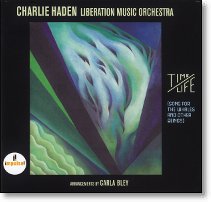
- Charlie Haden/Liberation Music Orchestra: Time/Life (Song for the Whales and Other Beings) (2011-15 [2016], Impulse): [r]: A-
- I Am Three: Mingus Mingus Mingus (2015 [2016], Leo): [r]: B+(***)
- Ich Bin Nintendo: Lykke (2016, Shhpuma): [r]: B+(**)
- Martin Küchen/Mark Tokar/Arkadijus Gotesmanas: Live at Vilnius Jazz Festival (2016, NoBusiness): [cdr]: B+(**)
- Lambchop: FLOTUS (2016, Merge): [r]: B
- Miranda Lambert: The Weight of These Wings (2016, RCA Nashville, 2CD): [r]: A-
- Live the Spirit Residency: Presents the Young Masters 1: Coming of Age (2016, self-released): [cd]: A-
- Donny McCaslin: Beyond Now (2016, Motema): [r]: B+(*)
- Mekons: Existentialism (2015 [2016], Bloodshot): [r]: A
- Myra Melford + Ben Goldberg: Dialogue (2014 [2016], BAG): [r]: B
- The Monkees: Good Times! (2016, Rhino): [r]: B-
- Van Morrison: Keep Me Singing (2016, Caroline): [r]: A-
- The Nu Band: The Final Concert (2012 [2016], NoBusiness): [cdr]: B+(**)
- Alexander von Schlippenbach: Jazz Now! (Live at Theater Gütersloh) (2015 [2016], Intuition): [r]: B+(***)
Recent reissues, compilations, and vault discoveries rated this week:
- Miles Davis Quintet: Freedom Jazz Dance [The Bootleg Series Vol. 5] (1966-68 [2016], Columbia/Legacy, 3CD): [r]: B+(*)
- David S. Ware & Matthew Shipp Duo: Live in Sant'Anna Arresi, 2004 (2004 [2016], AUM Fidelity): [r]: B+(***)
Unpacking: Found in the mail last week:
- Dave Burrell and Bob Stewart: The Crave (1994, NoBusiness): cdr
- François Carrier/Michel Lambert/Rafal Mazur: The Joy of Being (NoBusiness)
- Albert Cirera/Hernâni Faustino/Gabriel Ferrandini/Agustí Fernández: Before the Silence (NoBusiness)
- John Dikeman/Luis Vicente/Hugo Antunes/Gabriel Ferrandini: Salão Brazil (NoBusiness): cdr
- The Fat Babies: Solid Gassuh (Delmark)
- Noah Haidu: Infinite Distances (Cellar Live): February 15
- Irene Kepl: Sololos (Fou)
- Martin Küchen/Mark Tokar/Arkadijus Gotesmanas: Live at Vilnius Jazz Festival (NoBusiness): cdr
- Live the Spirit Residency: Presents the Young Masters 1: Coming of Age (self-released)
- Modus Factor: The Picasso Zone (Browntasaurus)
- The Nu Band: The Final Concert (NoBusiness): cdr
- Howard Riley: Constant Change 1976-2016 (NoBusiness, 5CD)
- Randy Weston: The African Nubian Suite (African Rhythms, 2CD): January 20
Also got a batch of Clean Feeds on Monday which I'll list next week.
Ask a question, or send a comment.
Monday, December 5, 2016
Peace Dinner
I ran behind in writing this, so I'll have to postpone Music Week
until tomorrow (Tuesday). Unfortunately, nobody I'm aware of thought
to take any pictures of the event below, and the evidence is now far
gone. Without such documentation, I reckon we're already entering the
realm of myth. I figure the least I can do is to write this event up,
to establish some sort of paper trail.
Friday night the
Peace and Social Justice Center
here in Wichita had its annual dinner and business meeting. My little
part in that was to plan and direct the menu, preparing food for 62
guests. I spent much of last week hashing out the menu with Janice
Bradley and Leah Dannar-Garcia. Leah and I went shopping on Wednesday.
I spent about thirteen hours on Thursday at home prepping and in some
cases finishing dishes, while Janice and Leah did their own home prep.
On Friday about 1 PM we met at Lorraine Avenue Mennonite Church, along
with several other people (Pat Cameron, Gretchen Eick, Kathy Hull,
Russ Pataki) where the dinner would be held, and started cooking. By
6 PM we had dinner ready to serve. We put small bowls of appetizers
and bread on the tables so people could start noshing. And we set
up a double-long table for people to serve themselves with the main
dishes. The menu was mostly Mediterranean, with dishes from Spain,
Italy, Greece, Turkey, Israel and the Arab countries, plus one salad
from Iran:
The appetizer array:
The main dishes:
-
Horiatiki Salad: Greek chopped salad with feta, olives, and
capers (but skipped the anchovies).
-
Baby Spinach Salad with Dates & Almonds.
-
Mast Va Khiar: Persian cucumber/yogurt salad with scallions,
golden raisins, and black walnuts.
-
Roots, Shoots and Squash (Roasted Winter Vegetables): sweet
potatoes, small gold potatoes, carrots, parsnips, turnips, rutabagas,
celeriac, acorn and butternut squash, leeks, garlic.
-
Caponata: eggplant, red bell peppers, zucchini, onions,
tomatoes, celery, capers.
-
Baked Fish with Capers and Olives: Pacific cod, topped with
tomato-capers-olives sauce and bread crumbs.
-
Chicken Cacciatore: chicken, browned, braised with shallots
and mushrooms in a tomato-wine sauce.
Dessert:
-
Mutabbaq: filo pastry sheets filled with ricotta and goat cheese.
-
Macedonia: mixed fruit: apples, pears, red and green grapes,
strawberries, pineapple, macerated with sugar and citrus juices.
-
Vanilla Cream: vanilla-flavored whipped cream.
The recipes (follow the links) were typically scaled 2 times for
the appetizers and desserts (more for the hummus and fruit), the
salads 2-3 times, the main dishes 3-4 times (8 lbs fish, 16 lbs
chicken). The main thing that limited the scaling was the size of
cooking and serving dishes, although several dishes were limited
by shopping -- I didn't buy nearly enough kalamata olives, so had
a single one pound recipe of tapenade and had to buy extra for the
salad. The salads ran out first -- possibly because they were first
in the serving line, but we could have fixed another batch of the
horiatiki and mast va khiar and served it in the same large bowls.
The root vegetables fit neatly into two deep baking dishes, the
fish into two shallow ones, and the chicken was optimally packed
into my largest pot (16-inch diameter, 6-inches deep).
I made two trays of mutabbaq, and cut them into 60 2.25 x 2.5-inch
pieces, so only a couple people missed out. We served them at the
counter, on plates, and let people add fruit and/or cream. (I was
surprised to see people dolloping the cream on top of the mutabbaq.)
The cream, which I had borrowed from a "berries and cream" recipe,
was exceptional -- we should have made a second batch. We had a
couple cups of caponata and a couple pints of cacciatore left at
the end, plus hummus and fruit -- Janice overscaled while I erred
on the low side -- but I didn't hear complaints about not cooking
enough.
I think it's safe to say that it all came out delicious -- one
could even say fabulous. Also that the mix of dishes worked and
the tastes complemented one another. (The desserts offered a mix
of sweet, tart, and creamy, none of which were overly heavy.) We
could have done a better job of pointing out which things were
vegetarian (or vegan), which dishes had dairy or gluten or nuts
or some other real or imagined hazard -- we published the menu,
but that was hardly self-explanatory.
The last few years we had the dinner catered, using various
Mexican and Middle Eastern sources, nothing especially memorable.
Further back, we tried pot lucks, and I made large main dishes
for a couple of those -- jambalaya and cacciatore are the ones
I remember -- which often produced better food, but were also
inconsistent and chancey. This year, when the board decided to
try another pot luck, I suggested that a planned and assigned
menu would work better, maybe something Mediterranean like the
Ottolenghi menu we fixed for an Alice Powell memorial dinner,
but a bit broader (and simpler). Leah, who runs a small organic
farm east of town, suggested a seasonal fall menu, which I was
fine with, but when I spelled out my proposal she embraced it,
and provided invaluable support.
Also invaluable was the kitchen and equipment provided by the
church. They had a 10-burner range (which we barely used), with
two ovens (exactly what we needed), large baking dishes and bowls,
lots of counter space, ample dishes and flatware, and a terrific
dishwasher for cleaning up. We also had about the right mix of
people helping out. If we were to do it again, the one change I
would make would be to get together in that kitchen the night
before and do the meze and prep together rather than dividing
them up and working at home (especially as I had taken on most
of that work myself -- by the end I was so exhausted that I
wound up knicking myself a couple times cleaning up a knife).
Friday had moments that seemed like chaos, but I managed to
keep everything lined up and moving along properly, so it all
came together at the appointed time (6 PM).
Also, other people (especially Leah and Russ) took over
the clean up when I wore out. I got in line after the salads
were gone, and wandered in and out of the actual meeting. The
guest speaker was Maxine Phillips, a former executive editor of
Dissent Magazine and a vice chair of Democratic Socialists
of America, who blogs at
religioussocialism.org. She spoke about "Forced Migrations
and US Immigration Policy." I didn't catch enough of this to
comment, but I will risk saying two things:
Most migration today, especially from Latin America, Africa,
the Middle East and South Asia, is the result of the US (and Europe)
exporting neoliberal economic dogmas and the tools of war which are
primarily used by complicit local elites against their own people.
It's all good and well to sympathize with the victims of economic
and military dislocation, but the root causes are embedded in our
own political system, so much under the thumb of supra-national
corporate interests. In particular, we need to guard against the
tendency to militarize our response to every crisis, especially as
that knee-jerk reaction primarily serves to avoid self-scrutiny. Nonetheless, the fact that refugees and emigrants still come
here is a testimony to the fact that America (and Europe) still have
functioning and (relatively) humane institutions such that most of
our citizens are spared the most brutal effects of our economic and
military dogmas. And it's worth noting that immigrants generally add
to supporting those institutions, and to the economy as a whole, in
part because they're more appreciative of them than so many of our
embittered "natives" (who have mastered the knack of taking them for
granted while doing little to support). Whatever else it may be, net
immigration is a vote of confidence in our shared future, something
we should appreciate rather than curse.
Unfortuantely, the 2016 election, especially of Donald Trump to the
presidency, promises nothing constructive on this front. Indeed, if
Trump does manages to reduce immigration it will probably be more due
to making our own country less livable than to enforcing draconian laws,
and even less to making the rest of the world any less treacherous.
I'm afraid I have rather mixed views on immigration. As someone
whose most recent foreign-born ancestors came to America nearly 150
years ago, and whose family preserved not one shred of previous
ethnic identity, I've never had any sentimental attachment to the
notion that America as a melting pot of immigrants. Nor do I have
a problem with the idea that a nation has a right to control its
borders and limit immigration. I'll also note that the one period
of history when Americans seemed to exhibit the greatest care for
one another -- at least in the sense of moving furthest to the
left -- was in the 1930-40s, when immigration was largely halted.
One wonders whether loosening immigration restrictions in the 1970s
didn't contribute somehow to the nation's rightward drift since
1980. (That nearly a third of last year's Republican presidential
candidates had at least one foreign-born parent is troubling, to
say the least.)
On the other hand, I've known dozens of immigrants, most real
fine people, credits to our communities, and they've helped to
broaden and deepen our lives. One way, of course, was to share
with us the range of food we made for this Peace Dinner (plus a
great many other dishes we couldn't include -- things we can
explore further in future dinners). Admittedly, most of the
immigrants I know are professionals, many citizens, pretty much
all with their legal status in order. The only problem I see is
with those lacking proper documentation, mostly because their
lack of proper credentials leaves them open to exploitation, and
that less because I'm sympathetic to their plight than because
their vulnerability allows those in power to be more abusive --
and not just to undocumented immigrants.
But Trump's anti-immigrant tirades are not some isolated tick.
They are wrapped up in all sorts of mutually reinforcing hatreds
meant to appeal to the vanity of increasingly marginalized white
voters -- at least those sucker enough to overlook the obvious
architects of their demise: the barons of industry and finance,
whose pillage of the economy has made everyone more vulnerable.
But we need to recognize that what makes this tactic work is how
effectively mass fears have been stoked through decades of war.
The only way to break that cycle is to insist on peace, which is
why organizations like out Peace Center are so important. Please
consider a
contribution.
Ask a question, or send a comment.
Wednesday, November 30, 2016
Streamnotes (November 2016)
No time to write an introduction. Maybe I'll have something to say
for next week's Music Week.
Most of these are short notes/reviews based on streaming records
from Napster (formerly Rhapsody; other sources are noted in brackets).
They are snap judgments based on one or two plays, accumulated since
my last post along these lines, back on October 29. Past reviews and
more information are available
here (8835 records).
Recent Releases
Sophie Agnel/Daunik Lazro: Marguerite D'Or Pâle
(2016, Fou): Piano/sax duets, Lazro on tenor and baritone, although
Agnel's concept of the piano ("a real living & breathing organism")
had me wondering whether they had slipped a percussionist into the
mix.
B+(**) [cd]
Aguankó: Latin Jazz Christmas in Havana (2016, Aguankó):
Percussionist Alberto Macif's group, inspired by Havana but based in
Michigan, have a couple previous albums. This one's subtitled "Cool
Sounds & Warm Wishes," and is that with an extra shot of clavé,
but the songs keep shaking off their dressing. Still, you could be
stuck in a department store with much worse.
B [cd]
Rodrigo Amado Motion Trio: Desire & Freedom
(2016, Not Two): Portuguese tenor saxophonist, always an imposing
figure in free jazz settings, with his most dependable group --
Miguel Mira on cello and Gabriel Ferrandini on drums. Three long
improv pieces, terrific all around, drummer especially.
A- [cd]
Amendola vs. Blades: Greatest Hits (2015 [2016],
Sazi): Duo of drummer Scott Amendola, probably best known for his
work with Nels Cline although he has his name on five previous
albums (doing back to 1999), and Hammond B3 impressario Wil Blades.
No known hits between them, but take the title as intending some
sort of semipop move -- pop in form if not in fact -- ane enjoy
the groove and pomp.
B+(**) [cd]
BassDrumBone: The Long Road (2013-16 [2016],
Auricle, 2CD): Long-running free jazz trio, first album together
recorded nearly 30 years ago, lineup on this seventh album the
same: Mark Helias (bass), Gerry Hemingway (drums), Ray Anderson
(trombone). Second disc is padded out with 31 minutes live. Studio
cuts include three cuts each with Jason Moran (piano) and Joe
Lovano (tenor sax), the latter making the bigger splash. Still
great to hear Anderson's trombone leads, but could be further
concentrated.
B+(***) [cd]
Martin Bejerano: Trio Miami (2016, Figgland): Pianist,
teaches at University of Miami, has a couple previous albums and side
credits with Roy Haynes and Russell Malone. Leads a trio, bright and
fast.
B+(*)
Eraldo Bernocchi/Prakash Sontakke: Invisible Strings
(2016, RareNoise): The former plays baritone and electric guitar, the
latter lap steel guitar, but Bernocchi is also credited with electronics,
which explains the percussion. The synthetic groove may be too regular
for jazz, but sets up a seductive ambience with the layered guitar.
B+(***) [cdr]
Nat Birchall: Creation (2016, Sound Soul & Spirit):
British tenor saxophonist, probably sounds more like Coltrane than any
saxophonist alive (including Ravi Coltrane), an effect added to by
pianist Adam Fairhall and bassist Michael Bardon, although the group
doubles up on drums. Unlike his last two albums, I never quite shook
the sense of imitation here, though it's hard to go far wrong while
hewing so close to genius.
B+(***) [bc]
Karl Blau: Introducing Karl Blau (2016, Raven Marching
Band): Singer-songwriter from Anacortes, Washington, with seven previous
records before this seeming debut, mostly Nashville covers, done with
disconcerting aloofness (no drawl, scant drama, anonymous backup singers).
B
Boi Akih: Liquid Songs (2016, TryTone): Dutch group,
formed in 1997, has a half-dozen previous albums. Guitarist Niels
Brouwer writes the pieces, Monica Akihary sings, also with: Ryoko
Imai (marimba, reyong & percussion) and Tobias Klein (bass &
contrabass clarinet). Abstract, arty, hated it at first but wound
up pleasantly surprised.
B+(*) [cd]
Christiane Bopp/Jean-Luc Petit: L'Écorce et la Salive
(2015 [2016], Fou): Free jazz duets, Bopp playing trombone, Petit
contrabass clarinet, tend to be sparse and abstract.
B+(*) [cd]
Buselli-Wallarab Jazz Orchestra: Basically Baker Vol. 2:
The Big Band Music of David Baker (2016, Patois, 2CD): A
fine big band based in Indianapolis, led by Brent Wallarab (credited
here as conductor and musical director, but previously a trombonist)
and Mark Buselli (trumpet), play compositions and arrangements by
David N. Baker (1931-2016), a longtime jazz studies professor at
Indiana University who back in the 1960s was affiliated with George
Russell. Their original Baker tribute was recorded in 2004, this
one about three months after the composer's death. An impressive
big band, although the case for Baker's music is less clear.
B+(*) [cd]
Oguz Buyukberber and Simon Nabatov: Wobbly Strata
(2014 [2016], TryTone): Free jazz duets, clarinet/bass clarinet and
piano, respectively. The former was born in Turkey, studied in
Amsterdam, probably still based there but this was recorded in
Germany. Nabatov is twenty years older, born in Russia, studied
in Rome and New York and wound up settling in Cologne. Brisk and
challenging.
B+(**)
Nick Cave & the Bad Seeds: Skeleton Tree (2016,
Bad Seeds): One of the year's top-metarated records, no idea why
unless the doom and gloom synth tones are somehow calming to the
doomed and gloomy. When we were young we used to look for something
cathartic to overcome a bad mood, not something that merely added
to it.
B-
John Chin: Fifth (2014 [2016], Jinsy): Pianist,
born in Korea, raised in LA and based in Brooklyn, has several
albums. My advance copy has Chin's name scratched out, implying
an eponymous group album. Chin's Bandcamp credits all five in
alphabetical order: Chin, Stacy Dillard (soprano sax), Lawrence
Leathers (bass), Spencer Murphy (drums), Tivon Pennicott (tenor
sax). Indeed, all five have song credits, but mostly Chin (7)
and Dillard (3), with one each for the others, and they go all
sorts of ways, the free-ish postbop just one tendency.
B+(**) [cdr]
Richie Cole: Plays Ballads & Love Songs (2015
[2016], Mark Perna Music): Alto saxophonist, not quite 70, his
discography goes back to 1976 but tails off after 1999 (several
featured spots, one album in 2005). Quartet with Eric Susoeff on
guitar, Mark Perna on bass and Vince Taglieri on drums -- surefire
material, bright, lovely.
B+(***) [cd]
Tom Collier: Impulsive Illuminations (2014-15 [2016],
Origin): Vibraphone/marimba player based in Seattle, discography
starts with Northwest Jazz Sextet in 1979, and has a half-dozen
albums since. Five 10-17 minute pieces here, with Richard Karpen
on piano and one guest for each piece: Bill Frisell (guitar), Ted
Poor (drums), Stuart Depmster (trombone/didjeridu), Bill Smith
(clarinet), Cuong Vu (trumpet). Mostly reminds me of Dempster's
"deep listening" pieces, so often too deep to keep me listening.
B [cd]
Common: Black America Again (2016, Def Jam):
Chicago rapper, can marshall guests ranging from BJ the Chicago
Kid to Stevie Wonder, is as conscious as he should be of the
uphill political struggle -- I can't fault him for being overly
didactic, but the music doesn't always carry him.
B+(**)
The Core Trio: Live Featuring Matthew Shipp (2014
[2016], Evil Rabbit): Houston-based sax trio, with Seth Paynter on
tenor, Thomas Helton on bass, and Joe Hertenstein on drums. They
have two previous albums, each with a pianist added, the second an
impressive match with Shipp, who returns here for two 31-34 minute
sets in a Houston night club. A bit spotty, the sax never quite
getting in gear, but the piano impressive (as you'd expect).
B+(**) [cd]
The Delegation: Evergreen (Canceled World) (2014-15
[2016], ESP-Disk, 2CD): Main person here is pianist-composer Gabriel
Zucker, also credited with electronics and voice (along with a couple
more singers). A sprawling art project, with long, complex forms and
a story line that's way over my head. Group includes trumpet (Adam
O'Farrill), three saxophones, violin-viola-cello, bass, drums, and
additional electronics. Music has points of interest.
B+(*) [cd]
Dim Lighting: Your Miniature Motion (2014 [2016], Off):
Guitar-bass-drums trio, based in Chicago, Andrew Trim, Kurt Schweitz,
Deven Drobka. First album, guitar metallic, can crunch out a groove or
spring free, or just bide time.
B+(*) [cdr]
Andrew Downing: Otterville (2016, self-released, 2CD):
Bassist, born in London, Ontario and based in Toronto, plays cello
here, presenting a series of ornate landscape pieces, lovely in a
rather uneventful way. Group includes alto sax, vibes, lap steel
guitar, bass guitar, and drums, with occasional touches of trumpet
and trombone.
B [cd]
Rebecca DuMaine and the Dave Miller Trio With Friends: Happy
Madness (2016, Summit): Standards singer trying to pass as
good-time girl -- nothing really standard but hits the usual bases
including Jobim and McCartney -- backed by piano trio and presumably
more, although I have no idea who the "friends" are.
B- [cd]
Earth Tongues: Ohio (2015 [2016], Neither/Nor, 2CD):
Filed this under trumpeter Joe Moffett, joined here by Dan Peck on
tuba and Carlo Costa on percussion, the horn players also credited
with "cassette player." Long-form industrial ambient, or (not quite)
noise, the length undoes any sense of structure (or as they put it,
"immersive pieces that explore dynamic and temporal extremes").
B [cd]
The Fat Babies: Solid Gassuh (2016, Delmark):
Seven-piece trad jazz band, founded 2010 by bassist Beau Sample,
based in Chicago, they play old stuff going back to "Maple Leaf
Rag" and clearly are having fun.
B+(**) [cd]
Clare Fischer Latin Jazz Big Band: ¡Intenso! (2016,
Clavo): Directed by son Brent Fischer, less a ghost band than a living
memorial to the late pianist-arranger, whose clients ranged from Dizzy
Gillespie to Prince. Six Clare Fischer originals (out of ten), mostly
old arrangements, the band solid, a couple Roberta Gambarini vocals a
plus.
B+(**) [cd]
David Friesen Circle 3 Trio: Triple Exposure
(2015 [2016], Origin): Bassist-led piano trio, the pianist Greg
Goebel, drummer Charlie Doggett. Friesen has a long discography
going back to 1976. He composed and arranged all the pieces here,
gets bright leads and patiently works his bass into the cracks.
B+(*) [cd]
Clay Giberson: Pastures (2015 [2016], Origin):
Pianist, based in Portland, has five previous records plus four
by his group Upper Left Trio. Draws on a strong quartet here
with Drew Gress (bass), Matt Wilson (drums), and most valuable
player Donny McCaslin, whose tenor sax chops dominate everything.
Less so his flute and soprano, or the string quartet added on
four tracks.
B+(***) [cd]
Jari Haapalainen Trio: Fusion Machine (2016, Moserobie):
Drummer-led sax trio, with Daniel Bingert on bass guitar, and Per 'Texas'
Johansson on "the saxophone." Reminiscent of the Thing in their new wave
fusion mode (though less squawky, and less free). Thirteen cuts, 28:29.
B+(*) [cd]
Jason Hainsworth: Third Ward Stories (2015 [2016],
Origin): Tenor saxophonist from Houston, studied in New Orleans and
Florida, teaches at Broward College. Probably his debut, a lively
hard bop sextet with Josh Evans on trumpet, Michael Dease on trombone,
and Glenn Zaleski on piano, makes it seem easy.
B+(***) [cd]
Stu Harrison: Volume I (2016, One Nightstand): Pianist,
Canadian, leads a trio with Neil Swainson (bass) and Terry Clarke (drums)
through a batch of very familiar standards, teasing and tussling without
losing the thread.
B+(**) [cd]
Heroes Are Gang Leaders: Flukum (2016, Flat Langston's
Arkeyes): Group abbreviated HAGL, led by poet Thomas Sayers Ellis (not
the sole lyricist) with saxophonist James Brandon Lewis and various
others, most songs with vocals in various voices ("dedicated to poets
Etheridge Knight and Ntozake Shange with moments of James Baldwin and
Michael S. Harper thematically-seasoned in"), pushing boundaries while
the sinewy music slithers around, or sometimes just enjoys a funk groove.
B+(**) [cd]
Eric Hofbauer Quintet: Prehistoric Jazz Volume 3: Three
Places in New England (2016, Creative Nation Music):
Guitarist, quintet includes trumpet, clarinet, cello, and drums.
Like the two previous volumes, this picks up a piece of modernist
classical music and reframes it as jazz -- the previous volumes
used Stravinsky and Messaien, this one goes after Charles Ives,
who patterned his own music on brass bands obliquely heard. The
indirection works nicely here.
B+(***) [cd]
Roger Ingram: Sklyark (2015, One Too Tree): Trumpet
player, finished second for trumpet in Downbeat's 2016 Readers
Poll, a complete surprise to me -- only his second album (and short
ones at that, this one seven cuts, 28:40) I can find, but he has many
side credits going back to Woddy Herman in 1986. Not sure of credits
here, but starts solo before a big band (Jim Stewart Orchestra) with
singer (Christine Cooney) enter. The vocals swing agreeably, but the
instrumentals are a little gaudy.
B
Erik Jekabson: A Brand New Take (2015 [2016], OA2):
Trumpet player, based in Bay Area, has a handful of records dating
back to 2002. Quintet here with alto sax (Kasey Knudsen) and piano
(Matt Clark), plus a couple tracks with guests -- "Thriller" is a
highlight, with John Gove (trombone) and Dave Ellis (tenor sax).
B+(*) [cd]
Jerome Jennings: The Beast (2016, Iola): Drummer,
wrote four (of nine) songs here, leading a hard bop sextet much like
the groups his bassist (Christian McBride) has led -- most obviously
with Christian Sands on piano, also Sean Jones on trumpet and Howard
Wiley on tenor sax. Steady pulse of energy, as if they're afraid they
might be taken for retro.
B+(**) [cd]
The Matthew Kaminski Quartet: Live at Churchill Grounds
(2015 [2016], Chicken Coup): Organ player, from Chicago, earns his scratch
playing for the Atlanta Braves. Quartet includes guitar and tenor sax
(Will Scruggs), and Kimberley Gordon sings a couple tunes. All covers,
done up like a gaudy burlesque, with "Sail On Sailor" a surprise lead.
B+(*) [cd]
Walter Kemp 3oh!: Dark Continent (2016, Blujazz):
Pianist, sometimes adds a III to his name but styles his piano trio
thusly, picking up last initials from bassist RiShon Odel and drummer
David Hulett. Densely chorded pieces have some power, slower ones
thoughtful.
B+(*) [cd]
Frank Kimbrough: Solstice (2016, Pirouet): Pianist,
first appeared as part of a New York postbop circle that included
Ben Allison, Ron Horton, and Matt Wilson, and always struck me as
the least adventurous of that crowd. Trio, with Jay Anderson on bass
and Jeff Hirshfield on drums. One original, one standard, the rest
from postmodern jazz sources like Carla Bley, Paul Motian, Andrew
Hill, Maria Schneider, and Annette Peacock (twice).
B+(**) [cd]
Lambchop: FLOTUS (2016, Merge): Acronym more
convoluted than expected: For Love Often Turns Us Still.
Band, fronted by Kurt Wagner, has recorded a dozen albums since
1994. This one's slow with a light touch, delicate even, pleasant
in passing but little registers.
B
Miranda Lambert: The Weight of These Wings (2016,
RCA Nashville, 2CD): Twenty-four songs, runs 94:01, the first disc
titled "The Nerve" and the second "The Heart." Gossip columnists
tell us it's about her breakup with Blake Shelton and her current
relationship with Anderson East. Still, not much tumult here --
certainly no "Kerosene" -- everything on a level keel, making me
wonder why the album had to be so damn long. Probably because she's
got a lot to say.
B+(***)
Ingrid Laubrock: Serpentines (2016, Intakt): German
tenor saxophonist, based in Brooklyn, has produced quite a few records
since 1999. This one mixes in trumpet (Peter Evans), koto (Miya Masaoka),
piano (Craig Taborn), electronics (Sam Pluta), tuba (Dan Peck), and
drums (Tyshawn Sorey). Some bright spots, especially Taborn, but also
seems rather scattered.
B+(*) [cd]
Jerry Leake: Crafty Hands (2016, Rhombus Publishing):
World-spanning percussionist, has a dozen or so albums as well as the
books that helped name his label, but draws mostly on African and
Indian here, plus a standard drum set, vibraphone, and he (and others)
sing some. The others add to the "world-rock fusion" -- eclectic is
their motto, making most of this enchanting, not that it all fits
neatly together.
B+(**) [cd]
Nate Lepine Quartet: Vortices (2016, Eyes & Ears):
Tenor saxophonist from Chicago, seems to be his debut album, quartet
with Nick Mazzarella on alto sax, Clark Sommers on bass, and Quin
Kirchner on drums. The extra sax shadows the leads, adding depth and
lustre, but beware of slowing down.
B+(*) [cd]
Jasmine Lovell-Smith's Towering Poppies: Yellow Red Blue
(2015 [2016], Paint Box): Soprano saxophonist, originally from New
Zealand, based in Mexico after a few years in New York. second album,
quintet with Josh Sinton (bass clarinet) and piano-bass-drums.
B+(**) [cd]
Allen Lowe: In the Diaspora of the Diaspora: A Day in Brooklyn:
At Ibeam (2015 [2016], Constant Sorrow, 2CD): The fifth (of
six so far) installment under this title, "a series of recordings based
on American song forms," something hardly no one has researched deeper
than alto-saxophonist Lowe. A disparate, sprawling set of works, with
two mid-sized groups and a number of guest spots -- hard to see how they
could all have fit into a single day of recording. Opens with a solo
piano piece by Loren Schoenberg, then another by Kelly Green -- the
first of several "Mary Lou Williams Variations." Then moves on to a
group with Kirk Knuffke (trumpet) and Paul Austerlitz (clarinet), later
to another with Lisa Parrott (baritone sax) and Larry Feldman (violin).
Not easy to follow, but even when you don't something liable to jump
out and grab you.
B+(***) [cd]
Allen Lowe: In the Diaspora of the Diaspora: Hell With an
Ocean View (2016, Constant Sorrow): Opens with some of Lowe's
best alto sax, but often gives way to let the twin guitarists (Nels
Cline and Ray Suhy) shine. With Matthew Shipp (piano), Kevin Ray
(bass), Larry Feldman (violin, mandolin), and Carolyn Castellano
(drums). The song forms range from hymns to Hendrix, each with its
own fascination.
A- [cd]
Thierry Maillard Trio and Philharmonic Orchestra: Ethnic
Sounds (2016, Blujazz): French pianist, has perhaps a dozen
albums since 1998, explains in the liner notes that "My biggest
musical dream has always been to hear one day my music written for
a jazz trio and a symphonic Orchestra," so I guess he can scratch
that off his bucket list. He went to Prague to get the orchestra,
an outfit that has never shown much finnesse around jazz, and he
brought in some ringers like guitarist Nguyen Lê. The music leans
toward fusion, or maybe it's just energetically muddled.
B- [cd]
Mamutrio [Lieven Cambré/Piet Verbist/Jesse Dockx]: Primal
Existence (2015 [2016], Origin): Alto saxophonist, from
northern Belgium, backed by bass and drums, Verbist the main writer
(5/10 compositions). Subtle, relaxed postbop, sometimes pushes not
out but in.
B+(***) [cd]
Tom Marko: Inner Light (2016, Summit): Drummer,
director of jazz studies at Illinois State, first album, lineups
vary but generally a standard quintet, sometimes with added guitar,
sometimes percussion. Big name here is "special guest" Scott
Wendholt (trumpet), who earns his billing. Postbop moves, has
some hot spots.
B [cd]
Melanie Marod: I'll Go Mad (2016, ITI): Standards
singer, from Michigan, based in New York, probably her debut. Has
a seductive voice, eclectic taste in Anglo standards ("Spanish
Harlem," "Dance Me to the End of Love," "Candy," but "Everybody's
Talkin'" is a let down; plus "Corcovado" and two equally obvious
Latin tunes. Backed by guitar (Masami Ishikawa), keyboards (Art
Hirahara), bass and drums.
B+(*) [cd]
Bruno Mars: 24K Magic (2016, Atlantic): Loved his
first album, shrugged off his second, and can't say that anything
really grabs me in this big-time pop production, though I continue
to be wowed by his voice.
B
Delfeayo Marsalis presents the Uptown Jazz Orchestra: Make
America Great Again! (2016, Troubadour Jass): Big band, led
by the trombone-playing Marsalis brother, takes America to be a
macro-extension of black New Orleans, with Wendell Pierce narrating
a spiel that reminds me of "Chocolate City," egged on by a chorus
reiterating the title with just a bit of sarcasm, reminding us that
the greatest traitors to America were the "rebels" who fought the
union for slavery. Frames the program with "Star Spangled Banner"
and "Fanfare for the Common Man." Personally, I'd rather make America
good than great, but that's the effect here, too.
B+(**) [cd]
MAST: Love and War_ (2016, Alpha Pup): Album cover
stylizes group name as all caps followed by an inverted-V and two
backslashes, sort of a broken-M, although their Bandcamp page sticks
with ASCII. Second group album, leader is Tim Conley, they didn't
bother to table up the credits, but it would have been a long list,
including the ten-piece Fresh Cut Orchestra. Structured as a three
act play, with various spoken and sung characters, lush instrumental
passages, the sort of high art concept I have trouble focusing on.
I will say he's better at it than the Pretty Things, though maybe
not better than Sufjan Stevens (or the Who).
B+(*) [cdr]
Matt Mayhall: Tropes (2015 [2016], Skirl): Drummer,
based in Los Angeles, also credited with keyboards on this debut album,
leads a trio with Jeff Parker on guitar and Paul Bryan on bass guitar,
plus guests on a couple cuts each: Chris Speed (tenor sax) and Jeff
Babko (organ, keyboards). Rather mellow showcase for Parker.
B+(*) [cd]
Donny McCaslin: Beyond Now (2016, Motema): Tenor
saxophonist, has outstanding chops which he frequently flexes to
steal the spotlight on others' albums, although I've only rarely
been a fan of his own albums (2008's Recommended Tools is
an exception). David Bowie hired him to work on his final album,
Blackstar, and McCaslin returns the compliment here, using
Bowie's band (Jason Lindner, Mark Giulliana, Tim Lefebvre) on a
couple of Bowie songs, others from Deadmau5 and Mutemath. Leans
hard toward fusion, turning into its own kind of sax blowout.
B+(*)
The Monkees: Good Times! (2016, Rhino): Someone
thought some sort of 50th anniversary remembrance was in order,
then discovered that three of the original four actors who were
tabbed for a popular TV series about an American Beatles spoof
were still living, so why not a reunion? They even hired three
members of Fountains of Wayne to craft fake Monkees songs. It's
not like they couldn't recapture the vibe, but somehow it sounds
pathetic this time around. Indeed, the whole thing turned so
depressing they let the original Monkees write some of their
own songs. And they dug up an unreleased 1967 track to pretend
Davy Jones lives.
B-
Van Morrison: Keep Me Singing (2016, Caroline):
Past 70 now, knighted, one of the all-time greats, so much so that
mere echoes of his great albums can blow you away. This one is that
and a bit more as he's found a new comfort not just in his skin but
in the warmth of his Celtic-blues soul.
A-
John Moulder: Earthborn Tales of Soul and Spirit
(2014-16 [2016], Origin): Guitarist, based in Chicago, teaches at
Benedictine and Northwestern, sixth album, cut in two sessions
with different bass/drums and tablas on one, but Jim Trompeter
(piano), Marquis Hill (trumpet), and Donny McCaslin (tenor sax)
appeared on both. McCaslin flexes his chops, but this can get
murky without him.
B [cd]
Moutin Factory Quintet: Deep (2016, Blujazz):
Twin brothers François (bass) and Louis Moutin (drums), leading
a quintet with alto/sopranino sax (Christophe Monniot), guitar
(Manu Codjia), and piano (Jean-Michel Pilc). One very nice Fats
Waller medley, mostly just bass and drums, but the originals
tend toward post-fusion (in the sense of what postbop made of
bebop, I suspect Weather Report was their ur-text).
B+(*) [cd]
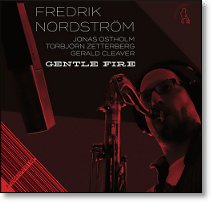
Fredrik Nordström: Gentle Fire/Restless Dreams
(2016, Moserobie, 2CD): Tenor saxophonist from Sweden, look him
up and most likely you'll find a different person -- a heavy
metal guitarist with the same name. This one has a half-dozen
previous albums going back to 2000. Two albums here cut in the
same two-day session, with the same quartet: Jonas Östhom (piano),
Torbjörn Zetterberg (bass), Gerald Cleaver (drums). Mixed with
the gentle stuff on one disc, the restless on the other (or vice
versa). Restless is better, of course, but I've played this enough
I've also grown quite fond of the fire.
A- [cd]
Phil Parisot: Lingo (2016, OA2): Seattle-based
drummer, first album, has a couple of side-credits including the
group Big Neighborhood. Sax quartet, Steve Treseler out front on
tenor and soprano, Dan Kramlich on piano and Fender Rhodes, Michael
Glynn on bass. Seven originals, three non-standard covers, pretty
much what everyone else is doing, though lively for that.
B+(*) [cd]
Felix Peikli & Joe Doubleday: It's Showtime!
(2016, self-released): Clarinetist, from Norway, and vibraphonist,
playing standards, backed by a swing-oriented rhythm section with
Rossano Sportiello on piano. Bright, even a bit frothy.
B+(*) [cdr]
Ivo Perelman/Karl Berger/Gerald Cleaver: The Art of the
Improv Trio Volume 1 (2016, Leo): Avant tenor saxophonist
from Brazil, celebrated twenty years of recording back in 2009-10
with six releases, and has duplicated that feat nearly every year
since. He released five records this spring (my top picks were
Soul and Blue), and now for the fall he's come out
with six volumes of Improv Trio -- one suspects too much
and too similar, but we'll see. Berger here plays piano, a steady
influence that mostly keeps the sax on track, even brings out a
touch of elegance.
B+(***) [cd]
Ivo Perelman/Mat Maneri/Whit Dickey: The Art of the Improv
Trio Volume 2 (2016, Leo): Tenor sax, viola, drums. Maneri
is the wild card here, his microtonal meanderings sometimes lose me,
but in the end he provokes the saxophonist into upping his game.
B+(***) [cd]
Ivo Perelman/Matthew Shipp/Gerald Cleaver: The Art of the
Improv Trio Volume 3 (2015 [2016], Leo): Probably the most
imposing of the trio lineups, but pianist Shipp -- a frequent
Perelman mate going back to 1996's Bendito of Santa Cruz --
never charges into the clear (as he sometimes managed in the David
S. Ware Quartet). Still a fine showing for the saxophonist, but
not exceptional.
B+(**) [cd]
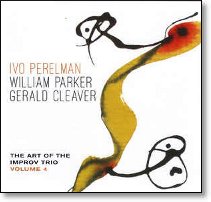
Ivo Perelman/William Parker/Gerald Cleaver: The Art of the
Improv Trio Volume 4 (2016, Leo): The bassist makes a difference
here, setting up a groove (or at least momentum) that keeps the sax man
on his toes, bobbing and weaving, never far from the edge. Moreover, he
can go loud without knocking the leader out, so he has no need to hold
back (as the pianists have done).
A- [cd]
Ivo Perelman/Joe Morris/Gerald Cleaver: The Art of the
Improv Trio Volume 5 (2016, Leo): Morris plays electric guitar,
somewhat inconspicuously poking around the edges, adding bits of color
and brightness. Another strong outing for the saxophonist.
B+(***) [cd]
Ivo Perelman/Joe Morris/Gerald Cleaver: The Art of the
Improv Trio Volume 6 (2016, Leo): Recorded in July, probably
the same time as Volume 5, the difference here is that Morris
has switched from guitar to bass. As with Volume 4, this both
loosens up the saxophonist and lets him be fiercer or more eloquent
as the opportunity arises.
A- [cd]
Pink Martini: Je Dis Oui (2016, Heinz): Portland
group dating back to 1994, principally pianist Thomas Lauderdale and
singer China Forbes, play an ecclectic mix of jazz, chanson, and
kitsch drawing on pretty much everything. More of all of that, in
some ways remarkable but less satisfying than, e.g., 2007's Hey,
Eugene!.
B+(*)
Bobby Previte: Mass (2016, RareNoise): Jazz drummer,
often leans toward fusion but has more eclectic tastes -- esoteric,
too. This starts with a baroque piece by Guillaume Du Fay (1397-1474,
Missa Sancti Jacobi), adds pipe organ "inspired by Olivier
Messaien" (played by Marco Benevento), vocals (The Rose Ensemble),
and some electric bass that could have been dubbed by Black Sabbath.
I suppose if you cared about any of those things, this might seem
interesting, or blasphemous, or something.
C+ [cdr]
Carol Robbins: Taylor Street (2016 [2017], Jazzcats):
Plays harp, has a couple previous albums, backed here by Los Angeles
musicians -- Bob Sheppard (tenor sax), Curtis Taylor (trumpet), Larry
Koonse (guitar), Billy Childs (piano), Darek Oles (bass) -- generating
an easy momentum without turning too smooth.
B+(*) [cd]
Rudy Royston Trio: RisEofOrion (2016, Greenleaf Music):
Drummer from Texas, only his second headline album but side credits go
back to 1992, notably with saxophonists Fred Hess and J.D. Allen, and
more recently with Jim Snidero, Doug Webb, and trumpet master Dave
Douglas. This is another sax trio, with Jon Irabagon tugging him out
of the mainstream, and Yasushi Nakamura on bass.
B+(***) [cd]
Ken Schaphorst Big Band: How to Say Goodbye (2014
[2016], JCA): Big band composer-conductor, chairs the jazz department
at New England Conservatory, has a half dozen albums since 1989, maybe
more. Plays trumpet and keyboards here, just one cut each. Band is chock
full of well-known names, including Ralph Alessi, Donny McCaslin, Chris
Cheek, Uri Caine, Brad Shepik, and Matt Wilson -- much solo power, some
impressive passages.
B+(*) [cd]
Adam Schneit Band: Light Shines In (2016, Fresh Sound
New Talent): Plays tenor sax and clarinet, has two previous appearances
with Old Time Musketry (both A- records), leads his debut album with
Sean Moran (guitar), Eivind Opsvik (bass), and Kenny Wollesen (drums).
Nice mainstream sax album, the clarinet less so.
B+(**) [cdr]
Steve Slagle: Alto Manhattan (2016 [2017], Panorama):
Mainstream alto saxophonist, most often heard with Dave Stryker (who
usually gets top billing), but here takes center stage and is terrific
though sevel cuts, mostly burners aside from a solo "Body & Soul."
He switches to flute on the last two cuts and adds congas, nice but
less impressive. Joe Lovano joins in on three cuts.
B+(***) [cd]
Enoch Smith Jr.: The Quest: Live at APC (2016,
Misfitme Music): Pianist, born in Rochester, based in New Jersey,
has several albums. Wears his religion on his sleeve -- first
album was called Church Boy -- and dabbles in nursery
rhymes, coming together here in two takes of "Jesus Loves Me."
Uses two singers, neither adding much nuance or style.
C [cd]
Snaggle: The Long Slog (2016, Browntasaurus):
Jazz group, "often described as Canada's answer to Snarky Puppy,"
main songwriter is keyboardist (no piano) Nick Maclean, plus guitar,
a couple horns (trumpet, tenor sax), bass and drums, with a "special
guest" credit for second trumpet player Brownman Ali (also producer).
CDBaby has a blurb from Randy Brecker saying "reminds me of a band
I used to play in." Underwhelming comps pursued vigorously, leaves
me uninterested.
B- [cd]
Soul Basement feat. Jay Nemor: What We Leave Behind
(2016, ITI): Recorded over three months in Siracusa [Sicily], Gothenburg
[Sweden], and Oslo. Soul Basement is an alias for Fabio Puglisi, who
plays keyboards, bass, drums, and programming, and co-wrote the songs
with non-bandmember J. Harden. Nemor does the speakeasy vocals and some
saxophone, making him the real focal point. All in English, including
a couple timely political excursions.
B+(*) [cd]
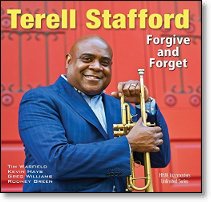
Terell Stafford: Forgive and Forget (2016, Herb Harris
Music): Mainstream trumpet player, originally from Miami, last time
tried his hand at a Lee Morgan tribute (BrotherLee Love), but
didn't really get the vibe right until now, with a superb hard bop
quintet. Pianist Kevin Hays is essential, tenor saxophonist Tim
Warfield mostly shades but delivers when he gets a solo shot. But
it's mostly the trumpet -- the fast ones grab you right away, the
ballads take a while for the slow burn to emerge.
A- [cd]
Andrew Van Tassel: It's Where You Are (2016, Tone
Rogue): Alto saxophonist, also plays soprano, based in New York,
probably his first album, a quartet with Julian Shore on piano and
Rhodes. One cover, from Charles Ives, the originals insightful but
soft-edged and pleasant.
B+(*) [cd]
Anna Webber's Simple Trio: Binary (2016, Skirl):
Plays tenor sax and flute, here in a prickly trio with Matt Mitchell
on piano and John Hollenbeck on drums.
B+(***) [cd]
Scott Whitfield: New Jazz Standards (Volume 2) (2016,
Summit): Trombonist, eighth album since 1989, side credits include
Toshiko Akiyoshi's big band. Quartet with Christian Jacob (piano),
Kevin Axt (bass), and Peter Erskine (drums) playing song written by
producer Carl Saunders. As far as I can tell, the previous volume of
New Jazz Standards was released in 2014 and credited to the
late flautist Sam Most -- another Saunders production.
B+(*) [cd]
Basak Yavuz: A Little Red Bug (2015 [2016], Things&):
Turkish singer-songwriter, studied jazz in New York and picked up some
tricks, but this second album was recorded in Istanbul with a long list
of Turkish names (but no instrument credits). Music, too, is more Turkish
than jazz, but its dramatic flair is informed (and stretched) by the
latter -- most obviously on the "Bye Bye Blackbird" cover.
B+(**) [cd]
Zarabande: El Toro (2016, AFlo): San Antonio-based
marimba player Alfred Flores is billed as "El Toro" here, and seems
to be the leader (listed first, producer) -- band includes Joe Caploe
on vibraphone, Mark Little on piano, plus bass and drums -- and
"Zarabande" is one of the song titles, but the credits are reversed,
perhaps because Little and Caploe split all the song credits (6-3).
Nice flow, lots of tinkle.
B+(*) [cd]
Recent Reissues, Compilations, Vault Discoveries
Miles Davis Quintet: Freedom Jazz Dance [The Bootleg Series
Vol. 5] (1966-68 [2016], Columbia/Legacy, 3CD): His greatest
group, close to mid-term, so it's fair to expect jazz of the highest
order, and to be disappointed with tentative outtakes and rambling
session dialogue only scholars need to hear once. The songs mostly
turned into Miles Smiles (1966) with some leftovers that wound
up on Water Babies (belatedly released in 1976). The false
starts and not-very-audible banter especially mar the first disc,
but the music on the latter discs is pretty much what you'd expect.
Doesn't strike me as essential, but I also don't have the booklet
that no doubt draws out the historical context.
B+(*)
Erroll Garner: Ready Take One (1967-71 [2016], Legacy):
Fourteen previously unreleased tracks from three sessions late in the
pianist's career. Mostly trio, some extra percussion, the sound weak
enough that the bass isn't always clear. Flashes of the idiosyncrasy
that marked his work in his '50s prime, but not a major find.
B+(*)
Old Music
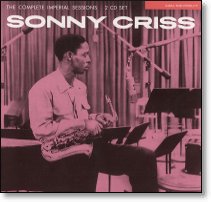
Sonny Criss: The Complete Imperial Sessions (1956
[2000], Blue Note, 2CD): Also saxophonist, cut his first albums for
Imperial at age 28 (although some older recordings were released
later), three albums -- Jazz USA (with Barney Kessel and
Kenny Drew), Go Man! (with Sonny Clark), and Sonny Criss
Plays Cole Porter (Clark again, plus Larry Bunker on vibes) --
all rounded up here. Bright and fast, manages to bridge bebop and
a more mainstream standards repertoire.
A- [cd]
Ella Fitzgerald & Duke Ellington: The Stockholm Concert
(1966 [1994], Jazz World): Same year as the official Ella and Duke at
the Côte D'Azur -- issued in an 8-CD box and a recommended 2-CD sampler.
Pretty much their standard show, opening with four Ellington pieces, closing
with scat takes of "How High the Moon" and "Mr. Paganini."
B+(***) [cd]
Notes
Everything streamed from Napster (ex Rhapsody), except as noted in
brackets following the grade:
- [cd] based on physical cd
- [cdr] based on an advance or promo cd or cdr
- [bc] available at bandcamp.com
- [sc] available at soundcloud.com
- [sp] available at spotify.com
- [os] some other stream source
- [dl] something I was able to download from the web; may be freely
available, may be a bootleg someone made available, or may be a publicist
promo
Ask a question, or send a comment.
Monday, November 28, 2016
Music Week
Music: Current count 27386 [27362] rated (+24), 362 [379] unrated (-17).
Finally, on Saturday, got my new computer build working, hooked up,
and able to stream from Napster. I'm somewhat embarrassed to finally
realize that the problem all along was a faulty monitor (a Samsung,
like most of the other faulty equipment in the house right now -- my
big complaint is a broken ice maker in the refrigerator, and by broken
I mean that the plastic tray is badly cracked on both ends, such that
the screw drive that moved the ice forward jams). The monitor actually
displays internally generated messages fine, but doesn't display the
signal coming in through the D-SUB connection. In fact, the manual
says the monitor has a self-test feature, and when I tried that the
self-test came out OK. But it took weeks for it to finally sink in
that the monitor was the problem.
Went out on Black Saturday and picked up a new LG 24-inch monitor
for about $140. The new computer works fine with it. The old computer
works fine too, so now I have a spare. It had been 5-6 years since I
built the old one, so one can argue that I was due for a new one, but
I hate to have blundered into it like that. The new one has an 8-core
AMD FX-8350 processor, ASUS motherboard and video card (not a fancy
one, but has 2GB RAM), plus I have 32GB RAM and a 2TB hard drive, a
DVD burner, and a parallel printer port board so I can still hook up
to my old HP laser printer. Loaded Xubuntu 16.04 desktop on it, and
I've had to load a couple dozen extra software packages so I have a
LAMP web server, emacs, gimp, and a few extra applications that looked
promising (including a CAD system, an alt-Adobe Illustrator, and a
database program for recipes). That's all free software. Had to jump
through some extra hoops to get non-free (but zero cost) Adobe Flash
(needed by Napster) and gstreamer drivers for playing DVDs. Probably
still need some further work, but it's basically functional now. Used
a cheap old box, so it's not the most elegant thing in the shop, but
should be a solid machine.
Only three Napster streams among the records listed below. I also
played the new A Tribe Called Quest (given an A+
last week by Christgau) but didn't get into it enough to pass any
sort of judgment. (Two-thirds sounds pretty good, but nothing sounds
as great as that grade implies. And it's two discs, and I'm often slow
getting into hip-hop records, so I figured it best to return later).l
The three rated below only got a single play. Could be that a second
play might nudge Common up a notch, but Bruno Mars was disappointing
and Pink Martini clearly not their best work. Playing the latest Miles
Davis bootleg as I write this, but at 3-CD it's going to take a while.
Besides, I needed to make a serious dent in the incoming jazz queue,
which I did. The 2016 pending list is currently down to six albums: no
one I've heard of (although I filed one under Ernest Dawkins, whose
last three albums came in at A-, so I need to check that one out soon).
Jazz Critics Poll ballot due next week, and Francis Davis is already
getting anxious about that. I did a preliminary sort on my
jazz list a couple weeks ago, but I still expect to fiddle with
the order quite a bit (depending on time and whether I can find things,
so possibly not before I have to turn a ballot in).
I'm afraid I have no sense whatsoever how that poll is going to go.
I currently list 61 A- (or better) new jazz albums. The only one in
my top-ten I'm reasonably sure will finish top-ten (probably top-three)
is Henry Threadgill's Old Locks and Irregular Verbs. I suppose
JD Allen (Americana) and David Murray (Perfection) are
possibles; further down my list Steve Lehman, Sonny Rollins, Greg
Ward, Jack DeJohnette, Dave Holland, and Fred Hersch seem likely to
get a few votes, but I'll be surprised if anything else cracks the
top forty. (George Coleman maybe? Rich Halley? Jane Ira Bloom?)
Rather seems more likely that some of my HM records will poll
well -- Michael Formanek, Mary Halvorson, Wadada Leo Smith, Tyshawn
Sorey -- or records I listed lower -- Darcy James Argue, Kenny
Barron, Vijay Iyer, Charles Lloyd -- not much else I've noticed
other critics liking, but I'm sure I've missed some things. As for
records I've heard of but haven't heard, I scanned through my
checklist file and added 13
records to the "estimated to have a 2% chance of A-" list in the
EOY Jazz file cited above (also added 19 to the
EOY Non-Jazz file).
I'll add more as I see some actual EOY lists.
Speaking of EOY lists, the first few have appeared (starting, as
usual, in the UK with NME, Mojo, Uncut, and a
few record store lists). I put a lot of work into tracking these
things last year, and doubted that I would again, but the last few
weeks have been so stressful to me that I thought it might be calming
to waste some time on them this year. After eight (or so) lists this
year looks like
this. (Note that I'm
already counting my grades, although I've only included those on
other lists.) My initial guess
was that Beyoncé would win going away, with Chance the Rapper in
second, and then, well, I don't know --
AOTY has Nick Cave top-rated based on review averages (a B- as far
as I'm concerned), followed by Bon Iver (*), Beyonce (?), Solange (**),
Radiohead (B), Frank Ocean (?), Leonard Cohen (A-), A Tribe Called
Quest (probably A-), Mitski (*), and Angel Olsen (***). But at least
in the UK, David Bowie jumped into a clear lead, followed by Cave,
Radiohead, Olsen, Thee Oh Sees, and Iggy Pop, with Beyoncé and Chance
back in the 30-40 range.
However, the first American list to appear, from
Consequence of Sound, is closer to what I expect: Beyoncé, Chance,
Bowie, Ocean, Anohni, Cave, Olsen, Anderson .Paak, Bon Iver, Cohen,
Mitski, A Tribe Called Quest (first list appearance for a late release),
Radiohead, Blood Orange, Schoolboy Q, Wilco, Tim Hecker, Car Seat
Headrest, Solange; plus some further down records that may do better:
Kaytranada, Danny Brown, Savages, Kevin Gates, Young Thug, White Lung.
One list that's out that I haven't bothered with is Decibel's.
Last year I faithfully tracked all the metal lists, but wound up
listening to fewer than five albums, so that much doesn't seem to be
worth the effort this year. I suppose that makes my tally a bit less
objective, but I'd rather spend my time on things I consider worthy.
I made a mistake last week in listing Heroes Are Gang Leader's new
album Flukum, so corrected that and repeated it this week. I
liked their previous album this year (Highest Engines Near/Near
Higher Engineers) a bit more, but both should be of interest if
you're interested in jazz-rap fusion. The two A- records this week
are from Ivo Perelman's six-volume set, only marginally better than
the others because bass seems to fit in better than piano (or viola
or guitar). Could be I downgraded the one with Shipp only because
I expected more (it was the one volume I singled out to listen to
in the car). Perelman finishes the year with 4 A-, 4 ***, 1 **, 2 *
records.
PS: Monday's mail brought a nice package from NoBusiness
in Lithuania, and a new Randy Weston 2-CD that officially drops on
January 20 (so I can ignore it for a couple weeks). Also email from
Steve Swell offering me a couple CDs, so they'll be coming soon.
Also, that new Dawkins album is pretty good.
New records rated this week:
- Aguankó: Latin Jazz Christmas in Havana (2016, Aguankó): [cd]: B
- Eraldo Bernocchi/Prakash Sontakke: Invisible Strings (2016, RareNoise): [cdr]: B+(***)
- Karl Blau: Introducing Karl Blau (2016, Raven Marching Band): [r]: B
- Common: Black America Again (2016, Def Jam): [r]: B+(**)
- The Delegation: Evergreen (Canceled World) (2014-15 [2016], ESP-Disk, 2CD): [cd]: B+(*)
- The Fat Babies: Solid Gassuh (2016, Delmark): [cd]: B+(**)
- Jari Haapalainen Trio: Fusion Machine (2016, Moserobie): [cd]: B+(*)
- Stu Harrison: Volume I (2016, One Nightstand): [cd]: B+(**)
- Heroes Are Gang Leaders: Flukum (2016, Flat Langston's Arkeyes): [cd]: B+(**)
- Jerome Jennings: The Beast (2016, Iola): [cd]: B+(**)
- MAST: Love and War_ (2016, Alpha Pup): [cdr]: B+(*)
- Ivo Perelman/Karl Berger/Gerald Cleaver: The Art of the Improv Trio Volume 1 (2016, Leo): [cd]: B+(***)
- Ivo Perelman/Mat Maneri/Whit Dickey: The Art of the Improv Trio Volume 2 (2016, Leo): [cd]: B+(***)
- Ivo Perelman/Matthew Shipp/Gerald Cleaver: The Art of the Improv Trio Volume 3 (2015 [2016], Leo): [cd]: B+(**)
- Ivo Perelman/William Parker/Gerald Cleaver: The Art of the Improv Trio Volume 4 (2016, Leo): [cd]: A-
- Ivo Perelman/Joe Morris/Gerald Cleaver: The Art of the Improv Trio Volume 5 (2016, Leo): [cd]: B+(***)
- Ivo Perelman/Joe Morris/Gerald Cleaver: The Art of the Improv Trio Volume 6 (2016, Leo): [cd]: A-
- Pink Martini: Je Dis Oui (2016, Heinz): [r]: B+(*)
- Bobby Previte: Mass (2016, RareNoise): [cdr]: B-
- Rudy Royston Trio: RisEofOrion (2016, Greenleaf Music): [cd]: B+(***)
- Enoch Smith Jr.: The Quest: Live at APC (2016, Misfitme Music): [cd]: C
- Snaggle: The Long Slog (2016, Browntasaurus): [cd]: B-
- Basak Yavuz: A Little Red Bug (2016, Things&): [cd]: B+(**)
- Zarabande: El Toro (2016, AFlo): [cd]: B+(*)
Old music rated this week:
- Ella Fitzgerald & Duke Ellington: The Stockholm Concert (1966 [1994], Jazz World): [cd]: B+(***)
Ask a question, or send a comment.
Sunday, November 27, 2016
Weekend Roundup
I didn't really plan on posting a Roundup this week, but when I
looked at Salon's politics section way too may red flags jumped out
at me. I'm generally inclined to give Trump a little rope to hang
himself, but I'm surprised by the speed with which he's set about
the task. I realized that Trump was a guy who spent every waking
moment conniving to make money (well, aside from the time spent
plotting sexual conquests), and thought it unlikely that he'd
change for a moment. But these pieces are mostly self-explanatory,
so at least I don't have to annotate them.
Some scattered links this week on all things Trump:
Donald Trump's Caldron of Conflicts
Yoni Appelbaum: Donald Trump's Revival of 'Honest Graft'
Dan Bacher: Trump Appoints Big Oil Think Tank Director to Lead Interior
Transition Team
Thor Benson: Donald Trump's surveillance state: All the tools to suppress
dissent and kill free speech are already in place: Thanks to 9/11 and
the permanent state of war.
Jamelle Bouie: Government by the Worst Men: Bannon, Flynn, Sessions --
but isn't that only the beginning?
Donald Brownstein: Donald Trump's Fragile Hold on America
Matthew Daly: Donald Trump's stock in Dakota Access oil pipeline company
raises concern
Amy Davidson: The Real Concerns of the Trump Transition
Joe Emersberger: How the Rich Are Getting Richer: Interview with
Dean Baker.
Garrett Epps: Donald Trump Has Broken the Constitution
Henry Farrell: Kissing the Ring: After considering Trump as Cosimo
de Medici, a prediction:
If this is right, the key qualities of presidential politics over the
next four years will be instability, frequent policy change, palace
intrigues, and Trump looking to reign triumphant above it all, not
particularly caring (a la Padgett and Ansell's Cosimo) about attaining
specific goals, but instead looking to preserve his position at the
center of an ever shifting spider web of political relations, no matter
what consequences this has for the integrity of the web.
Dana Goldstein: How Trump Could Gut Public Education: First clue
is his pick of fellow billionaire Betsy DeVos as Secretary of
Education. Also note that Trump has some previous experience in
the business of education.
William Hartung: Trump for the Defense
Joshua Holland: Struggling White Voters Who Helped Elect Trump Are Headed
for Some Serious Pain
Paul Krugman: Infrastructure Build or Privatization Scam?
Gary Legum: Peak "crony captialism": Donald Trump indulging in corrupt
favoritism isn't surprising -- but so much of it so soon?!
Simon Maloy: The Trump sleaze factor: Let the GOP own the new, expanded
"culture of corruption" Trump promises
Josh Marshall: Must Reads on the Coming Privatization of Everything and
The Historic Cash-In Continues. Marshall has also been on top of Paul
Ryan's scheme to wreck Medicare -- for all the world it sounds like he's
trying to replace the popular and effective program with something similar
to but a bit shadier than Obamacare -- including this piece on the politics:
Medicare for the Win.
Richard C Paddock, et al: Potential Conflicts Around the Globe for
Trump, the Businessman President
Phil Plait: Trump's Plan to Eliminate NASA Climate Research Is Ill-Informed
and Dangerous
Joy-Ann Reid: Already Happening: Media Normalization of Trumpism
Matthew Rozsa: This week in Donald Trump's conflicts of interest: What
was the president-elect doing this week to possibly make himself
rich?
David Swanson: Michael Flynn Should Remember Truths He Blurted Out Last
Year: like criticizing Obama for his obsession with death-by-drone.
Jim Tankersley: Trump can't revive industry. But his voters might still
get raises. Unfortunately, that depends on Trump sustaining growth
rates comparable to Clinton in the 1990s, and assuming that the labor
market hasn't deteriorated in the meantime -- I'm pretty doubtful on
both counts. On the other hand, if Trump succeeds in deporting virtually
all undocumented workers, that could tighten labor markets a bit (but
probably not enough).
Jeremy Venook: Donald Trump's Conflicts of Interest: A Crib Sheet
Matthew Yglesias: Don't let Donald Trump's antics distract you from what's
really important, following up on
We have 100 days to stop Donald Trump from systemically corrupting our
institutions.
Also a couple things not exactly on the incoming disaster, although
not exactly unrelated either:
I don't have much to say about Fidel Castro. I've never held any
romantic attachment for Cuba's communist regime, and I don't doubt
that it has sometimes been repressive and that its planned economy
could have been more dynamic. However, I can't begrudge their early
expropriation of foreign (mostly American) assets, and must admit
that they've built a literate, highly educated, and for the most
part egalitarian society, while maintaining a vibrant culture, all
despite cruel economic hardships imposed variously by America and
Russia. It's worth remembering that Cuba was the last slaveholder
society in the Americas, and the last of Spain's colonial outposts,
and after the US seized it in America's 1898 imperialist expansion
was only granted "independence" because it was thought easier to
run it through local puppet strongmen -- a scandalous series that
was only ended by Castro's revolution.
I've long thought that the vitriolic reaction of American politicos
to Cuba's real independence and defiance reflected a deep-seated guilt
(and embarrassment) about how badly we had mishandled our power there.
But it manifested itself as sheer spite, ranging from the CIA's Bay of
Pigs invasion and numerous assassination plots the CIA tried to mount
against Castro to the long-running blockade -- all of which reinforced
Castro's anti-Americanism and made him a hero for underdogs all around
the world. Obama's recent normalization of US-Cuban relations finally
gives us a chance to be less of an ogre -- although the reflexive
instinct is still apparent in recent comments by
Trump, Rubio, and others. Hopefully they'll blow this jingoistic
thinking out of their systems.
Here are a few scattered comments on Castro from:
Tariq Ali;
Greg Grandin;
Tony Karon (2008);
also:
Stephen Gibbs/Jonathan Watts: Havana in mourning: 'We Cubans are Fidelista
even if we are not communist';
Kathy Gilsinan: How Did Fidel Castro Hold On to Cuba for So Long?.
One quote, from the Karon piece above:
There's been predictably little interesting discussion in the United
States of Fidel Castro's retirement as Cuba's commandante en jefe,
maximo etc. That's because in the U.S. political mainstream,
Cuba policy has for a generation been grotesquely disfigured by a
collective kow-towing -- yes, collective, it was that craven Mr.
Clinton who signed into law the Draconian Helms-Burton act that made
it infinitely more difficult for any U.S. president to actually lift
the embargo, and the equally craven Mrs. Clinton appears to pandering
to the same crowd -- to the Cuban-American Ahmed Chalabi figures of
Miami, still fantasizing about a day when they'll regain their
plantations and poor people of color will once again know their place.
[ . . . ]
What fascinates me, however, is the guilty pleasure with which so
many millions of people around the world revere Fidel Castro -- revere
him, but wouldn't dream of emulating his approach to economics or
governance. People, in other words, who would not be comfortable
actually living in Castro's Cuba, much as they like the idea of him
sticking it the arrogant yanqui, his physical and political
survival a sure sign that Washington's awesome power has limits --
and can therefore be challenged.
Ask a question, or send a comment.
Monday, November 21, 2016
Music Week
Music: Current count 27362 [27338] rated (+24), 379 [395] unrated (-16).
I expected my computer problems would be solved by now, but seems
like they've multiplied. I basically work on three computers. I built
my main one close to a decade ago, then upgraded most of it four or
so years ago: new motherboard, 8-core AMD cpu, 32GB RAM, kept the old
mirrored hard drives. I write on it, and maintain master copies of a
half-dozen websites. It's great, but I fell off the update track some
while back, so it's still running Ubuntu 12.04, which includes one
very annoying flaw: Firefox doesn't handle JavaScript very well, so
I avoid it (NoScript helps) but even so it crashes a couple times a
week. Ubuntu is now up to 16.04, and at some point I need to break
down and do the upgrade(s).
Meanwhile, I've had a second, less powerful Ubuntu computer --
I bought the components there on a pretty limited budget (probably
something like $500, maybe five years ago), and I've kept it up
to date. I hooked up some Klipsch speakers to it, and used it for
streaming music, downloading, and Facebook (one of those JavaScript
monsters that kills my main computer). However, a couple months ago
I started noticing loud clicks in the audio, and occasional freezes
when I would look at DVDs. I tried replacing the power supply, which
got rid of the clicks. But then something happened: the video went
blank (a deep screensaver option), but wouldn't wake up. I could
still log into the machine remotely, and I've been tracking down
similar issues and possible fixes, but none have worked. Knowing
the computer was old and weak, I decided to buy new components --
AMD 8-core FX cpu, motherboard, 32GB RAM, 2TB hard drive, a fairly
cheap ATI Radeon video card. I figured I'd use the recently purchased
power supply (a 650W Corsair) and an old box (which previously hosted
my wife's computer; when I rebuilt I got her a new mini-tower box).
The old box had a 550W Thermaltake power supply which looked quite
viable, so I decided to try an experiment: I swapped power supplies,
then stuck my new video card into the old computer. I rebooted, and
it came up with proper graphics. I finally was able to listen to a
record on Napster (Erroll Garner, below, and got about half-way through
the new Miles Davis bootleg before I went to bed). Anyhow, that seemed
to work well enough I ordered yet another video card. Then next morning
I got up and the video was blanked, and nothing I did made could wake
it up. The blackout is so bad not even the BIOS splash screen appears.
The monitor, however, displays diagnostic info (analog, digital, no
cable). I just remotely did a software update, then reboot. Still no
screen. Very frustrating, very perplexing.
Meanwhile, I've built the new computer, except for the new video
card I expect to arrive tomorrow. Then I'll plug it in, do a fresh
Xubuntu desktop install, and try to patch up the various things I
need (emacs, mysql, apache, php, etc.). Should take the better part
of a day, if all goes well. Not that anything's gone well in the
last month or so. At some point all this frustration threatens to
turn into depression.
So, all but one of this week's records were reviewed from CDs,
so all are jazz. (I don't think I've bought a single CD all year.)
At least I've drained about half of the queue that built up in
September and October. Main thing left is six Ivo Perelman discs,
giving him ten on the year. All are titled The Art of the Improv
Trio then a volume number. First one is pretty good, and most
likely they're all like that, so I'll be struggling with marginal
distinctions for a couple days -- at least that beats the Xmas CDs,
which I figure I'll suffer through sometime closer to the holiday.
I did finally flesh out my first pass at EOY lists: one for
Jazz, and the other for
Non-Jazz. The former
is much larger (61 A-list, 120 HM, 385 other, so 566 total, 8-6-11=25
for reissues/compilations, vs. non-jazz: 41 A-list, 36 HM, 105 other,
so 182 total, 11-9-6=26 for reissues/compilations). At this time last
year the Jazz A-list was well ahead of the Non-Jazz, but eventually
they evened out. That seems less likely this year, but is still possible.
Assuming I get Napster up and running again, the ratio of Jazz/Non-Jazz
further down the grade scale should reduce somewhat, but hard to see
that ever balancing out. Reissues and compilations remain especially
hard to get hold of.
No Thanksgiving plans. My wife never wants me to cook on that day,
and all the usual friends and family have their own plans, so most
likely we'll be home alone. Maybe I'll get some listening done.
Still scanning through the notebooks for stray record reviews. Up
to December 2006, where I noticed that I had in fact made Thanksgiving
dinner that year. Went Japanese that year:
- miso soup
- pan-fried gyoza
- salmon teriyaki
- tiny roast potatoes
- french-cut green beans with peanut sauce
- grilled Japanese eggplant with spicy peanut sauce
- agedashi (fried bean curd)
- pineapple upside down cake
Also planned on sushi rice with grilled unagi (eel), but evidently
didn't get that done until the next day. I hardly ever cook Japanese
(except for the salmon, one of the easiest really good recipes I know),
so this mostly seems unfamiliar (aside from the ringers: the eggplant
is one of Barbara Tropp's Chinese fusion recipes, and the cake is my
Mom's recipe, an old family standard -- in fact, one of the cakes I
made for her funeral reception).
New records rated this week:
- Sophie Agnel/Daunik Lazro: Marguerite D'Or Pâle (2016, Fou): [cd]: B+(**)
- Tom Collier: Impulsive Illuminations (2014-15 [2016], Origin): [cd]: B
- Dim Lighting: Your Miniature Motion (2014 [2016], Off): [cdr]: B+(*)
- David Friesen Circle 3 Trio: Triple Exposure (2015 [2016], Origin): [cd]: B+(*)
- Clay Giberson: Pastures (2015 [2016], Origin): [cd]: B+(***)
- Heroes Are Gang Leaders: Flukum (2016, Flat Langston's Arkeyes): [cd]: B+(**)
- Erik Jekabson: A Brand New Take (2015 [2016], OA2): [cd]: B+(*)
- Walter Kemp 3oh!: Dark Continent (2015 [2016], Blujazz): [cd]: B+(*)
- Frank Kimbrough: Solstice (2016, Pirouet): [cd]: B+(**)
- Jerry Leake: Crafty Hands (2016, Rhombus Publishing): [cd]: B+(**)
- Allen Lowe: In the Diaspora of the Diaspora: A Day in Brooklyn: At Ibeam (2015 [2016], Constant Sorrow, 2CD): [cd]: B+(***)
- Allen Lowe: In the Diaspora of the Diaspora: Hell With an Ocean View (2016, Constant Sorrow): [cd]: A-
- Thierry Maillard Trio: Ethnic Sounds (2016, Blujazz): [cd]: B-
- Mamutrio [Lieven Cambré/Piet Verbist/Jesse Dockx]: Primal Existence (2015 [2016], Origin): [cd]: B+(***)
- Tom Marko: Inner Light (2016, Summit): [cd]: B
- Melanie Marod: I'll Go Mad (2016, ITI): [cd]: B+(*)
- John Moulder: Earthborn Tales of Soul and Spirit (2014-16, Origin): [cd]: B
- Moutin Factory Quintet: Deep (2016, Blujazz): [cd]: B+(*)
- Fredrik Nordström: Gentle Fire/Restless Dreams (2016, Moserobie, 2CD): [cd]: A-
- Phil Parisot: Lingo (2016, OA2): [cd]: B+(*)
- Ken Schaphorst Big Band: How to Say Goodbye (2014 [2016], JCA): [cd]: B+(*)
- Steve Slagle: Alto Manhattan (2016 [2017], Panorama): [cd]: B+(***)
- Anna Webber's Simple Trio: Binary (2016, Skirl): [cd]: B+(***)
- Scott Whitfield: New Jazz Standards (Volume 2) (2016, Summit): [cd]: B+(*)
Recent reissues, compilations, and vault discoveries rated this week:
- Erroll Garner: Ready Take One (1967-71 [2016], Legacy): [r]: B+(*)
Unpacking: Found in the mail last week:
- Dr. Mint: Voices in the Void (Orenda): January 21
- Live Human: Scratch Bop (Cosmic)
- Mast: Love and War (Alpha Pup): advance, October 7
- Rudy Royston Trio: RisEofOrion (Greenleaf Music)
- David Wise: Till They Lay Me Down (self-released): January 6
- Basak Yavuz: A Little Red Bug (Things&Records): December 15
Ask a question, or send a comment.
Saturday, November 19, 2016
Election Roundup
First, a few summary points, many drawing on my previous
post-election piece:
Hillary Clinton still has a popular vote margin over Donald
Trump, one that currently stands at 1,322,095 votes, up nearly one
million votes since I checked earlier, and up about 100,000 votes
since I started this post. (I've seen a tweet that has Clinton's
lead at 1.65 million votes.)
Still, that's less than Clinton's margin
in New York state alone (1,507,241), a mere 45% of her margin in
California (2,904,526). In fact, California topped Hawaii as her
best percentage state (61.78%; she won 90.4% in DC). By contrast,
Trump's biggest popular win, in Texas, was 813,774, followed by
Tennessee (651,073), Alabama (588,841), Kentucky (574,108), Missouri
(530,864), Indiana (520,429). Trump topped 60% in 9 states (AL, AR,
KY, NB, ND, OK, SD, WV, WY), but most were small. Clinton lost three states that she was heavily favored in
by very slim margins: Michigan (0.27%), Wisconsin (0.93%), and
Pennsylvania (1.24%). Had she hung on to those three states she
would have won the electoral college. It's easy to imagine various
technical shifts in her campaign strategy that might have secured
those states and won her the election, even without any substantive
adjustments to her platform. She was not a hopeless candidate, but
was a flawed and for many people uninspiring one, and was not well
served by a staff and organization built to flatter her. Voter turnout was down 1.2 points, to 53.7%. Trump was elected
president with about 25% of the vote, and Clinton lost with just a
hair more. As was widely reported, they were the two least approved
candidates in history. Clinton maintained a polling lead throughout
the campaign, but was never able to top 50%, her leads varying widely
as Trump's numbers waxed and waned. Trump caught a break a week before
the election when FBI Director James Comey re-opened Clinton's email
troubles, and Trump avoided major blunders in his last week, so his
win can be attributed to a lucky break. The Democrats gained two Senate seats and seven House seats,
so the party as a whole was not swept up in a Republican tide. More
likely she was a drag on down-ticket Democrats. I believe that one
of the biggest tactical errors was Clinton's failure to run against
what Harry Truman once called "the do-nothing Congress" (Democrats
lost control of Congress in 1946, but recovered in 1948 with Truman's
come-from-behind campaign). Ultimately we'll see that most of the
bad things that happen in the next four years will originate in the
Republican Congress, and most of Trump's own disasters will be tied
to his forming an extremist Republican administration. The election
would have been very different if Clinton had run not on Obama's
"successes" but by blaming Republicans for his shortcomings. I think it's safe to say that Bernie Sanders would have been
a more formidable candidate for the Democrats. What is certain is
that we didn't have any of Clinton's sleazy vulnerabilities. Also
that he was far enough removed from the Clinton-Obama mainstream
he could have run as a credible change, and that he has shown the
ability to rally large and enthusiastic crowds (which Trump did
and Clinton did not). Maybe the Republicans could have come up with
an effective set of slanders to undo him, but they wouldn't have
had the benefits of 24 years of target practice against Clinton.
Sanders' real vulnerability was that the Clinton-Obama Democrats
would sandbag him (much as previous generations of Democrats did
to Bryan and McGovern), but perhaps fear of Trump would have held
them in check. Whatever divisions were thought to exist in the Republican
party have vanished. The only thing Republicans really care about
is winning and ruling, and they really don't care how ugly it
looks. And while their current margins are extremely thin, that
didn't impose any scruples on Bush and Cheney in 2000 -- another
time when the presidential victor lost the popular vote -- and
Republicans have only become more vicious and unscrupulous since
then. (Trump, for one, never had to feign compassion.)
One thing that we should bear in mind is that many disasters take
a long time to fully reveal themselves. That Republican Congress
elected in 1946 has had an especially long-lasting impact. George
Brockway, for instance, cited a banking "reform" bill that they
passed as the first chink in the deregulation that finally sunk the
economy in 2008. More obvious was the Taft-Hartley Act, which made
it significantly harder to form and maintain labor unions. After
that act was passed, the CIO gave up on organizing unions in the
South, which left American businesses with an alternative to union
labor in the North. That, more than anything else, gradually ate
away at the Rust Belt, leading to this year's Democratic debacle.
But then the Democrats haven't been passive observers to the
destruction of their party's base. Harry Truman was so militantly
opposed to worker strikes after WWII that he inadvertently validated
the public opinion behind Taft-Hartley (a bill he vetoed, but his
veto was overridden). And one can argue that the Clinton-sponsored
NAFTA was the straw that broke the camel's back -- he's certainly
the one who gets blamed, even though it was mostly Republicans who
voted for the agreement.
On the other hand, the half-life of disasters certainly seems
to be quickening, especially as public institutions become more and
more corrupt, as wealth and income are distributed ever more inequally,
as decades of bad choices slowly add up into harder ones. A lot of
the links below concern the destruction of the middle class, especially
in the Rust Belt, and raise the question of why even people who are
still doing OK have become anxious about the economy. This can only
remind me of a book published back in 1989, Barbara Ehrenreich's
Fear of Falling: The Inner Life of the Middle Class. And
really, she wasn't way ahead of the learning curve. She was merely
more perceptive than most people were. Recent books, such as the
six recommended in the list below, focus more on those who have
fallen, and who can't get up. But fear came first, and Democrats
would have been better served had they recognized that, instead
of blundering on and pushing more and more people down and out.
Here are a mess of links I've collected, thinking they may be of
some interest (more or less alphabetical by author).
Scott Alexander: You Are Still Crying Wolf: Title refers to a piece,
Frank Bruni: Crying Wolf, Then Confronting Trump, which complains
that Democratic denunciations of "honorable and decent men" like McCain
and Romney have inoculated many Americans against even more strident
warnings about Trump (he cites an essay by Jonah Greenberg, "How the
Media's History of Smearing Republicans Now Helps Trump"). Alexander
argues that Trump did better than Romney among blacks, Latinos and
Asians, then concludes: "The only major racial group where he didn't
get a gain or greater than 5% was white people." He then goes on to
argue that Trump isn't nearly as racist (i.e., no more than "any other
70 year old white guy") as people think, and that white supremacists --
at least as represented by people like David Duke (who got 3% in his
Louisiana Senate campaign) or groups like the KKK (national membership
in the 3000-6000 range) are extremely marginal. I think he goes too
far in making excuses for Trump, but it does raise the question: given
that Republicans have spent forty-some years "dog-whistling" race-charged
themes, isn't it possible that Democrats have become hyper-sensitive to
that veiled rhetoric? (And conversely, isn't it possible that much of
the Republican target audience have grown so accustomed to it they no
longer pay it any mind?) On the other hand, Alexander does stress how
bizarre he finds Trump:
16. But didn't Trump . . .
Whatever bizarre, divisive, ill-advised, and revolting thing you're
about to mention, the answer is probably yes.
This is equally true on race-related and non-race-related issues.
People ask "How could Trump believe the wacky conspiracy theory that
Obama was born in Kenya, if he wasn't racist?" I don't know. How could
Trump believe the wacky conspiracy theory that vaccines cause autism?
How could Trump believe the wacky conspiracy theory that the Clintons
killed Vince Foster? How could Trump believe the wacky conspiracy
theory that Ted Cruz's father shot JFK?
Trump will apparently believe anything for any reason, especially
about his political opponents. If Clinton had been black but Obama
white, we'd be hearing that the Vince Foster conspiracy theory proves
Trump's bigotry, and the birtherism was just harmless wackiness.
Likewise, how could Trump insult a Mexican judge just for being
Mexican? I don't know. How could Trump insult a disabled reporter
just for being disabled? How could Trump insult John McCain just
for being a beloved war hero? Every single person who's opposed him,
Trump has insulted in various offensive ways, including 140 separate
incidents of him calling someone "dopey" or "dummy" on Twitter, and
you expect him to hold his mouth just because the guy is a Mexican?
I don't think people appreciate how weird this guy is. His
weird way of speaking. His catchphrases like "haters and losers!" or
"Sad!" His tendency to avoid perfectly reasonable questions in favor
of meandering tangents about Mar-a-Lago. The ability to bait him into
saying basically anything just by telling him people who don't like
him think he shouldn't.
Krishnadev Calamur: Donald Trump's CIA Pick Made His Name on the Benghazi
Committee: That's Mike Pompeo, currently 4th district congressman from
Canada, a district which includes Wichita and a half-dozen rural counties.
Pompeo was first elected in 2010 when Todd Tiahrt ran for Senate (and lost
to Jerry Moran). Tiahrt, who I had long regarded as the worst congressman
in America, tried to take back his House seat in 2012, and lost to Pompeo --
at the time I characterized them as R(Boeing) and R(Koch), respectively.
Indeed, the Wichita Eagle has an article today titled "Koch Industries,
Pompeo's biggest backer, cheers his CIA nomination." In Congress, Pompeo
has been a faithful defender of the Koch's brand of laissez-faire, but
far more than that he's emerged as one of the House's most rabid neocons --
a fact that was recognized by Bill Kristol when he put Pompeo's name on
his short list of vice presidential candidates. At this article points
out, Pompeo's was one of the Benghazi Committee's most forceful foes
of Hillary Clinton. Indeed, as CIA Director it wouldn't surprise me if
he forgoes the Special Prosecutor and just "renders" her to a black site
to be tortured until she confesses all. At least, nothing in that sentence
violates his understanding of law or morality.
Martin Longman has more on Pompeo (as well as Flynn and Sessions) here:
Trump Makes Three Catastrophic Picks. I do have a bone to pick with
one line: "What unites [Pompeo] with Mike Flynn is his outrage about
Obama's firing of Gen. Stanley McChrystal for disloyalty." Uh, McChrystal
was fired for incompetence. If you go back to the Rolling Stone
article where all this dirty laundry was aired, you'll find that Flynn
was even more outspoken in berating and belittling Obama, yet somehow
Obama looked past that to nominate Flynn to be head of the DIA. Sure,
that may rank as the worst appointment Obama ever made, but you can't
say it was because he was thin-skinned about criticism.
Robert Christgau on the End of the World
David Dayen: Beware Donald Trump's Infrastructure Plan:
Does this sound familiar? It's the common justification for privatization,
and it's been a disaster virtually everywhere it's been tried. First of
all, this specifically ties infrastructure -- designed for the common
good -- to a grab for profits. Private operators will only undertake
projects if they promise a revenue stream. You may end up with another
bridge in New York City or another road in Los Angeles, which can be
monetized. But someplace that actually needs infrastructure investment
is more dicey without user fees.
So the only way to entice private-sector actors into rebuilding
Flint, Michigan's water system, for example, is to give them a cut of
the profits in perpetuity. That's what Chicago did when it sold off
36,000 parking meters to a Wall Street-led investor group. Users now
pay exorbitant fees to park in Chicago, and city government is helpless
to alter the rates.
Elizabeth Drew: How It Happened: Some fairly dumb things here,
including a metric comparing votes in counties that have Cracker
Barrel vs. Whole Foods stores, and an assertion that the third
party vote cost Clinton the election. Also includes this quote
from J.D. Vance (author of Hillbilly Elegy):
"People who are drawn to Trump are drawn to him because he's a little
outrageous, he's a little relatable, and fundamentally he is angry
and spiteful and critical of the things that people feel anger and
spite toward," Vance has said. "It's people who are perceived to be
powerful. It's the Hillary Clintons of the world, the Barack Obamas
of the world, the Wall Street executives of the world. There just
isn't anyone out there who will talk about the system like it's
completely rigged like Donald Trump does. It's certainly not
something you're going to hear from Hillary Clinton."
Jason Easley: It Was a Union Contract, Not Trump, That Kept a Ford Plant
From Leaving the US
Barbara Ehrenreich: Forget fear and loathing. The US election inspires
projectile vomiting: Pre-election piece (sorry I didn't link to
it earlier). Still, this works fairly well as a post-mortem:
[Trump's] supporters -- generally portrayed as laid-off blue-collar
workers who, in the absence of unions, have devoted themselves to the
cause of whiteness -- cheer on each of his macro-aggressions. To them,
he is a giant middle finger in the face of the bipartisan political
elite, and the crazier he acts, the more resounding this fuck-you gets.
It doesn't matter that most of Trump's assertions can't stand up to
fact-checking; ignorance has been enshrined by an entire alternative
media, stretching from Fox News to Stormfront on the Nazi-leaning right.
On the liberal left, tragically, we do not have Bernie Sanders, who
would have dispatched Trump's populist pretensions with a wrist flick.
But no, representing the side of tolerance, good government and
cosmopolitanism, we have the very epitome of Democratic party elitism,
a woman who labeled half of Trump's supporters "deplorables," a politician
who is so robotic that any efforts to analyze her motives risk the charge
of anthropomorphism.
Liza Featherstone: Elite, White Feminism Gave Us Trump
Matt Feeney: The Book That Predicted Trump: The book touted here
is Corey Robin's The Reactionary Mind: Conservatism From Edmund
Burke to Sarah Palin (2012) -- I'm pretty sure those names are
just historical bookends and not meant to imply a general vector of
declining intelligence and coherence, as Robin's central thesis is
that conservatism, whether you're talking about Burke or John Calhoun
or Ronald Reagan or Trump is always pretty much the same thing, for
the same reasons: to defend the privileged few against anything that
might make us more equal.
Speaking of books, the New York Times recommends
6 Books to Help Understand Trump's Win:
- George Packer, The Unwinding: An Inner History of the New America
(Farrar, Straus and Giroux)
- Arlie Russell Hochschild, Strangers in Their Own Land: Anger and
Mourning on the American Right (The New Press)
- J.D. Vance, Hillbilly Elegy: A Memoir of a Family and Culture in
Crisis (Harper)
- Thomas Frank, Listen, Liberal: Or, What Ever Happened to the Party
of the People? (Metropolitan Books/Henry Holt & Company)
- John B. Judis, The Populist Explosion: How the Great Recession
Transformed American and European Politics (Columbia Global Reports)
- Nancy Isenberg, White Trash: The 400-Year Untold History of Class
in America (Viking)
I've only read one of these -- Thomas Frank's critique of Clinton's
Democrats, a legacy which needs to be critically reviewed by anyone
who wants to rebuild the Democratic Party -- but the common theme here
is the economic and social stresses felt by the vanishing middle class
of white people.
Kathleen Frydl: The Oxy Electorate:
The number of people who cast a ballot in the 2016 presidential race
was greater than in 2012, even though, as a state, Ohio recorded a net
loss in turnout from the previous election. This pattern holds for
nearly all opioid-ravaged counties. And not just in Ohio -- in
Pennsylvania, Wisconsin, and Michigan as well, all of them crucial
to the presidential election's outcome. In 9 of the Ohio counties
that Trump successfully turned from Democrat to Republican, six log
overdose rates well above the national norm. All of the Pennsylvania
counties that chose Obama in 2012 and Trump in 2016 have exceptionally
high overdose rates, averaging 25 people per 100,000; in none of these
counties did vote totals fall.
Kathleen Geier: Inequality Among Women Is Crucial to Understanding
Hillary's Loss:
In these white working-class communities, it is the women who have
experienced some of the worst hardships. You may have heard of that
famous study that showed that showed an unprecedented decline in
longevity among white Americans who lack college degrees. But most
media reports missed a crucial point: As the statistician Andrew
Gelman pointed out, "Since 2005, mortality rates have increased
among women in this group but not men." And in addition to economic
insecurity and rising mortality rates, working-class women have
suffered from another indignity: invisibility. During the campaign,
there was a blizzard of articles about the concerns of elite
Republican women and white working-class men, but practically
nothing about female members of the working class.
John Judis: Why Trump Won - and Clinton Lost - and What It Could Mean for
the Country and the Parties: Quickie post-mortem, including some things
that don't make much sense to me (like the anti-third term pendulum), but
one thing I'm struck by is that immigration has different regional effects,
and appears particularly threatening when used to break or undermine unions --
meatpackers in Iowa is a case in point. One conclusion I'd draw is that
Democrats need to come up with better ways of talking about immigration,
because the way this campaign played out they came off as reflexively pro,
which raised legitimate questions of how much they cared about people who
were born here.
Theda Skocpol wrote a rejoinder which pokes a few holes without doing
much to fill them in (partly because she feels the need to defend Clinton
and to denigrate Sanders).
Mike Konczal: Preparing for the Worst: How Conservatives Will Govern
in 2017:
Unlike 2009, the conservative policy agenda is designed to not require
any Democratic votes. The idea that a conservative policy agenda would
create a dysfunctional system is a feature, not a bug. And the hope
that conflicting factions of the GOP will provide opportunities to
break them apart are not likely to pan out. But there's some reason
for hope, because their overreach and lack of preparedness will give
us opportunities. [ . . . ]
They aren't ready with a replacement for Obamacare. They aren't
ready for the heat of privatizing Medicare, or weakening Medicaid.
There are constituencies for both, and town halls can be flooded and
people organized. Those who desperately wanted a change towards
economic security are going to be surprised that the factories aren't
coming back and that they signed up for a libertarian kleptocracy
instead. But we should also be clear on the challenges of their
policy agenda, and that the cracks won't appear by themselves.
Konczal recommends a book (as do I): Thomas Frank's The Wrecking
Crew: How Conservatives Rule (2009) -- no mention of Trump, but lots
of things you're going to be seeing. And back on Sept. 21, Konczal wrote
a piece that provides useful background here:
Trump Is Actually Full of Policy.
Michael Kruse: What Trump Voters Want Now: Talking to blue collar
Trump voters in Pennsylvania:
"Your government betrayed you, and I'm going to make it right," Trump
told a boisterous crowd at the Cambria County War Memorial Arena less
than three weeks before Election Day. "Your jobs will come back under
a Trump administration," he said. "Your steel will come back," he said.
"We're putting your miners back to work," he said.
The people here who voted for Trump want all that. They want him
to loosen environmental regulations. They want their taxes to go down
and their incomes to go up. They want to see fewer drugs on their
streets and more control of the Mexican border. They want him to
"run the country like a business." And they want this fast. So now
comes the hard part for Trump -- turning rhetoric into results. Four
years ago, the largely Democratic voters in Cambria County flipped
on President Obama, disgusted that he had not made good on his
promise of change. What's clear from a series of interviews with
Trump supporters here is that they will turn on Trump, too, if he
doesn't deliver. [ . . . ]
But beyond flared tempers in the immediate aftermath of this
ugly election, said Rininger and Daloni, the larger point is that
this isn't going to work. There's next to no way, they believe,
that Trump can deliver on his promises.
"The infrastructure for the steel is all gone," Daloni said.
"It just doesn't exist anymore in Johnstown. It did used to be a
steel boomtown, but it was long before Obama was elected. It was
decimated, really, before Bill Clinton was elected. The mills
were going down in the '70s and '80s."
The Trump voters say they want change, but Daloni and Rininger
say the change has happened already. And despite what Trump promised
at the downtown arena a month ago, they believe there's a real chance
that Trump's solutions could make things worse. Incomes won't go up --
they'll go down. "I make $32 an hour, with good benefits, and that's
because I'm union," Rininger said. "I wouldn't even be f--king close
to that if I wasn't union."
And jobs, they worry, won't come back -- they'll disappear faster.
And before long, they said, the only work in Cambria County will be
minimum-wage counter jobs at the familiar collection of ring-road
fast food-joints. "The service industry, I'm afraid," Daloni said.
"If Trump starts trade wars," Rininger said, "you hurt us. You hurt
our plant" -- which is owned by Swedes, with a CEO from India. And the
steel the workers do still make, Rininger said, is sold to Brazil.
It's sold around the world.
Charles Pierce comments:
You Can Keep Studying White Working Class Voters, But We Know the
Answers.
David Leonhardt: The Democrats' Real Turnout Problem: Cites a study
by Douglas Rivers of five east-to-midwest swing states that switched
from Obama to Trump (plus Minnesota, which was very close):
In counties where Trump won at least 70 percent of the vote, the number
of votes cast rose 2.9 percent versus 2012. Trump's pugnacious message
evidently stirred people who hadn't voted in the past. By comparison,
in counties where Clinton won at least 70 percent, the vote count was
1.7 percent lower this year.
Eric Lichtblau: US Hate Crimes Surge 6%, Fueled by Attacks on Muslims:
I wouldn't call 6% a surge, but it turns out that's a gross "hate crime"
count. The real bottom line:
There were 257 reports of assaults, attacks on mosques
and other hate crimes against Muslims last year, a jump of about 67
percent over 2014. It was the highest total since 2001, when more than
480 attacks occurred in the aftermath of the Sept. 11 attacks.
Ryan Lizza: Donald Trump's First, Alarming Week as President-Elect:
Old history, now eclipsed by an even more disturbing second week
(e.g., Michael Flynn, Mike Pompeo).
Amanda Marcotte: Voter suppression helped make Donald Trump president --
now he'll make it worse
Sophia A McClennen: Like a double dose of Dubya: Donald Trump's presidency
will be like the George W. Bush disaster -- only worse
Michael Moore: 5 Reasons Why Trump Will Win: This piece dates
from July 21, 2016, so it counts now as prophetic, but was meant
more as a warning, from someone who grew up in an industrial Great
Lakes state and has spent much of his career chronicling the hard
times his people have suffered. Here's the first point:
I believe Trump is going to focus much of his attention on the four
blue states in the rustbelt of the upper Great Lakes -- Michigan,
Ohio, Pennsylvania and Wisconsin. Four traditionally Democratic
states -- but each of them have elected a Republican governor since
2010 (only Pennsylvania has now finally elected a Democrat). In the
Michigan primary in March, more Michiganders came out to vote for
the Republicans (1.32 million) that the Democrats (1.19 million).
Trump is ahead of Hillary in the latest polls in Pennsylvania and
tied with her in Ohio. Tied? How can the race be this close after
everything Trump has said and done? Well maybe it's because he's
said (correctly) that the Clintons' support of NAFTA helped to
destroy the industrial states of the Upper Midwest. Trump is going
to hammer Clinton on this and her support of TPP and other trade
policies that have royally screwed the people of these four states.
When Trump stood in the shadow of a Ford Motor factory during the
Michigan primary, he threatened the corporation that if they did
indeed go ahead with their planned closure of that factory and move
it to Mexico, he would slap a 35% tariff on any Mexican-built cars
shipped back to the United States. It was sweet, sweet music to the
ears of the working class of Michigan, and when he tossed in his
threat to Apple that he would force them to stop making their iPhones
in China and build them here in America, well, hearts swooned and
Trump walked away with a big victory that should have gone to the
governor next-door, John Kasich. . . .
And this is where the math comes in. In 2012, Mitt Romney lost
by 64 electoral votes. Add up the electoral votes cast by Michigan,
Ohio, Pennsylvania and Wisconsin. It's 64. All Trump needs to do to
win is to carry, as he's expected to do, the swath of traditional
red states from Idaho to Georgia (states that'll never vote
for Hillary Clinton), and then he just needs these four rust belt
states. He doesn't need Florida. He doesn't need Colorado or Virginia.
Just Michigan, Ohio, Pennsylvania and Wisconsin. And that will put
him over the top. This is how it will happen in November.
And that was exactly what happened -- had Clinton held the
line in the three closest states (Michigan, Wisconsin, Pennsylvania;
forget Ohio) she would have been elected. She is, of course, one of
the other four points, but more interesting is what Moore calls "the
Jesse Ventura Effect":
Finally, do not discount the electorate's ability to be mischievous
or underestimate how any millions fancy themselves as closet anarchists
once they draw the curtain and are all alone in the voting booth. It's
one of the few places left in society where there are no security
cameras, no listening devices, no spouses, no kids, no boss, no cops,
there's not even a friggin' time limit. You can take as long as you
need in there and no one can make you do anything. You can push the
button and vote a straight party line, or you can write in Mickey
Mouse and Donald Duck. There are no rules. And because of that, and
the anger that so many have toward a broken political system, millions
are going to vote for Trump not because they agree with him,
not because they like his bigotry or ego, but just because
they can. Just because it will upset the apple cart and make mommy
and daddy mad. And in the same way like when you're standing on the
edge of Niagara Falls and your mind wonders for a moment what would
that feel like to go over that thing, a lot of people are going to
love being in the position of puppetmaster and plunking down for
Trump just to see what that might look like.
Of course, the polls told them that Trump didn't have a chance,
that someone sane would catch them when they jumped. Moore also
wrote another pre-election piece called
5 Ways to Make Sure Trump Loses, which included this bit:
So many people have given up on our system and that's because the
system has given up on them. They know it's all bullshit: politics,
politicians, elections. The middle class in tatters, the American
Dream a nightmare for the 47 million living in poverty. Get this
straight: HALF of America is planning NOT to vote November 8th.
Hillary's approval rating is at 36%. CNN said it last night: No one
running for office with an approval rating of 36% has ever been
elected president (Trump's is at 30%). Even in these newer polls,
60% still say that Hillary is "untrustworthy to be president."
Disillusioned young people stop me every day to tell me they're not
voting (or they're voting 3rd Party). This is a problem, folks. Stop
ignoring it. You need to listen to them. Chastising them, shaming
them, will not work. Acknowledging to them that they have a point,
that Hillary Clinton is maybe not the best candidate, . . .
The rest of the paragraph doesn't make a lot of sense, and maybe
acknowledging your candidate's flaws won't convince many people to
overlook them, but one way to approach this would be to refocus the
campaign on electing Democrats to Congress, both to help her and to
keep her honest. And the easiest thing in the world should have been
running against our current batch of Congressional Republicans. Of
course, it didn't happen, perhaps because the Clintons rarely concern
themselves with any but the first person.
Toni Morrison: Making America White Again: This is one of sixteen
pieces the New Yorker commissioned as
Aftermath: Sixteen Writers on Trump's America. See especially
Jane Mayer on Trump and the Koch network. Also this from Jill Leopre:
The rupture in the American republic, the division of the American
people whose outcome is the election of Donald Trump, cannot be
attributed to Donald Trump. Nor can it be attributed to James Comey
and the F.B.I. or to the white men who voted in very high numbers
for Trump or to the majority of white women who did, too, unexpectedly,
or to the African-American and Latino voters who did not give Hillary
Clinton the edge they gave Barack Obama. It can't be attributed to the
Republican Party's unwillingness to disavow Trump or to the Democratic
Party's willingness to promote Clinton or to a media that has careened
into a state of chaos. There are many reasons for our troubles. But
the deepest reason is inequality: the forms of political, cultural,
and economic polarization that have been widening, not narrowing, for
decades. Inequality, like slavery, is a chain that binds at both ends.
[ . . . ]
Many Americans, having lost faith in a government that has failed
to address widening inequality, and in the policymakers and academics
and journalists who have barely noticed it, see Trump as their deliverer.
They cast their votes with purpose. A lot of Trump voters I met during
this election season compared Trump to Lincoln: an emancipator. What
Trump can and cannot deliver, by way of policy, remains to be seen; my
own doubts are grave. Meanwhile, though, he has added weight to the
burden that we, each of us, carry on our backs, the burden of old hatreds.
I agree that inequality infects everything, but would also have
blamed war: it's impossible to spend fifteen years at war, even if
it only rarely touches us personally (as has oddly been the case
with this one), without it coarsening and brutalizing us, and that
shows up in an increasingly bitter and violent campaign. Trump
evinced by far the more popularly resonant stance, on the one
hand disowning misguided conflicts like Bush's Iraq war yet on
the other hand showing an unflinching will to inflict violence
whenever threatened. Clinton, on the other hand, seemed to follow
Obama in thinking that war can be compartmentalized and managed,
something that can continue indefinitely without changing us.
For more on this point, see:
Tom Engelhardt: Through the Gates of Hell: How Empire Ushered in
a Trump Presidency.
Charles P Pierce: I Am Sure of Nothing Now: Concludes with this
quote from Hunter S. Thompson on the 1972 election, the first time
I was as grossly disappointed by American voters as this time (not
that there haven't been a couple more times sandwiched between):
This may be the year when we finally come face to face with ourselves;
finally just lay back and say it -- that we are really just a nation
of 220 million used car salesmen with all the money we need to buy
guns, and no qualms at all about killing anybody else in the world
who tries to make us uncomfortable. The tragedy of all this is that
George McGovern, for all his mistakes . . . understands what a
fantastic monument to all the best instincts of the human race this
country might have been, if we could have kept it out of the hands
of greedy little hustlers like Richard Nixon. McGovern made some
stupid mistakes, but in context they seem almost frivolous compared
to the things Richard Nixon does every day of his life, on purpose . . .
Jesus! Where will it end? How low do you have to stoop in this country
to be President?
Sean T Posey: How Democrats lost the Rust Belt in 2016:
In 1964, 37 percent of Ohio workers belonged to a union; that number
fell to 12 percent by 2016, and incomes for the working class tumbled
in tandem. It's a similar story in Pennsylvania, Michigan, Indiana,
West Virginia and Wisconsin. Republican policies are largely responsible,
but Democrats have done little to address the precipitous decline of
the working class.
When Hillary Clinton famously referred to half of Trump's supporters
as a "basket of deplorables," it rang hollow for voters who had waited
in vain for her to acknowledge their economic plight. Ohio, Pennsylvania
and Michigan helped elect Barack Obama in 2008 and 2012. However, for
working families, the economic hangover of the post-industrial era never
went away. Clinton's campaign failed to fully appreciate their pain.
A couple years into the "recovery" it was reported that 97% of the
gains had been reaped by the 1%. Maybe that number has inched down a
bit since then, but that translates as a windfall for the very rich
and no recovery for most people.
John Quiggin: The dog that didn't bark: One of the most glaring
results from the election is that virtually none of the Republicans
who had been so critical of Trump early on failed to vote for him
in the end. Perhaps that's because socially liberal, economically
moderate, or libertarian Republicans have become urban myths --
even though Clinton wasted a lot of time courting them (she did
seem to be doing better among the neocons, but it looks like they'll
do quite nicely under Trump).
Sam Stein: The Clinton Campaign Was Undone by Its Own Neglect and a
Touch of Arrogance, Staffers Say
Steven Waldman: Did the Decline of Labor Finally Kill the Democrats?
Uh, yes.
Gary Younge: How Trump took middle America: Lead-in: "After a month
in a midwestern town, the story of this election is clear -- when people
feel the system is broken, they vote for whoever promises to smash it."
Steve Bannon: 'we'll govern for 50 years': A boast that only seems
modest next to "Thousand Year Reich." From the cited
interview (more of a profile piece than tete-a-tete):
When Bannon took over the campaign from Paul Manafort, there were many
in the Trump circle who had resigned themselves to the inevitability of
the candidate listening to no one. But here too was a Bannon insight:
When the campaign seemed most in free fall or disarray, it was perhaps
most on target. While Clinton was largely absent from the campaign trail
and concentrating on courting her donors, Trump -- even after the leak
of the grab-them-by-the-pussy audio -- was speaking to ever-growing
crowds of 35,000 or 40,000. "He gets it; he gets it intuitively," says
Bannon, perhaps still surprised he has found such an ideal vessel. "You
have probably the greatest orator since William Jennings Bryan, coupled
with an economic populist message and two political parties that are so
owned by the donors that they don't speak to their audience. But he
speaks in a non-political vernacular, he communicates with these people
in a very visceral way. Nobody in the Democratic party listened to his
speeches, so they had no idea he was delivering such a compelling and
powerful economic message. He shows up 3.5 hours late in Michigan at 1
in the morning and has 35,000 people waiting in the cold. When they got
[Clinton] off the donor circuit she went to Temple University and they
drew 300 or 400 kids."
Oh, then there's this final quote: "I am Thomas Cromwell in the court
of the Tudors."
As I was putting this post together, I started reading Corey Robin's
Conservatism From Edmund Burke to Sarah Palin (2011), and noted
this quote (p. 59) on the asymmetry between left and right, on how
hard change is for the former, and how easy reaction is for the
latter:
Where the left's program of redistribution raises the questions of
whether its beneficiaries are truly prepared to wield the powers they
seek, the conservative prospect of restoration suffers from no such
challenge. Unlike the reformer or the revolutionary, moreover, who
faces the nearly impossible task of empowering the powerless -- that
is, of turning people from what they are into what they are not -- the
conservative merely asks his followers to do more of what they always
have done (albeit, better and differently). As a result, his
counterrevolution will not require the same disruption that the
revolution has visited upon the country.
My main worry about the Sanders campaign wasn't that he might get
slandered and lose his appeal, but that there wasn't a strong enough
movement under him to deliver on his promises. And that mattered, of
course, because his promises mattered. By contrast, all Trump voters
had to do was to put their guy in power. After that, go back to work,
and let their new right-thinking leader do what needs to be done.
I've never had any inkling why they would trust him with that power,
but then I don't think like they do: I learned early to question all
authority, and found that when you give a greedy monster more power
he only becomes greedier and more monstrous. But in a way, the great
appeal of the right is that it offers simplistic solutions, wrapped
in a little virus of paranoia which allows them to be used again and
again, regardless of their repeated failures.
Ask a question, or send a comment.
Wednesday, November 16, 2016
Golden Oldies (5)
A few more posts as I'm sifting through the old
online notebook for a few stray record reviews, and finding a world
that looks and sounds eerily familiar, marked by six years of corrupt
Republican rule (following eight years of corrupt Clinton and twelve
years of even more corrupt Reagan-Bush). This shows that ten years ago
I was starting to doubt that some of the damage could ever be reversed.
Clearly, eight years of Obama has had little effect -- one statistic
is that 97% of the gains of the recovery have been captured by the top
1%, which implies that the overwhelming majority of Americans haven't
seen anything vaguely resembling a recovery, no matter what the stock
markets say -- and now we're poised for another plunge into disaster.
From February 1, 2006, when "the Liar in Chief gave his State of the
Disunion speech":
Of course, not everything Bush has tried has worked out exactly
according to plan. But it's hard to tell given that the real plans
have always been secret, and that the administration and its pliant,
co-opted media have consistently been able to put their spin over.
Maybe Iraq was intended to be a cakewalk that would deliver us a
steady source of cheap oil, but the worst case scenario -- that
Iraqi oil falls off the market, constricting supplies and driving
prices up -- works just as well for Bush, and better still for
Exxon-Mobil. Maybe John ("no carrot") Bolton's non-proliferation
diplomacy was intended to pacify Kim Jong Il, but a nuclear-armed
North Korea is just the sort of threat that keeps Japan in line
and helps sell anti-missile defense systems. Maybe Bush actually
wanted to capture or kill Osama Bin Laden, but the latter's taunts
are always good for a bump in the polls. Win-win scenarios like
those encourage boldness by insulating Bush from the consequences
of screwing up. If Herbert Hoover had been able to spin like Bush,
America wouldn't have had that New Deal for the Republicans to try
to repeal.
The fact is that most Americans are worse off than they were
five years ago. Real wages are down. The real cost of living is
up, with energy and health care, education and housing leading
the way. Fewer people have jobs; those who do work longer hours
for less benefits. Productivity is up, but all of the benefits
have gone to management. More people live in poverty. Fewer have
health insurance, so more skip non-emergency care. Many people
have compensated for their declining incomes by borrowing more,
so savings is down and debt is up. The federal budget has gone
from a surplus to record deficits. Trade deficits have also hit
new record levels. This has been temporarily covered by foreign
funds, which own more and more of America's capital and debt.
The portion of federal spending on such non-productive expenses
as defense, security, and prisons has grown considerably, in
turn starving social services and infrastructure investments.
Where state and local governments have tried to compensate for
loss of federal funds, their tax increases have often swallowed
up the federal cuts. Meanwhile, safety nets have been reduced,
not least under the guise of tort reform and bankruptcy reform.
Environmental protections have been slashed, and the Super Fund
clean-up system is defunct. Much of the federal government has
been turned into a super-police agency, the Dept. of Homeland
Security -- the domestic equivalent of the Dept. of Imperial
Security (formerly the Dept. of Defense). The right to privacy
(i.e., the right to be secure in one's home and person) has
been attacked from every angle: through new laws like the USA
PATRIOT Act, through blatantly extralegal acts like NSA spying,
through Bush's packing of the courts with right-wing extremists.
And on all fronts, whatever competency government once had has
diminished as the civil service system has been turned into a
major new system of political patronage.
The key idea here is not just that the Republicans are crooks
(cf. Jack Abramoff) or scoundrels (cf. Scooter Libby) or both (cf.
Tom DeLay): it's that they're building a political machine to
perpetuate their control, a brutally efficient Tamany Hall that
straddles the entire globe. It's a spectacular vision, but it's
already -- long before such new space weapons as the Rods from
God come on-line -- showing signs of overreach. The Iraq war may
be good for Exxon-Mobil, maybe even for Halliburton, but it's been
rough on the US Army, stretched now to the breaking point. And the
longer a few thousand insurgents in Iraq are able to tie the US
down, the more defiant others become. The Muslim world is still
mostly tied down in crony dictatorships, but when democratization
comes they won't be so easy to push around. For an example of how
this works, cf. Latin America, where anti-US politicos have won
every election recently. Moreover, Bush's domestic programs weaken
the US economy in nearly every way, making any number of economic
disasters possible, on top of the long term rot caused by the
right's political attacks on science and education, the closing
of opportunities, and the increasing tolerance of graft.
That was written a couple years before the predicted economic
disaster got out of hand.
From February 15, 2006, when Dick Cheney went hunting:
The sea change in the media coverage of Dick Cheney's little hunting
accident just proves that what goes around comes around. Cheney was the
guy who insisted on going full bore ahead on the Republicans' agenda
after they squeaked through the tainted 2000 presidential election. His
cynical exploitation of ill-gotten power was unprecedented in its scope
and depravity. (Not only had Bush taken office under a cloud, compare
what he said during the campaign to what they did afterwards to get a
glimpse of how disengenuous they were before power corrupted them
further. And just as secrets and lies got them into office, secrets
and lies followed them everywhere.) Although Cheney hasn't exactly
gotten a free ride for all he's done, he's gotten a lot of slack --
the media's customary deference to the powerful, who are often (and
this is important) the ones who feed them the spin they report as
news. I'm tempted to suggest that the real reason they've turned on
Cheney so hard is that he denied them the scoop, but at least part
of their bite comes from resentment at having been lied to over and
over. The media has a bad case of "kiss up, kick down" (to borrow
a phrase used to describe John Bolton), so now that Cheney has
gotten himself into a pickle, they can finally show their love.
On March 3, 2006, I wrote a comment about a quote from Robert D.
Kaplan, an American journalist who served in the IDF and went on to
be a major neocon cheerleader in books about Afghanistan, the Balkans,
and The Arabists. I read a lot of his work after 9/11, but had
largely given up on him by the time I wrote this:
One thing to remember about Kaplan is that he's consistently argued
that democracy is not a viable goal for US (or any imperial) foreign
policy. His prescription for Iraq was that the US install an
authoritarian regime -- possibly another Baathist, another Saddam but
on a tighter leash. Allawi would have suited Kaplan fine had it
worked, but by the time the US brought Allawi in it was already too
late. The US lost the re-use Saddam's systems of control -- the
"decapitation" option -- when Bremer dissolved the Iraq army, or you
can go further back to the decision to short-staff the invasion
force. This meant that the US depended on the Kurds and Shiites to
stabilize Iraq after the invasion, and the price of their
participation was de-Baathification. Bush also tied his shoelaces
together with his liberation/democracy spiel -- while the US actually
did very little very slowly to promote democracy (the two-thirds rule
is an especially clever poison pill) the idea is still a dangling
sword over the head of the occupation.
Kaplan's books are very readable and quite useful, except when he
starts "thinking". Even then his "pragmatism" is rigorous and
consistent -- to the point that he insists that imperialism needs a
"pagan ethos". His big problem is that his ideals and preferred
practices are rooted in some other century. That strikes me as a fatal
debilitation in a "pragmatist."
On the other hand, recent news does make the rather sobering case
that bad as Saddam was, removing him has led to worse. One thing we
need to give some serious consideration to is how it might be possible
to ameliorate conditions under Saddam-like dictators without plunging
entire countries into the hell of war. As far as I can tell, since
1991 all the US ever did viz. Iraq, and for purely domestic political
reasons of the basest sort, was try to make conditions there
worse.
By the way, has anyone noticed that in Saddam's show trial, he's
being charged with ordering fewer executions than Bush signed off on
while governor of Texas?
On May 12, 2006, I wrote a post around quotes about Berlusconi
and Nixon that seemed to fit the election results so well I went
ahead and posted them
here.
On June 22, 2006, I wrote a post called "Clintonistas for
Armageddon" -- it's one of those things you forget about because
it led to nothing, but it was about an op-ed written by two
Clinton war guys, William Perry (Clinton's Secretary of Defense)
and Ashton Carter (a Clinton under-secretary, who later became
Obama's Secretary of Defense). They were upset about North Korea
testing one of its missiles, and urged Bush to pre-emptively fire
cruise missiles at the site. While North Korea's missiles (and
most likely a couple fission bombs) were works-in-progress, this
overlooked that North Korea has thousands of pieces of heavy
artillery capable of raining destruction on Seoul. That's not
a very smart deterrent to test. I spent some time researching
North Korea at that point. Today I'm more struck by the Clinton
connection. I led off the post with this line:
One reason we're always stuck in a hopeless, hapless mess in foreign
policy is that the people the Democrats hire to staff those positions
are for all intents and purposes the same pinheaded warrior wannabes
as the ones the Republicans hire.
On June 23, 2006, I wrote a post based on an Eagle article
reporting that sociologists are finding that Americans have fewer
and fewer close friends (the average dropped from 3 in 1985 to
2). I quoted the piece, then added:
This trend has been going on all my life. It's easy to think back
to the '50s and '60s when people actually worried about this -- you
don't hear much about alienation any more, but it was so much on the
mind that existentialism was invented to salve it. The arch trends
all date back to the '50s: the move to the suburbs, the envelopment
of passive entertainment, the time demands of careerism. More recent
is the notion of Quality Time, another time encroachment that has
come about as parenting has been shaped by the career ethic. Another
factor is fear: the threat of nuclear destruction dates back to the
'50s, but everyday fear of your neighbors has built up slowly over
time. (The current obsession with tracking "sex offenders" is a good
example.) But then fear may also be a consequence of having fewer
friends: as you lose the knack of making friends the rest of the
world becomes unapproachable.
The consequences of this for politics are almost too obvious to
point out. The more isolated and self-contained people's lives are,
the less appreciation people have for others not like them. Passive
intake of news and information leaves you vulnerable to manipulation --
especially the sort of manipulation that's become the stock and trade
of the new right in America. Most of this nonsense would fall apart at
the first dissent, but if you avoid anyone who might think differently,
you can wind up convincing yourself of any fool thing.
On
July 8 I wrote an untitled
piece, a bit of autobiography trying to explain why I write this shit.
Interesting to read it a decade later, because sometimes I forget.
I've written a lot on Israel ever since 2001 but haven't quoted
much in this series. However, in July 2006 Israel opened a brutal
assault on Lebanon, an event Condoleezza Rice memorably dubbed "the
birthpangs of a new Middle East." On July 25, I wrote:
The irony in all this is that the neocons
got snookered worse than anyone in thinking of Israel as the model the
American military should aspire to. The fact is that Israel hasn't had
anything resembling a clean military victory since 1967. The War of
Attrition with Egypt was exactly that. 1973 was a draw perceived as
a psychological defeat. Lebanon was a bloody, pointless mess from the
very start, dragged out to 18 years only to give Hezbollah training.
The counter-intifadas were like trying to fight roaches by pummelling
them with garbage.
To be fair, America hasn't done any better, unless you're still
excited by Grenada. Korea was a draw. Vietnam was a flat-out loss.
The Cuba invasion never got off the beach. Panama was good for one
kidnapping then a hasty retreat. Kuwait left Iraq as an open sore,
then you know what happened when they opened that one up again.
Afghanistan is a slow burn. The War on Terrorism has left its Most
Wanteds at large. The War on Drugs hasn't made a dent. The War on
Poverty was quietly abandoned, at least until Bush revised the
semantics. The last winner we had was WWII, and that was won by
manufacturing, logistics and engineering -- as Billmon points out,
not by the will to fight, which the Germans and Russians were far
more effective at mustering.
The neocons, both American and Israeli, don't understand a lot
of things, but at the top of their list is that, while we like
everyone else will fight for our homes, we don't really want to
go somewhere else and fight to take or crush someone else's homes,
especially when they're willing to fight back, and we might get
killed or maimed. The only way the US can staff its military is
by promising folks that their tours will be virtually riskless --
which thanks to the neocons is getting tougher and tougher, and it
shows. Israel still has universal military draft -- well, nearly
universal, except for the Arabs they don't trust and the ultra
orthodox who get a pass -- but even they are so used to riskless
conflict that the real thing is shocking. The fact is, very few
people these days want anything to do with war. The destruction
is extraordinary and mutual, the chances of gain are negligible.
Why do these war mongers even exist?
Finally (for now, anyway), on September 13, 2006 -- two years before
"The Great Recession" became official -- I called this post "The Great
Decline":
Yesterday I mentioned a long list of problems the Bush administration
has at best ignored, more commonly exacerbated, and in some cases flat
out caused. I didn't bother with the tiresome task of enumerating, but
Billmon has come
up with a reasonable summary, occasioned by the 5th anniversary of the
9/11 atrocity:
You can learn a lot about a country in five years.
What I've learned (from 9/11, the corporate scandals, the fiasco in
Iraq, Katrina, the Cheney Administration's insane economic and
environmental policies and the relentless dumbing down of the
corporate media -- plus the repeated electoral triumphs of the Rovian
brand of "reality management") is that the United States is moving
down the curve of imperial decay at an amazingly rapid clip. If
anything, the speed of our descent appears to be accelerating.
The physical symptoms -- a lost war, a derelict city, a Potemkin
memorial hastily erected in a vacant lot [the still-empty hole where
the WTC used to be] -- aren't nearly as alarming as the moral and
intellectual paralysis that seems to have taken hold of the
system. The old feedback mechanisms are broken or in deep disrepair,
leaving America with an opposition party that doesn't know how (or
what) to oppose, a military run by uniformed yes men, intelligence
czars who couldn't find their way through a garden gate with a GPS
locator, TV networks that don't even pretend to cover the news unless
there's a missing white woman or a suspected child rapist involved,
and talk radio hosts who think nuking Mecca is the solution to all our
problems in the Middle East. We've got think tanks that can't think,
security agencies that can't secure and accounting firms that can't
count (except when their clients ask them to make 2+2=5). Our churches
are either annexes to shopping malls, halfway homes for pederasts, or
GOP precinct headquarters in disguise. Our economy is based on asset
bubbles, defense contracts and an open-ended line of credit from the
People's Bank of China, and we still can't push the poverty rate down
or the median wage up.
I could happily go on, but I imagine you get my point. It's hard to
think of a major American institution, tradition or cultural value
that has not, at some point over the past five years, been shown to be
a) totally out of touch, b) criminally negligent, c) hopelessly
corrupt, d) insanely hypocritical or e) all of the above.
The next line is: "It's getting hard to see how these trends can
be reversed." Then Billmon starts comparing the US to the Soviet
Union in the '80s. He recommends a book by David Satter: Age of
Delirium: The Decline and Fall of the Soviet Union. I have some
other reading planned on the post-fall depression. The thing I find
most interesting about Russia isn't the stupidity of the (especially
late) Communist years -- it's the absolute collapse of living
standards following the fall. We're so used to the idea of progress
that we have trouble seeing decline even when the facts are hard to
read otherwise. This collapse hit Russia so the hard life expectancy
metrics declined. A quarter or more of Russia's GDP vanished. There
are other examples scattered around the world, especially war-induced
losses like in Iraq, and war-inducing ones in parts of Africa.
In some measures living standards in the US have been declining
since roughly 1970. This has been masked by technological progress,
by debt accumulation, by scapegoating, and by political delusion.
Take medicine, for instance: science and technology have advanced,
but insurance and delivery of basic health care has in some cases
actually regressed, such that US life expectancy has finally begun
to decline, especially compared to other wealthy nations. But the
new stuff gets the press and sets the perception. Only when you
need it do you find out you can't get it, or it doesn't really
work, or something else goes wrong.
Immigration is another source of cover-up. Undocumenteds provide
low skill labor that compensates for demotivating our own unskilled
labor. There's a lot of scapegoating over that, but more important
is legal immigration, which is needed to compensate for our failures
to educate and develop knowledge workers -- everyone from school
teachers to computer programmers to doctors. Immigration stimulates
the economy, but it also levels the world. It's not necessarily a
problem per se, but what it covers up is.
Beyond the obvious declines, there's a steady build up of risk
and liability, as well as plain old depreciation. I've been reading
complaints about not putting enough money into infrastructure for
decades now. It's like, if you have a house with termites, it may
look fine for years, especially if you don't look very close. Then
one day a gust of wind, or just gravity, will bring it down. That's
basically what happened to the Alaska pipeline. That's what happened
to the New Orleans levees. Katrina wasn't the big storm everyone had
so feared, but it was big enough anyway, because we didn't realize
how vulnerable we had become.
That sort of rot has been accumulating for a long time -- George
Brockway dated a lot of recent economic problems to the Republicans'
first attempts to dismantle the New Deal when they took over Congress
in the 1946 elections. Laws they passed like Taft-Hartley had little
immediate effect, but over time undermined labor unions and working
wages and the very principle of equal opportunity. Banking laws, as
well as later deregulations, have had similar long-term effects. The
long-term dip in growth rates occurred during the Vietnam War, which
had many other corrosive effects -- especially as the politicos have
dug themselves ever deeper in duplicity and cover-ups.
By now they have to keep denying, they have to keep runing from
the truth. Acknowledgment is failure, and as long as they keep from
failing they can pretend they're succeeding, which is what keeps
the whole scam going. But sometimes failure strikes too suddenly
and/or unshakeably to spin. The last five years have shown us some
examples like that.
Ask a question, or send a comment.
Monday, November 14, 2016
Music Week
Music: Current count 27338 [27329] rated (+9), 395 [394] unrated (+1).
I spent Tuesday evening following the election results on a pair
of computers -- my main writing (work) computer and a Chromebook I
use for travel. I mostly used two websites: I followed 538's
2016 Election Night "live coverage and results," and I used the
New York Times'
Presidential Election Results page, which was the first one I
found that gave me a map with red/blue states I could scroll over
to see that state's vote totals. My first hint that anything was
amiss was early in the evening when I saw that Trump was winning
Indiana and Kentucky with 60-61% -- like everyone else, I expected
those states to go to Trump, but those margins struck me as a bit
on the high side. Still, at that point 538's monitor was still
showing Clinton with a 75% chance of winning, and even when her
chances started slipping it wasn't very obvious to me what was
happening. I thought the Republicans were projected to hold the
House way too early, and the Democrats' chances of taking over
the Senate collapsed pretty early in the evening, as Indiana and
Florida were called quite early. However, by the time I went to
bed (about 4AM CST) I was shocked and rather sick.
I remained in a daze for several days (or maybe I'm still in
one). I finally sat down and wrote up my analysis on Friday, then
sat on it a day, edited some, and finally posted it on
Sunday. I figure I'll follow up with a "Roundup" post some
time this week (not necessarily waiting until my usual Sunday
column -- a practice I'm thinking of discontinuing, unsure as
I am of how much "reality" I can stand anymore). You might
consider prodding me with questions and/or helping by pointing
out particularly interesting links (I've grown rather weary of
my usual sources).
Music should be a salve in times like this, but my first
reaction was to favor silence -- there seemed to be too much
noise, too much stimulus, from an Umwelt that suddenly seemed
alien, hostile, and more than a little deranged. Since the
election I've watched no conventional television news, nor
have I returned to the late-night shows we followed regularly
during the campaign. I still get stuff from the web, but
aside from the numbers I used in Sunday's list, I haven't
gone looking for much -- least of all opinions. Nor have I
in any way been tempted to go out and protest -- I gather
there have been anti-Trump protests, but have no idea how
common they are. More generally, I don't see much point in
getting worked up over what bad thing Trump and the Republicans
might do (e.g.,
Ryan Plans to Phase Out Medicare in 2017). There will be
plenty of opportunity in the future when we'll have tangible
threats to try to stop, so you might as well save your energy
for that, or prepare quietly out of sight (better to appear
genuinely shocked than blanketly obstructionist).
When I did finally play some music, it was Leonard Cohen's
Live in London. Partly I wanted to only hear real good
stuff, partly I didn't want to be critical, and partly I had
thought of "Democracy Is Coming to the USA" during a fairly
optimistic Tuesday afternoon. I didn't know at the time that
he had died (although I played it a couple more time after the
news broke). After Cohen, I started playing some old jazz I
liked, especially Coleman Hawkins. I mostly relied on my travel
cases before I started picking things I hadn't heard in years
from a nearby shelf. That's where I found the Sonny Criss set
below: I had noticed it when looking for ungraded records in
the database, so with it I finally returned to grading.
Only late in the week did I give the new jazz queue a chance.
The Terrel Stafford looked old-fashioned, and turned out to be a
good deal better than his Lee Morgan tribute (not coincidentally
because it sounds more like prime Morgan). Rodrigo Amado's album
came in the mail during the week, and jumped the queue. I wasn't
sure I wanted to hear anything avant -- I had been considering
Allen Lowe's latest when the cataclysm disoriented me -- but I
have him down for four previous A- records, so he seemed like a
pretty good prospect.
Still, only nine records rated this past week. Again, everything
here comes from CDs. The computer I normally stream music on is
unusable (well, it still prints, and I haven't tried workarounds
like setting up an X-server or moving the speakers to a machine
that still works, so I guess I haven't been trying very hard).
I should remedy that some time this week: I've ordered new parts,
so I'm pretty much building a whole new computer. The new one
should actually be slightly more powerful than my work machine,
so that opens up some possibilities for rebalancing my work.
I'll get to more new jazz next week -- I've gone through five
records today since I started work on this post (none very good) --
and when I get the new machine running I should be able to check
out some promising things on Napster or elsewhere. Still would
be a good idea to drain the new jazz queue, as the Jazz Critics
Poll deadline is December 4 -- well before anything else I'm
likely to be invited for. (If you're a critic who hasn't gotten
an invite and should, let me know and I'll pass you on to Francis
Davis -- or you can contact him directly.)
I had rather hoped I'd get my
Jazz and
Non-Jazz working
EOY lists set up by the time I posted this, but it now looks like
all you're going to get if you follow the links is stubs. Also,
at this point I have to stress that order is very preliminary.
I'll get them fleshed out later this week, and will be updating
them through the end of the year (and maybe next year as well --
as I've done so far for the 2015
Jazz and
Non-Jazz lists).
I should point out that Robert Christgau has a piece on Leonard
Cohen:
Our Man, the Sophisticate. Christgau also
tweeted a recommendation for another Noisey piece on Cohen:
Rajeev Balasubramanyam: An American State of Grace: Darkness and Light
in Leonard Cohen's Political Imagination. Most likely there are
many other worthy pieces on Cohen: e.g., see
Richard Gehr,
Rob Sheffield,
Adam Sweeting.
Comparatively little has been written about another music death
last week: Leon Russell. For a few years in the 1970s I thought he
was one of the greats (especially his eponymous debut album, plus
his work on Joe Cocker's Mad Dogs & Englishmen), and with
Hank Wilson's Back it looked like he could be a credible
country singer. A couple of really awful albums followed (Stop
All That Jazz and Will o' the Wisp) and I quickly lost
interest, so I can't say much about his last forty years. I reckon
I could say he was the Mac Rebennack of Tulsa, but Tulsa doesn't
give a brilliant pianist and outrageous singer much to work with.
Still, something else to mourn in one helluva awful week.
New records rated this week:
- Rodrigo Amado Motion Trio: Desire & Freedom (2016, Not Two): [cd]: A-
- Buselli-Wallarab Jazz Orchestra: Basically Baker Vol. 2: The Big Band Music of David Baker (2016, Patois, 2CD): [cd]: B+(*)
- Earth Tongues: Ohio (2015 [2016], Neither/Nor, 2CD): [cd]: B
- Jason Hainsworth: Third Ward Stories (2015 [2016], Origin): [cd]: B+(***)
- Ingrid Laubrock: Serpentines (2016, Intakt): [cd]: B+(*)
- Jasmine Lovell-Smith's Towering Poppies: Yellow Red Blue (2015 [2016], Paint Box): [cd]: B+(**)
- Felix Peikli & Joe Doubleday: It's Showtime! (2016, self-released): [cdr]: B+(*)
- Carol Robbins: Taylor Street (2016 [2017], Jazzcats): [cd]: B+(*)
- Terell Stafford: Forgive and Forget (2016, Herb Harris Music): [cd]: A-
- Andrew Van Tassel: It's Where You Are (2016, Tone Rogue): [cd]: B+(*)
Old music rated this week:
- Sonny Criss: The Complete Imperial Sessions (1956 [2000], Blue Note, 2CD): [cd]: A-
Unpacking: Found in the mail last week:
- Rodrigo Amado Motion Trio: Desire & Freedom (Not Two)
- Jari Haapalainen Trio: Fusion Machine (Moserobie)
- Fredrik Nordström: Restless Dreams (Moserobie)
- Ivo Perelman/Karl Berger/Gerald Cleaver: The Art of the Improv Trio Volume 1 (Leo)
- Ivo Perelman/Mat Maneri/Whit Dickey: The Art of the Improv Trio Volume 2 (Leo)
- Ivo Perelman/Matthew Shipp/Gerald Cleaver: The Art of the Improv Trio Volume 3 (Leo)
- Ivo Perelman/William Parker/Gerald Cleaver: The Art of the Improv Trio Volume 4 (Leo)
- Ivo Perelman/Joe Morris/Gerald Cleaver: The Art of the Improv Trio Volume 5 (Leo)
- Ivo Perelman/Joe Morris/Gerald Cleaver: The Art of the Improv Trio Volume 6 (Leo)
- Enoch Smith Jr.: The Quest: Live at APC (Misfitme Music)
- Zarabande: El Toro (AFlo)
Ask a question, or send a comment.
prev -- next
|